Kapa Haka (Pango), 2003
Michael Parekōwhai
automative paint on fibreglass
188.0 x 60.0 x 50.0 cm
Roslyn Oxley9 Gallery, Sydney
Private collection, acquired from the above in 2009
Michael Parekowhai, Kapa Haka, Michael Lett Gallery, Auckland, 21 – 22 December 2003
Paradise Now? Contemporary Art from the Pacific, Asia Society and Museum, New York, 18 February - 9 May 2004
Rainbow Servant Dreaming, Roslyn Oxley9 Gallery, Sydney, 28 April - 21 May 2005, cat. 2 (another example)
Unnerved: The NZ Project, Queensland Art Gallery | Gallery of Modern Art, Brisbane, 1 May - 4 July 2010, NGV International, National Gallery of Victoria, Melbourne, 26 November 2010 – 27 February 2011 (another example)
A World View: The Tim Fairfax Gift, Queensland Art Gallery | Gallery of Modern Art, Brisbane, 28 May 2016 - 16 April 2017 (another example)
Simon Denny, Mine, Museum of Old and New Art, Hobart, 8 June 2019 – 19 March 2020
Leonard, R., 'Michael Parekowhai: Kapa Haka Pakaka', Auckland Art Gallery News, Auckland, March – June 2005, n.p. (another example)
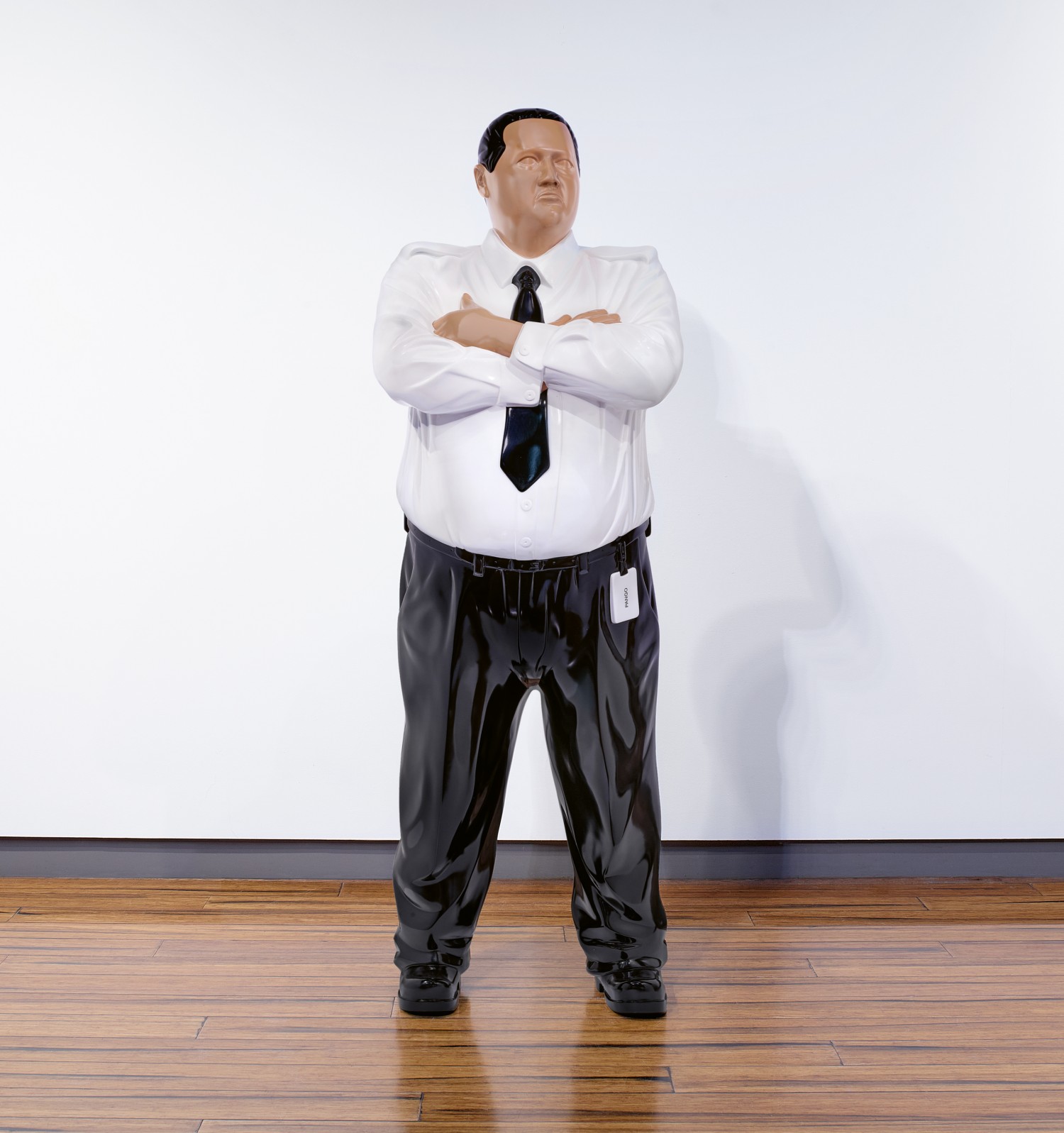
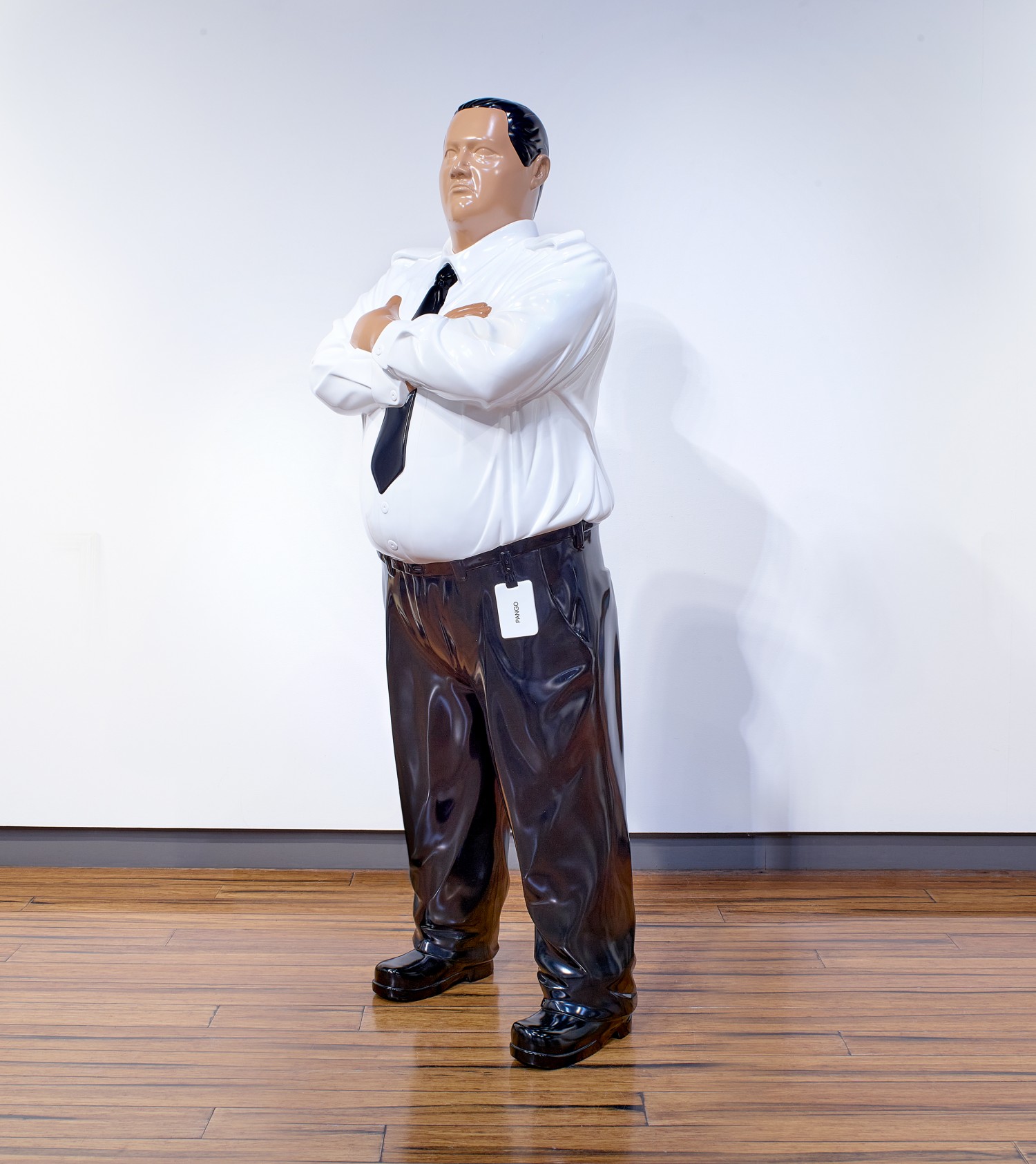
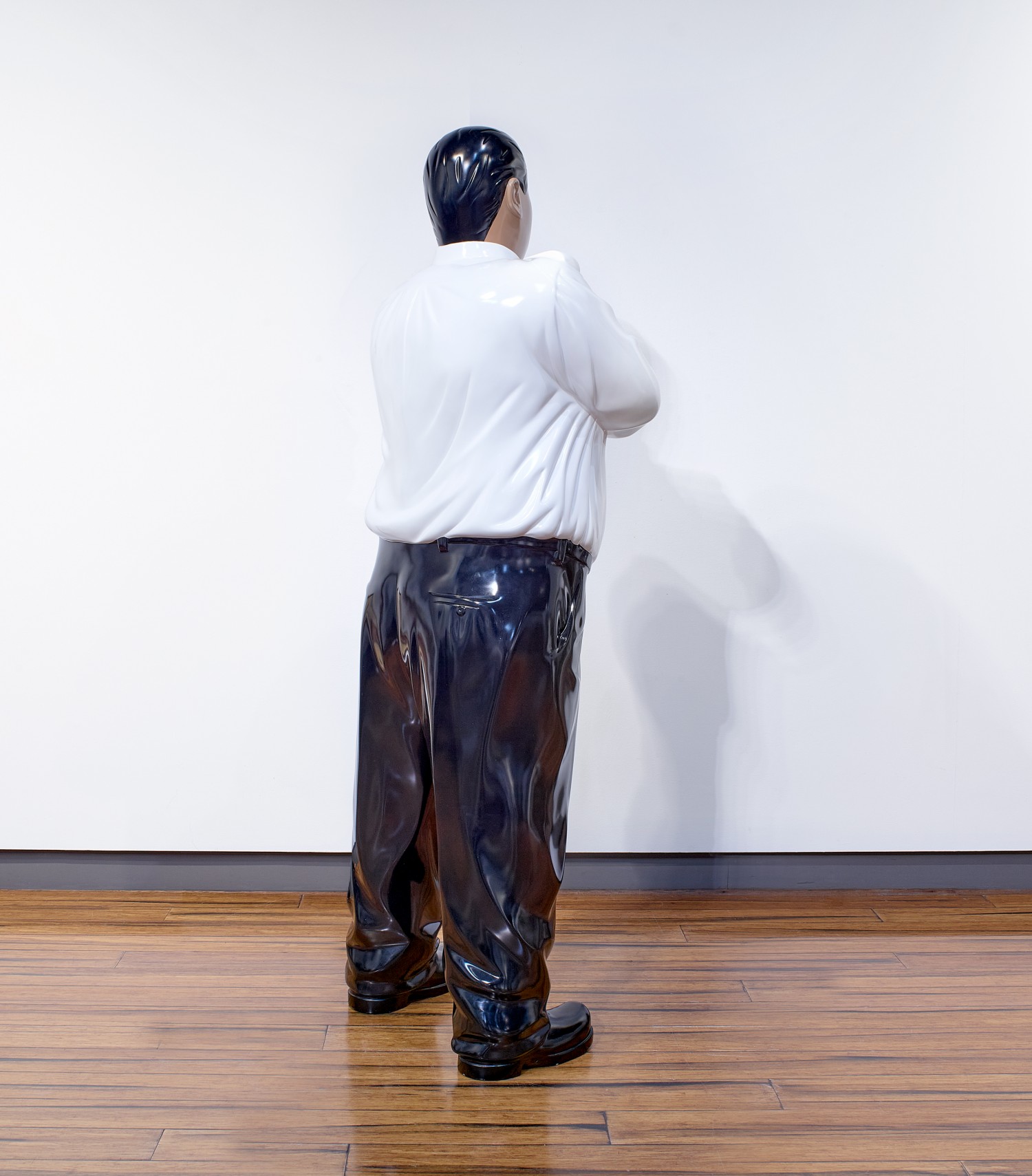
Standing guard and surveying the audience with a blank face, Michael Parekōwhai’s lifesize Māori bouncer, while instantly recognisable, maintains a slippery and elusive identity. New Zealand sculptor of Ngāti Whakarongo, Ngā Ariki and Pakeha (European) descent, Parekōwhai places intriguing solitary objects as polished and open-ended intrusions into the art and performance space, carrying with them playful and critically incisive allusions to underlying issues in New Zealand |Aotearoa’s postcolonial reality. Kapa Haka (Pango), 2003 fashioned of fiberglass and lustrously painted with the artist’s signature two-pot polyurethane finish, leans into and subtly subverts racial, social and economic stereotypes affecting Pacific peoples in contemporary society.
Created during a period of contemporary revival of Māori tikanga and matauranga (customs, laws and traditional knowledge), Michael Parekōwhai’s security guard is a subtle reminder of the quiet and steadfast presence of Indigenous peoples in New Zealand. Kapa Haka (Pango) is one of fifteen figures, a full rugby team, each with an identical physical morphology that the artist gently mocks: big bellied, arms crossed over a barrel chest, the white shirts of their uniform straining against paunches and ill-fitting trousers gathering at their ankles. While their facial features are smoothed and airbrushed to the point of anonymity, Parekōwhai’s figures were modelled on the artist’s elder brother, Paratere, who works in the security business. Each figure is named for a colour, ‘like the gangsters in Reservoir Dogs’, their names inscribed in te reo Māori on the access cards hanging from their belts.1 ‘Pango’ refers to black or a dark colour, and is famously featured in the All Black’s haka Kapa o Pango ‘the Team in Black’. Although grounded in the economic reality of the prevalence of Māori and Pasifika peoples employed in low-paid service positions, Parekōwhai subtly restores cultural dignity to their disenfranchisement, applying the collective title of Kapa Haka to the group – the te reo Māori term for performing arts. With a hint of irony, with this title Parekōwhai equates the guards’ solid stance into that of a fearsome haka performance, uniting these individual figures in the camaraderie of the collective activity.
Appearing in the landmark exhibition of contemporary art from the Pacific, Paradise Now in New York’s Asia Society Galleries in 2004, Parekōwhai’s performative and tragicomic security guards have been installed, individually and collectively, in various exhibition contexts over the last twenty years. Their startling presence was noted in a one-night only happening at Michael Lett’s gallery on Auckland’s busy K-road in 2003, each facing out of the full-length glass windows, with critic Justin Paton noting ‘the sight of five of them guarding a room full of nothing was enough to make the space crackle with politics.’2 In May 2026, a version will be installed out the front of Queensland Art Gallery | Gallery of Modern Art as part of Rising Voices: Contemporary Art from Asia and the Pacific, a celebration of 30 years of the Asia Pacific Triennial of Contemporary Art. With their high-gloss polish of a commercially manufactured toy, the Kapa Haka guards are parachuted into different contexts, their unyielding large volumes intruding in the physical space. Undermining the power and authority afforded by their epauletted uniform and solid physicality, their passive and static presence is easily circumvented. Removed from the phalanx of their collective performance, this lone guard valiantly attempts to protect assets that are not his own. Temporarily rootless, his meaning and purpose changes according to his placement.
1. Leonard, R., ‘Michael Parekowhai: Kapa Haka Pakaka’, Auckland Art Gallery News, March – June 2005 at: https://robertleonard.org/michael-parekowhai-kapahaka-pakaka/ (accessed 30 March 2026)
2. Justin Paton, cited in Derby, M., ‘Māori humor – te whakakata – Māori humour in the 2000s’, Te Ara – the Encyclopaedia of New Zealand, September 5, 2013 at: http://www.TeAra.govt.nz/en/photograph/40401/kapa-haka-by-michaelParekōwhai (accessed 30 March 2026)
LUCIE REEVES-SMITH