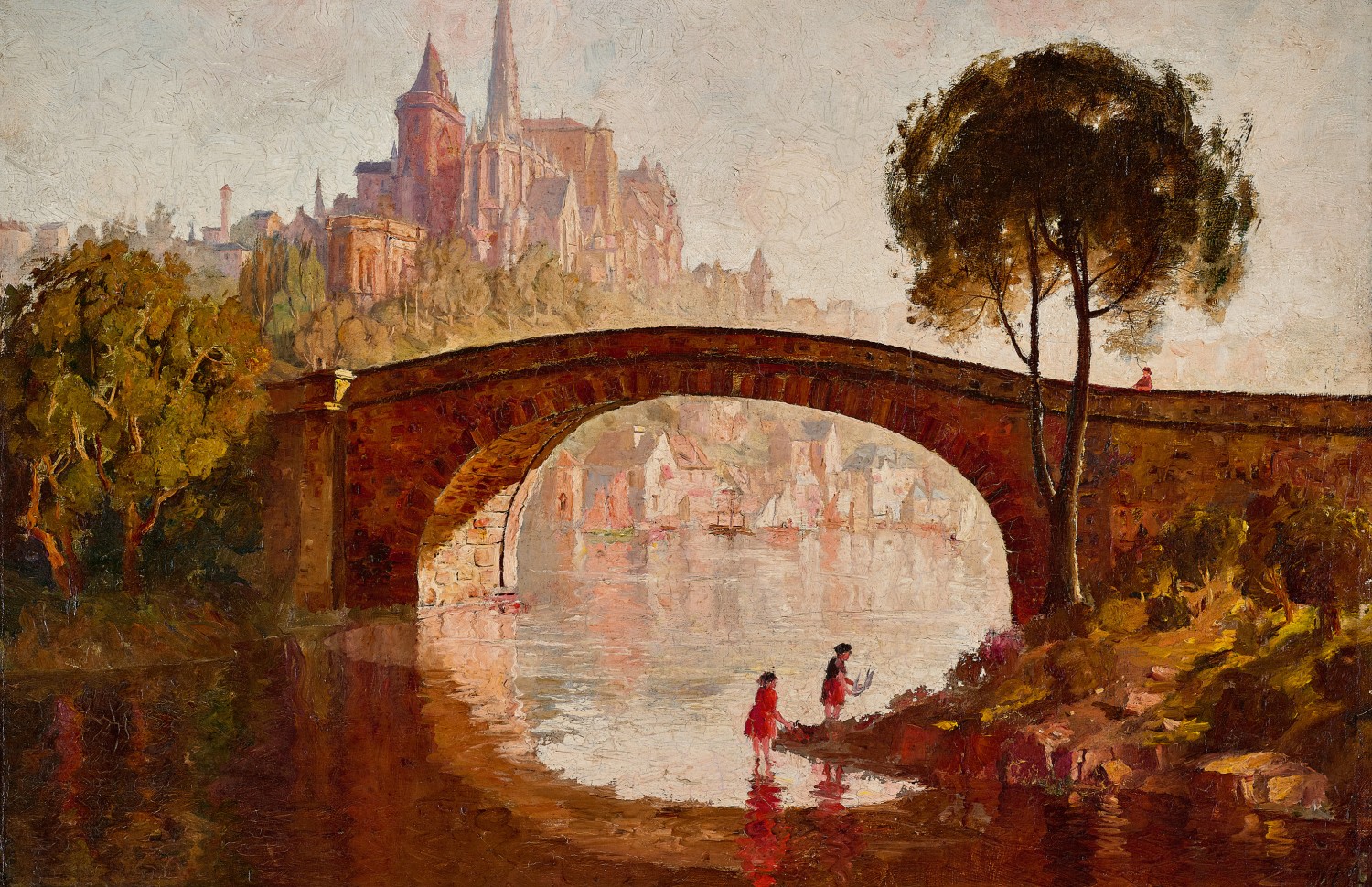
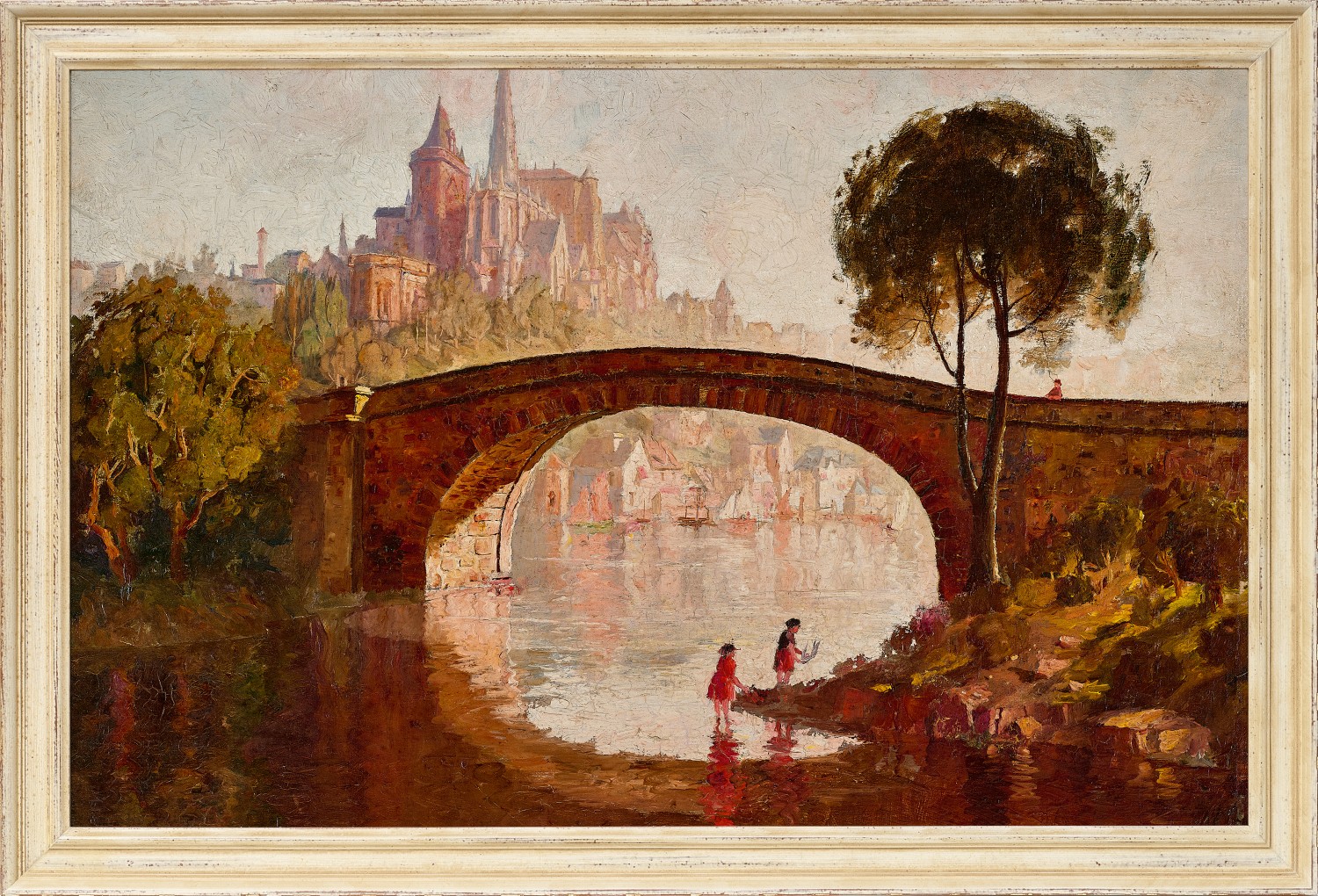
Lennox Bridge, 1926
Lloyd Rees
oil on canvas on board
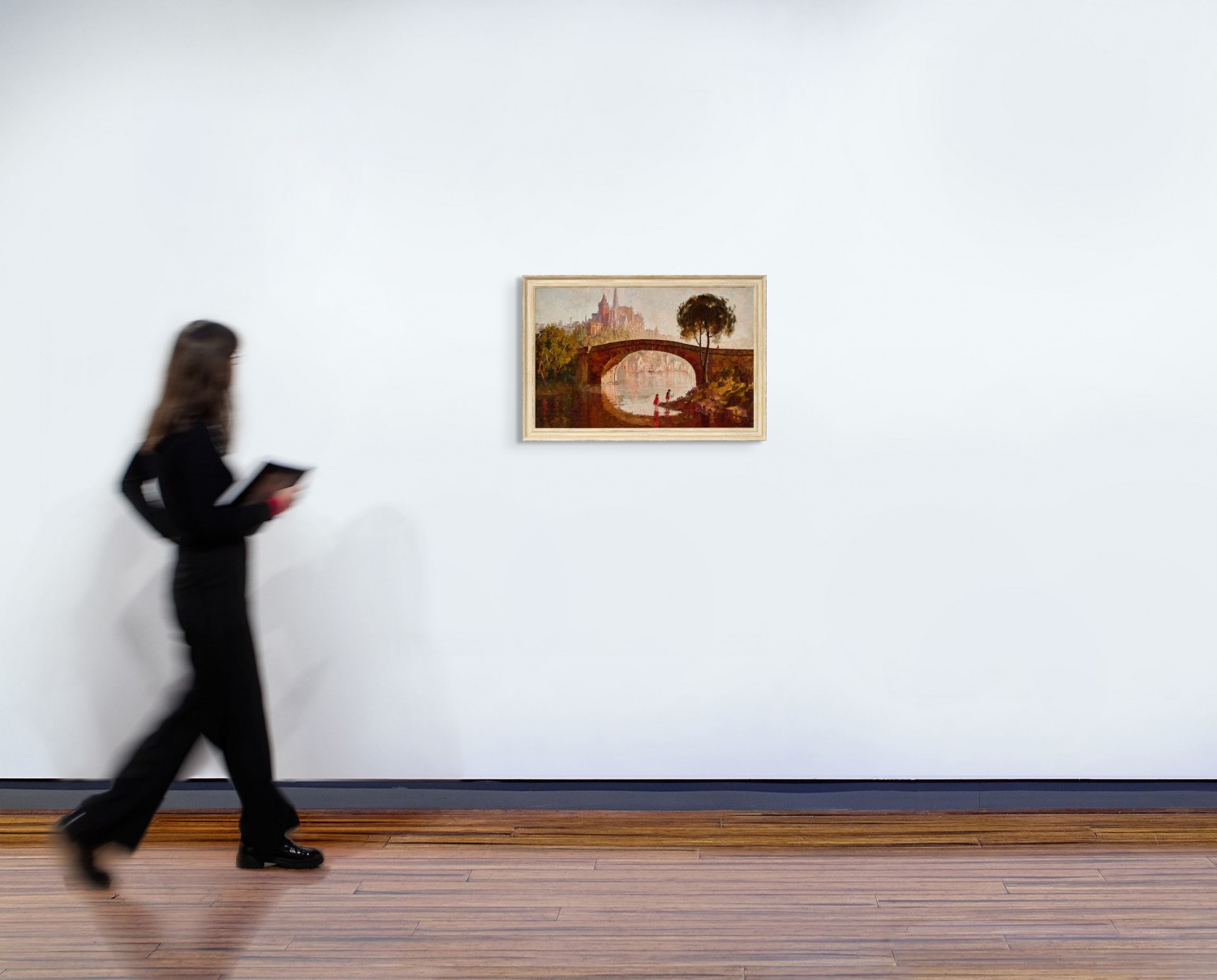
47.0 x 72.5 cm
signed indistinctly with initials lower right: LR
Stanly Wilson, Sydney, a gift from the artist, c.1929
Thence by descent
Private collection, Sydney
Thence by descent
Private collection, Brisbane
Eight Painters, Grosvenor Galleries, Sydney, opened 19 March 1926 (as 'The Riverbank')
‘Paintings at Grosvenor Galleries’, The Sydney Morning Herald, Sydney, 20 March 1926, p. 14 (as ‘The River Bank’)
When looking at Lloyd Rees’ early paintings, there are two things to keep in mind. First, that he was drawn to architecture from an early age, fascinated particularly by the spiritual ‘presence’ of cathedrals and churches, and second, that he was not interested in painting topographically accurate views. Instead, he experimented, introducing elements whilst removing others. This led a contemporaneous critic to perceptively note that ‘Mr Rees dreams his picture, and then strives to render the dream.’1 Some of these additions were quite fanciful, as seen in Lennox Bridge, 1926, where an imposing European Gothic-spired church rises dramatically from the riverbank above Lennox Bridge, located in Parramatta, 24 kms to the west of Sydney. Rees spent some years living there in the early 1920s attracted by the clear skies as the Sydney skyline was already ‘blurred by fog.’2 In 1923, Rees travelled to Europe where he did numerous drawings of ecclesiastic architecture only to lose his sketchbooks on a bus in Paris. He returned to Paramatta the following year where he continued to paint ‘under the general influence of Corot and Max Meldrum.’3
The humble Lennox Bridge is a single span, arched bridge over the Parramatta River constructed of sandstone and completed in 1839. In the current painting, the bridge now has a gently curved upper level, a Rees distortion which sympathetically enhances the near circularity of the arch and its reflection. He did several studies and paintings of the location and one of these, Crossing the Lennox Bridge, 1925, is surprisingly accurate and the distant skyline includes the silhouette of the single-spired St Patrick’s Cathedral to the right. It is plausible that in Lennox Bridge, Rees built this visual trigger into a somewhat fanciful suggestion of what could be possible for Parramatta. In a way, it was not so extreme as within four years, the town welcomed its own secular cathedral for the masses with the Hollywood-inspired, Egyptian-temple-themed Roxy Cinema.
Although the cathedral in Lennox Bridge is imaginary, it finds its genesis within a mixture of sources. The tall spire, for example, may acknowledge Chartres, but its lower battlement echoes Notre Dame, while Rees’ use of red oxide for the smaller tower suggests the brickwork of the Italian campanile (bell towers) from the Renaissance. The scatter of houses and moorings at the base could even come from Polperro in Cornwall. The foreground, however, remains firmly antipodean and the total effect is akin to one of Claude Lorrain’s ‘three-step’ landscapes. When exhibited as The riverbank in 1926, a review spoke of how ‘the architectural forms in the distance – particularly in the upper right – dissolve into soft light nothingness, supporting the reviewer’s observation that the background is “so high in tone, that they may be there or not.”’4
This painting sits at an important junction in Rees’ career for soon after the painterly optimism of Lennox Bridge, disaster struck the following year when his wife Dulcie died after giving birth to their stillborn child. The grief-stricken artist attempted to continue painting – mostly still lifes – before he had a complete nervous collapse six months later. He did not return to painting until 1935.
1. ‘Work of Lloyd Rees. An Australian romantic’, The Daily Mail, Brisbane, 3 August 1921, p. 8
2. Rees, L., Small Treasures of a Lifetime: some early memories of Australian art and artists, Collins, Sydney, 1969, p. 144
3. ibid.
4. R. W. C., ‘Eight painters’, The Triad, Sydney, vol. 11, no. 6, 1 April 1926, p. 53
ANDREW GAYNOR