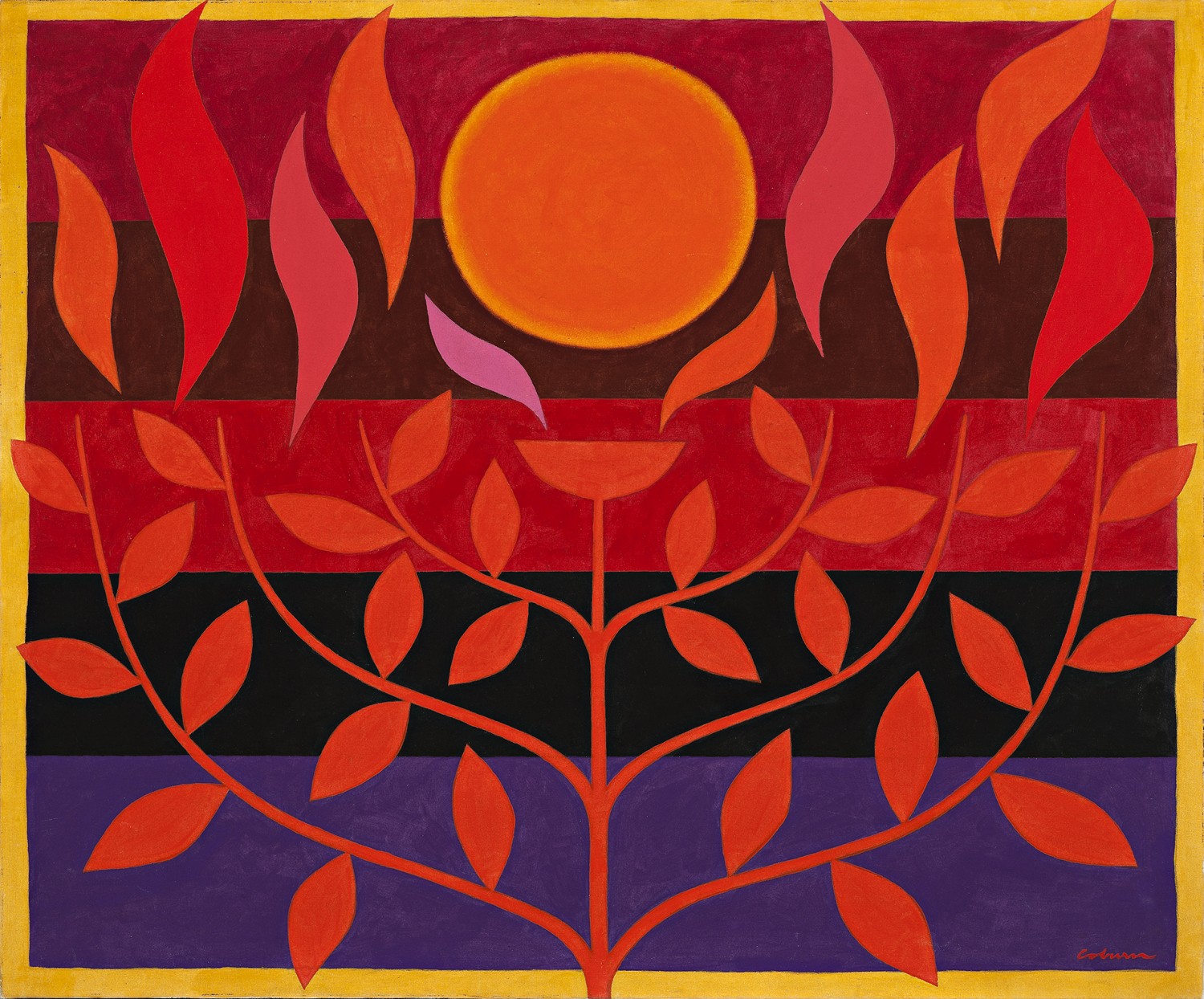
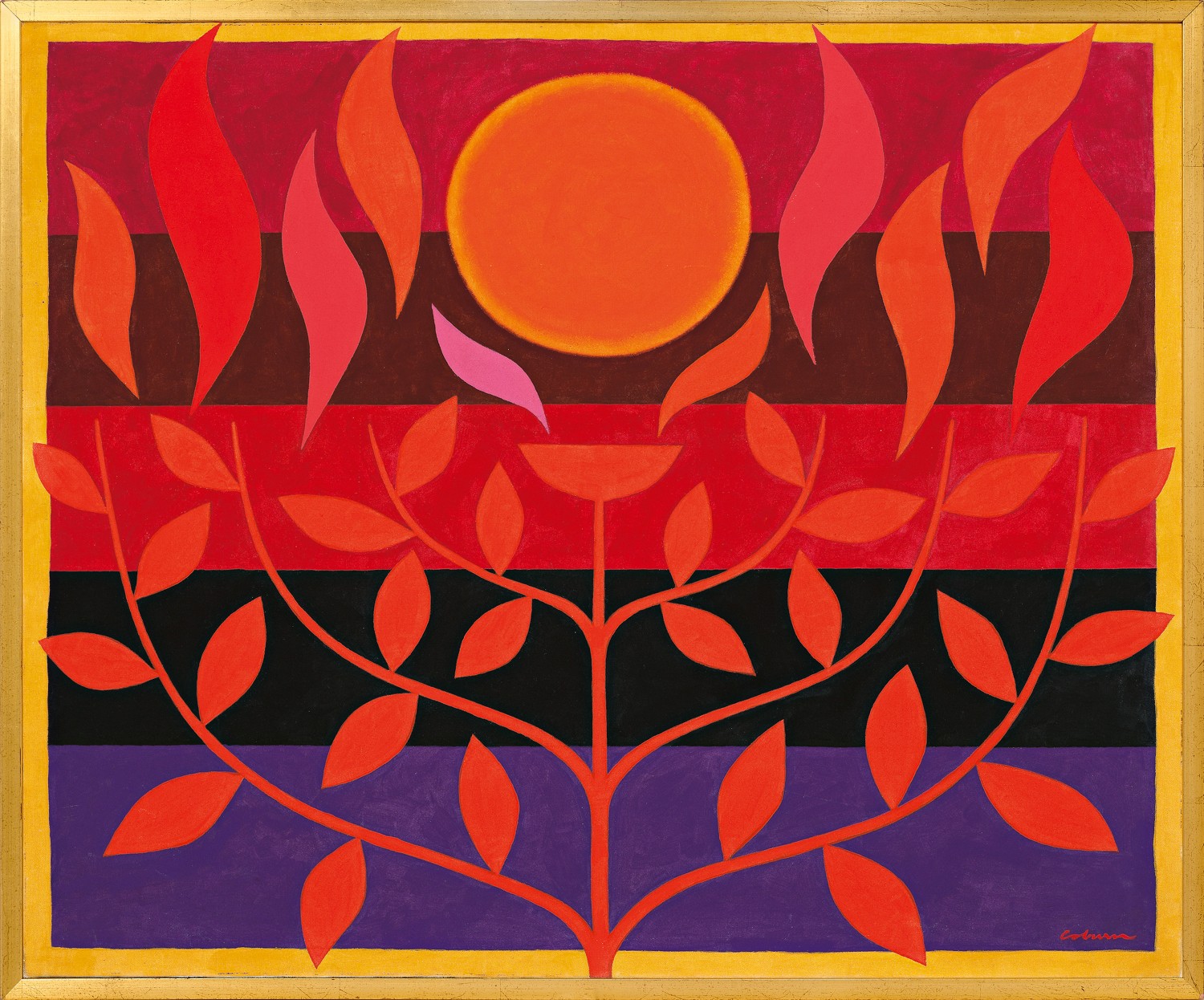
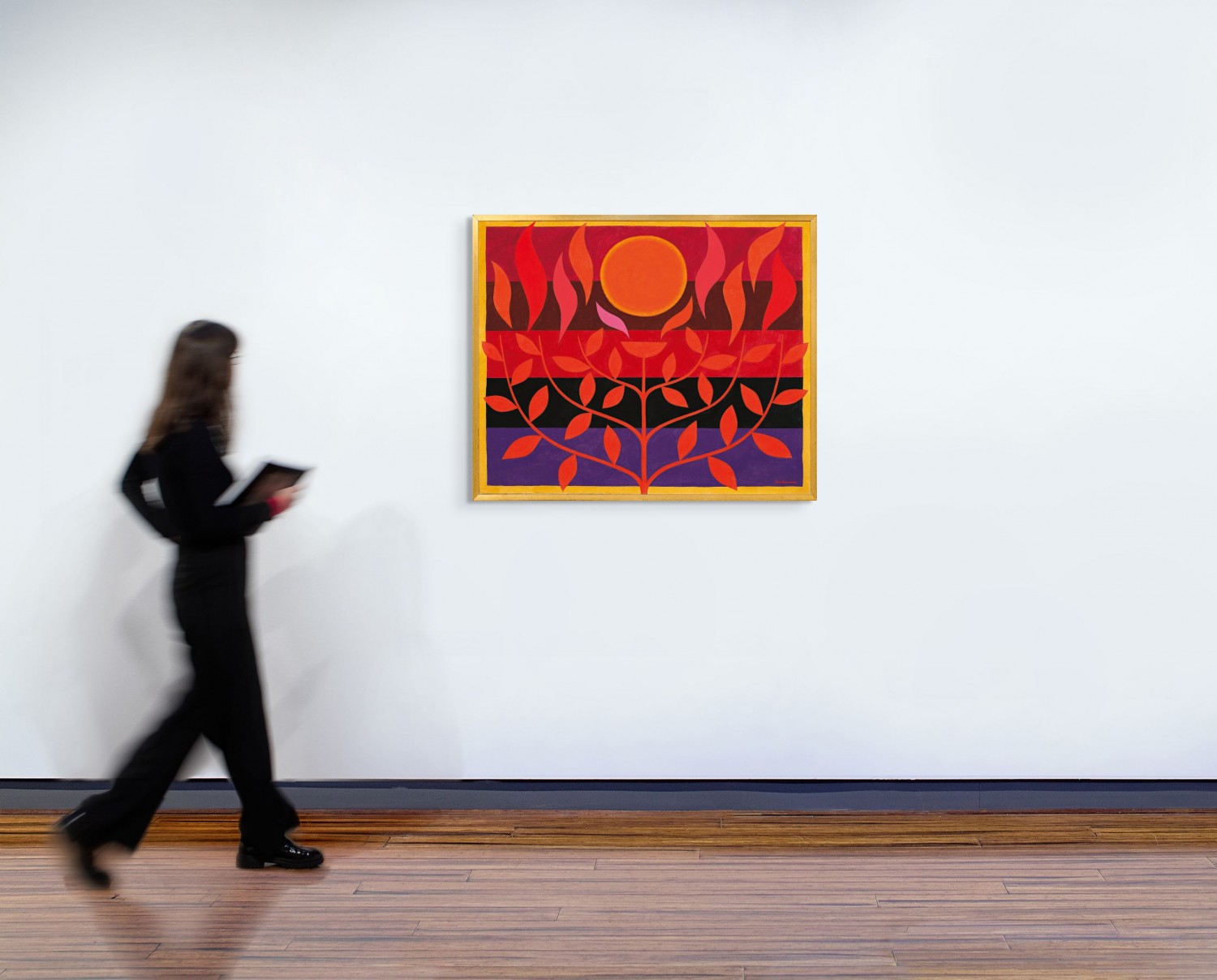
Tree of life (maquette for tapestry), 1967
John Coburn
oil on canvas
90.0 x 110.0 cm
signed lower right: Coburn
signed, dated and inscribed with title verso: JOHN COBURN MAQUETTE FOR TAPESTRY / "TREE OF LIFE" / 11/67
Private collection
Christie’s, Melbourne, 22 August 2000, lot 99
Private collection
Lawson~Menzies, Sydney, 22 July 2003, lot 99
Queensland Art Brokering, Queensland
Private collection, Sydney
Company collection, Melbourne
Deutscher and Hackett, Sydney, 2 December 2015, lot 67
Private collection, Indonesia
Throughout the 1960s and ’70s, the overarching theme of John Coburn’s work was his religious faith. Indeed, given the colour and exuberance of his paintings from this period, they may be considered among his most vibrant and theatrical achievements. Frequently highlighted with gold or silver paint, these works are imbued with a precious, almost devotional quality, endowing them with a palpable sense of the sacred. Their often-symmetrical compositions further echo the art and architecture of Christian places of worship.
Alongside his faith, Coburn drew deeply upon nature for inspiration. Tree of life (maquette for tapestry), 1967, stands as a quintessential example of the artist’s celebration of belief, incorporating stylised ecumenical symbolism as its central motif. Within this work, Coburn appears to merge two generative forces: the artist as creator and a higher, divine presence as the origin of all things. Alan Rozen succinctly articulates this duality: ‘He is constantly aware of the abstraction of a feeling for beauty and achieves his aims by a union of this feeling and beliefs in religion and nature. This then presents a twofold approach by Coburn to his work: first, he wants to produce something that is beautiful and pleasing to look at and, secondly, on a more profound level, he wants to relate his religion to nature, and nature to his religious beliefs.’1
While abstract painting in Sydney at this time was largely characterised by a lyrical sensibility, Coburn’s direct application of opaque paint and his personal repertoire of forms became hallmarks of his mature style. His broad, elemental forms, articulated in slabs of secondary colour, offered a cool and measured counterpoint to the more gestural, arabesque tendencies of artists such as John Passmore, John Olsen, Robert Dickerson Johnson and Brett Whiteley.
Robert Hughes made a prescient observation in a review of an early Coburn exhibition at the Macquarie Galleries: ‘Coburn is unlike any other significant Australian non-figurative painter in that his works are deadpan, unmarked by the evidence of struggle which gives other abstracts their peculiar intensity… It may all look effortless and inevitable, as though the problems of painting had given way to those of assembling a jigsaw puzzle. His intuition does not, it seems, unfold itself during the final creative act; everything is thought out beforehand.’2
What Coburn may have lacked in lyricism, he more than compensated for through an astute instinct for colour and design. His popularity has not only endured but grown steadily over subsequent decades. Through numerous solo exhibitions, important commissions and prestigious awards, he has firmly cemented his place within the canon of Australian painting.
1. Rozen, A., The Art of John Coburn, Ure Smith, Sydney, 1979, p. 10
2. Hughes, R., ‘Coburn Jigsaws’, Nation, Sydney, 19 November 1960
HENRY MULHOLLAND