Adam and Eve, 1950 - 52

Arthur Boyd
44 glazed ceramic tiles
15.0 x 15.0 cm (each)
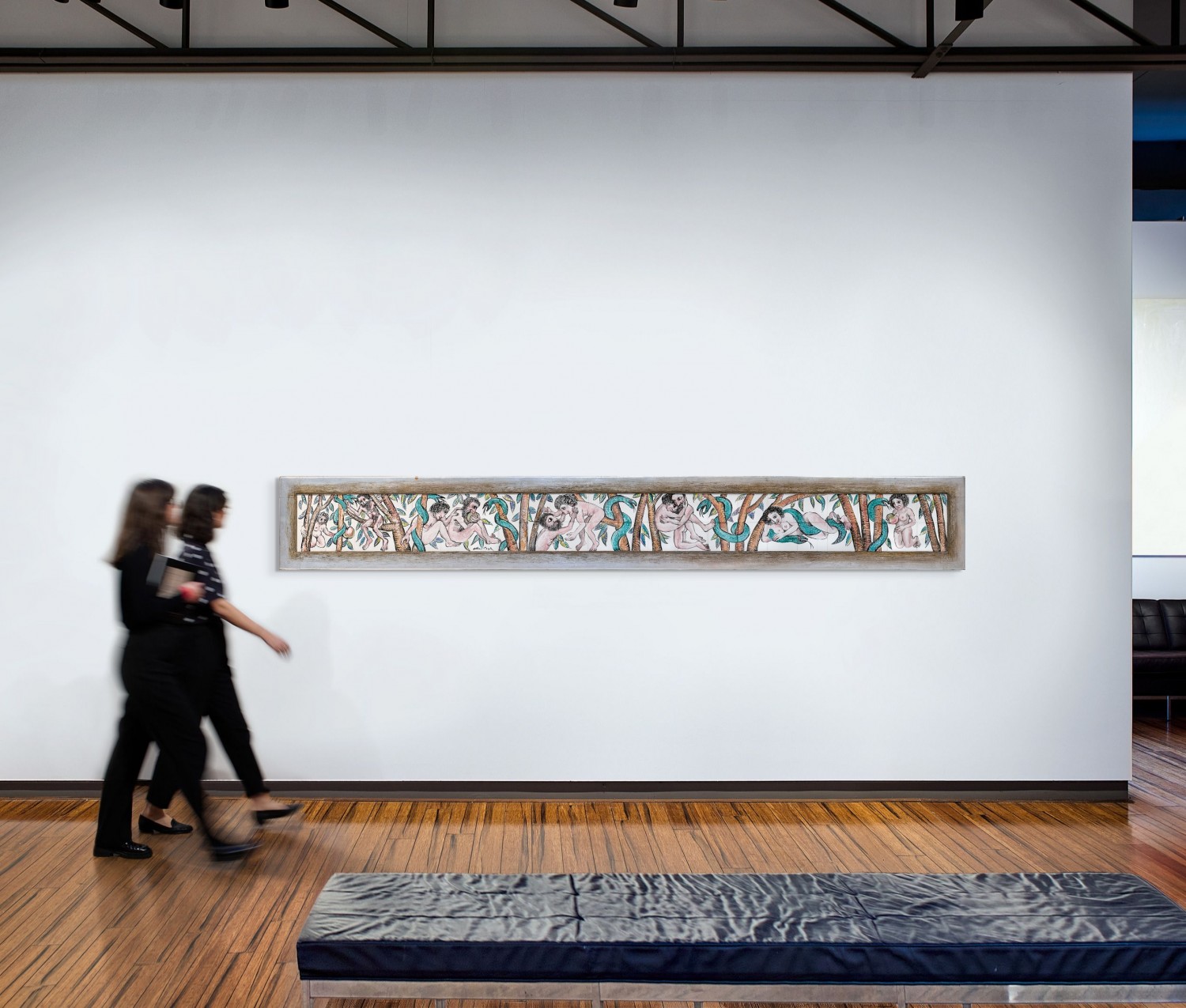
30.0 x 330.0 cm (overall)
signed lower centre: Arthur Boyd
G. D. Hillas Pty. Ltd., Melbourne, commissioned directly from the artist
Private collection, Sydney
Deutscher~Menzies, Melbourne, 9 May 2001, lot 20
Private collection, Melbourne
The works of Arthur Boyd, Savill Galleries, Sydney, 12 May – 6 June 1998; Savill Galleries, Melbourne, 1 – 18 July 1998
Philipp, F., Arthur Boyd, Thames and Hudson, London, 1967, cat. 6.73, p. 252
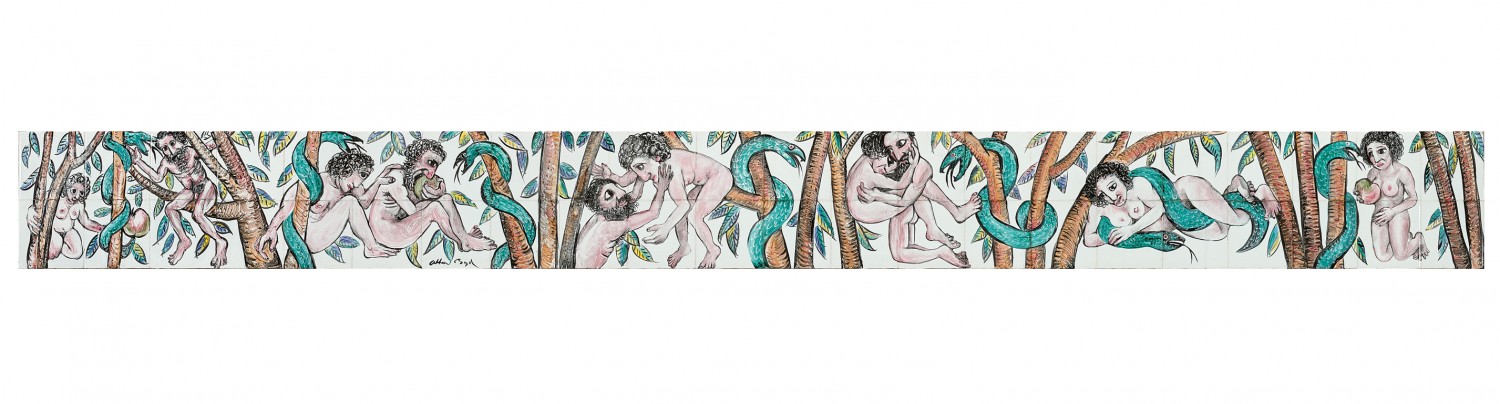
The career of Arthur Boyd is distinguished by his mastery across media, be it painting, drawing, printmaking or ceramics. The son of Australia’s first studio potter Merric Boyd, Arthur learnt first by example, then through his own experimentation on his father’s equipment at the family compound known as ‘Open Country.’ In 1944, he formed his own business, AMB Pottery, in partnership with his brother-in-law John Perceval and their colleague Peter Herbst. Sited in a former butcher’s shop in Neerim Road, Murrumbeena, the pottery utilised some of Merric’s old machinery bolstered by a new gas kiln, stillage and electric wheel. The immediate aim was mass manufacture of utilitarian crockery to meet the demand caused by wartime shortages but once released from these restrictions, they set about making earthenware to their own design with under-glaze painted decorations featuring flowers, animals and joyous, boisterous scenes. Concurrently, Boyd was also painting significant works such as The Mockers (Art Gallery of New South Wales) and The Mourners (private collection), both from 1945, based on biblical stories inspired in part by his grandmother’s practice of reading aloud ‘from an illustrated bible, the tinted engravings in the text being as marvellous as they were bizarre, often even gruesome.’1 The frieze Adam and Eve, 1950 – 52, reflects all of these sources.
The mid-1940s was also the period when Boyd became enamoured of the imagery of Rembrandt and the Flemish artists Pieter Brueghel and Hieronymus Bosch, as well as the simplified passages of rich colour in the paintings of Tintoretto. With the added impetus of his involvement in the AMB Pottery, he started experimenting with an ‘‘idiosyncratic’ combination of oxides and slip mixed to the consistency of oil paint.’2 Boyd was quickly dazzled by the results, recalling in later years his excitement as he took the first tile out of the kiln: ‘It was the most marvellous feeling… a painting doesn’t have anywhere near the impact of pulling something out that has been almost purged by being through fire… It is a pure object and it is changed. It’s formed in the fire and so the surprise is marvelous.’3 He and Perceval further explored painting directly onto commercially produced tiles, some later fixed to small coffee tables, but Boyd was excited too by the possibility of these being used for extended friezes incorporating narratives depicted in episodes.
In Adam and Eve, Boyd employs the serpent as a unifying motif that also punctuates the events. The figure of Eve is based on Betty Burstall, identifiable by her curly black hair. Her presence links the frieze to Boyd’s earlier painting The expulsion, 1947 – 48 (Art Gallery of New South Wales), painted in a fury after she had conducted an adulterous affair with Perceval. Adam, however, is based on imagination, a wild and hirsute man who is initially shown living in harmony in the Garden before the serpent’s intervention. His emotions then erupt, first in violence then with desire, before ending with Eve firmly within the snake’s embrace. Boyd’s fluidity with the brush is exemplary and the narrative is further energised by ‘a dominant pictorial rhythm, (with) a strong telling and pervading gesture.’4
1. Gunn, G., ‘Tribute. Arthur Boyd: 1920-1999', Art and Australia, Sydney, vol. 37 no. 2, December 1999/January 2000, p. 207
2. See Pearce, B., Arthur Boyd: retrospective, Beagle Press, Sydney, 1993, p. 170
3. Arthur Boyd, cited in Pearce, ibid., p. 169
4. Philipp, F., Arthur Boyd, Thames and Hudson, London, 1967, p. 68
ANDREW GAYNOR