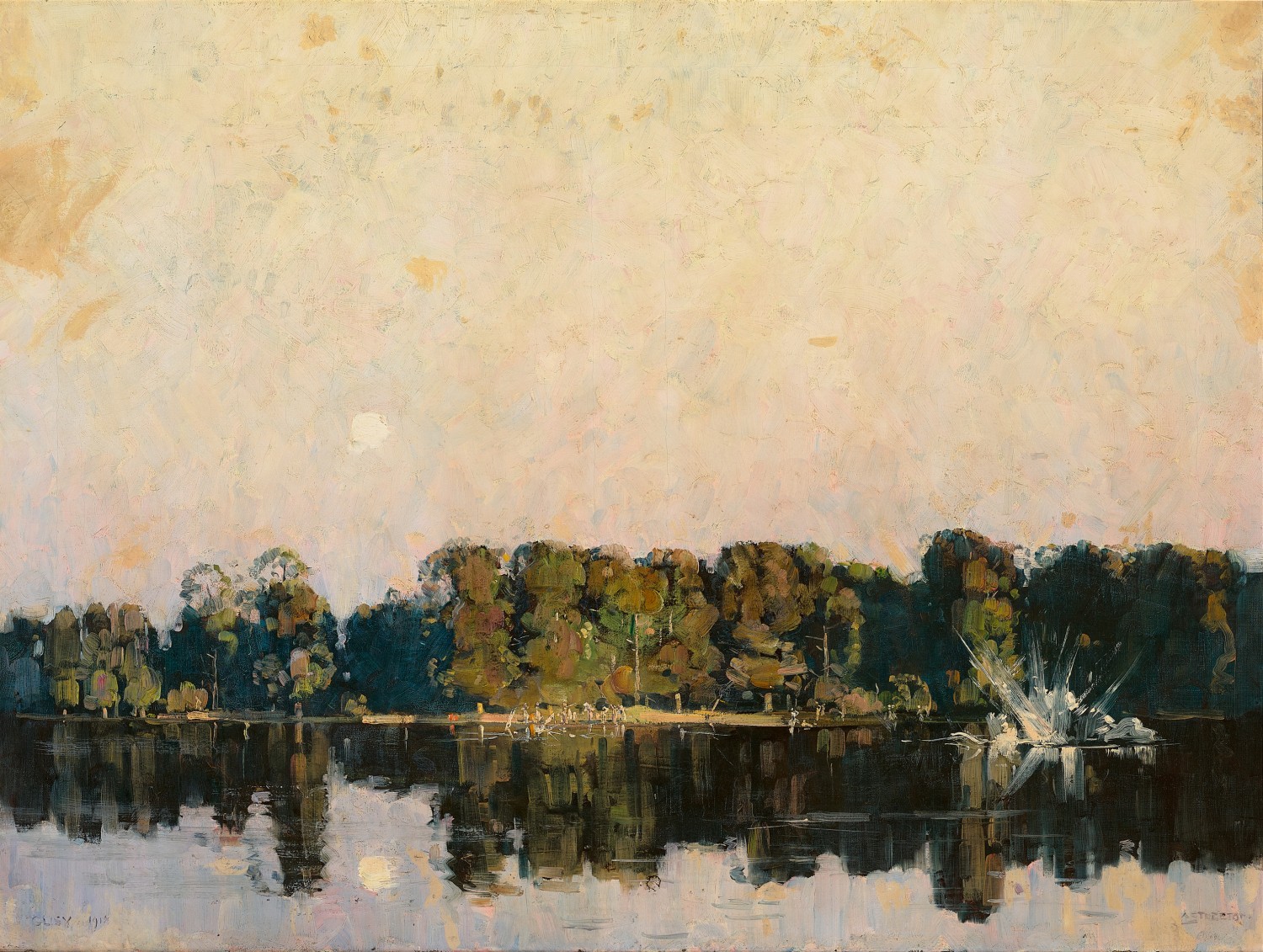
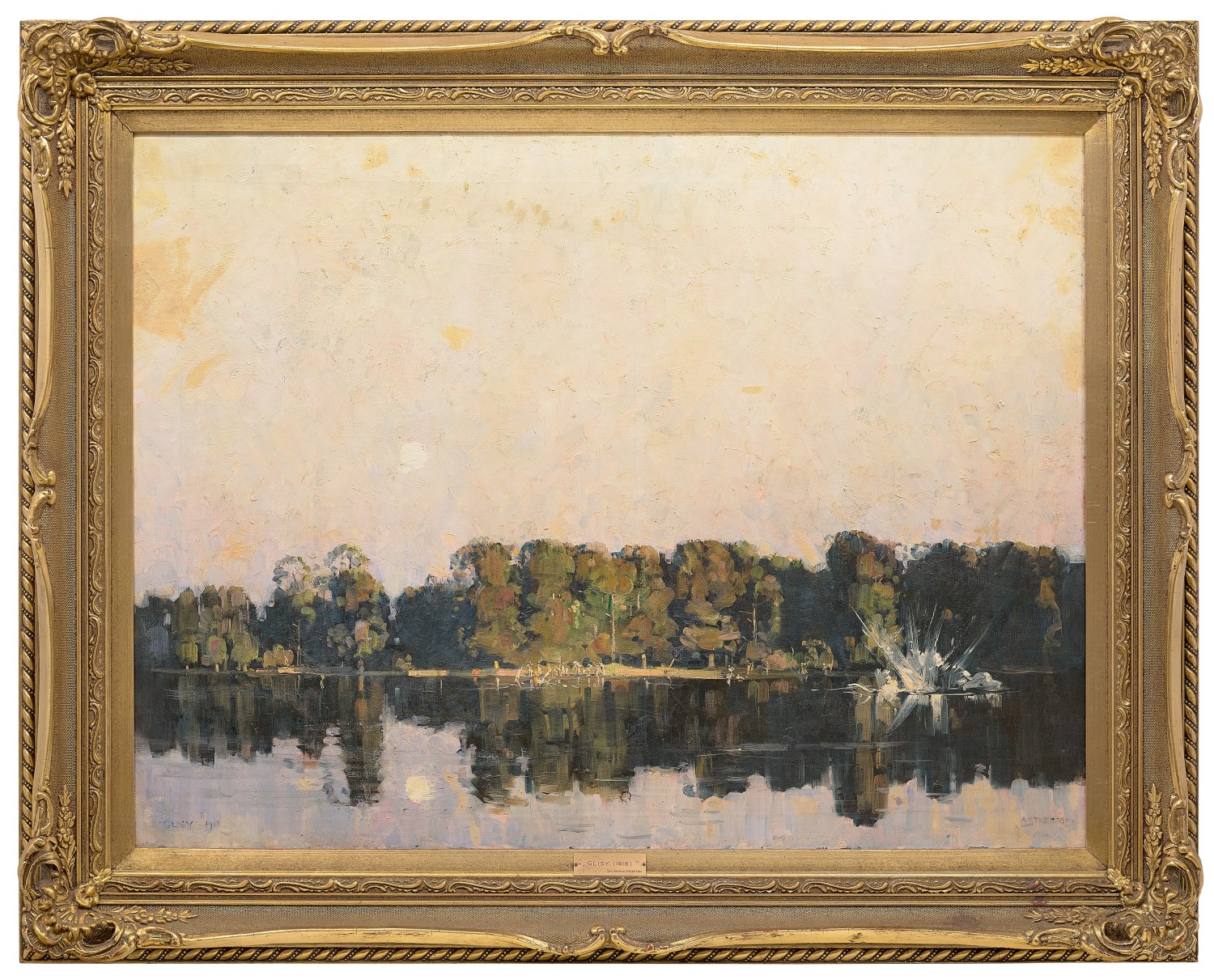
Troops bathing, Glisy, 1918
Arthur Streeton
oil on canvas
76.0 x 101.0 cm
signed lower right: A. STREETON
inscribed and dated lower left: GLISY 1918
signed and inscribed on artist’s label verso: Aussies bathing / (Glisy) / 14 A Streeton
The Naval & Military Club, Melbourne, a gift from the artist in 1926
Naval & Military Club Collection of Fine Art, Deutscher and Hackett, Melbourne, 21 July 2009, lot 6
Private collection, Sydney, acquired from the above
An Exhibition of Paintings and Drawings by Arthur Streeton, The Fine Arts Gallery, Melbourne, opened 14 July 1926, cat. 9
The Naval & Military Club, Melbourne, until 2009
Arthur Streeton – The Art of War, National Gallery of Australia, Canberra, 15 December 2017 – 29 April 2018, cat. 43
Streeton, Art Gallery of New South Wales, Sydney, 7 November 2020 – 14 February 2021
Art Notes, War Record Paintings. Drawings by Mr A. Streeton', The Age, Melbourne, 14 July 1926, p. 13
Streeton, A., The Arthur Streeton Catalogue, Melbourne, 1935, cat. 605
Gray, A., Arthur Streeton: the art of war, National Gallery of Australia, Canberra, 2017, cat. 43, pp. 48 (illus.), 60 (illus., detail), 61, 63, 162 (illus.), 163
Tunnicliffe, W., Streeton, Art Gallery of New South Wales and Thames & Hudson, Sydney, 2020, pp. 13, 244 (illus.), 372
Streeton label cmyk (web).jpg
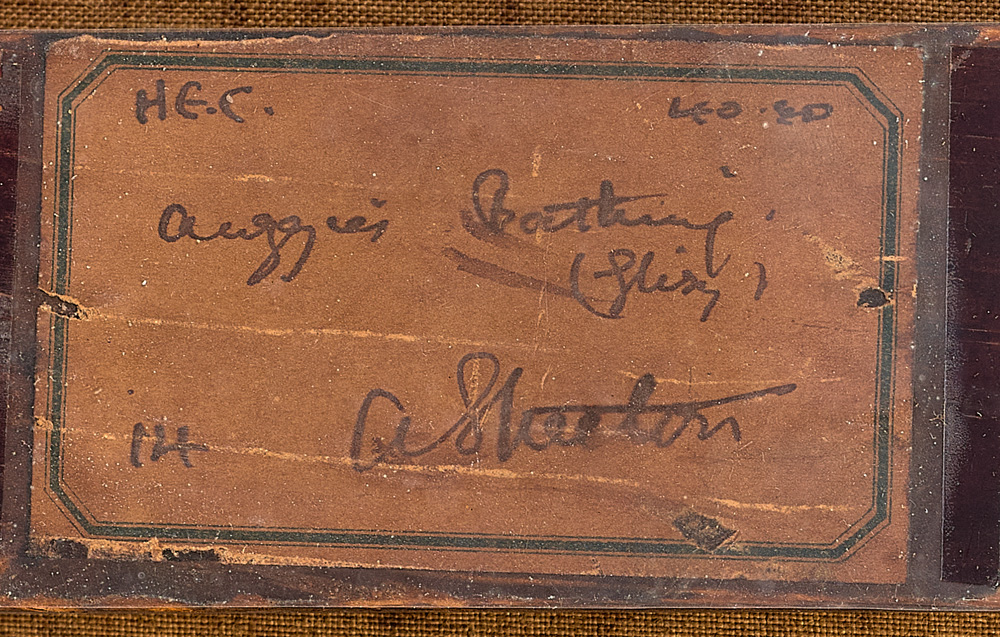
Label verso
Signalling a decisive turning point in his distinguished career, Arthur Streeton’s service as an official Australian war artist in France in 1918 inspired some of his most compelling achievements, revealing a mature painter at the height of his powers confronting an entirely new visual and emotional reality. Long celebrated for his luminous evocations of the Australian landscape, Streeton was suddenly required to depict a world transformed by industrialised conflict, where mechanised warfare, artillery and camouflage had irrevocably altered both the appearance and experience of war. Deliberately rejecting the heroic conventions of nineteenth-century battle painting, he instead evolved a restrained yet profoundly observant pictorial language in which the beauty of the natural world and the devastation of modern warfare coexist in uneasy equilibrium. A subtle work whose haunting stillness alludes to the horrors of war, Troops bathing, Glisy, 1918, eloquently encapsulates this tension – ranking among the most poignant and psychologically nuanced images of Streeton’s wartime oeuvre.
260289 Streeton (web).jpg
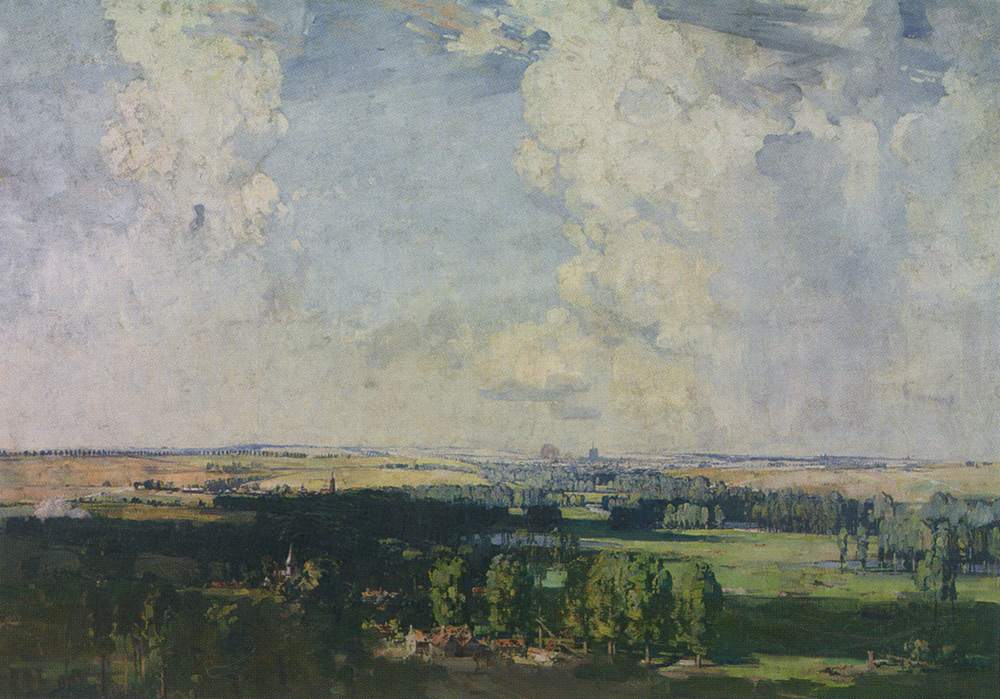
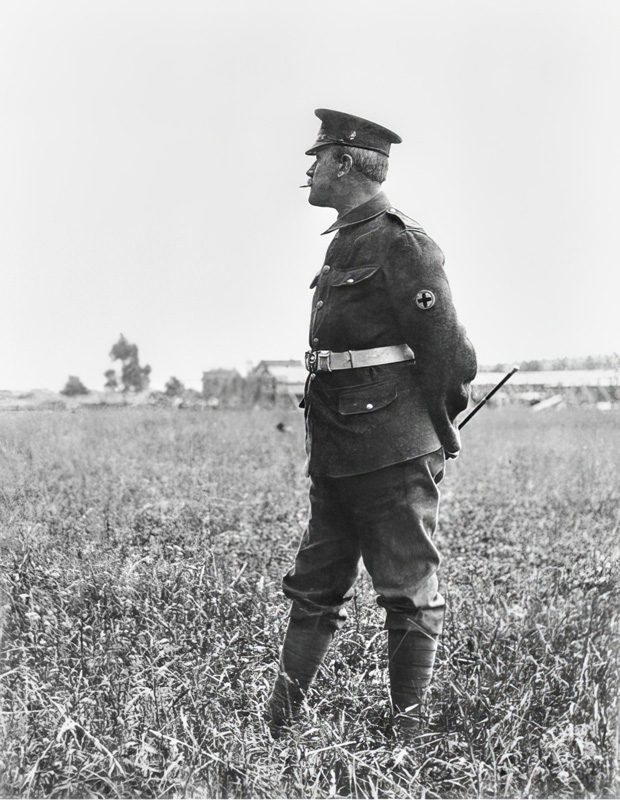
On 14 May 1918, Streeton arrived in France as an official war artist of the Commonwealth, having previously aided the Allied war effort from London as a member of the Royal Army Medical Corps. After preliminary training in Boulogne, he was assigned to the 2nd Division of the Australian Imperial Force (AIF) in the Somme Valley, only a short distance from the front – initially stationed in the stately eighteenth-century Château Saint-Gratien set within picturesque grounds, before relocating in June to dugouts concealed in the woods near Glisy. Although finding his fellow troops in good spirits following the successful recapture of Villers-Bretonneux only weeks earlier, Streeton was nevertheless struck by the unsettling juxtaposition of cultivated tranquillity and relentless violence that had come to define life on the Western Front. Writing to his friend and patron Baldwin Spencer, he thus reflected upon the unique pictorial challenges posed by this new form of warfare: ‘True pictures of Battlefields are very quiet looking things. There’s nothing much to be seen, everybody and everything is hidden and camouflaged… it is only in the illustrated papers that one gets a real idea of Battle as it occurs in the mind of the man [who has] never been there.’1
260289 Streeton Amiens the key (web).jpg
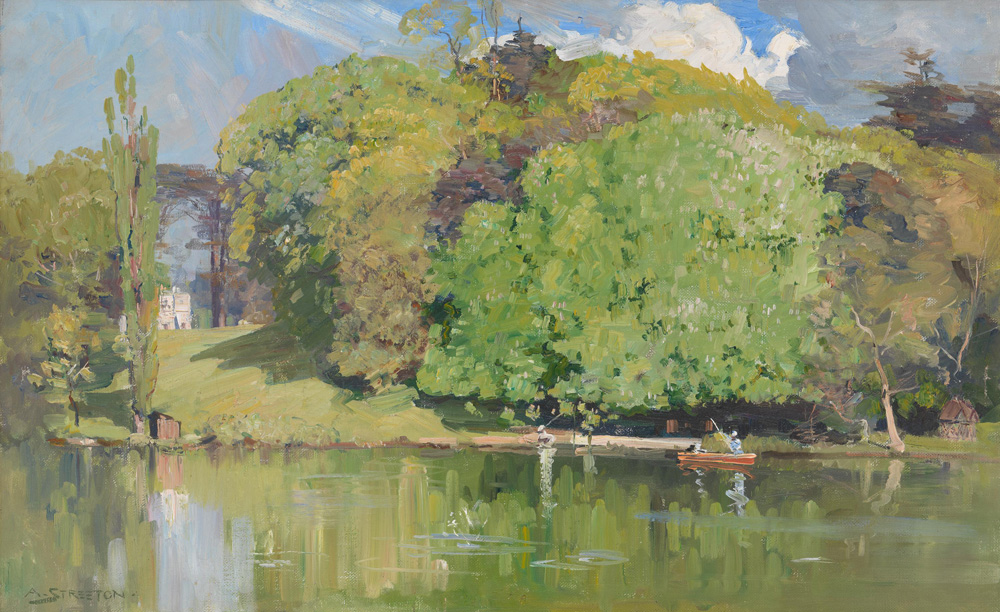
At first glance, Troops bathing, Glisy appears to portray an Arcadian idyll. Beneath a broad expanse of sky, sunlight shimmers across the calm waters of a tree-lined lake where ‘Aussie’ soldiers enjoy a rare moment of respite from the privations of the Western Front. Streeton renders the landscape with the lyrical sensitivity for which he was renowned – the tranquil reflections and delicate harmonies of colour recalling the superb pastoral landscapes of his pre-war career, exemplified by the similar composition, The lake, Coombe Banks, 1913 (National Gallery of Victoria). Yet beneath such apparent serenity lurks a pervasive sense of menace. To the right, a violent splash erupts across the surface of the lake as an artillery shell lands near the bathers – abruptly transforming the bucolic scene into a theatre of uncertainty where death may arrive at any moment without warning. Importantly however, Streeton refrains from depicting any violence directly – rather, its psychological impact is conveyed through the disruption alone, the fragile tranquillity of the scene heightening the horror of such intrusion. As a critic for The Age perceptively observed when the painting was exhibited in 1926, ‘Troops Bathing shows the dangers of innocent sport during war time. The whole scheme is a delightful setting of late afternoon sun and rising moon, with trees on a riverbank, bathers and the exploding bomb.’2
STREETON FIRST PREFERENCE-topaz-upscale-2x (web).jpg
Significantly, in 1926, eight years after the Armistice, Streeton organised a major exhibition of his war paintings, watercolours and drawings, announcing his intention to present many of them as gifts to Australian public institutions, returned servicemen organisations and distinguished military leaders including Lieutenant General Sir John Monash and Major General Sir Charles Rosenthal, both of whom he greatly admired. Describing the collection as an expression of gratitude to the Australian Imperial Force, Streeton hoped the paintings would not only stand as an enduring testament to the courage, sacrifice and service of those who had fought, but also serve as a lasting ‘reminder of what may be possible in Australia without an efficient and continuously progressive organisation for the defence of our country.’3 Indeed, Streeton’s conviction proved remarkably prescient with his wartime paintings attracting renewed scholarly attention in recent decades, culminating in the National Gallery of Australia’s landmark exhibition, Arthur Streeton: The Art of War, in 2018. Originally gifted to the Naval and Military Club in Melbourne, Troops Bathing, Glisy featured prominently in this exhibition, thereby reaffirming its significance both as a valuable record of Australia’s wartime experience and one of the finest painterly meditations on the Great War by an Australian artist.
1.Arthur Streeton, Letter to Sir Baldwin Spencer, 20 July 1918, cited Galbally, A. and Gray, A., (eds.), Letters from Smike: The Letters of Arthur Streeton 1890 – 1943, Oxford University Press, Melbourne, 1989, p. 149
2. ‘Art Notes, War Record Paintings. Drawings by Mr A. Streeton’, The Age, Melbourne, 14 July 1926, p. 10
3. Arthur Streeton, ‘Foreword’, Catalogue of War Pictures Presented by Sir Arthur Streeton to Public Galleries, Returned Sailors' and Soldiers' Organisations, Military Institutions, etc., Melbourne, July 1926
VERONICA ANGELATOS