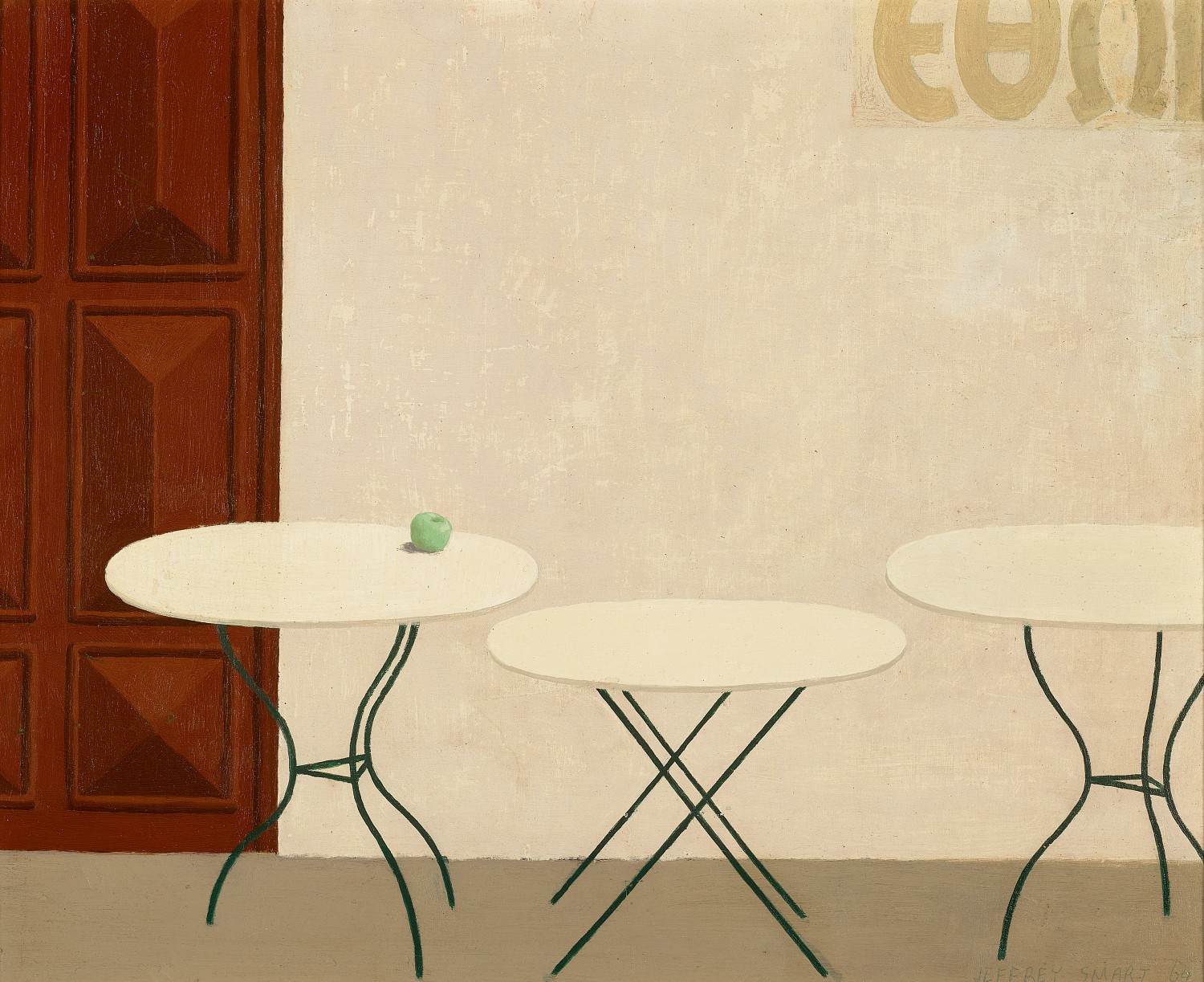
Bar, Skyros, 1964
Jeffrey Smart
oil on composition board
25.0 x 31.0 cm
signed and dated lower right: JEFFREY SMART 64
Galleria 88, Rome
Private collection
Macquarie Galleries, Sydney
Private collection
Art Galleries Shubert, Queensland (label attached verso, as 'Bar Tables Skyros')
Private collection, California, acquired from the above
Private collection, Melbourne, acquired from the above in December 2000
Jeffrey Smart, Galleria 88, Rome, 8 – 23 April 1965, cat. 18
Exhibition of Paintings, Jeffrey Smart, Macquarie Galleries, Sydney, 29 September – 11 October 1965, cat. 17
Quartermaine, P., Jeffrey Smart, Gryphon Books, Melbourne, 1983, cat. 417, p. 108
We are grateful to Stephen Rogers, Archivist for Jeffrey Smart, for his assistance with this catalogue entry.
After having assiduously saved for many years, in 1964 the young Jeffrey Smart left Australia for Europe, arriving in London in February, alongside his friend and fellow painter, Justin O’Brien. Each delighting in the artistic history of the continent, they visited museums and galleries in London and Paris before purchasing a Simca touring car to make the 6000km journey to Greece for the spring and summer.1 Although Smart made drawings and took photographs of promising subjects in the capital, he quickly became disenchanted with the crowds and heat of Athens, seeking instead ‘a summer retreat… somewhere unspoilt.’2 Recommendations led the artists to Skyros, a remote island in the Sporades archipelago, where, joined by the artist Brian Dunlop, they stayed in a rustic fisherman’s cottage by the sea for a period of four months. In June of 1964, the Sydney Morning Herald published a missive from the artists in their ‘Hello, Hello’ tabloid segment, relating that Skyros was ‘absolutely biblical, very primitive. A very beautiful place with a town crazily placed on a high jagged rock.’3
While this sojourn on Skyros (the first of many) provided for Justin O’Brien a wealth of landscape and figurative subjects, Jeffrey Smart produced only a few paintings of Greek subjects over the summer, most of which related to Athens – Piraeus I and Piraeus II; House outside Athens; and Outskirts, Athens, all dated 1964. With a quiet stillness and compositional serenity, Bar, Skyros, 1964 is a rare painting within Jeffrey Smart’s oeuvre, directly relating to their time on the idyllic island.
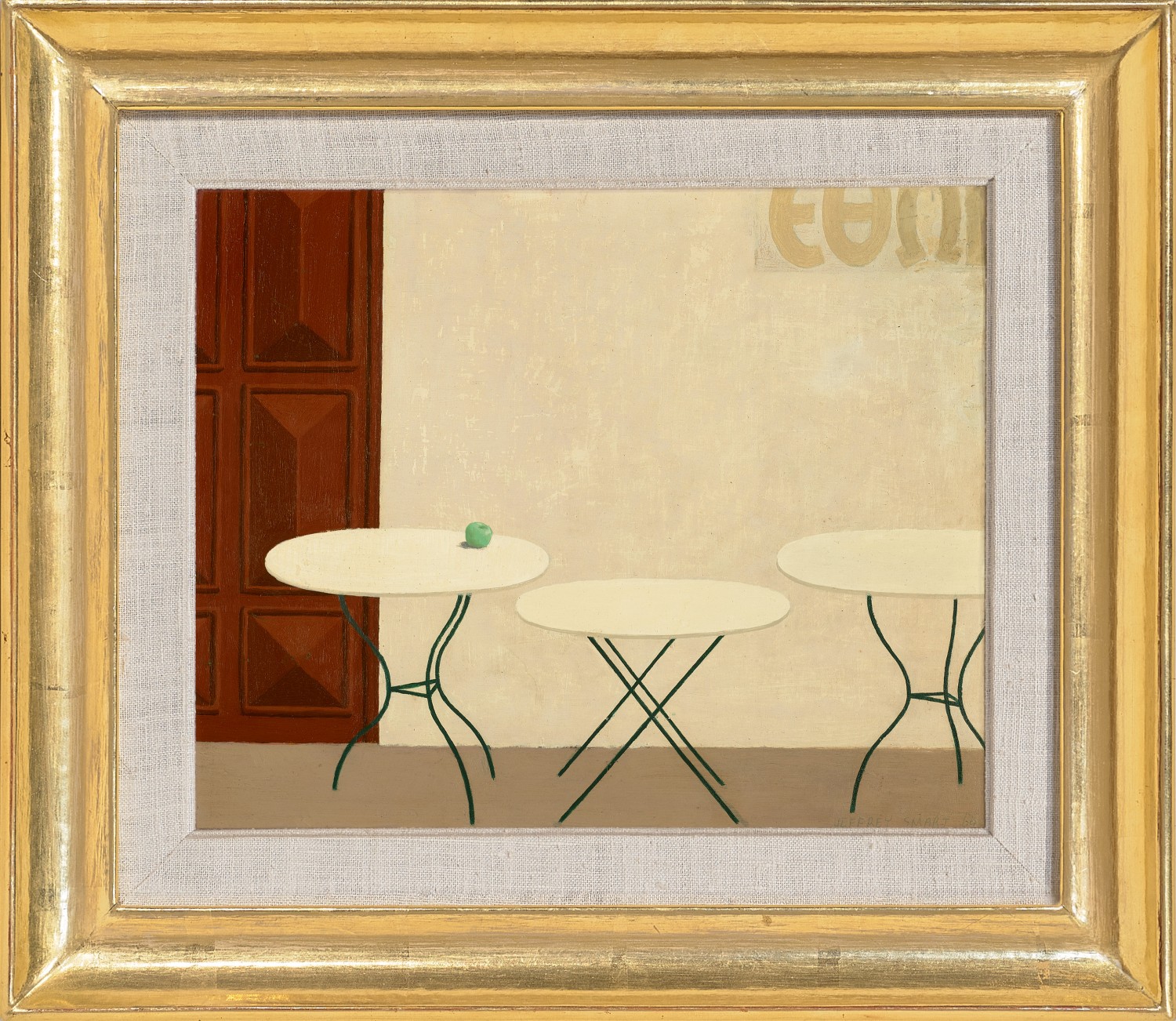
Tightly cropped, the view presented by Smart focuses on a chess-like arrangement of three empty bar tables set in shallow space, against a whitewashed wall displaying truncated Greek lettering (eta, theta, and omega) and a heavy wooden door. This orchestration of inanimate objects with no one in sight, is painted by Smart in a fresco-like pattern of flat colour, almost entirely devoid of shadows. The graphic arrangement of foldable table-legs animates the pictorial surface and highlights Smart’s asymmetric composition. With the artist’s crisp outlines and a muted palette ranging from dark brown to cream and white, Bar, Skyros captures the bleaching light of a Greek summer, and the prosaic sophistication of outdoor dining. The tables, however, are empty, stand-ins for absent people. They are devoid of chairs, an assortment of which was painted in contemporaneous paintings Piraeus I and Piraeus II. A green apple provides a focal point and startling shock of colour in an otherwise harmonious chromatic palette. A master of stillness, Smart’s painting of Skyros portrays the ancient stasis of the island, so distinct from the cacophony of burgeoning modernity that he was to find some months later in Rome.
John McDonald noted ‘Smart invites us to look at a functional object as though we were connoisseurs assessing its sculptural qualities.’4 In this respect Smart was indebted to the pittura metafisica of Giorgio Morandi, an artist he admired as one of the greatest of modern artists. In Bar, Skyros, in particular, Smart, like Morandi, presents a mysterious sense of temporal suspension and intimate unhurried contemplation, displaying clusters of everyday objects in few colours, lined up into a simple and serene still life.
1. Pearce, B. and Wilson, N., Justin O’Brien: The Sacred Music of Colour, Art Gallery of New South Wales, Sydney, 2010, p. 166
2. Jeffrey Smart, cited in Pearce, B., Jeffrey Smart, The Beagle Press, Sydney, 2005, p. 143
3. ‘Hello Hello’, Sydney Morning Herald, Sydney, 21 June 1964, p. 121
4. McDonald, J., Jeffrey Smart Paintings of the ‘70s and ‘80s, Craftsman House, Sydney, 1990, p. 48
LUCIE REEVES-SMITH