
John Brack
(1920 - 1999)
PROMENADE, 1978
oil on canvas
130.0 x 97.0 cm
signed and dated lower right: John Brack 1978, inscribed verso: Promenade
Estimate:
$400,000 - $500,000
Sold:
$432,000 (inc. BP)
lot details
Private collection, Melbourne
Exhibited
John Brack, Rudy Komon Gallery, Sydney, 27 May – 21 June 1978, cat. 5
John Brack: A Retrospective Exhibition, National Gallery of Victoria, Melbourne, 10 December 1987 – 31 January 1988, cat. 98 (label attached verso)
John Brack: Selected Paintings 1950s–1990s, Geelong Art Gallery, Geelong, 15 June – 14 July 1996, cat. 16
A Question of Balance: John Brack 1974–1994, Heide Museum of Modern Art, Melbourne, 1 April – 28 May 2000, p. 45
John Brack, National Gallery of Victoria, Melbourne, 24 April – 9 August 2009 (label attached verso)
Literature
Lindsay, R., John Brack: A Retrospective Exhibition, National Gallery of Victoria, Melbourne, 1987, cat. 98, p. 78 (illus.)
Grishin, S., The Art of John Brack, Oxford University Press, Melbourne, 1990, vol. I, p. 142, vol. II, cat. O246, pp. 33 and 164 (illus.)
Grant, K., John Brack, National Gallery of Victoria, Melbourne, 2009, p. 185 (illus.)
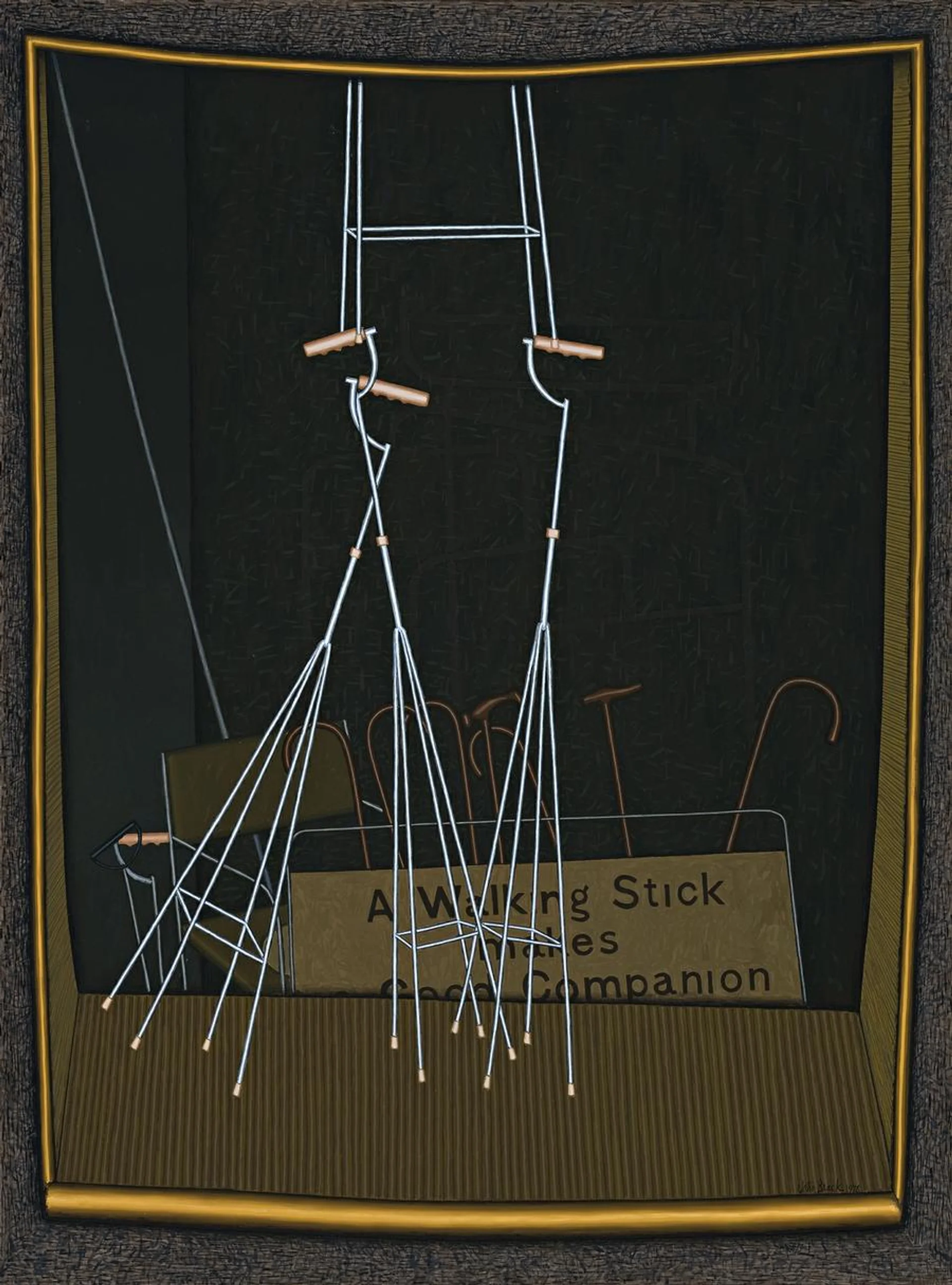
The walking stick series arose out of Brack's encounter with a sign in the window of a chiropodist's shop, reading 'A walking stick makes a good companion', which was surrounded on all sides by a selection of walking sticks and walking frames. Brack transferred the irony of the situation into the watercolour, pen and ink drawing, A walking stick makes a good companion and the [present] related oil, Promenade. Here, unlike his earlier shop window adaptations, few similarities can be made out between the photographs of the shop window and the related paintings. While the idea may derive from the window display, the compositional design bears no resemblance.1
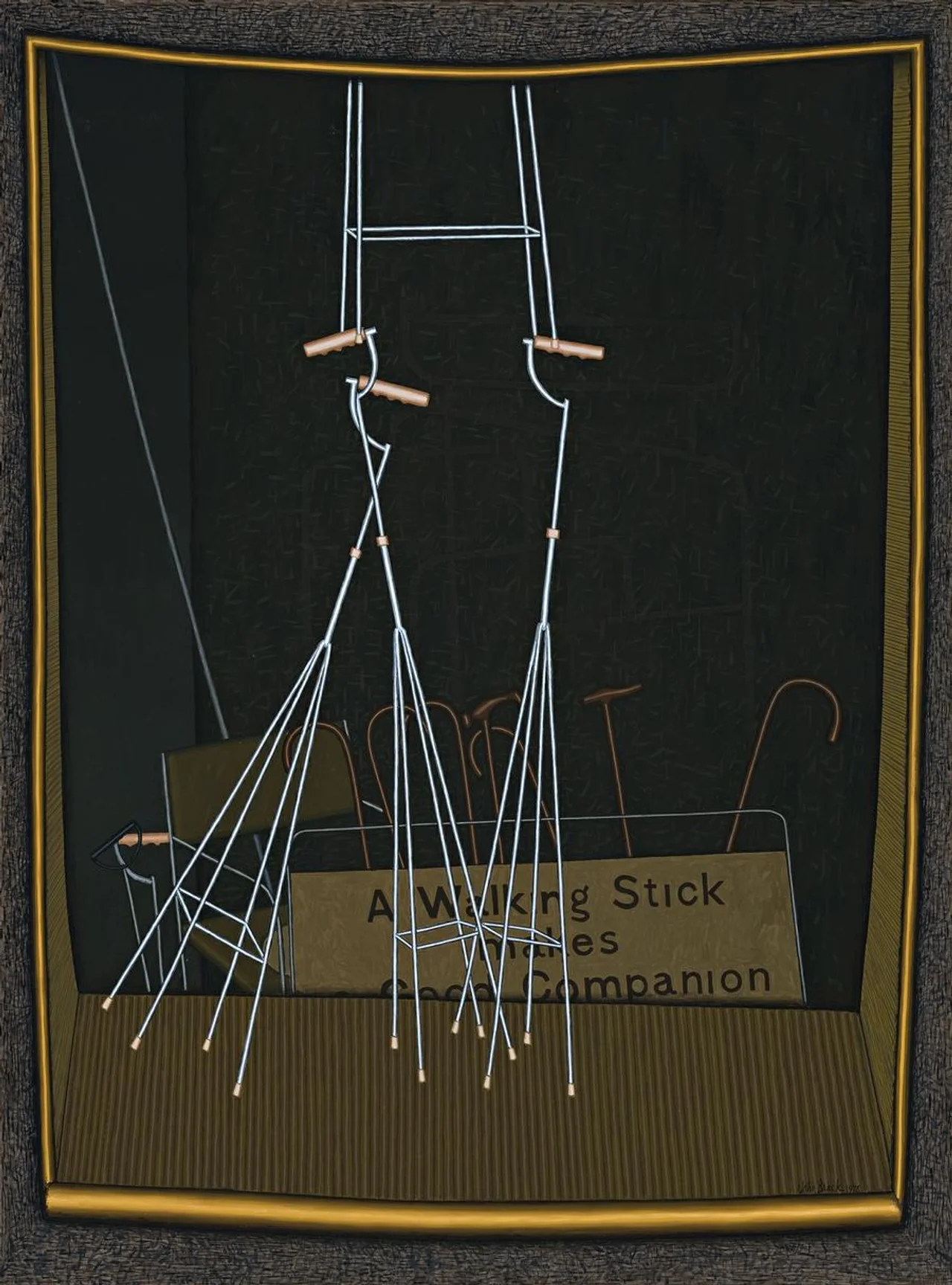
As Helen Brack elucidates, 'In Promenade, the gold frame of the window, hanging from the top corners of the picture rectangle, is on top of the picture plane – the rectangle thus containing the space behind the window frame. We look frontally at the walking frames, but down at the floor of the window box, and then refocus to look frontally at the written notice – 'A walking stick makes a good companion'. Behind this, further into the back of the window, are the brown wooden walking sticks leaving the chair – the one leading off the right side of the picture being larger, its curve almost a shepherd's crook. Into the picture space just behind this walking line, is a cold slanting line directing out of the tableau into the nether regions of the left extreme corner of the window, pointing to the corner of the picture, itself. This line is cold and metallic as are the walking frames taking their promenade. The cold dark space of the window goes beyond the back plane of the picture, into a dark area with superimposed grey flicks, a dense nothing, within which are ghostly shapes of wheelchairs echoing the shapes in the front window. This harks back to the ghostly figures in The Slicing Machine Shop, 1955. The middle tone aerated space outside the window is flicked with dark and belongs to the picture rectangle itself; it is not the same space as the window's dense nothing, indeed it is the opposite. This space is, perhaps, the time space of the living, of us, the viewers. It is interesting, that John has given the color of flesh to the handles of the walking frames, and the feet, and reconfigured the three frames into backwards and forwards; two heads together, one leading; two sets of feet together, one trailing; to every possible combination of the three…2
Significantly, while he was working on the walking stick series, Brack made seven drawings of gymnasts which, in a sense, experiment with very similar forms of strained, suspended stick-like figures caught in the moment before collapse. When the two series are placed side by side, the walking sticks form the stronger and more flexible metaphorical system. As Brack commented in 1980: 'they are intended to have some reference to the complexity of life, of any life, so therefore they are intended to be both balanced and unbalanced, they are intended to be moving and intended to be still, they are intended to be coherent and intended to be incoherent… in other words, these are premeditated ambiguities.'3
1. Grishin, S., The Art of John Brack, Oxford University Press, Melbourne, 1990, vol I, p. 142
2. Helen Brack, 'Essay on The Promenade 1978', Melbourne, 2010.
3. John Brack, Australian Contemporary Art Archive, No.1, Deakin University Media Production, Melbourne, 1980, p. 5
We are grateful to Helen Brack for her assistance with this catalogue entry.