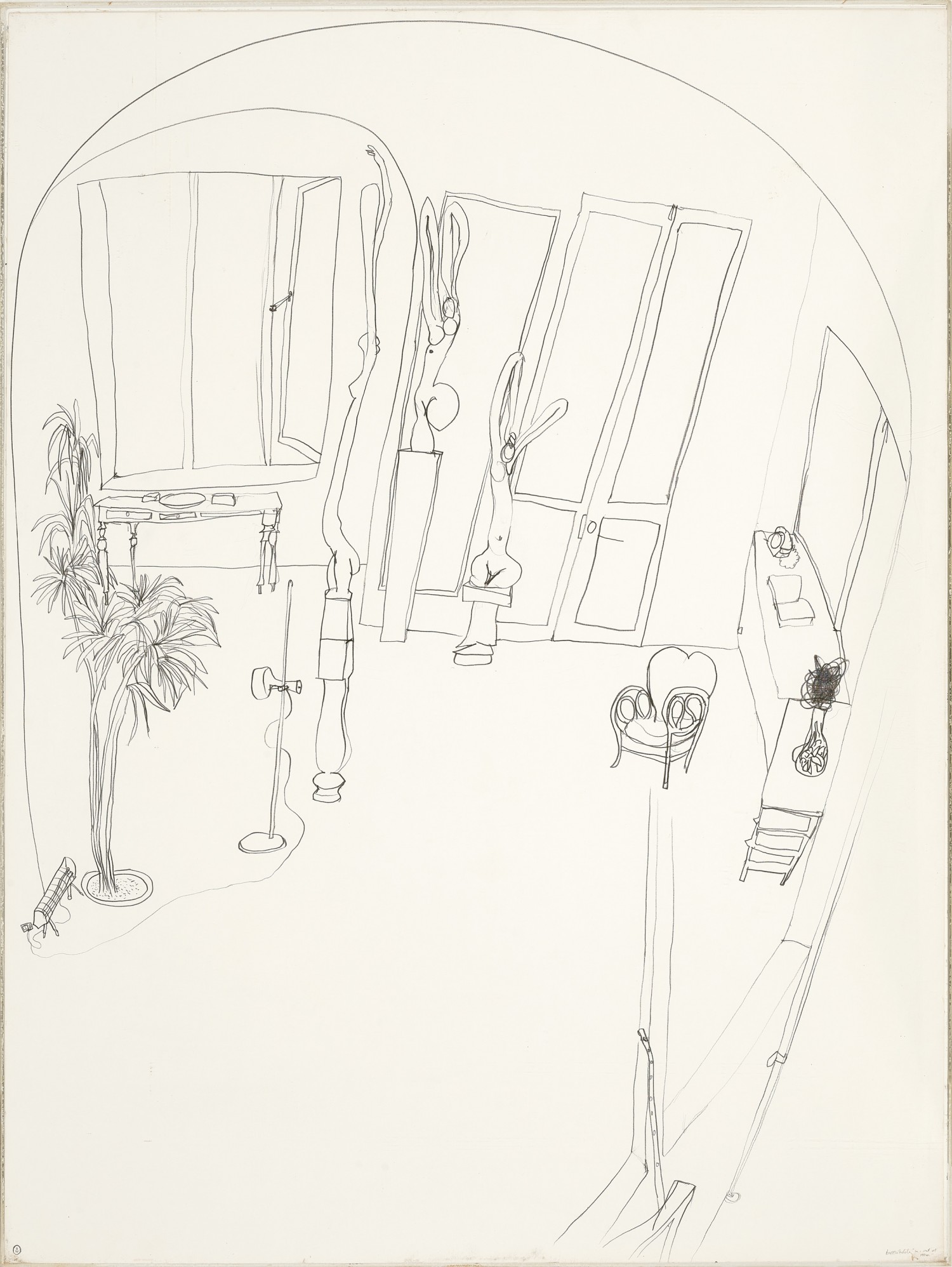
In and out of room, c.1975
Brett Whiteley
pencil on card
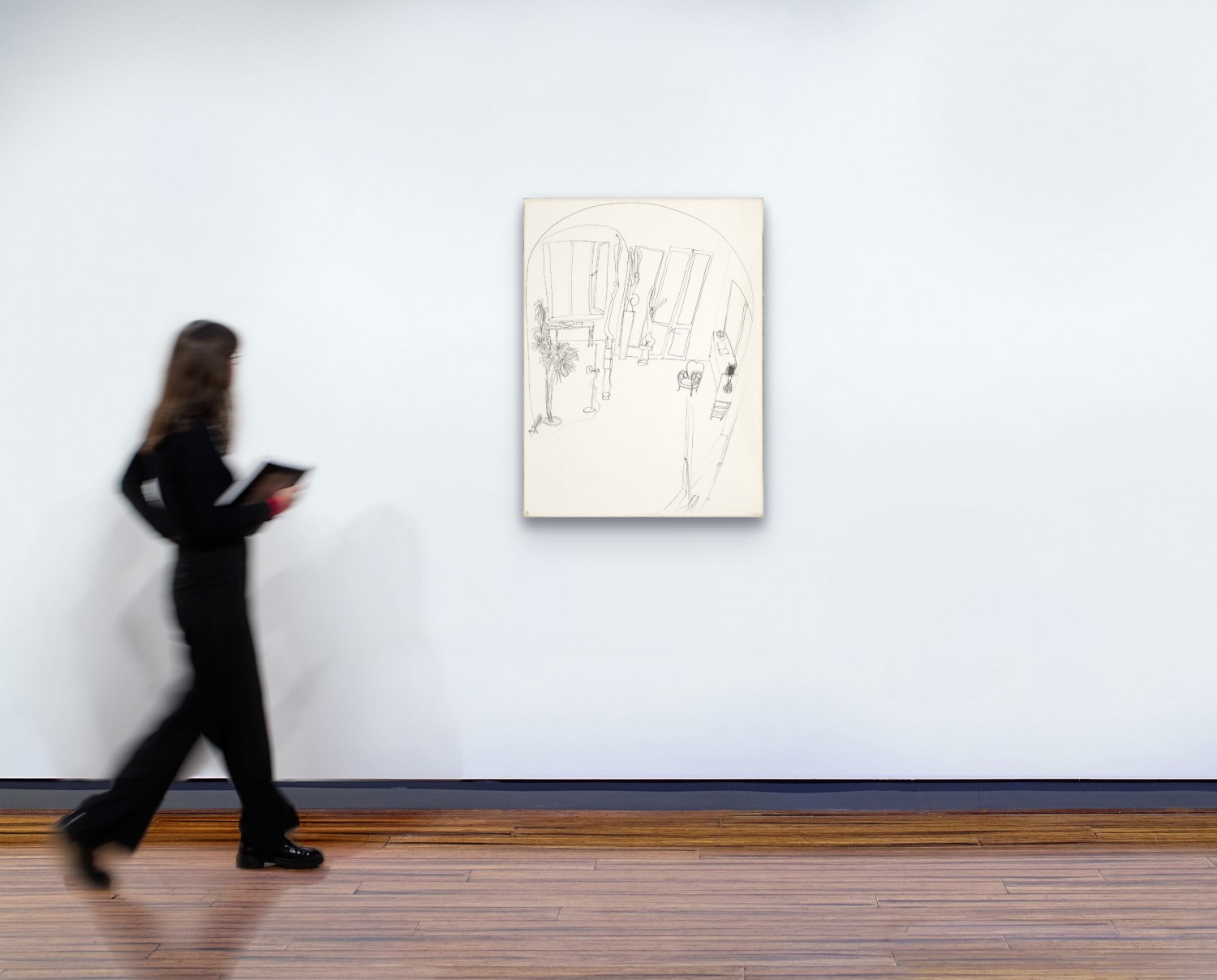
103.0 x 77.0 cm
signed and inscribed with title lower right: brett whiteley “in and out / of room”
stamped lower left with artist’s monogram
bears inscription verso: No. 9
Holdsworth Galleries, Sydney
Private collection, Sydney
Private collection, Sydney, a gift from the above c.2005
This work will be included in the addendum to Sutherland, K., Brett Whiteley: Catalogue Raisonné, Schwartz Publishing, Melbourne, 2020, provisional cat. 104.75
More than a simple line drawing, In and out of room, c.1975 is an unadulterated expression of the hermetic creative sanctuary that Brett Whiteley found at his home in Sydney’s Lavender Bay. In early 1974, Whiteley and his wife, Wendy, purchased the entire residence on Walker Street, having rented the upstairs apartment since their sudden return from Fiji in November of 1969. Biographer Ashleigh Wilson writes of this milestone: ‘Brett and Wendy turned the house inside out. They cleared obstacles to the sun and the harbour, opened out the main living area, created access between levels, extended the balcony, and installed arches between the rooms.’1 These efforts in curating his immediate environment coincided with the emergence of Whiteley’s mature phase as an artist, and the picturesque setting of the Lavender Bay living room provided the basis of his most acclaimed and lyrical paintings: the Matissean interiors of the 1970s: Henri’s armchair, 1974 – 75, Interior with time past, 1976; My armchair, 1976, and the Archibald Prize-winning, Self-portrait in the studio, 1976.
Rather than highlighting the expansive views of the harbour that the windows provided, In and out of room is a quiet meditation on interior space. It evidences Whiteley’s move into three-dimensionality throughout the 1970s, and the compressed perspective of the image builds on the pictorial devices employed by the artist in the Bathroom and Christie paintings in his London apartment in the early 1960s. As the title would suggest, this drawing presents a visual journey around the artist’s inner sanctum, from a high vantage point and through an open window frame outlined in the bottom left hand corner. Whiteley was an accomplished draughtsman, a facet of his artistic practice he honed throughout this decade. The wrap-around perspective effectively modulates the volumetric space to fit on a small picture plane, crowding its key identifying features into one unified scene below an arched frame. In and out of room joins a flurry of other line drawings of this space created between 1974 – 77, most bearing titles using variations of ‘Interior, Lavender Bay’. These works, featuring an array of Whiteley’s treasured possessions, artworks and occasionally even sitters such as Wendy or domestic pets, effectively become self-portraits in absentia.
Whiteley’s crisp linework in In and out of room left little room for revision. The scene was quickly recorded, capturing the tensions between the vertical architectural elements of the room, and the organic curves of the objects held within its confines. These range from emblems of domesticity such as an open book, rotary telephone, bunch of flowers in a vase and an electric heater, to Whiteley’s famous wicker armchair dwarfed in the empty room, and a selection of his own artworks described by Wendy as ‘bits of sculpture which were there at the time.’2 The rounded forms of the chair, the sculptures and the unruly, leafy canopy of the palms soften an otherwise austere architectural interior. The palms, we know from related works, to be an artwork of Whiteley’s in papier mâché painted electric blue. The three large figurative sculptures are carved mangrove wood forms each titled Her, made by Whiteley between 1975 – 76. Collectively titled Four studies of her, these sensual wooden forms appear in the drawing as stand-ins for his absent muse. Roughly hewn, the sculptures provide an organic counterpoint to the urbane sophistication of the Whiteleys’ living room with its views across Sydney harbour.
1. Wilson, A., Brett Whiteley, Art, Life and The Other Thing, The Text Publishing, Melbourne, 2016, pp. 230 – 231
2. Wendy Whiteley on Self Portrait in the Studio, 1976, interview, 4 June 2012, Art Gallery of New South Wales, see: https://www.artgallery.nsw.gov.au/art/watch-listen-read/watch/389/ (accessed 27 May 2026)
LUCIE REEVES-SMITH