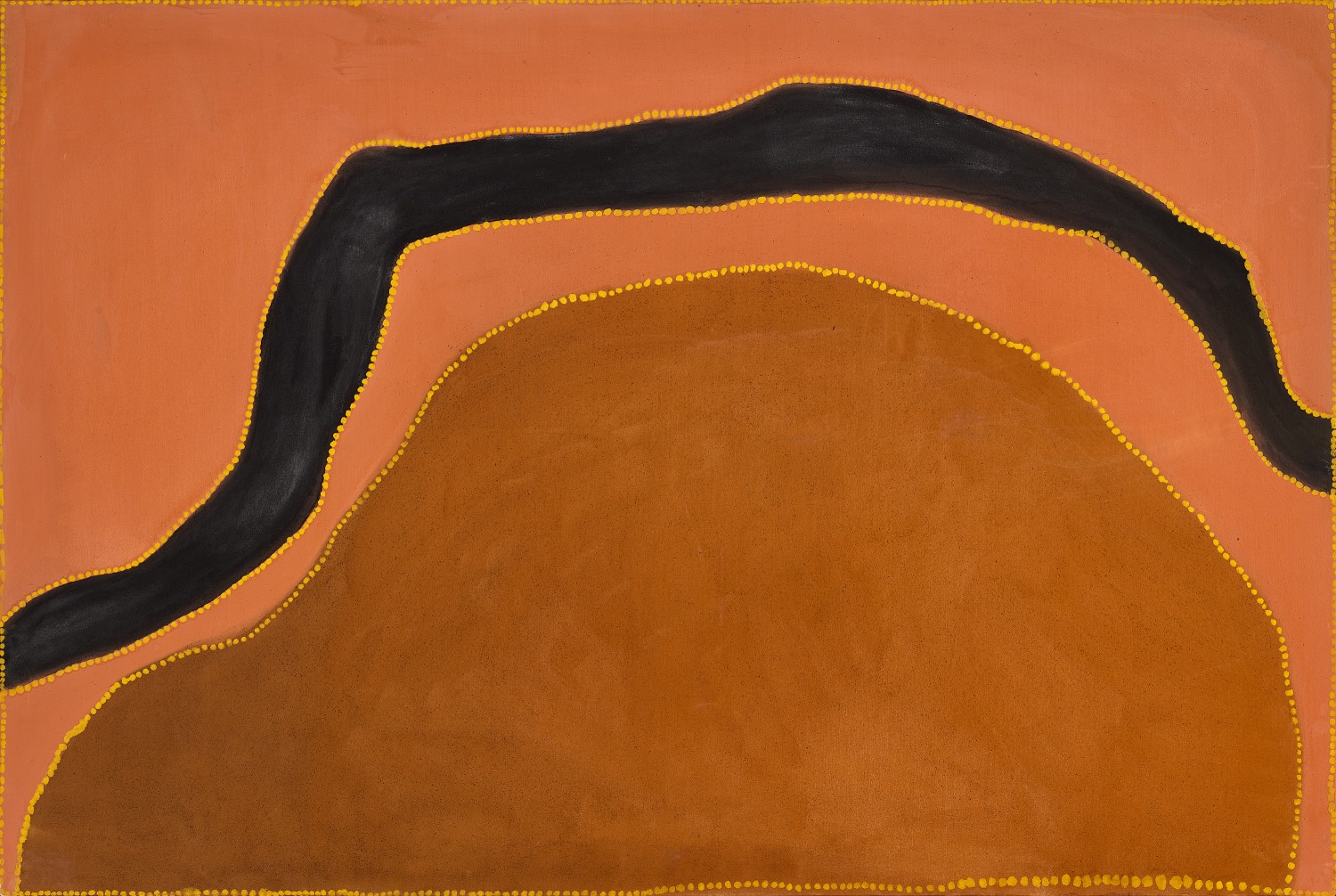
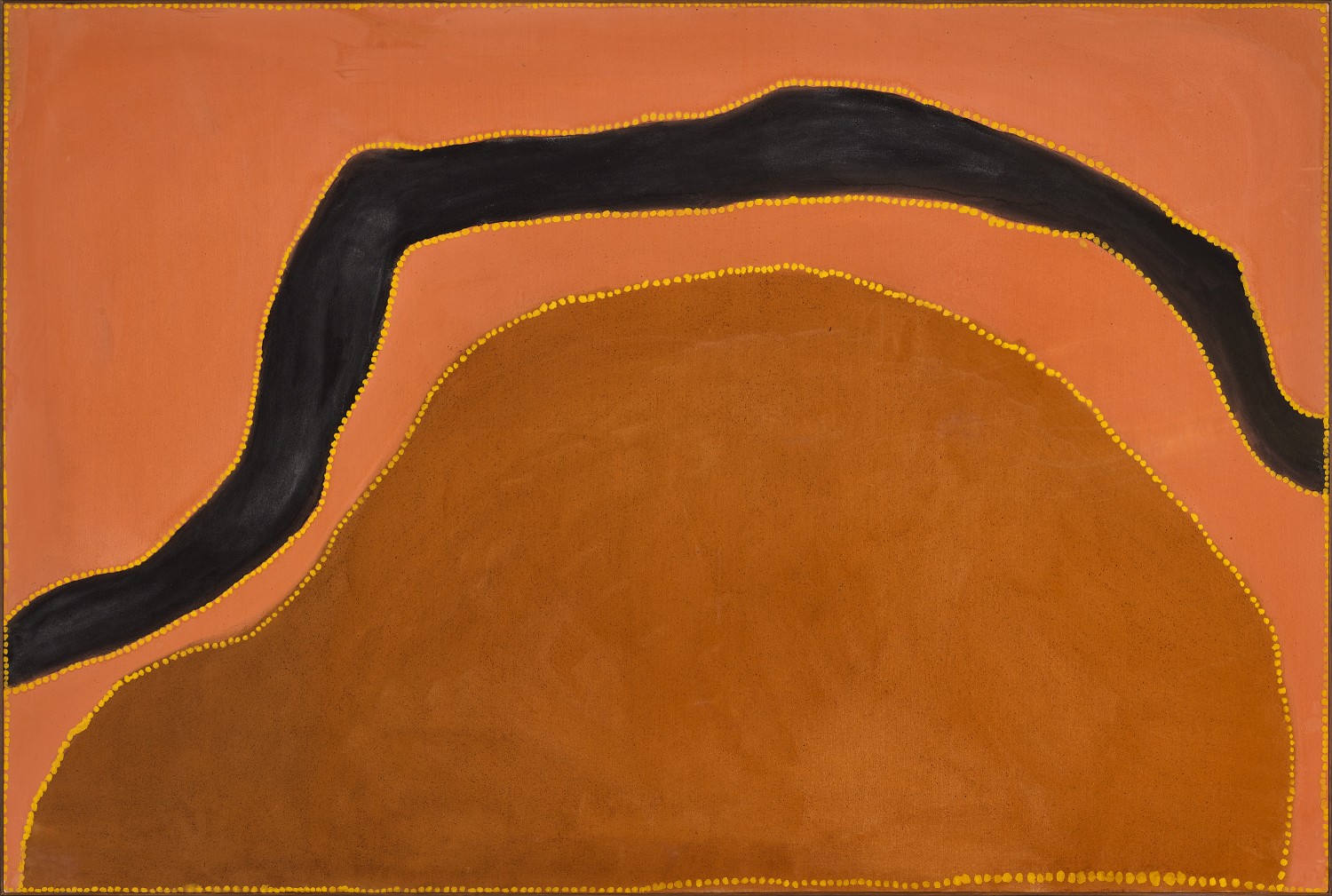
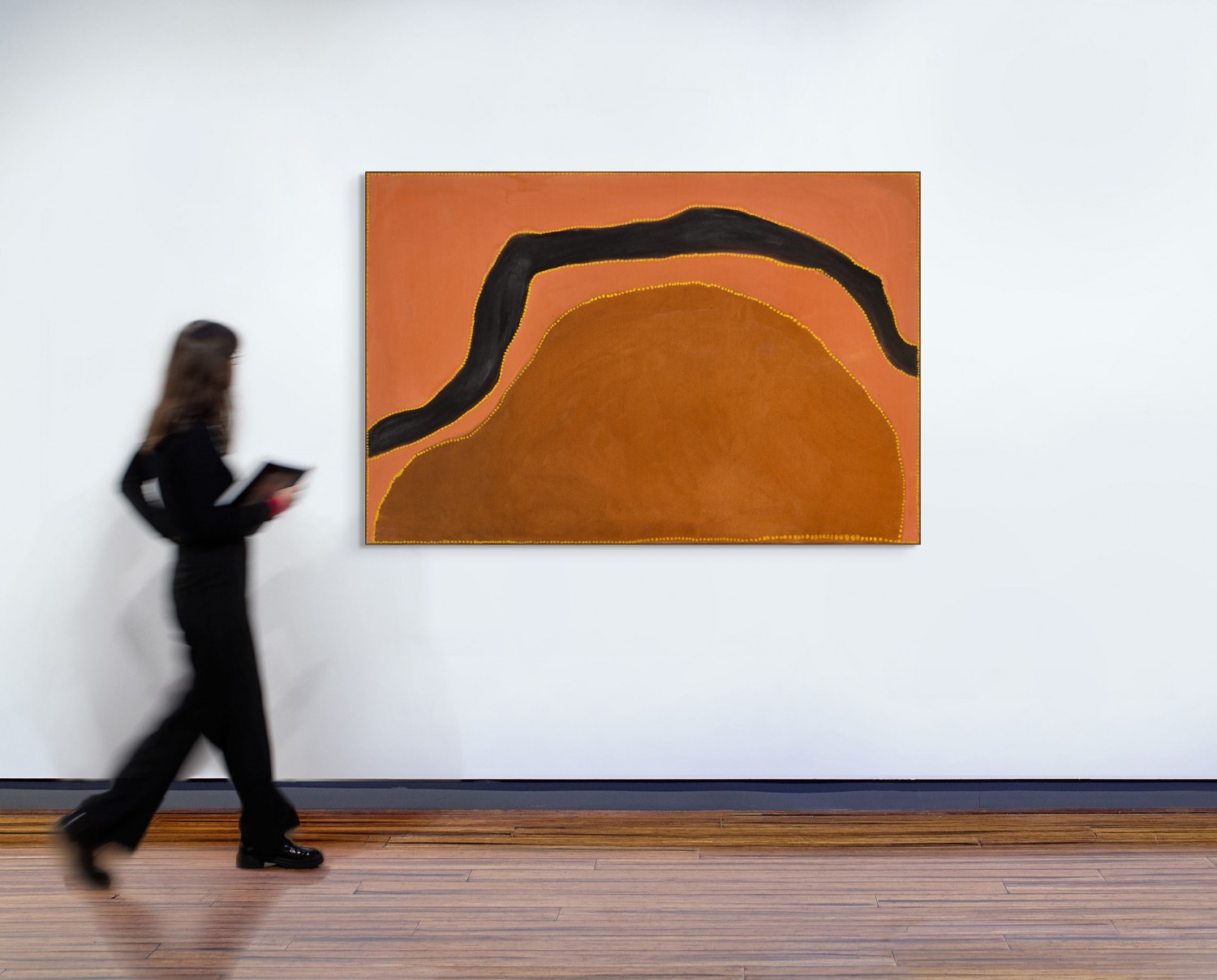
Langurr (The Rainbow Serpent) making the river, 1991
Rover Thomas (Joolama)
natural earth pigments and bush gum on canvas
121.5 x 181.0 cm
bears inscription verso: 5
Commissioned by Mary Macha, Perth in 1991
Aboriginal Dreamings Gallery, Canberra
Private collection, Canberra
Thence by descent
Private collection, Canberra
260013 Rover Thomas.png
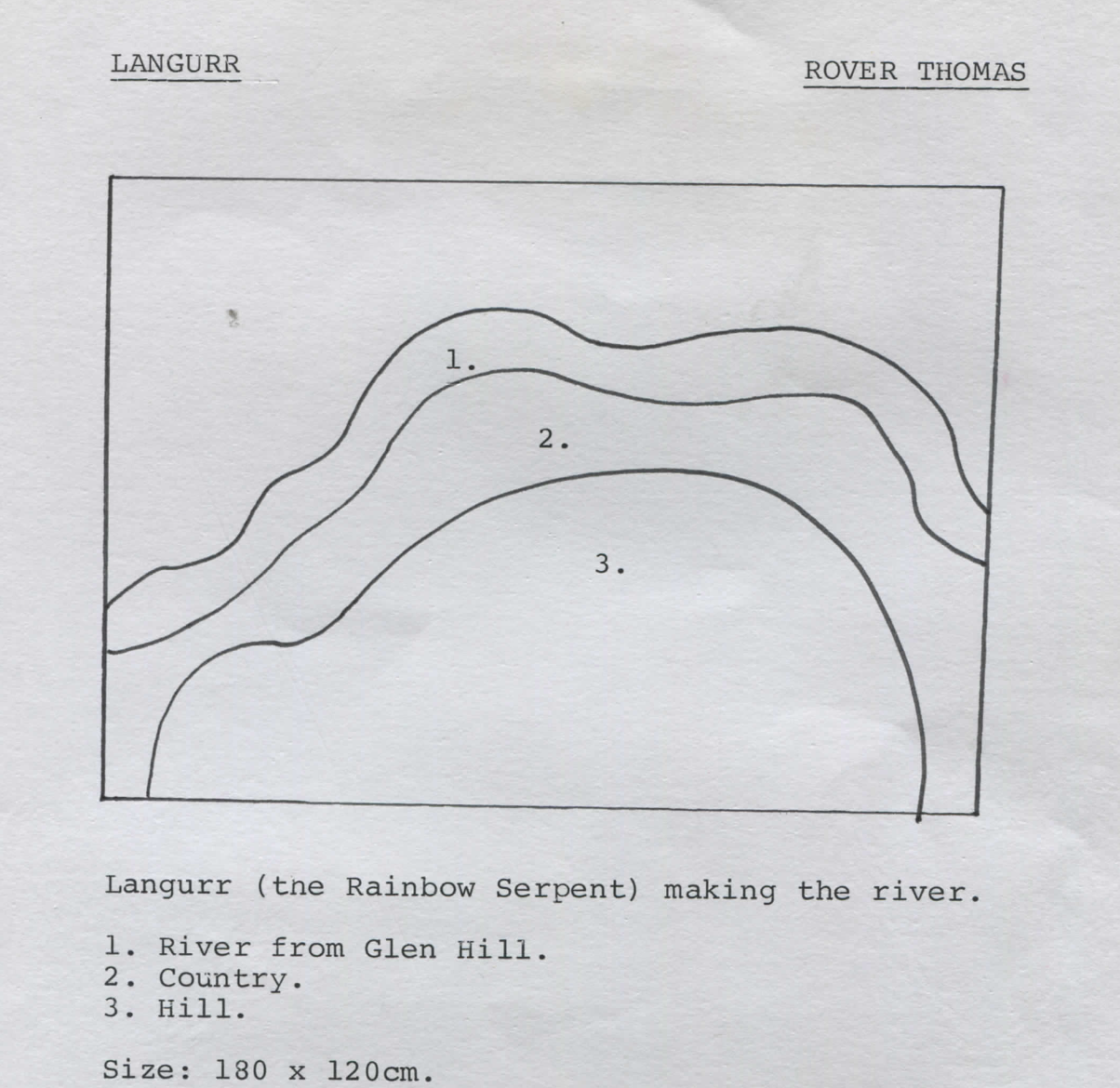
This work is accompanied by a copy of the original
cataloguing note from Mary Macha.
Fresh from his acclaimed presentation in Future Directions at the 44th Venice Biennale in 19901, Rover Thomas embarked upon a series of major canvases including Cyclone Tracy (National Gallery of Australia); Paruku (Lake Gregory) (Art Gallery of South Australia); and Djugamerri and Bolgumerri (both formerly in the Laverty Collection). To this significant group of works, all completed in 1991, may be added Langurr (The Rainbow Serpent) making the river, 1991 offered here. In these paintings, Julama’s [sic] palette remains consistent with his earlier works, yet the handling of paint shifts noticeably. The layers are thinner and more fluid, applied in soft, flat strokes or delicate dots, by contrast to the thick impasto surfaces that characterised his previous canvases.
Rover Thomas was born at Kunawarritji (Well 33) on the Canning Stock Route but was taken to the Kimberley as a youth. There he spent decades working on cattle stations, as did many young Aboriginal men of his generation. Adopted into the traditional cultural milieu of the Kimberley, he developed an intimate knowledge of the region – an understanding that became central to the map-like quality of his paintings. Rather than directly depicting ancestral or historical events, Julama painted the landscapes that bore witness to them.
Although widely travelled within the Kimberley and the Northern Territory – and a regular visitor to his friend and agent Mary Macha in Perth – Thomas had never journeyed beyond Australia until his visit to Venice for the Biennale vernissage in May 1990. In preparation, Macha took him to Canberra for a fortnight at the National Gallery of Australia, where he encountered, firsthand, a major international art institution and its collections. There Thomas showed a lively curiosity about diverse artistic traditions and styles, yet he was particularly struck by Mark Rothko’s No. 20, 1957. Confronted with the painting, he reportedly exclaimed in astonishment, ‘Who’s this bugger who paints like me?’2
In works produced after his return from Venice, Thomas’ application of thin, even layers of pigment – soaking into the canvas support – bears a certain resemblance to Rothko’s technique of building colour through successive washes. The extent to which this encounter influenced Julama’s subsequent practice, however, remains open to conjecture.
The title of this painting refers to Langurr (or Wungurr), the ancestral Snake invoked by Thomas to describe the force that, in the form of Cyclone Tracy, devastated Darwin in 1974 before sweeping across the eastern Kimberley. In the months following the disaster, Thomas experienced a series of revelations communicated by the spirit of his classificatory mother’s sister, who had perished in the cyclone. These visionary experiences led to the creation of the Gurirr Gurirr (Krill Krill) ceremony, of which Thomas was custodian.
260013 Rover Thomas.jpg
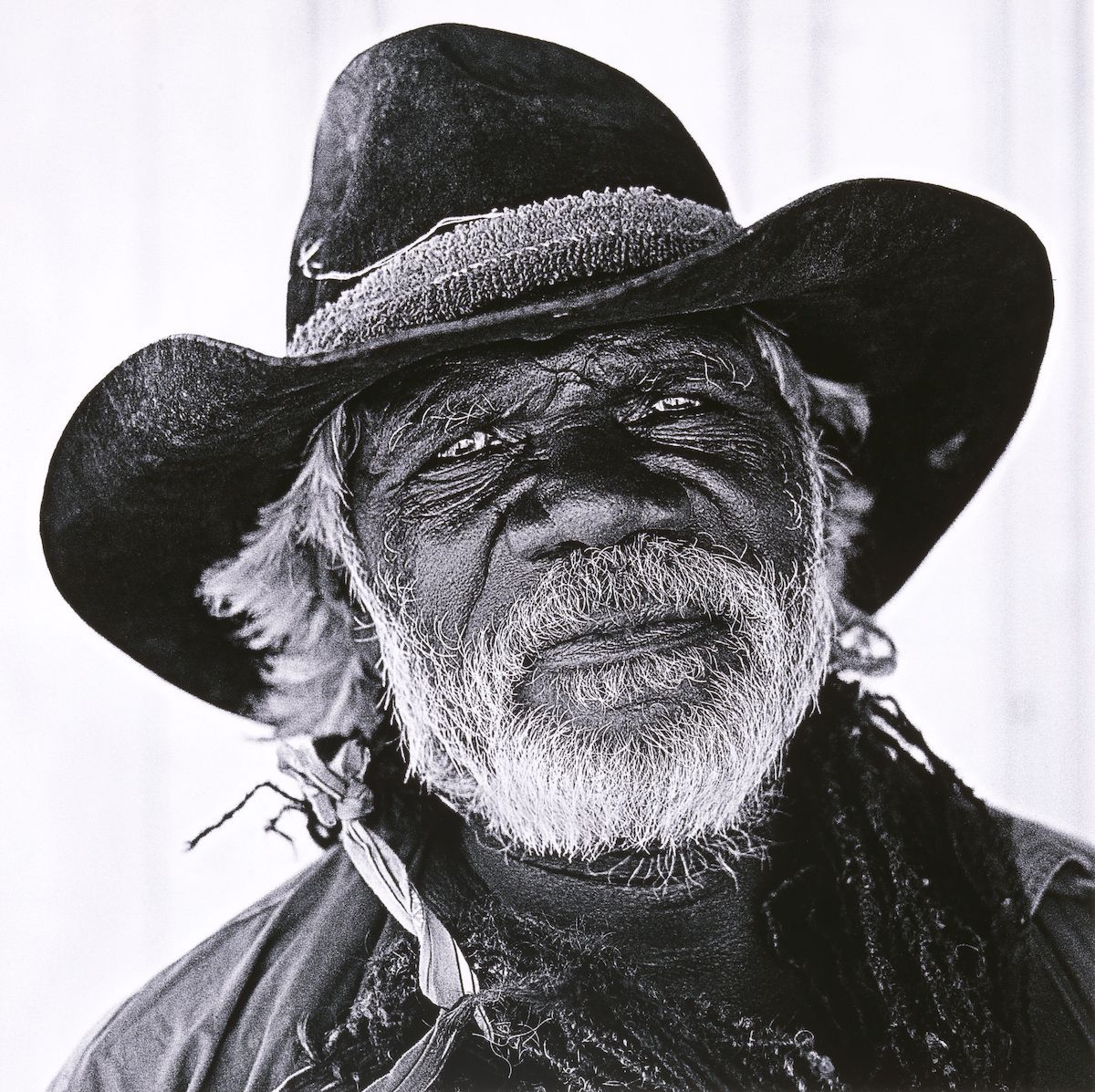
Rover Thomas, 1986
photographer: Martin van de Wal
National Portrait Gallery, Canberra
© Martin van der Wal
According to Mary Macha’s annotated diagram of the composition, the black serpentine line represents the river flowing from Glen Hill, north of Thomas’ home at Warmun (Turkey Creek), as it is formed by the Rainbow Serpent. The large, rounded form dominating the canvas signifies the hill itself, while the intervening space is described by the artist simply as ‘Country’. The setting appears to evoke the area where Thomas’ aunt was fatally injured in a car accident caused by floodwaters from the cyclone.
1. Along with Trevor Nickolls (1949 – 2012), Rover Thomas was the first Aboriginal artist to represent Australia at the Biennale of Venice. Their exhibition was curated by Michael O’Ferrall from the Art Gallery of Western Australia.
2. Rex Butler describes Rover Thomas’ reaction as the recognition of a type of ‘lyricism’ where the artist’s ‘voice or viewpoint [is] uninterrupted’ by any form of verbal description or interpretation. See Butler, R., ‘What was Abstract Expressionism? Abstract Expressionism after Aboriginal Art’, Australian and New Zealand Journal of Art, vol. 14 (1), 2014, pp. 76 – 91 at: https://www.tandfonline.com/doi/full/10.1080/14434318.2014.936529 (accessed 18 February 2026)
WALLY CARUANA