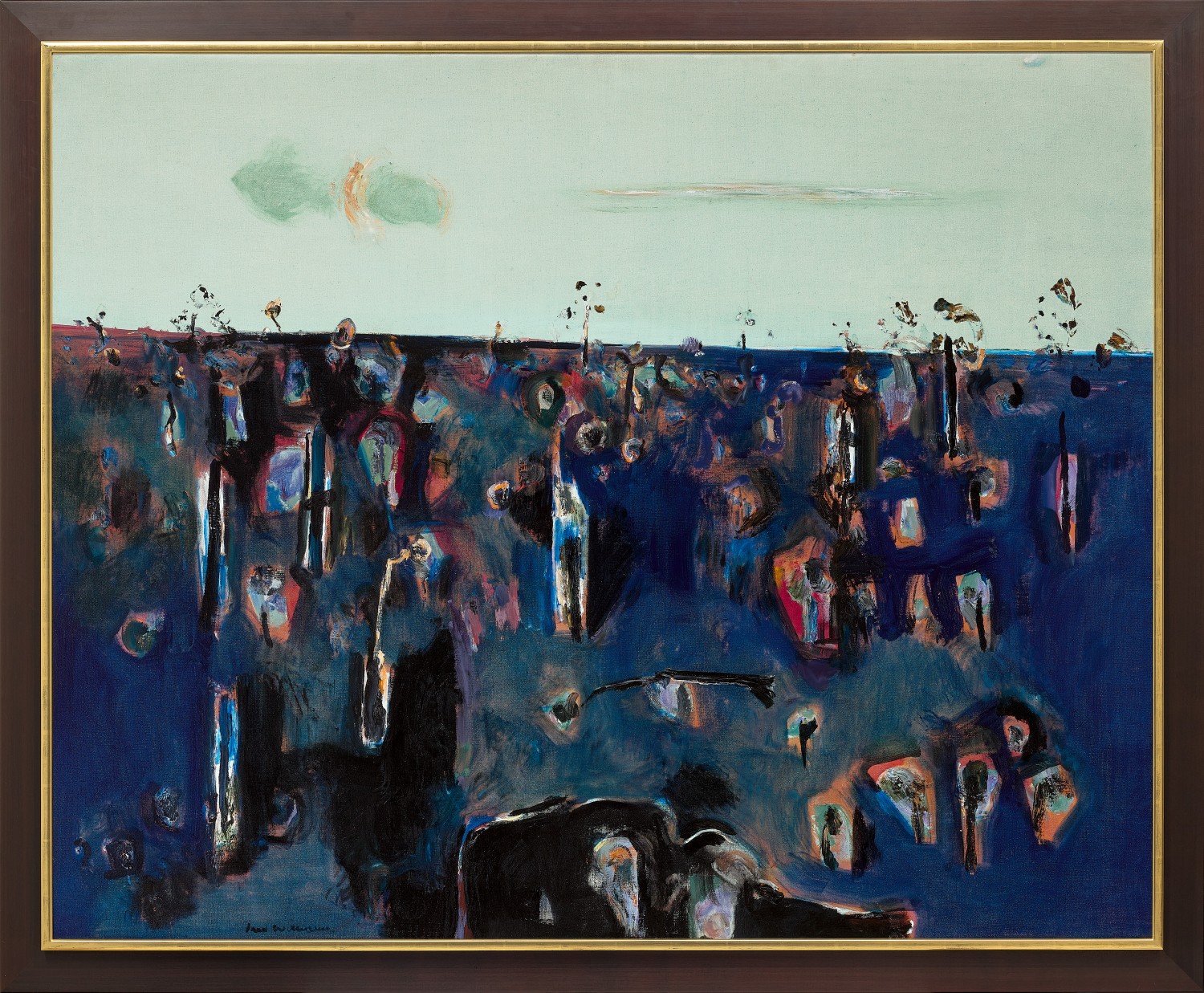
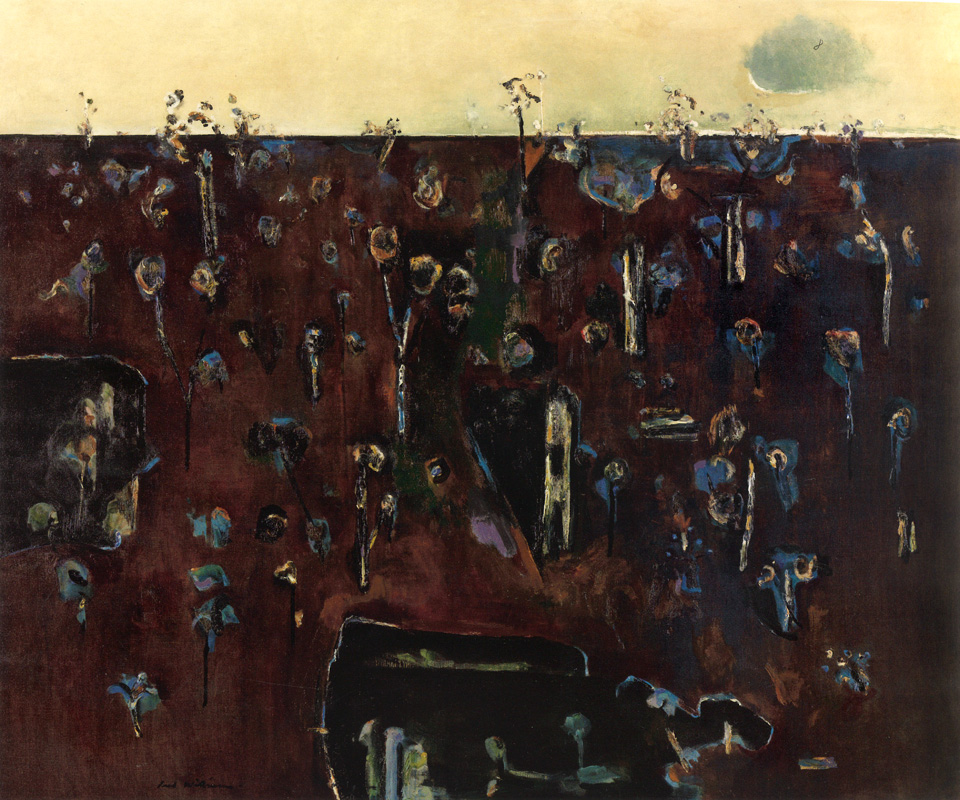
Two green clouds, 1967
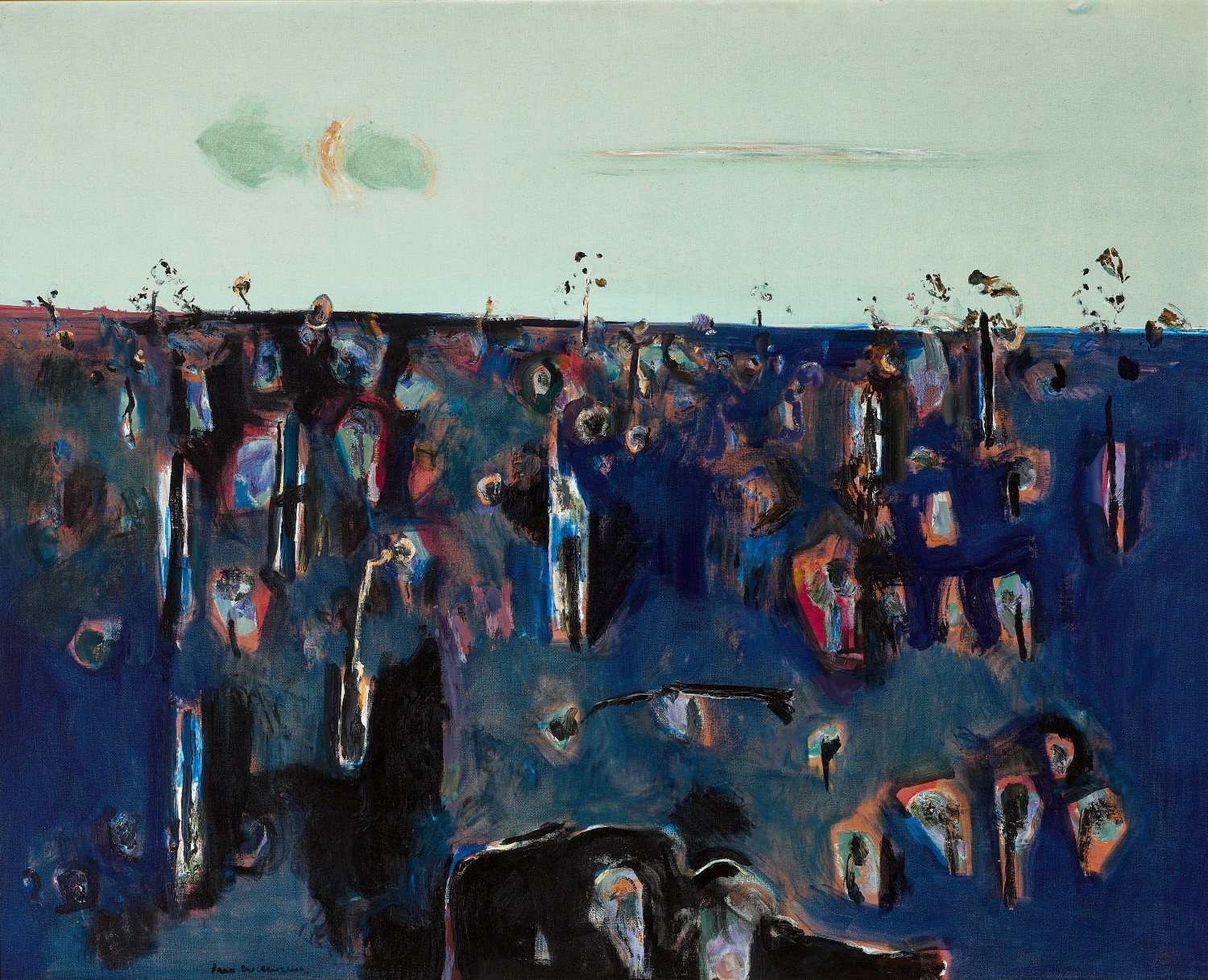
Fred Williams
oil on canvas
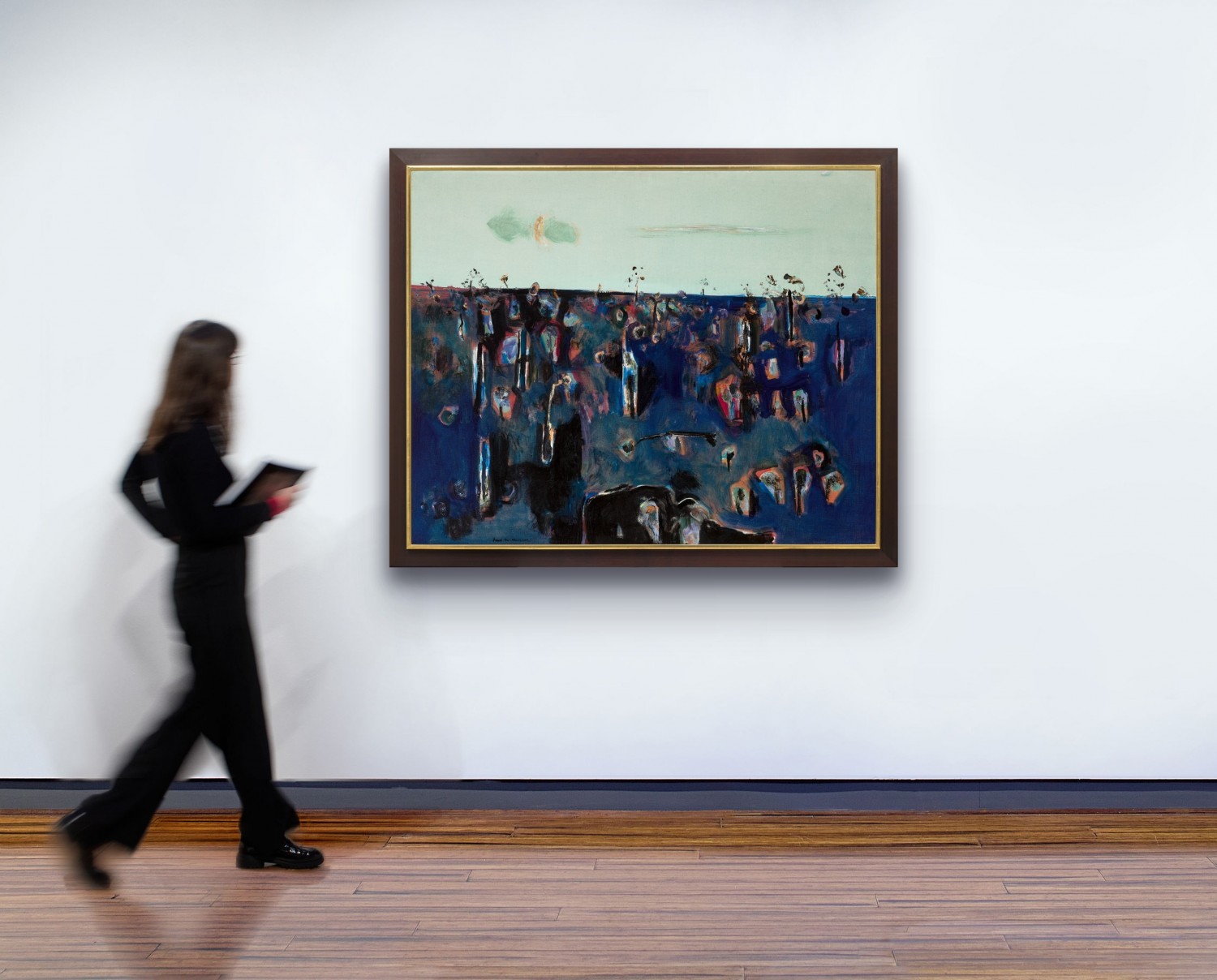
122.0 x 152.0 cm
signed lower left: Fred Williams
bears inscription on typed label verso: Fred Williams / “Two Green Clouds”
Rudy Komon Gallery, Sydney (label attached verso)
Walter McGrath, Sydney, acquired from the above in 1967
Rudy Komon Gallery, Sydney
Ray and Diana Kidd, Sydney, acquired from the above 1971
Deutscher and Hackett, Sydney, 17 November 2010, lot 11 (dated 1966)
Private collection, Queensland
Fred Williams, Georges Gallery, Melbourne, 25 September – 14 October 1967, cat. 15
Archibald, Wynne and Sulman Prizes 1967, Art Gallery of New South Wales, Sydney, 20 January – 18 February 1968, cat. 92
McCaughey, P., Fred Williams, Bay Books, Sydney, 1980, pl. 8, p. 19 (illus.)
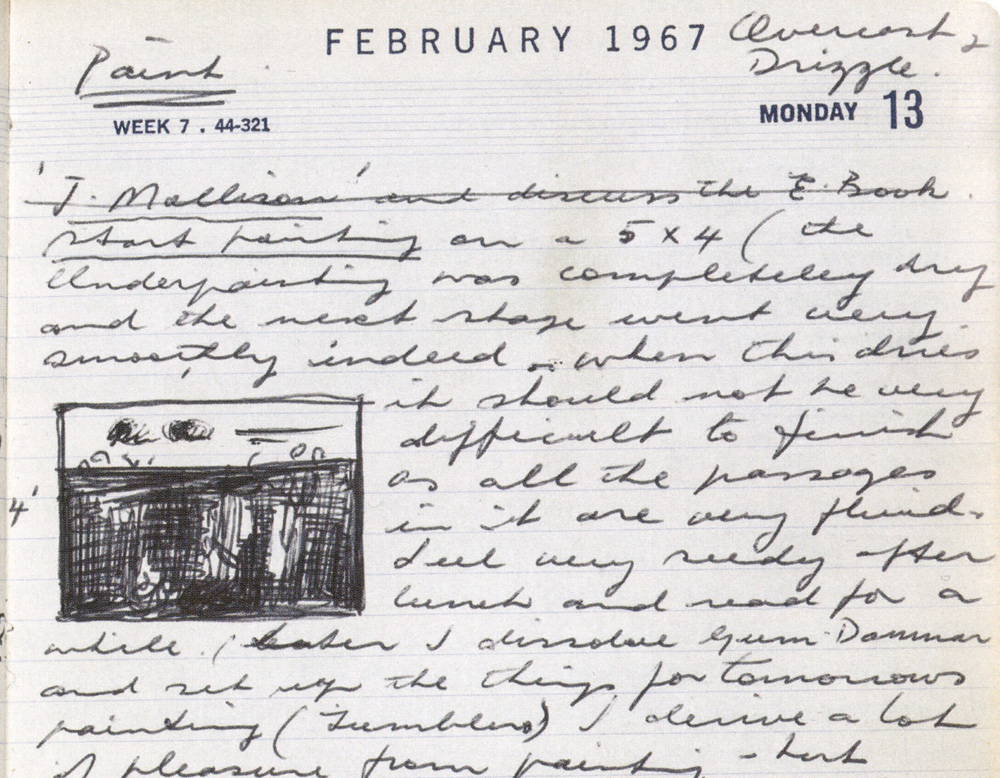
Fred Williams, cited in McCaughey, P., and Timlin, J., The Diaries of Fred Williams. 1963 – 1970, The Miegunyah Press, Melbourne, 2024, pp. 217 (illus.), 236, 238, 248
100678 Green cloud and owl (web).jpg
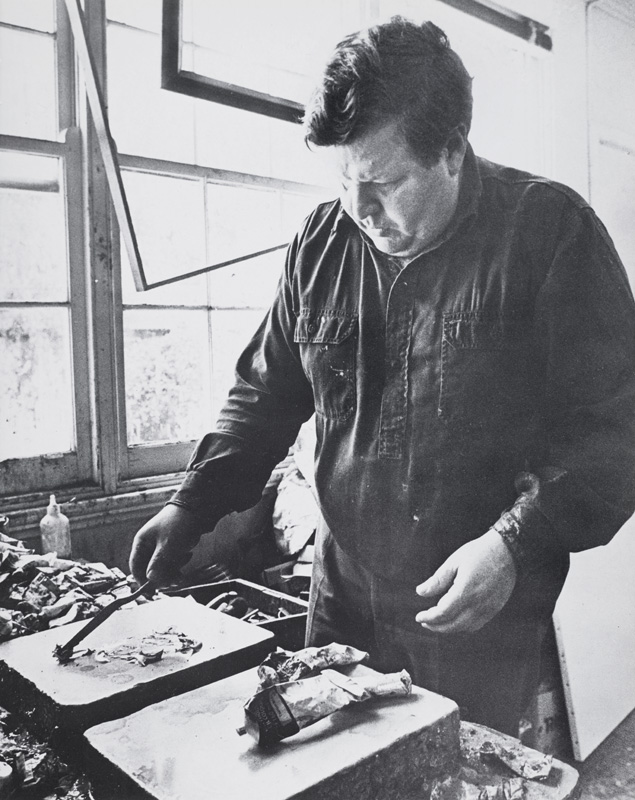
Like so many young artists of his generation, Fred Williams left Australia and travelled overseas at the end of 1951, seeking exposure to broader artistic and cultural influences than those which were available to him in mid-century Melbourne. While his training had emphasised the centrality of the figure in Western art, returning home after five years in London, Williams saw opportunity and creative potential in the landscape of his own country and the focus of his art changed direction. His friend, John Brack, expressed reservations about the landscape – and particularly the ubiquitous gum tree – as a valid subject for contemporary painting, but Williams recognised it as part of a longstanding and respected artistic tradition which was ripe for new interpretation. Similarly, although the anti-picturesque qualities of his homeland seemed uninspiring to some, for Williams it represented the ideal subject:
‘It's perfectly true, it is monotonous… There is no focal point, and obviously it was too good a thing for me to pass up… the fact [that] if there’s going to be no focal point in a landscape [then] it had to [be built] into the paint… I’m basically an artist who sees things in terms of paint.’1
Williams developed a distinctive painterly language and approach to the formal composition of landscape subjects that is now ingrained in our collective consciousness. Whether he is depicting a semi-rural hillside covered with scrubby bushes and trees, or an abstract aerial view of the desert thousands of kilometres away from any city centre, his images have come to influence the way Australians see and imagine their own country. This phenomenon and the significant place that Williams was carving out for himself within the history of Australian art were recognised early on: ‘Of all the modern Australians, he is said to be the one most likely to emerge as the finest landscapist since Tom Roberts.’2
100678 Diary entry (web).jpg
100678 (web).jpg
The 1960s was an important decade for Williams. In 1963, he was invited to join the stable of artists represented by Sydney art dealer, Rudy Komon, and the monthly retainer he received gave Williams and his wife, Lyn, the financial confidence to buy a house at Upwey in the Dandenong Ranges, about thirty kilometres to the east of Melbourne. That same year, Williams was awarded the prestigious Helena Rubinstein Travelling Art Scholarship, travelling for seven months in Europe in 1964. The following year was also significant – ‘for the first time [Williams] was able to paint full-time. The concentration and energy, and the time he now brought to his art, resulted in four years of astonishing variety and contrast in his painting.’3 The You Yangs continued to feature as an important subject in his work alongside new landscapes that were based on Upwey and nearby Lysterfield.
100678 Upwey landscape (web).jpg
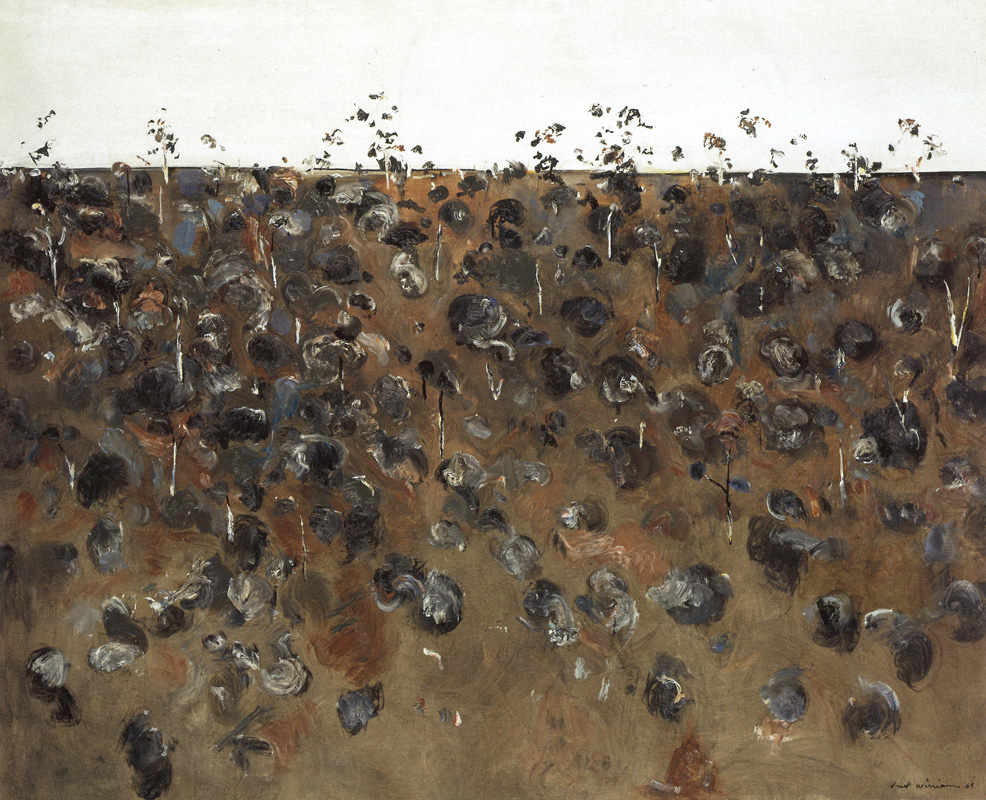
The composition of the Upwey landscapes reflected the view from his home studio, looking up a hillside from the base of a valley, and paintings from this series are characterised by a narrow band of sky running across the top of a steep and often treed slope. The response to these works which are now considered ‘classic’ Williams paintings was positive: the National Gallery of Victoria purchased Upwey landscape, 1965, directly from the studio in 1965; in 1966 Williams won the Georges Invitation Art Prize with another major Upwey picture; and the following year, an Upwey subject was awarded the Wynne Prize at the Art Gallery of New South Wales. Since that time, major Upwey paintings have been acquired for the collections of the National Gallery of Australia, Art Gallery of New South Wales and Tate, London. In the words of Patrick McCaughey:
‘They were clearly paintings of substance, well-made and fully fashioned and yet they still allowed Williams’ touch to operate. They made of the drab and featureless bush, a landscape of enduring, even monumental proportions and dignity.’4
100678 Landscape with water ponds (web).jpg
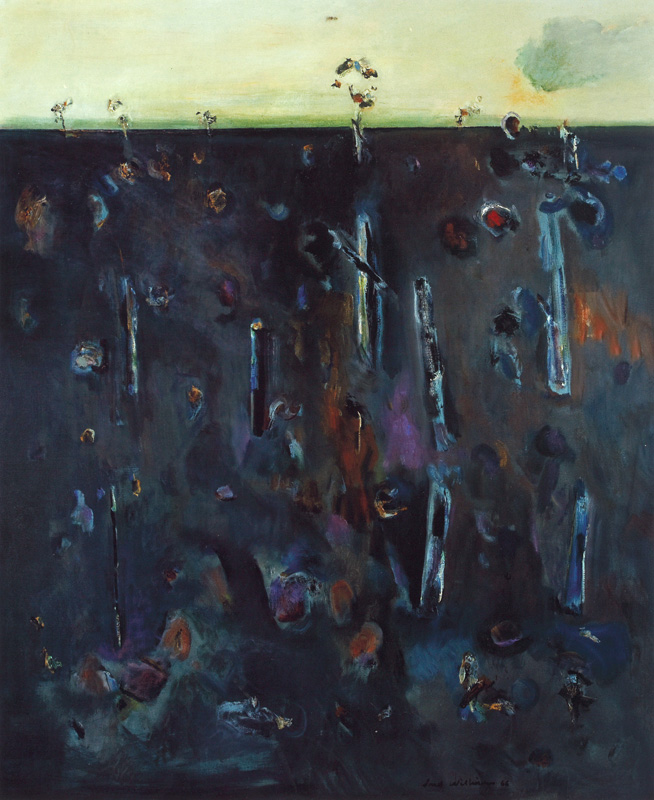
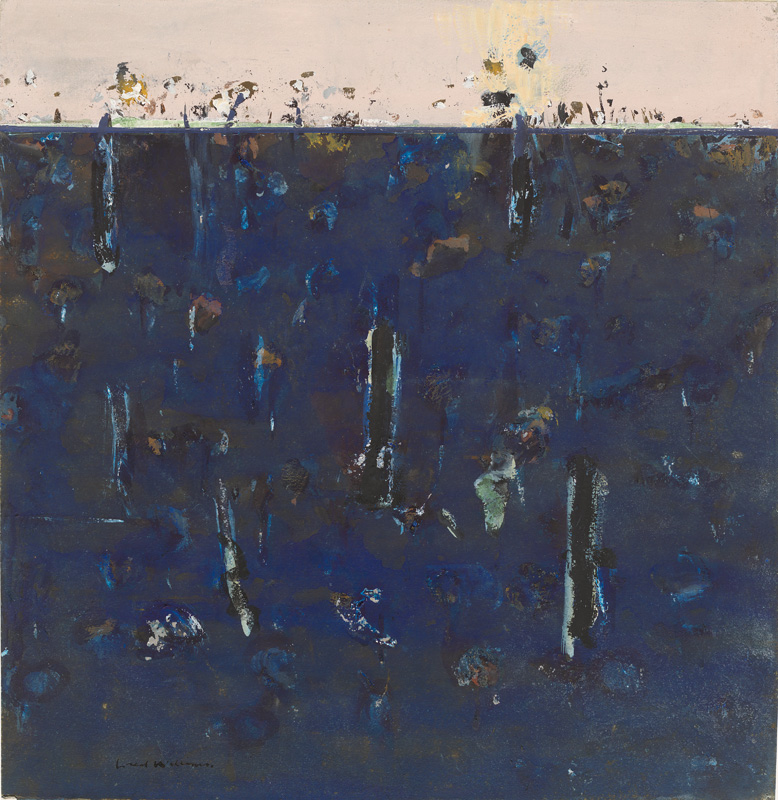
Part of the extended Upwey series, Two green clouds, 1967, is one of a small group of paintings that are linked by the presence of a distinctive pale green cloud (or in this case, a pair of clouds) which Williams had seen ‘as it passed its single way across the early evening sky at Upwey.’5 The origin of these works was a gouache painted outdoors on a summer evening during early 1965 with no light other than that emitted by the moon. Typical of Williams’ practice of working in various media – drawing on the material qualities, technical requirements and creative innovations of one to push his work in another in new directions – subsequent gouaches of this nocturnal scene were followed by a series of five etchings in which he used various intaglio printmaking techniques as expressively as he used a paintbrush, creating rich inky tones and texture on their paper support. James Mollison explains that one of these prints inspired a subsequent gouache painted in Prussian blue and that this, in turn, led to the painting of Green cloud and owl, 1965 – 66 (private collection, formerly the Harold E. Mertz Collection, New York).6
Fred Williams Lot 3 01 cmyk (web).jpg
The present painting adopts the familiar composition of the Upwey landscapes. The top third of the canvas depicts a luminous band of summer sky – the sun has gone down but there is still light in the distance – which is interrupted only by the pair of amorphous green clouds that suggest the subtle movement of air on an otherwise still summer’s night. The hillside below, which fills most of the picture, is covered with tall vertical trees and one decisive horizontal in the lower centre representing a tree that has fallen or perhaps one that has been felled. Pictorial space is radically flattened and the foliage that extends beyond the horizon line is described in the painterly hieroglyphics so distinctive of Williams’ hand. At first glance it is the rich blue of the hillside and the black tree trunks that predominate, but a closer look reveals a typically complex palette where the artist has built up layers of non-representational colour, including green, red, ochres and white highlights, which nevertheless, still describe the subject in a manner that looks and feels like the scrubby local landscapes that we all know. Highly regarded at the time they were made, the Upwey paintings presented a singular vision that ‘revalued Australian landscape painting… and renewed hope in the genre’7, further cementing Williams’ place in the history of twentieth century Australian art.
1. Fred Williams interviewed by James Gleeson, 3 October 1978, cited in Mollison, J., Fred Williams: A Singular Vision, Australian National Gallery & Oxford University Press, Canberra, 1989, p. 35
2. Millar, R., ‘Landscapist who is different’, The Australian student, Country Press, Sydney, undated, unpaginated, cited in Hart, D., Fred Williams: Infinite Horizons, National Gallery of Australia, Canberra, 2011, p. 61
3. McCaughey, P., Fred Williams 1927 – 1982, Murdoch Books, Sydney, 1996, p. 166
4. ibid., p. 170
5. Mollison, op. cit., p. 91
6. See Mollison, ibid., pp. 90 – 93
7. McCaughey, op. cit., p. 170
KIRSTY GRANT