
Important works from the Estate of Michael Gleeson-White AO, Sydney (Lots 24 – 37)
Fred Williams
(1927 - 1982)
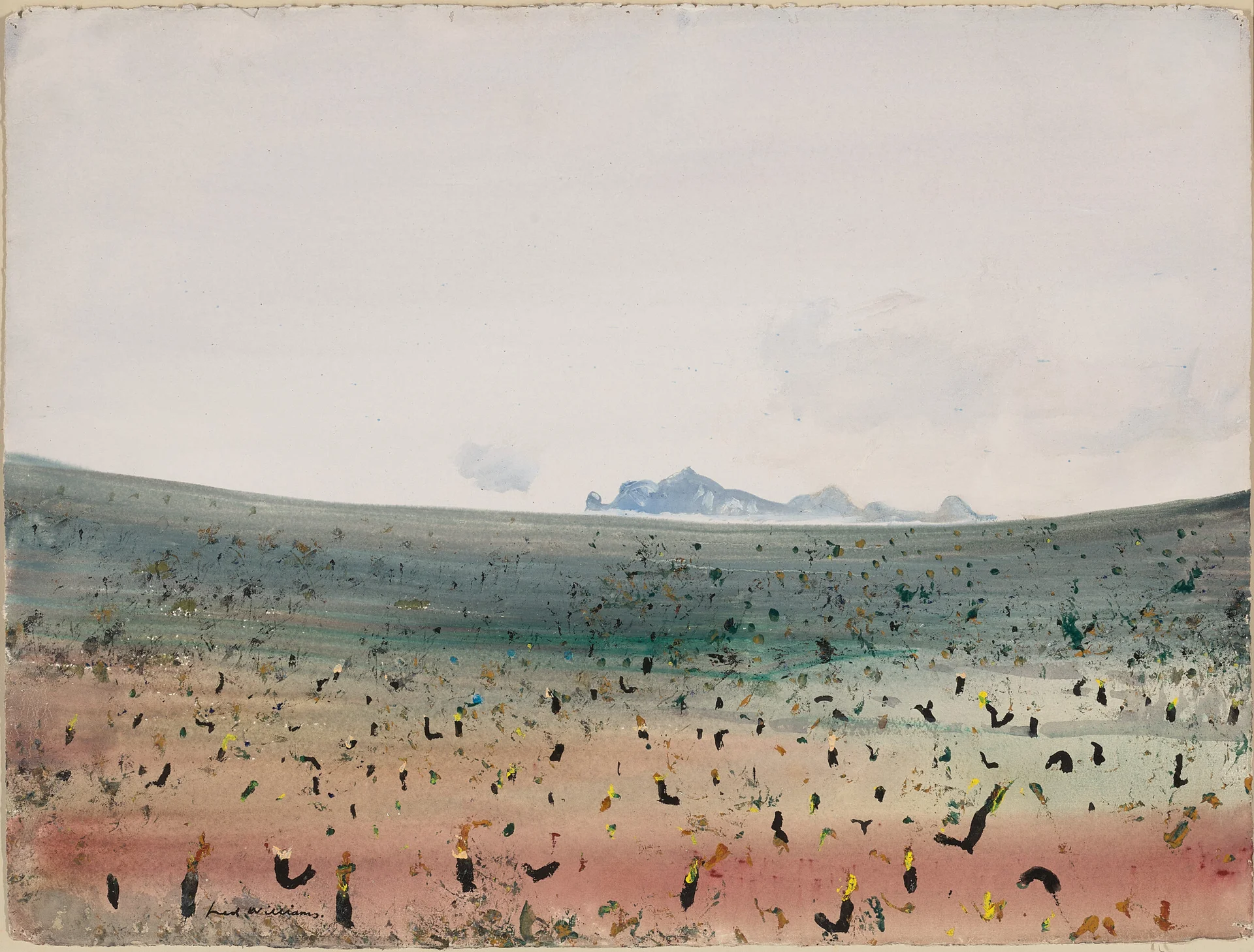
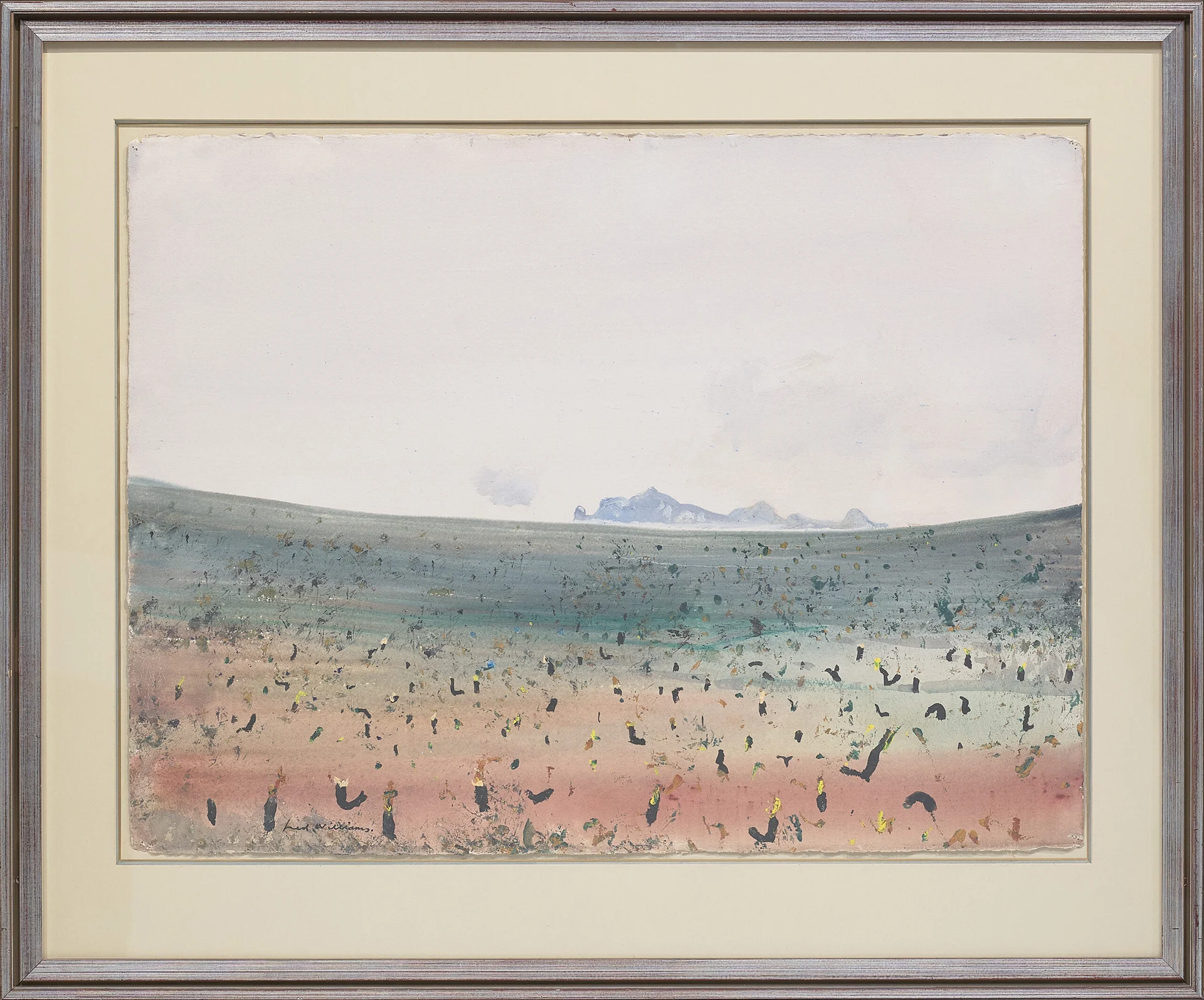
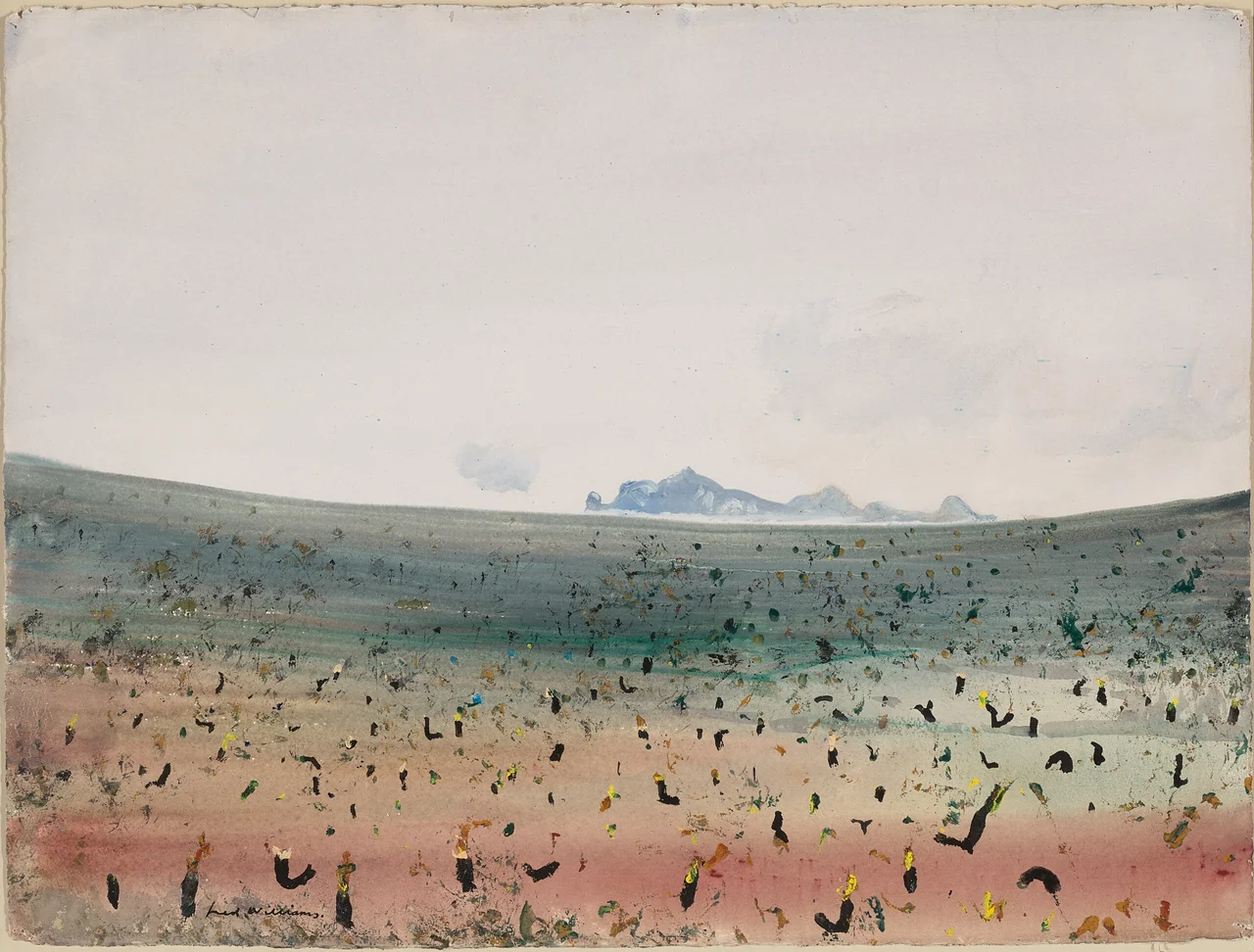
Flinders Island, 1981
gouache on paper
57.0 x 75.0 cm
signed lower left: Fred Williams.
Estimate:
$30,000 - $40,000
Sold:
$66,273 (inc. BP)
© Estate of Fred Williams/Copyright Agency 2026
lot details
Michael Gleeson-White, AO, Sydney, acquired directly from the artist in 1981
Estate of the above, Sydney
Related Works
Flinders Island, 1974, gouache and synthetic polymer paint on paper, 56.8 x 76.8 cm, Museum of Modern Art, New York
We are grateful to Lyn Williams for her assistance with this catalogue entry.
Flinders Island lies to the south of Victoria in eastern Bass Straight and is the largest of fifty islands known collectively as the Furneaux Group. It was the site of much sorrow for Indigenous Australians in the nineteenth century, but by the time Fred Williams visited in 1974, the resident population was sparse, subsisting on rural industries including fishing, muttonbirding, dairying and sheep farming. It was nonetheless a striking environment of great physical beauty and Williams completed there a small suite of robust yet atmospheric gouaches. He travelled to the island at the beginning of the year with his family and his painting colleague Fraser Fair, noting in his diary for 5 January, that he had decided to ‘try for finished pictures on the spot – rather than simply fact gathering.’1 Flinders Island, 1981, is an excellent example of this strategy, likely painted on Vinegar Hill looking west towards the peak of Mt Strzelecki, the tallest mountain on the island.
For more than a decade, Williams had been determinedly reinterpreting the Australian landscape, finding patches of otherwise nondescript bush and turning them into masterworks of painterly process. Indeed, it is now possible to visit areas outside Melbourne, particularly the You Yangs and the Dandenongs, and ‘see’ it anew through the artist’s eyes – a response achieved by only a handful of Australian artists. On Flinders Island, Williams was presented with a new range of possibilities from the granite ridges of Mt Strzelecki to the south and Mt Killiecrankie in the north, connected in between by extensive lowlands containing lagoons and marshes fringed by beaches with extensive views over Bass Strait. It was also a landscape of extremes often beset by howling winds which no doubt played havoc as Williams painted en plein air onto large sheets of watercolour paper. After two weeks, he wrote in his diary that ‘(t)he main character [of the island]… is the apparent hourly changes in the weather – and the main part of my next week’s work will try and include this more.’2 Flinders Island is painted using gouache, a most unforgiving medium that does not allow for subsequent corrections once it is dry, particularly when creating large sections of solid colour. It is a testament to Williams’ skill that areas such as the sky and the tonal gradations of the ground are applied so fluidly, with the more thickly textured clouds added later with an equally sure hand. The sparse scrub of the marshes is punctuated by the artist’s trademark dot-dash patches of colour, and he no doubt chose the particular location – a slight depression between hills – due to the inverted curved horizon line it provided. A description of his technique, observed two months later about nearby Erith Island, credits Williams with ‘working from the inside out – [starting] with the minutiae of a painting and [building] up these into a coherent whole.’3
Williams would subsequently develop some of the Flinders and Erith Island ideas into large scale paintings, but it is in these dramatic gouaches that the immediacy of his sensations is retained. A companion work of the same title and dimensions is held in the collection of the Museum of Modern Art in New York.
1. Fred Williams, 5 January 1974, cited in Mollison, J., A singular vision: the art of Fred Williams, Australian National Gallery, Canberra, 1989, p. 166
2. Fred Williams, 18 January 1974, cited in ibid., p. 166
3. Turner, I., ‘Artists’ Camp Erith Island: March 1974’, Overland, no. 60, 1974, p. 42, cited in Hart, D., Fred Williams: Infinite Horizons, National Gallery of Australia, Canberra, 2011, p. 121
ANDREW GAYNOR