

Albert Namatjira
(1902 - 1959)
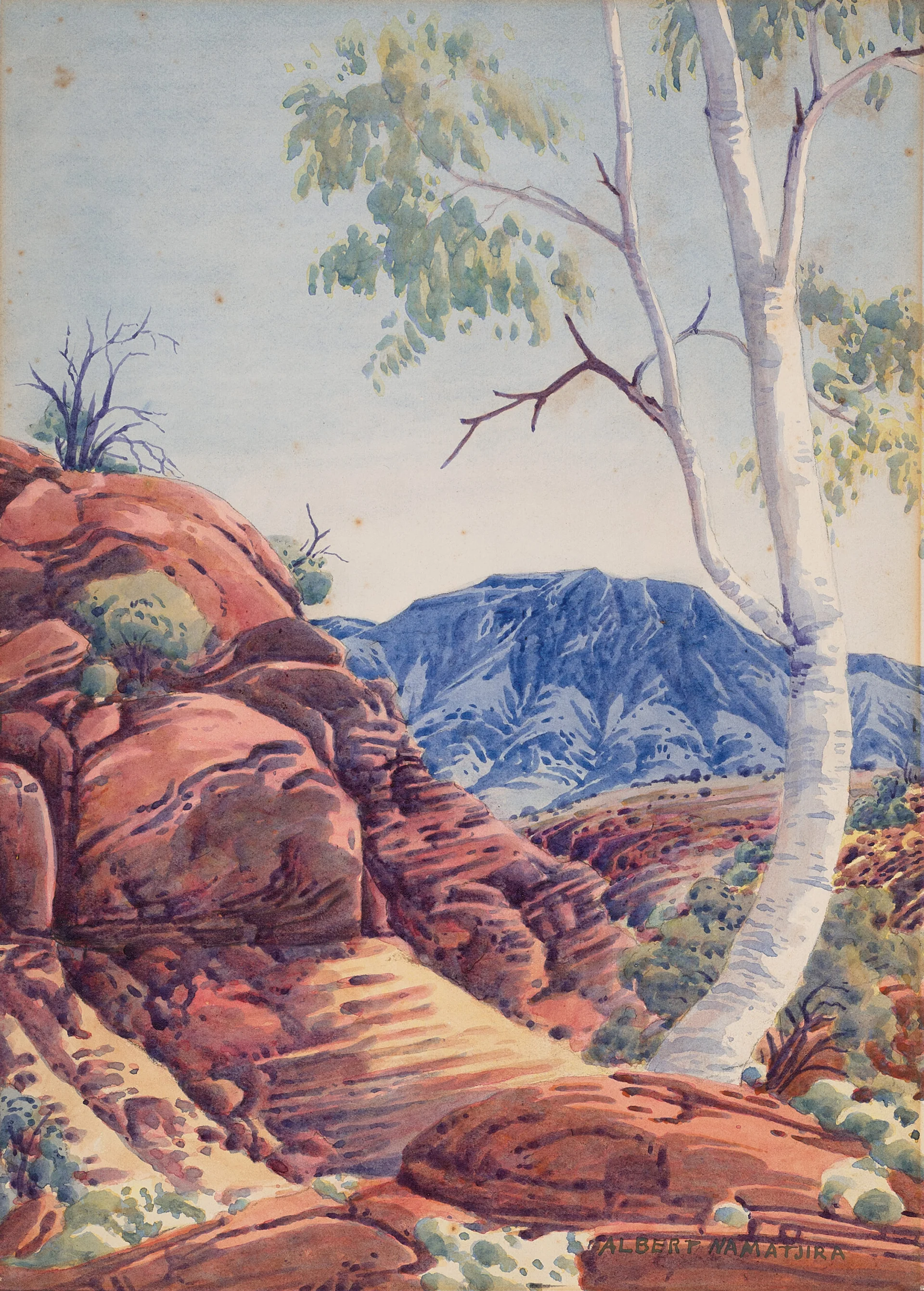
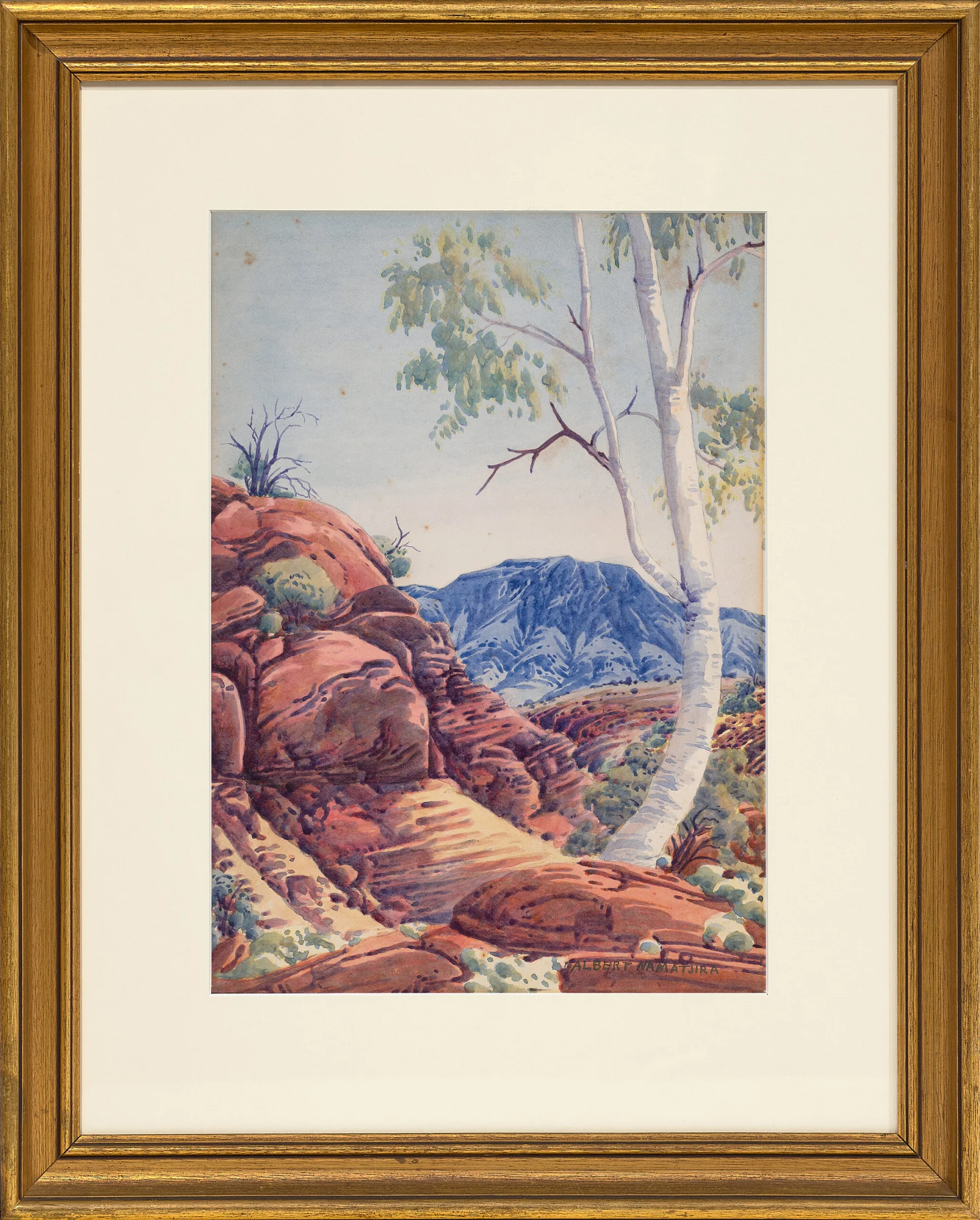
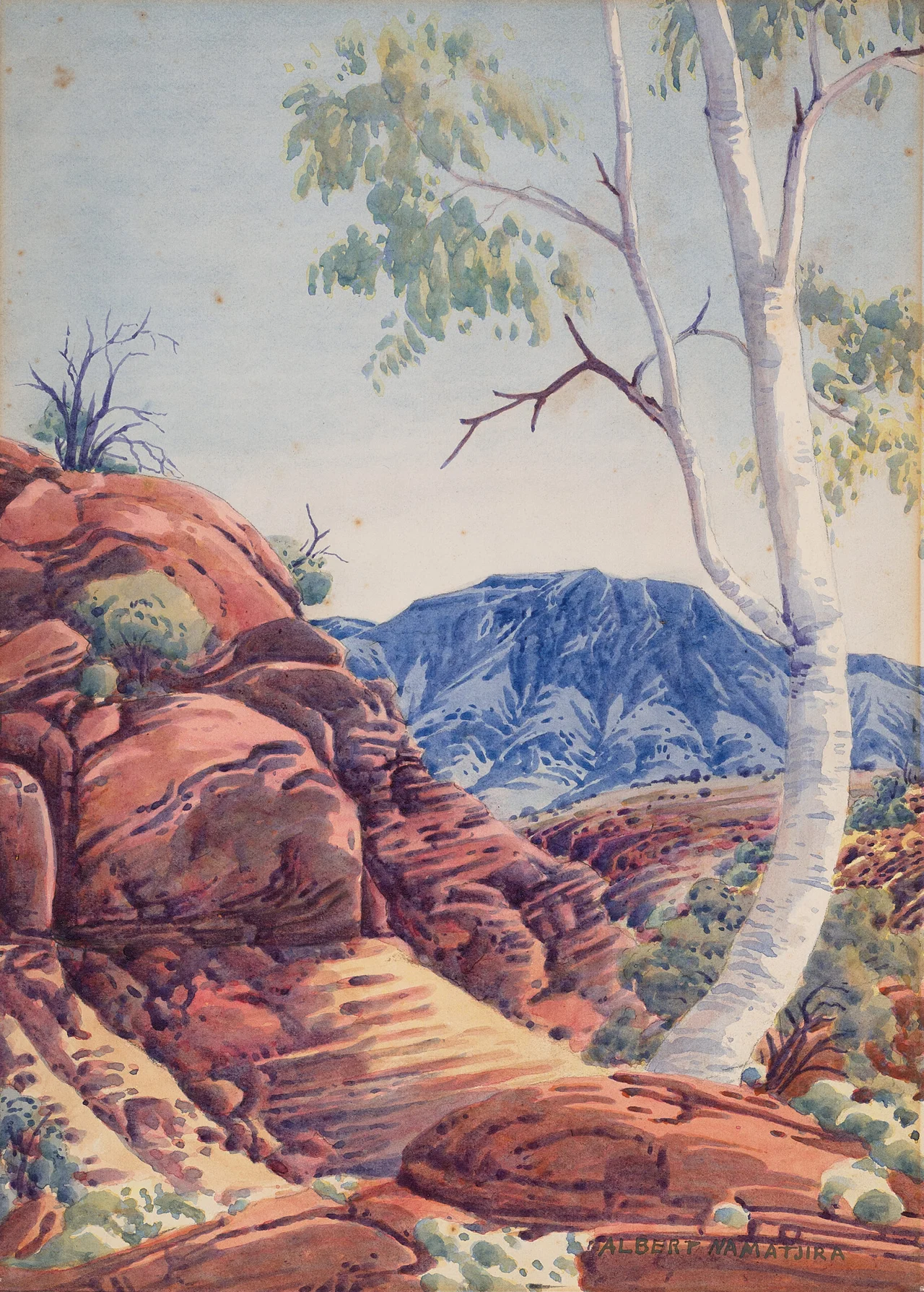
Ghost Gum, c.1950
watercolour on paper
36.5 x 26.0 cm (sheet)
signed lower right: ALBERT NAMATJIRA
bears inscription on partial label verso: to my dear Friends / […] Charles, & John / with love to all / from Agnes Baker
Estimate:
$40,000 - $60,000
Sold:
$51,545 (inc. BP)
© Namatjira Legacy Trust/Copyright Agency 2026
lot details
bears inscription on partial label verso: to my dear Friends / […] Charles, & John / with love to all / from Agnes Baker
Agnes Baker, New South Wales
Private collection, New South Wales, a gift from the above c.1950s
Thence by descent
John Evans, New South Wales
Thence by descent
Private collection, Queensland
Thence by descent
Private collection, Queensland
‘Space defines landscape, where space combined with memory defines place.’1
The visual lexicon employed by Albert Namatjira in his watercolours of central Australia encompassed distant views of hills and mountains, narrow valleys, sloping hillsides, rocky outcrops, monoliths, gorges and gaps, together with local foliage and fauna. Through the depiction of the physical characteristics of his ancestral lands, the connection between place and history comes together in Namatjira’s landscapes, where ‘sights are also sites.’2 It is in these renderings that Namatjira’s intimate familiarity with Country is evident, as ‘trees, peaks and monoliths provide a rich range of possibilities and responses that arise from constantly re-engaging with the same subject.’3 However, without doubt, the most recognisable and enduring motif of his practice is the iconic luminous white-trunked Ghost Gum (Eucalyptus papuana), known as ilwempe to the Western Arrernte.
Countless variations of the Ghost Gum appear in his work, sometimes rendered as the subject – a portrait of the grand eucalypt. These views, often in vertical format, record a closely observed, often cropped, and finely detailed rendering of the powerful, pock-marked trunk. Here the tree is anthropomorphised, often read as a sentient being ‘where twisted trunks become torsos and branches become arms while the bark functions like skin, folding and wrinkling due to external pressure from the elements.’4 In other views, the Ghost Gum provides the foundation for the pictorial organisation of the landscape. These views, mostly executed in a horizontal format, have the tree placed to either the left or right of the composition, anchoring the foreground and directing the viewer’s gaze to the distant blue peaks through the overhanging branches.
Painted in the last decade of Namatjira’s life and abounding with the artist’s most familiar imagery, the three watercolours offered here – Ghost Gum, c.1950, Mount Sonder at Glen Helen, and South Ranges, c.1958 – each celebrate the majestic Ghost Gum in its own distinctive manner. In Ghost Gum (lot 54), the tree, set to the right of the composition, acts as a counterbalance to the sloping rock formations on the left while the branches and foliage frame the distant blue hills. In Mount Sonder at Glen Helen (lot 55) and South Ranges (lot 56), the white gum of two or three trunks is set to the left of the picture and provides the key to the pictorial organisation. Dominating the foreground, it serves both to open and frame the picture plane. Viewed through the trunk and branches of the tree, the distant mountain range lies beyond small valleys populated with olive-foliaged trees with black trunks in the middle ground, each chronicled in harmonious red and purple tones. The distant vista contrasts strikingly with the luminous whiteness and solid strength of the Ghost Gum which is both the paintings’ focal point and the pointer to a far-off landscape. An incredibly hardy species, ‘the Ghost Gum features in Aboriginal creation stories where individual trees can be considered to represent ancestral beings.’5 Namatjira’s innovative and personal painting of the central Australian landscape was both a representation of landscape and a claim to his country. His landscapes can be read as memories of an ancestral site and, through the repeated return to this subject, a claim of ownership is subtly asserted. Gum trees and mountains feature prominently in Namatjira’s work, and the three paintings offered here are compelling examples of both these familiar motifs and the artist’s enduring statement of belonging.
1. Lucy Lippard, cited in French, F., Seeing the Centre: The Art of Albert Namatjira 1902 – 1959, National Gallery of Australia, Canberra, 2002, p. 95
2. French, ibid., p. 95
3. ibid., p. 97
4. ibid., p. 117
5. ibid., p. 121
CRISPIN GUTTERIDGE