
Important works from the Estate of Michael Gleeson-White AO, Sydney (Lots 24 – 37)
Jeffrey Smart
(1921 - 2013)
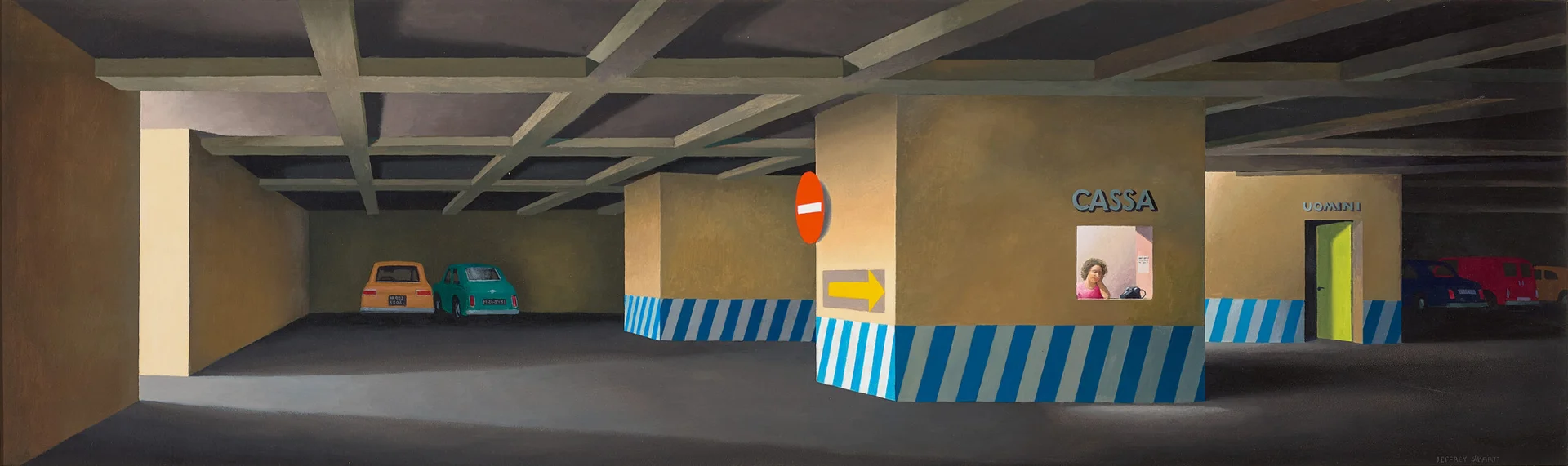
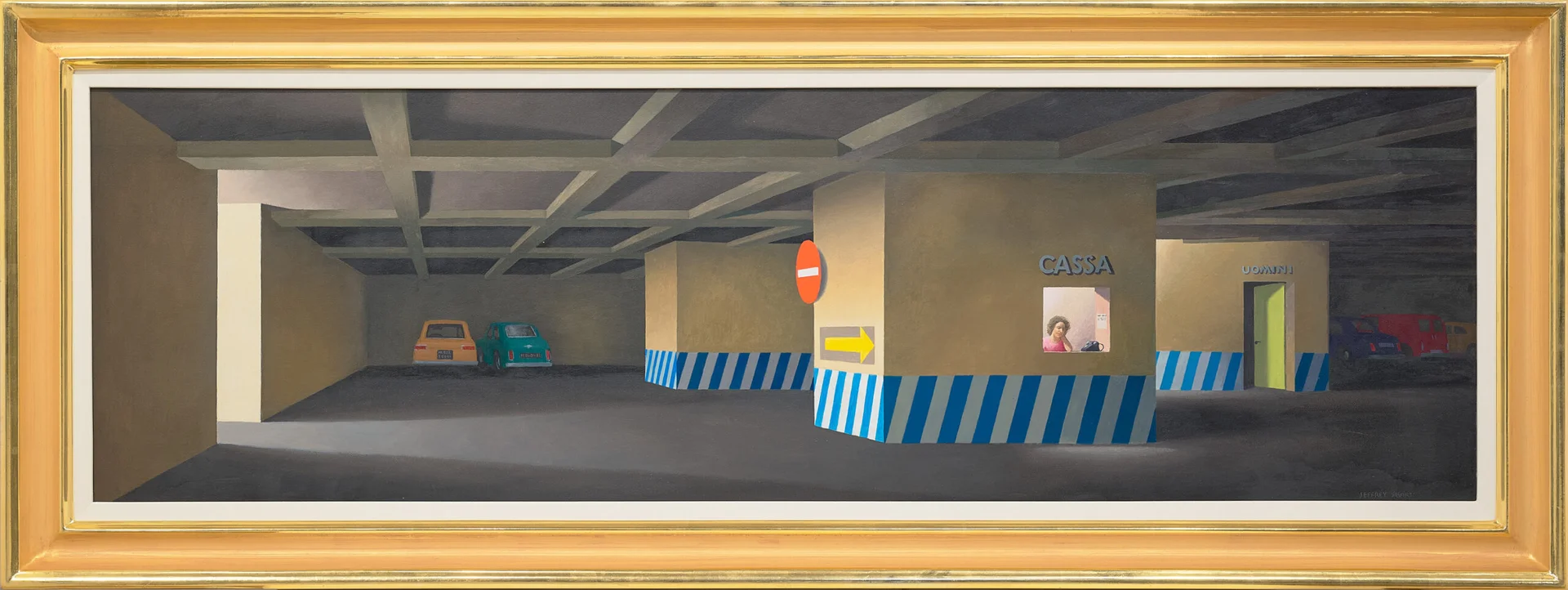
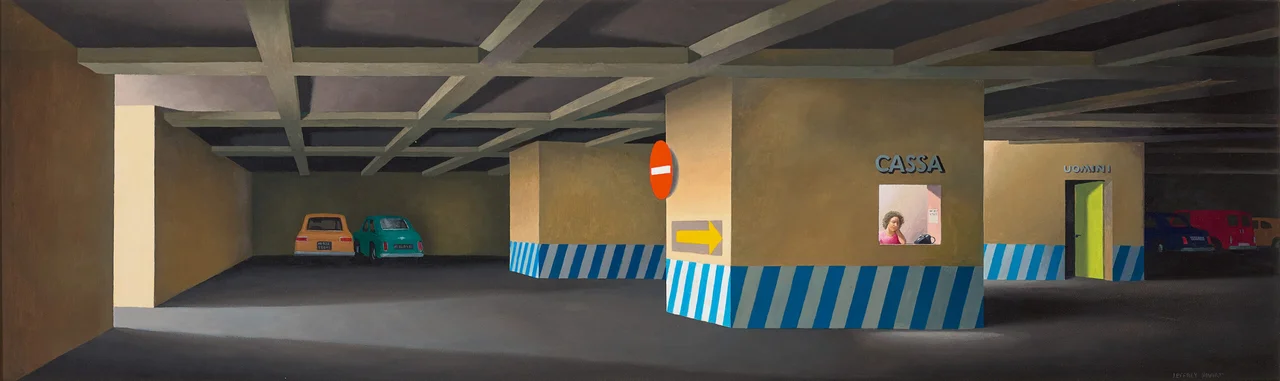
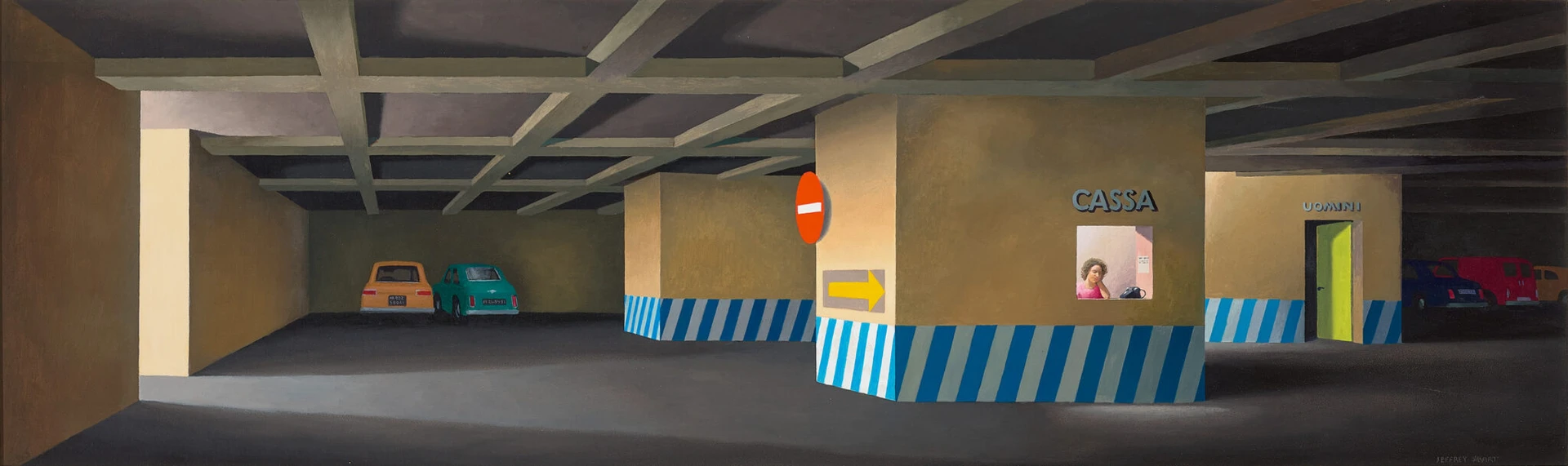
Municipal car park, 1983
synthetic polymer paint and oil on fibreglass canvas on composition board
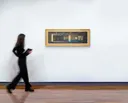
36.0 x 120.0 cm
signed lower right: Jeffrey Smart
bears inscription verso: 8
Estimate:
$300,000 - $400,000
Sold:
$582,955 (inc. BP)
© courtesy of The Estate of Jeffrey Smart 2026
lot details
bears inscription verso: 8
Rex Irwin Art Dealer, Sydney
Michael Gleeson-White AO, Sydney, acquired from the above in 1984
Company collection, Sydney, acquired from the above in 2000
Exhibited
Jeffrey Smart: Recent Paintings, Rex Irwin Art Dealer, Sydney, 6 – 24 November 1984, cat. 8
Literature
McDonald, J., Jeffrey Smart – Paintings of the ’70’s and ‘80s, Craftsman House, Sydney, 1990, no. 266, p. 160
We are grateful to Stephen Rogers, Archivist for the Estate of Jeffrey Smart, for his assistance with this catalogue entry.
Car parks are the ubiquitous non-places of our age. We might use one almost every day but never feel inclined to linger. They are strictly utilitarian spaces that few owners ever attempt to beautify – mostly bare concrete with the odd directional sign stencilled on walls and floors. The largest car park never seems to require more than one attendant, while some have none at all. They are grimy environments, reeking of spilled oil and exhaust fumes.
One marvels at the pleasure Jeffrey Smart took from painting these inhospitable spaces, which make regular appearances in his work. I was driving with him near Naples one day when he pulled over to take a photo and make a quick sketch of a car park that had caught his eye. This was the way Smart found many of his motifs, although they might be completely transformed in the way he chose to paint them.
Smart loved the challenge of taking a scene most of us would barely notice and imbuing it with a near-theatrical character. Municipal car park, 1983 with its deadpan, descriptive title, is a textbook example – a bare interior in which everything seems to be made of concrete, from the gridded ceiling to the yellow-tinted cashier’s booth in which a lonely worker is dozing, her head propped up on one hand. A splash of bright colour is provided by a yellow arrow, a red sign signifying ‘no entrance’, and bands of blue stripes intended to catch drivers’ attention. Neither can one ignore the lime green door to the men’s toilets, left ajar.
The bulk of the picture is as grey and dark as a cave, which is pretty much what it is – an urban cave for sleeping automobiles. But we should remember that a cave is a magical place. Whether we think of the cave in which Odysseus and his men encounter the Cyclops, the underground caverns in Jules Verne’s Journey to the Centre of the Earth, or the grotto in which Tom Sawyer finds hidden loot, to venture into a cave is to step into a realm of mystery.
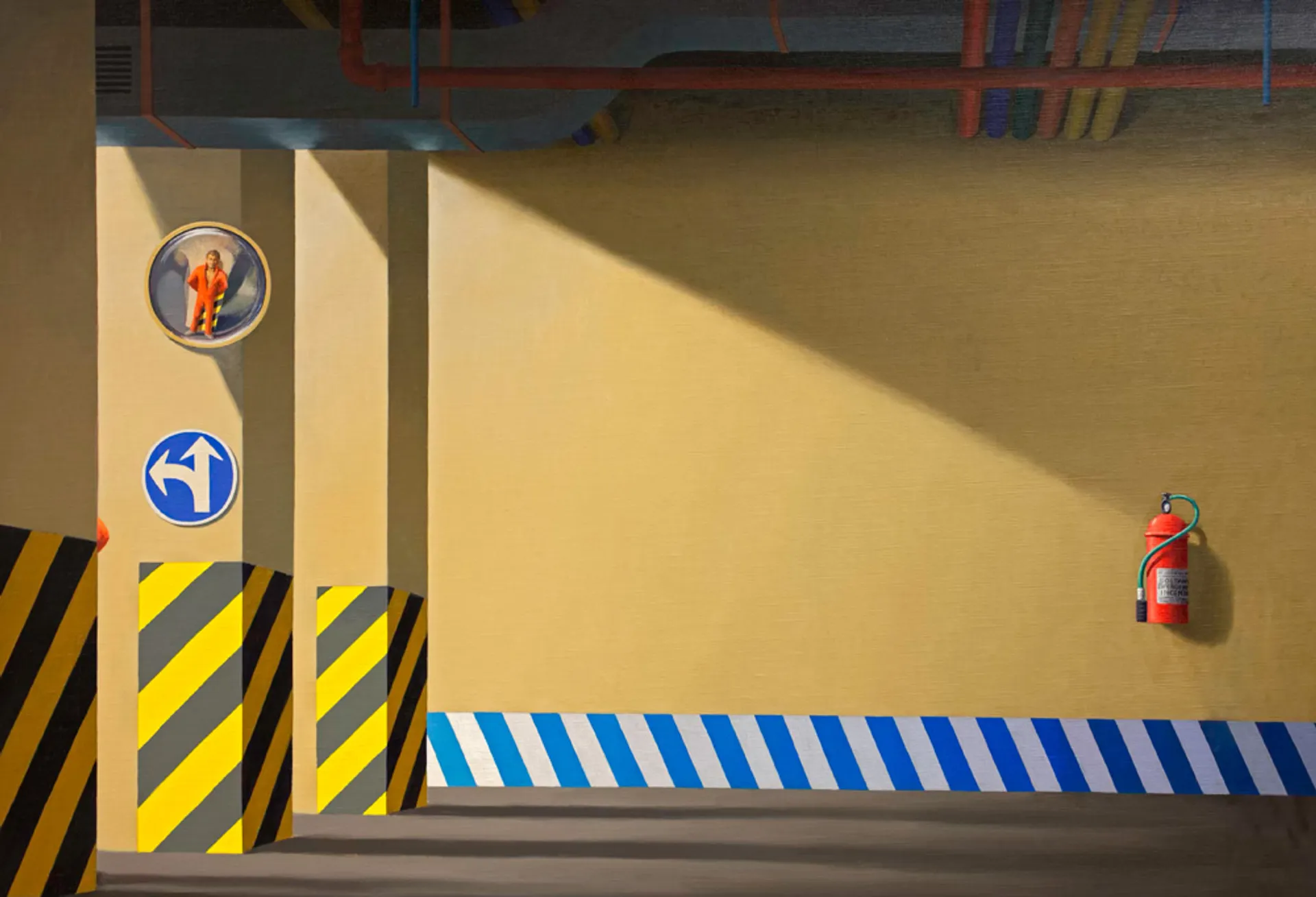
Can we say as much about Smart’s car park? The artist almost dares us to find anything attractive in this barren setting. Even by the standards of Smart’s other car parks, this one is forbiddingly minimal. A painting such as Morning Jogger in Parking Garage, Adelaide, 1987, seems baroque in comparison. Aside from glimpses of sky and city, it features a figure who looks directly at the viewer, drawing us imaginatively into the picture. It’s the antithesis of the sleeping cashier in Municipal car park.
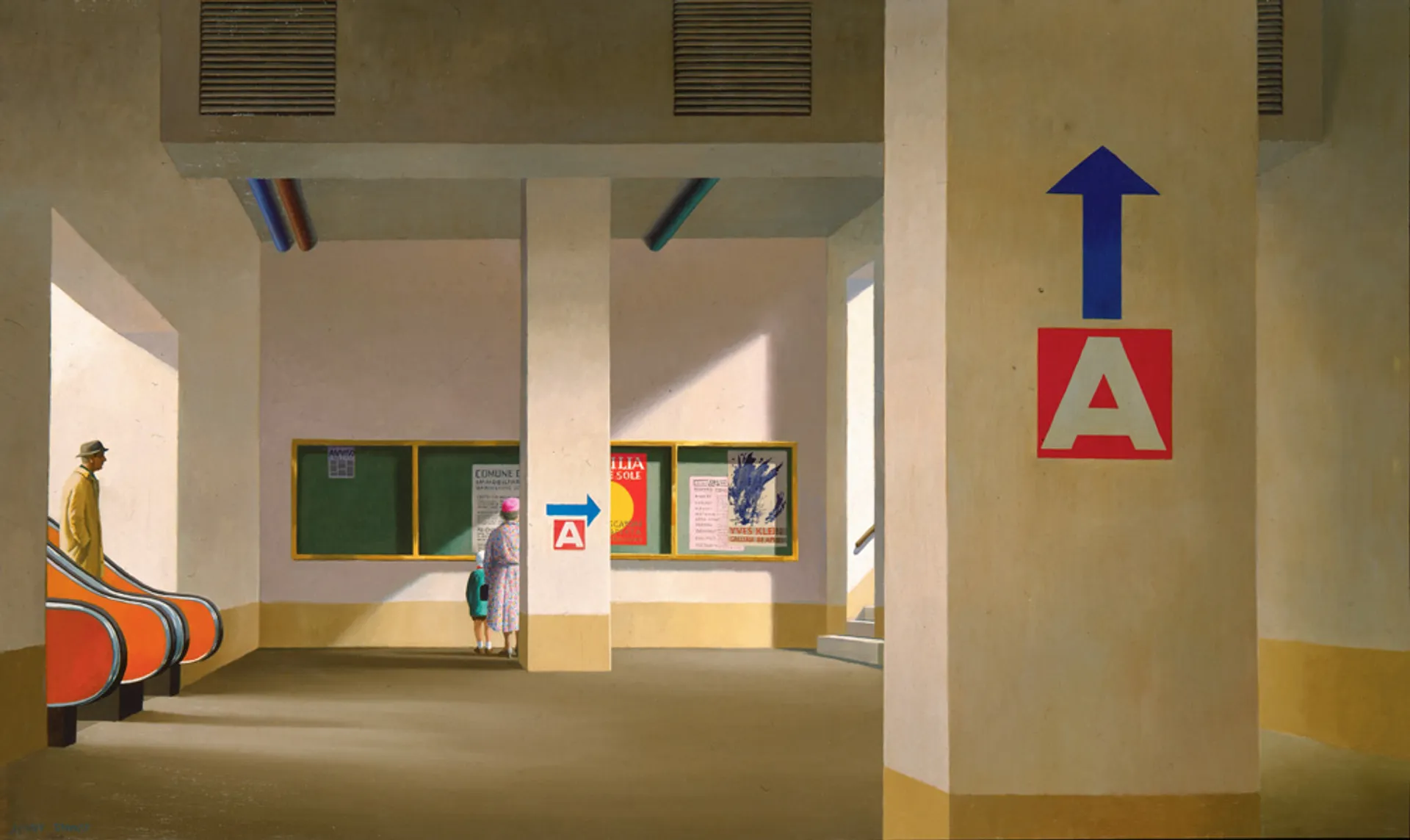
Smart made complex paintings of car parks in Florence and Pisa, and numerous other examples in which the settings have not been identified. One of the gloomiest is The Underground Car Park, 1993, which has no human presence whatsoever, the only pictorial drama deriving from a red van viewed against the far wall. One smiles, however, at the tubs of greenery placed at the base of the concrete pillars, as if this dismal bunker might be enlivened by the addition of a few nondescript plants.
As always with Smart, the geometric complexity of the composition makes Municipal car park more than a humdrum slice of life. Intensely aware that a successful painting requires a visual lure, not simply a clever idea, Smart has used a series of vertical planes to create a pictorial rhythm. From left to right, a dark, shadowy rectangle of wall gives way to a bright rectangle that reflects an exterior light. Traversing another area of shadow, we pick up the light as it strikes the two pillars facing the entrance. We finish with another squarish wall, illuminated by a fainter light, before concluding with an equivalent area of darkness.
The sequence is very much like a piece of music in which sombre chords and tones are interrupted by sudden highlights that gradually return to the original key. Given Smart’s lifelong love of music, this is not a far-fetched analogy. He understood that in art, as in music, it’s possible to generate an emotional response by the skilful manipulation of formal elements.
This is what we find in Municipal car park. An empty stage upon which nothing is happening creates a trap for the eye and mind, making us feel this space has its own cache of secrets. We might look for a key in the barely visible vehicles at the extreme right, the partially open door of the toilets, or the cashier’s phone, which may ring at any moment. Smart knew that the longer we look at anything, the more interesting it becomes, as we are prompted to contribute our own stories. The role of the artist is to create a structure that encourages us to slow down and investigate those endless possibilities that lie dormant in every detail.
JOHN McDONALD
Writer and editor of the site, ‘Everything the artworld doesn’t want you to know’, at Everythingthe.com