
Saplings, 1961

Important Australian + International Fine Art
Melbourne
26 August 2026
25

Fred Williams

(1927 - 1982)
Saplings, 1961

oil on composition board

121.0 x 83.5 cm

signed lower left: Fred Williams. 
bears inscription verso: 9 

Estimate: 
$180,000 – $240,000
Provenance

Rudy Komon Art Gallery, Sydney 
Michael Gleeson-White AO, Sydney, acquired from the above in 1962 
Estate of the above

Exhibited

Fred Williams, Rudy Komon Art Gallery, Sydney, opened 29 August 1962, cat. 9
Art from the Collections of the Trustees of the Art Gallery of New South Wales, Blaxland Gallery, Sydney, 14 – 29 October 1981, cat. 32 (label attached verso)

Catalogue text

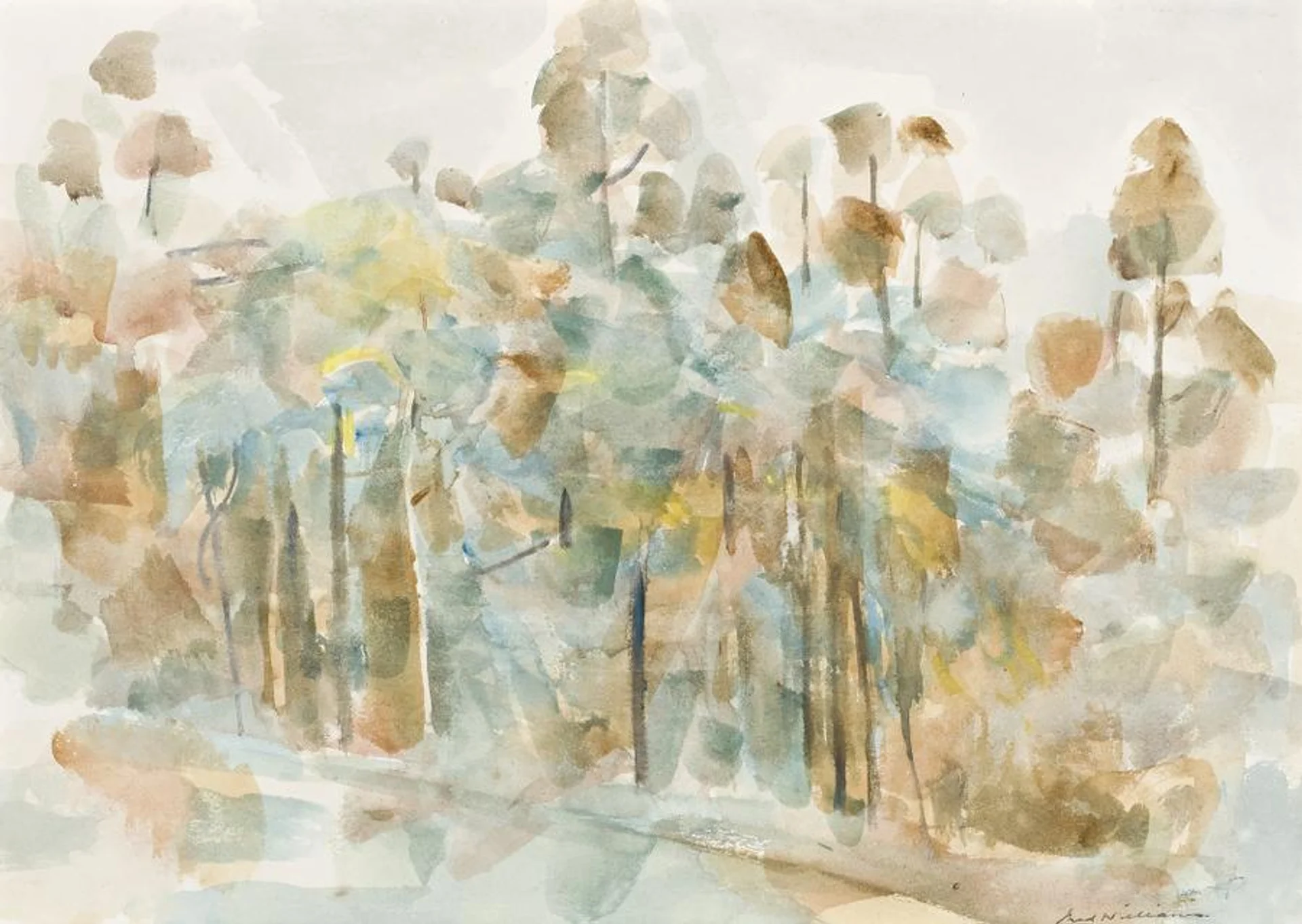
Saplings, 1961, belongs to a select group of early paintings by Fred Williams where he first successfully integrated the ideas of his great hero Paul Cézanne into a tangible reinterpretation of the Australian forest landscape. This group includes other significant paintings such as Landscape with steep road, 1958 (National Gallery of Australia) and The charcoal burner, 1959 (National Gallery of Victoria), in which Williams fragmented then reconstructed a view of the ‘not-very-distinguished-looking scrubby country [which was] known to everybody, but nobody had found the language with which to describe it.’1 Australia to that date had a long tradition of ‘painters of the bush’ from the Heidelberg School and its acolytes, through to the modernist breakthroughs of Clarice Beckett, Sidney Nolan and Arthur Boyd. Nonetheless, Williams was determined to bring his own concentrated study to the subject following a revelation in Fremantle as he was returning by ship to Melbourne in December 1956 after four years of study in London and was struck anew by the possibilities of the Australian light and expansiveness.

230235 Williams in Bush_cmyk (web).jpg


Fred Williams, Upwey, Victoria, 1963
photographer: David Moore
National Portrait Gallery, Canberra
© Lisa, Michael, Matthew and Joshua Moore

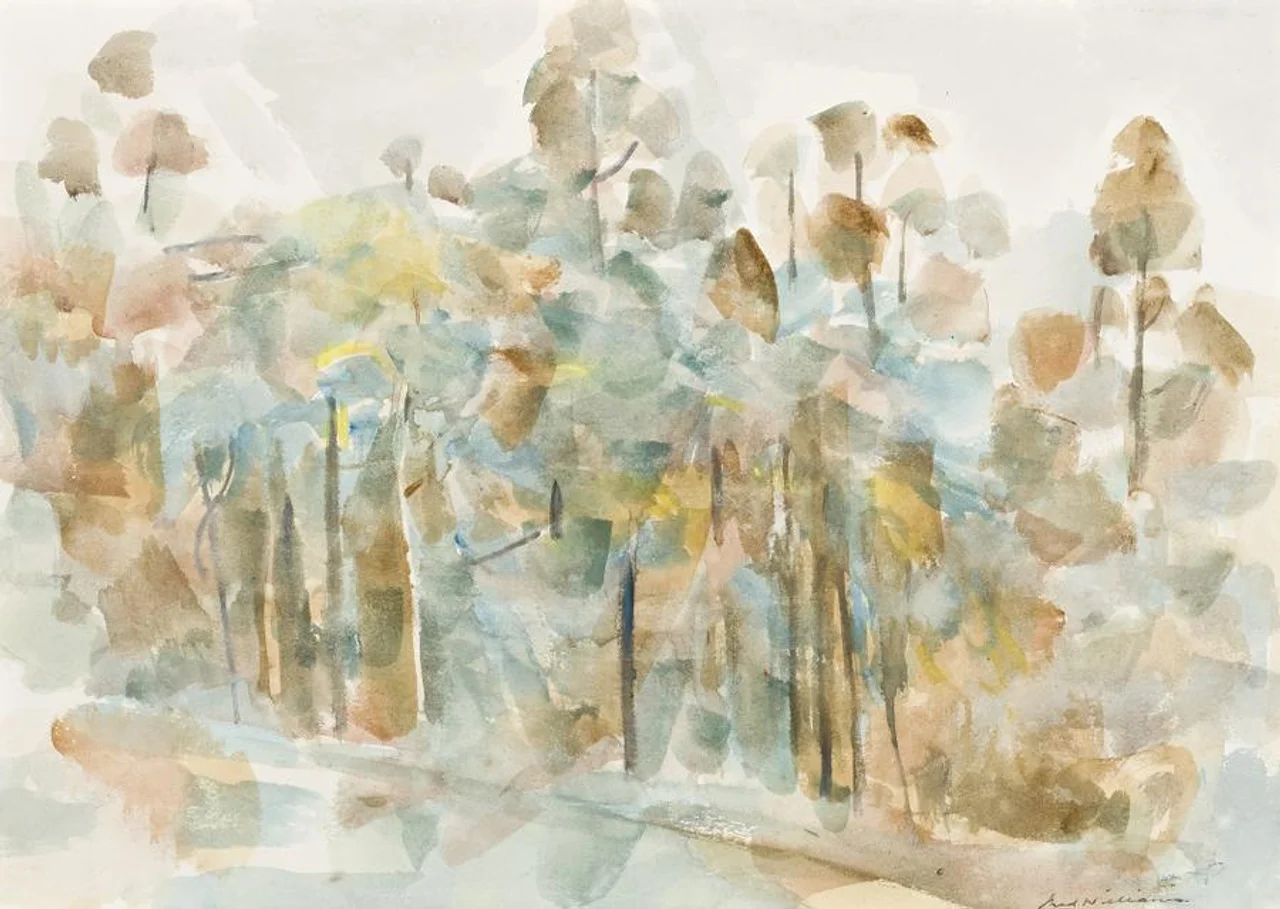
In Melbourne, he reconnected with former National Gallery School colleagues including John Brack who suggested that Williams visit his friends John and Joan Stephens who lived in Colo Vale, near Mittagong in New South Wales. Located on the traditional lands of the Gundungurra and Dharawal people, this is a region of eucalypt woodlands and open forests set amongst gullies and sandstone gorges cut through by the Nattai River. Williams arrived in August 1957, staying for a month and soon discovered that it was a ‘very romantic bit of country’, noting afterwards that ‘it was in Mittagong that I… formulated my ideas.’2 Such was his attraction that Williams returned again the following year, returning each time with a collection of images that marked a turning point in his career, ‘remarkable for their formal mastery and the originality of their vision.’3 He painted Saplings first as a gouache on site in 1958 and worked it into a larger painting three years later in his studio above his step-father’s hardware store in Exhibition Street, Melbourne. This became a common practice for Williams, bringing stand-alone studies back to the studio and putting them aside ‘for as long as possible… so that I am not emotionally involved.’4 He explained this desire to resist his original impulse as ‘a form of being more objective.’5 As with Cézanne and the Cubist painter Georges Braque, Williams recognised that a painting is not simply a replica of a landscape where an artist tries not ‘to reconstitute an anecdotal fact but [instead] constitute a pictorial fact.’6 The gouache version from 1958 is of a softer palette with a pronounced pink blush, whereas in Saplings, 1961, the tone is one of terracotta as if enduring an extended rainless spell. The brushwork too is more vigorous, particularly in the slope of the background gully wall, and he has added two imagined hilltops to the raised horizon line to increase the sense of distance. Additionally, Williams removes clouds and any cast shadows, causing the viewer to focus instead on the formal solidity of the trees and the undulation of their canopies set against the sharply angular lines of the surrounding terrain, a painterly strategy that was to preoccupy him throughout his subsequent career.
 
1. James Mollison, interviewed by Bala Starr, cited in Fred Williams: Pilbara series, Ian Potter Museum of Art, Melbourne, 2000, p. 5
2. Fred Williams, cited in Mollison, J., A singular vision: the art of Fred Williams, Australian National Gallery, Canberra, 1989, p. 36
3. McCaughey, P., Fred Williams 1927 – 1982, Murdoch Books, Sydney, 1984 (revised ed. 2008), p. 138
4. Fred Williams, recorded by Film Australia. c.1976, cited in Mollison, op. cit., p. 166
5. ibid.
6. Georges Braque, cited in McCaughey, op. cit., p. 114
 
ANDREW GAYNOR