Still Life with native rose, 1920
Margaret Preston
oil on cardboard
55.5 x 45.5 cm
signed and dated lower left: M.PRESTON / /20
Amy Beddome (née Byard), Adelaide
Elizabeth White (née Beddome), Adelaide
Samuel Paul Mortimer White, Adelaide
Thence by descent
Private collection, Adelaide
Margaret Preston: Art and Life, Art Gallery of New South Wales, Sydney, 29 July – 23 October 2005, then touring to: National Gallery of Victoria, Melbourne, 12 November 2005 – 29 January 2006; Queensland Art Gallery, Brisbane, 18 February – 7 May 2006; Art Gallery of South Australia, Adelaide, 26 May – 13 August 2006 (label attached verso)
Edwards, D., Peel, R. and Mimmocchi, D., Margaret Preston, Art Gallery of New South Wales, Sydney, 2005, pp. 63 (illus.), 66, 282
Margaret Preston Catalogue Raisonne of paintings, monotypes and ceramics, Art Gallery of New South Wales, Sydney, 2005, Cd–Rom compiled by Mimmocchi, D., with Edwards, D., and Peel, R.
Margaret Preston's talent was evident from an early age, and she received initial study from William Lister Lister whilst still a teenager. Born Margaret Rose MacPherson, she enrolled at Melbourne’s National Gallery’s School of Design in 1893 under Frederick McCubbin but returned briefly to Adelaide on her father’s death, before recommencing at the Gallery School, choosing painting under Bernard Hall and winning one year’s free tuition for a still life painting. Preston excelled under Hall and ‘was eventually elevated to work in the ‘number one’ studio among the most talented in her cohort, including Hugh Ramsay, Violet Teague and Max Meldrum.’1 On conclusion, she returned to Adelaide undertaking a short spell of further tuition before leasing a studio and teaching full time. In 1903, one of her students was Bessie Davidson to whom she became very close, travelling to Europe together the following year with Preston undertaking yet more study in Munich before moving on to Paris where the two attended an atelier libre associated with the renowned Académie Colarossi; she also had paintings selected for the New Salons of 1905 and 1906. Equally important to her increasing knowledge and skill was exposure to the first fauves exhibition in 1905 which allowed her to attain a technical understanding of artists such as Matisse, Derain and Vlaminck. On returning to Adelaide in late 1906, the two opened a studio school together, a student of which was Stella Bowen who later described Preston as being ‘a red-headed little fire-brand of a woman who was not only an excellent painter… but a most inspiring teacher.’2 Davidson returned to Paris in 1910 and by 1911, one local critic considered that Preston was ‘probably unequalled in Australia in the department of still lifes.’3 Unfortunately, such displays of support did not prevent the straight-talking artist from feeling increasingly constrained by the otherwise prevailing conservatism of Adelaide. Thus in 1912, she returned to Europe, this time in the company of her star student Gladys Reynell, where she reconnected with Davidson and her old friend Rupert Bunny, and again sought further tuition.
Preston’s continued search for new ideas and teachers has been described as ‘an opportunity to ‘fill the well’ and (thus) be able to return to her own work with refreshed eyes and enthusiasm.’4 Other new inspirations from these years included the decorative possibilities of Japanese prints and post-Impressionism, with Preston infusing her paintings further with defined rhythms and colour whilst simultaneously experimenting with the shallow space of modernism, all underscored by her prodigious intellect. The declaration of war compelled the women to relocate to London, a move which benefited Reynell who could now provide closer family support to her three serving brothers, one of whom, Carew, died at Gallipoli. Preston exhibited regularly at the Royal Academy, New English Art Club and the Society of Women artists, and with Reynell, took two separate groups of women students to Ireland for artist camps. A new radiance entered her work using a palette of less saturated colour to depict still life and dining settings, both indoor and outdoor, arranged on boldly patterned geometric tablecloths with the blooms set in a variety of local and Asian ceramic containers. Her paintings began to gain serious attention with one, Anemones, 1916, aka The window, being hung ‘on the line’ at that year’s Royal Academy, attracting praise for its ‘sheer beauty of painting and colour’5, whilst her entry at the following year’s annual exhibition by the Society of Women Artists saw her Indoor still life acclaimed by the Sunday Times as ‘one of the best exhibits.’6 Preston and Reynell studied further in pottery and various forms of printmaking, two particular skills they subsequently took to the Seale-Hayne Neurological Military Hospital in Devon, where Rupert Reynell, Gladys’s elder brother, was a surgeon. On his invitation, they taught pottery and basket weaving to shell-shocked veterans and a short film made there poignantly captures Preston helping these damaged men unload a kiln.7
At the cessation of hostilities, it appears the two women began making plans to return to Adelaide together and open their own pottery, but another fate intervened – Preston had met the man who was to become her husband. This was William (Bill) Preston, a Second Lieutenant Gunner in the Field Artillery Brigades who had served on the Western Front. Recently demobbed, he was now heading back to Australia to take up the position as a manager for Dalton Brothers, a mercantile firm and importing agency. They left London together in 1919, travelling via North America en route to Australia. Reynell, who was already back in Adelaide and had established the pottery she named ‘Reynella’, did not take kindly to the news that the couple were to marry, leading to an awkward estrangement which affected their planned two-person exhibition in Adelaide. In short, neither attended the opening though the show was well received. Happily, the two women reconciled, and the Prestons were married at Christ Church, O’Halloran Hill, Adelaide. Gladys and May Reynell (Carew’s widow) were witnesses, and the reception was held at Reynella. Preston stayed with May prior to the ceremony and gave her daughter Lydia painting lessons, later recalling that her teacher was ‘great fun’ but also ‘had very colourful language for the time. My mother’s eyebrows used to shoot up when Margaret used the word ‘bloody.’’8 In thanks for her kindness, Preston gifted May with a still life – Flowers, 1917 (National Gallery of Australia) – depicting ‘bright red geraniums and mauve primulas in a little Chinese porcelain bowl.’9 Following a honeymoon on Norfolk and Lord Howe islands, the Prestons moved to Sydney taking up residence at ‘Glenorie’ in Musgrave Street, approximately fifty metres from the South Mosman Wharf.
Still life with native rose, 1920, dates from this first year in Sydney, likely painted in winter due to the leafless tree trunks visible through the window with the choppy waters of Sydney Harbour beyond. Due no doubt to the activities involved in setting up house in a new city, there are only four works by the artist from 1920 listed in her catalogue raisonné. Apart from native roses, this painting also features buttercups and (probably) pink stocks, and whilst the table setting and palette are similar to her British work, Preston was already responding to ‘regional nuances of colour and light… The striped awnings of earlier English paintings were raised to reveal the urban and harbour landscape’10, and indeed, one buttercup seems to be merging with the trees outside. The flowers are contained in a jug and a vase, and Preston again tilts the table’s angle, the bottom corner of which acts as a counterpoint for the pronounced diagonal of the blooms. Significantly, the painting is signed with her new married name, with the artist proclaiming emphatically that ‘(i)f my work would not stand, apart from the merit gained under my previous name as an artist, it would have to go. I did not want to be an artist with a name for past merits.’11 The strength of her European work was quickly noticed and the Art Gallery of New South Wales purchased two paintings – Nasturtiums, c.1916, and Summer, 1915 – within months of her arrival.
In Adelaide, Gladys Reynell caused her own scandal by marrying the family’s gardener in 1922 – the ex-serviceman, George Osbourne, who was ten years older and whose standing as a ‘servant’ was beneath her parents’ snobbish dignity. The couple quickly moved to Bendigo as a result and set up a new pottery there. A number of subsequent paintings by Preston feature ceramics made by her friend including the exceptional The pottery of Gladys Reynell, SA, 1922 (Kerry Stokes, Perth). These events provide some clue as to when Preston gifted the painting to Amy Beddome, née Byard, sister of May Byard who had married Carew Reynell. Beddome’s descendants believe that Still life with native rose was given ‘in return for a small favour’ and although the exact details are now lost, it is plausible that the act occurred during Preston’s wedding or Reynell’s two years later. It has stayed within the family ever since and is now offered for the first time at auction. Still life with native rose is a vital and significant painting by Preston who would be described soon after as being ‘a distinguished and original artist… with abundant vitality, unerring taste in selection, the intellectual gift of invention and an emotional colour sense which amounts to genius.’12
Significantly, Anemones, 1916 (private collection), which in 2024 achieved the highest price ever paid for the artist's work at auction13, likewise originated in the Reynell family as a gift from Preston to Gladys. Both works are the same size and it is fascinating to study the stylistic differences between the two, painted four years apart – especially given that, by the time she painted Still life with native rose, Preston was already one of this country’s most rigorously trained artists and would remain Australia’s most prominent and outspoken modernist painter for the next four decades. What is equally remarkable is that each of her paintings was a logical step from the one preceding as Preston sought methodically to solve technical and stylistic challenges usually utilising the still life motif which she saw as being akin to a laboratory table ‘on which aesthetic problems can be solved.’14
1. Harding, L., Margaret Preston: recipes for food and art, Miegunyah Press, Melbourne, 2016, p. 6
2. Stella Bowen, cited in Edwards, D., Peel, R. and Mimmocchi, D., Margaret Preston, Art Gallery of New South Wales, Sydney, 2005, p. 273
3. ‘South Australian Society of Arts annual exhibition’, Adelaide Advertiser, Adelaide, 6 April 1911, p. 9
4. Harding, op. cit., p. xiii
5. The Morning Post, London, cited in ‘Personal’, The Journal, Adelaide, 23 June 1916, p. 1
6. Rutter, F., ‘The Galleries: Society of Women Artists’, Sunday Times, London, March 1917 cited in Drayton, J., Edith Holmes: her life and work 1885 – 1964, Canterbury University Press, New Zealand, 1999, p. 45
7. War Neuroses, British Pathé, 1918, at: https://www.youtube.com/watch?v=HYW5WaJRkL4 (accessed 6 July 2026)
8. Butel, E., Margaret Preston, Imprint, Sydney, 1995 (1985 edition), p. 21
9. ibid.
10. Edwards, D. et al., op. cit., pp. 66, 68
11. Preston, M., ‘The artist who changed her name’, Woman’s Budget, Sydney, 16 December 1931, p. 5
12. Proctor, T., ‘An artist’s appreciation of Margaret Preston’, Art in Australia, Ure Smith, Sydney, 3rd series, no. 22, 1 December 1926 [Margaret Preston issue]
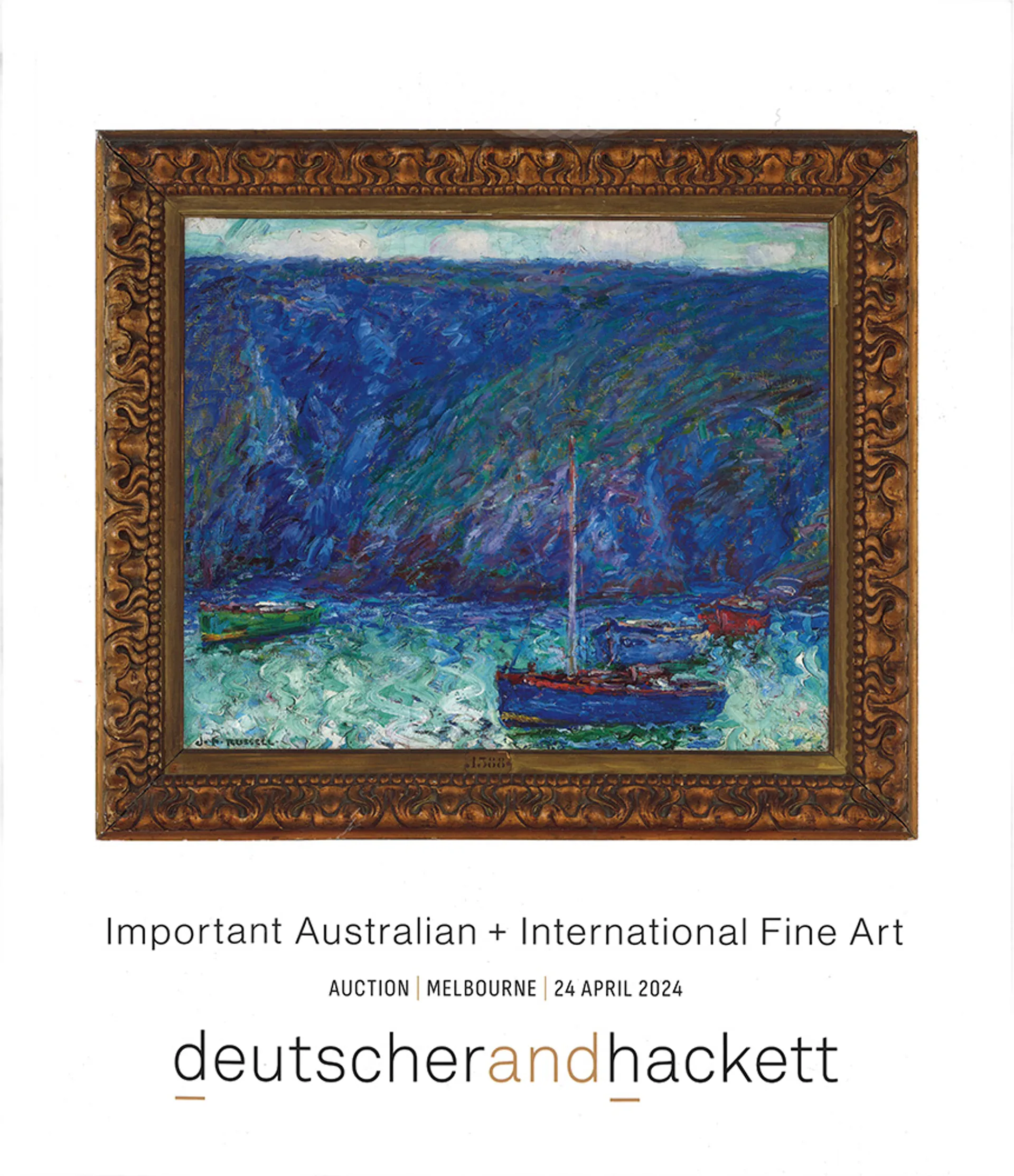
13. See Deutscher and Hackett, Important Australian and International Fine Art, 24 April 2024, lot 12
14. Preston, M., ‘Aphorism 46’, in Gellert, L., and Ure Smith, S., (eds.), Margaret Preston: recent paintings 1929, Art in Australia, Sydney, 1929, non-paginated
ANDREW GAYNOR