
Important works from the Estate of Michael Gleeson-White AO, Sydney (Lots 24 – 37)
Ivon Hitchens
(British, 1893 - 1979)
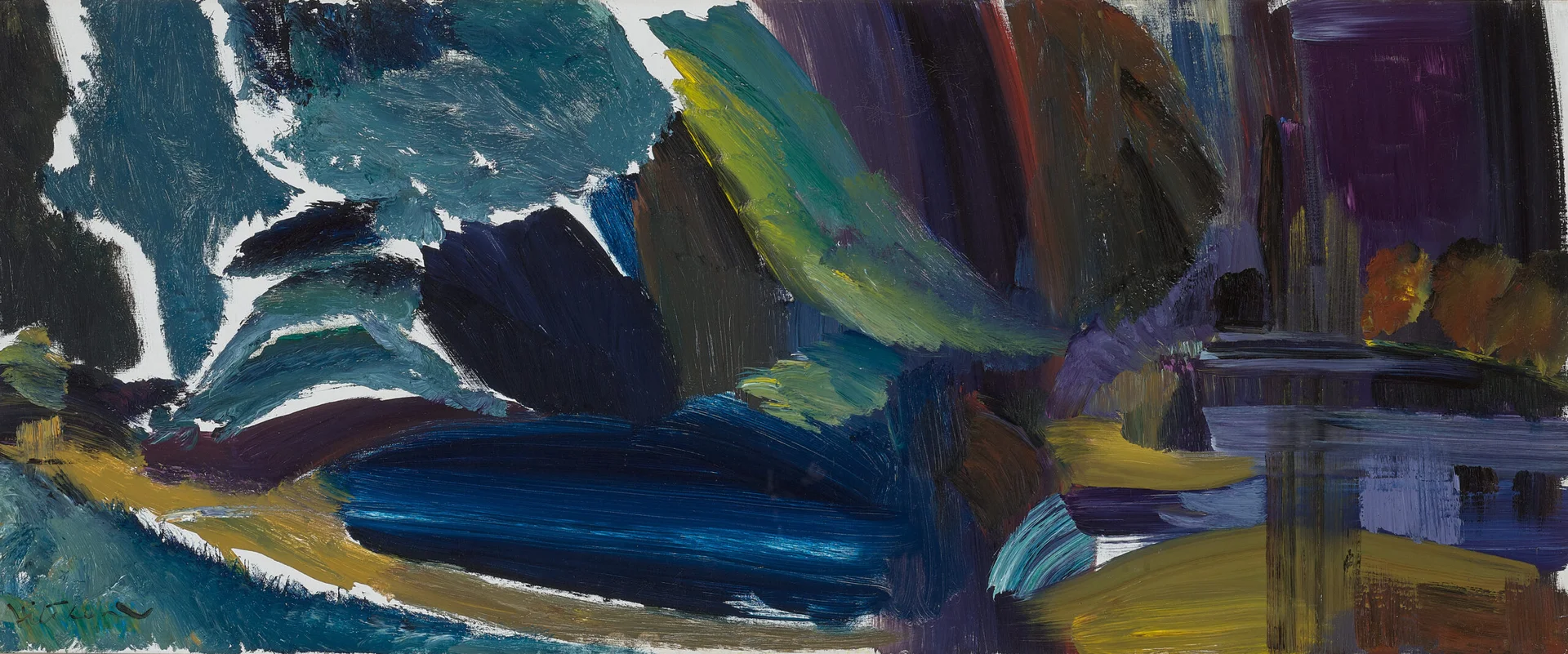
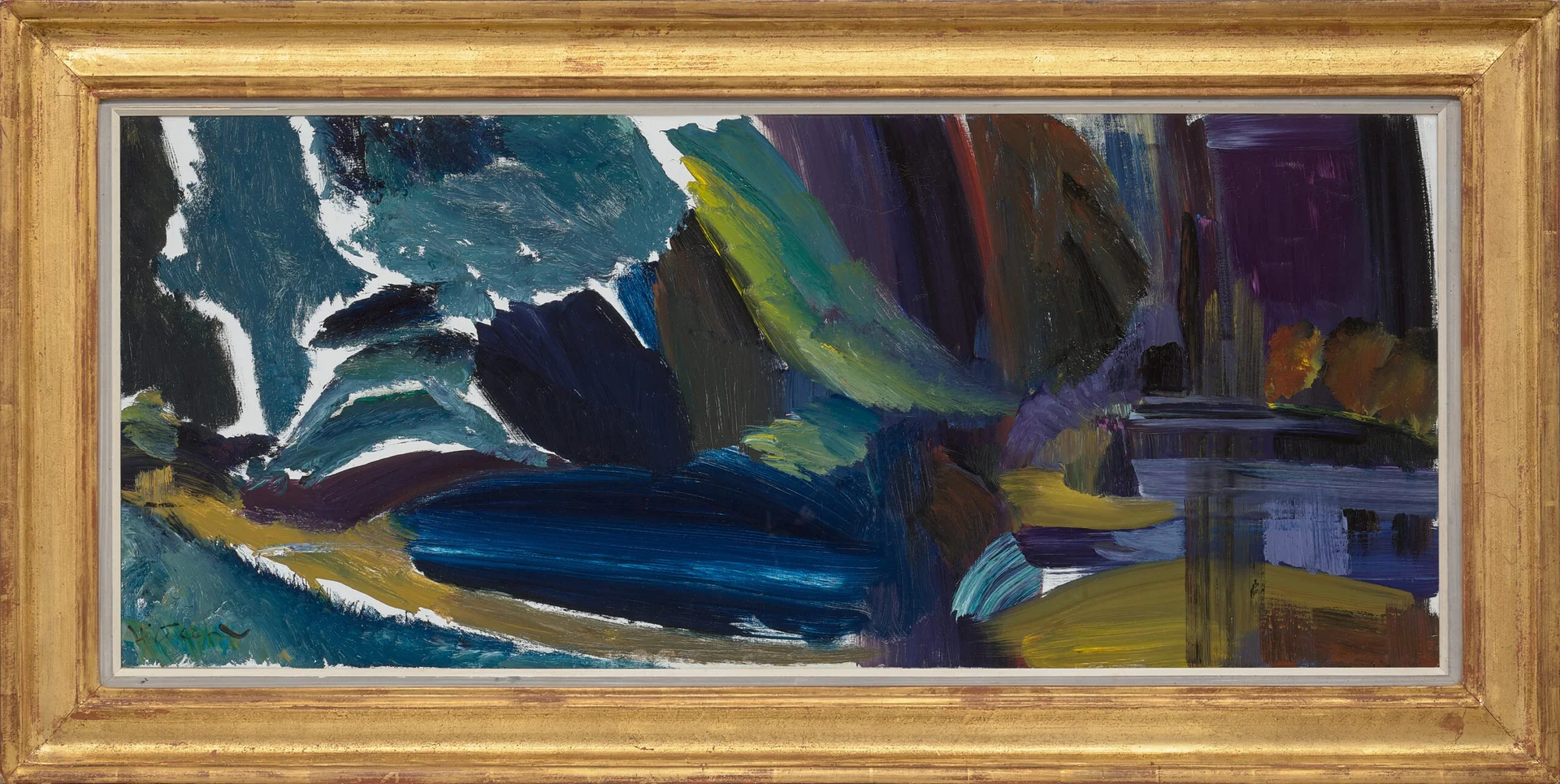
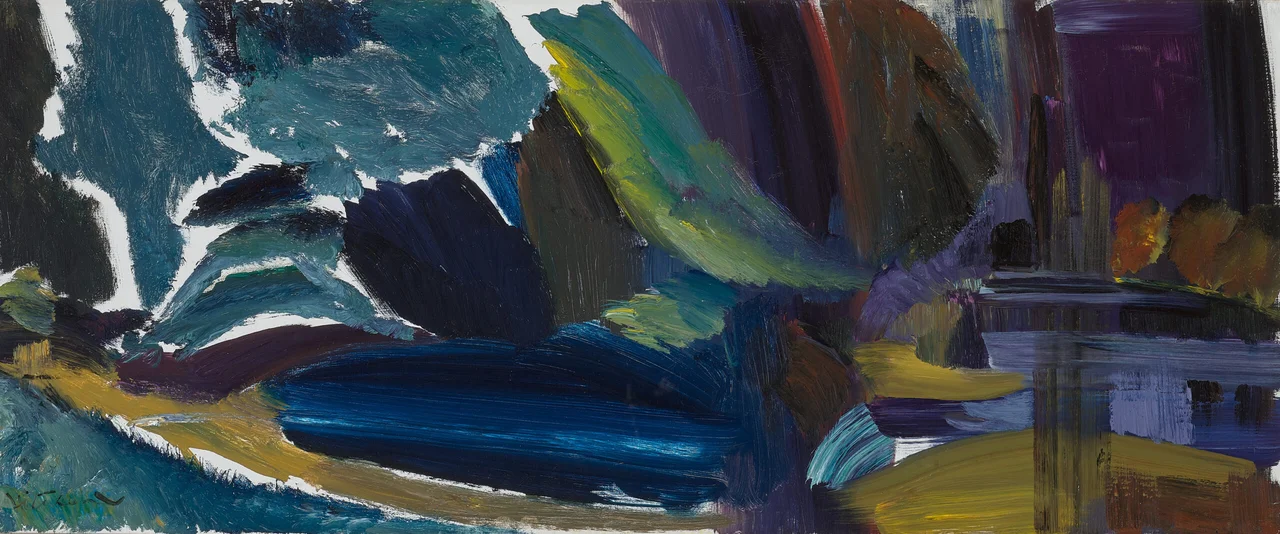
Warnford water, pool and dark distance, 1960
oil on canvas
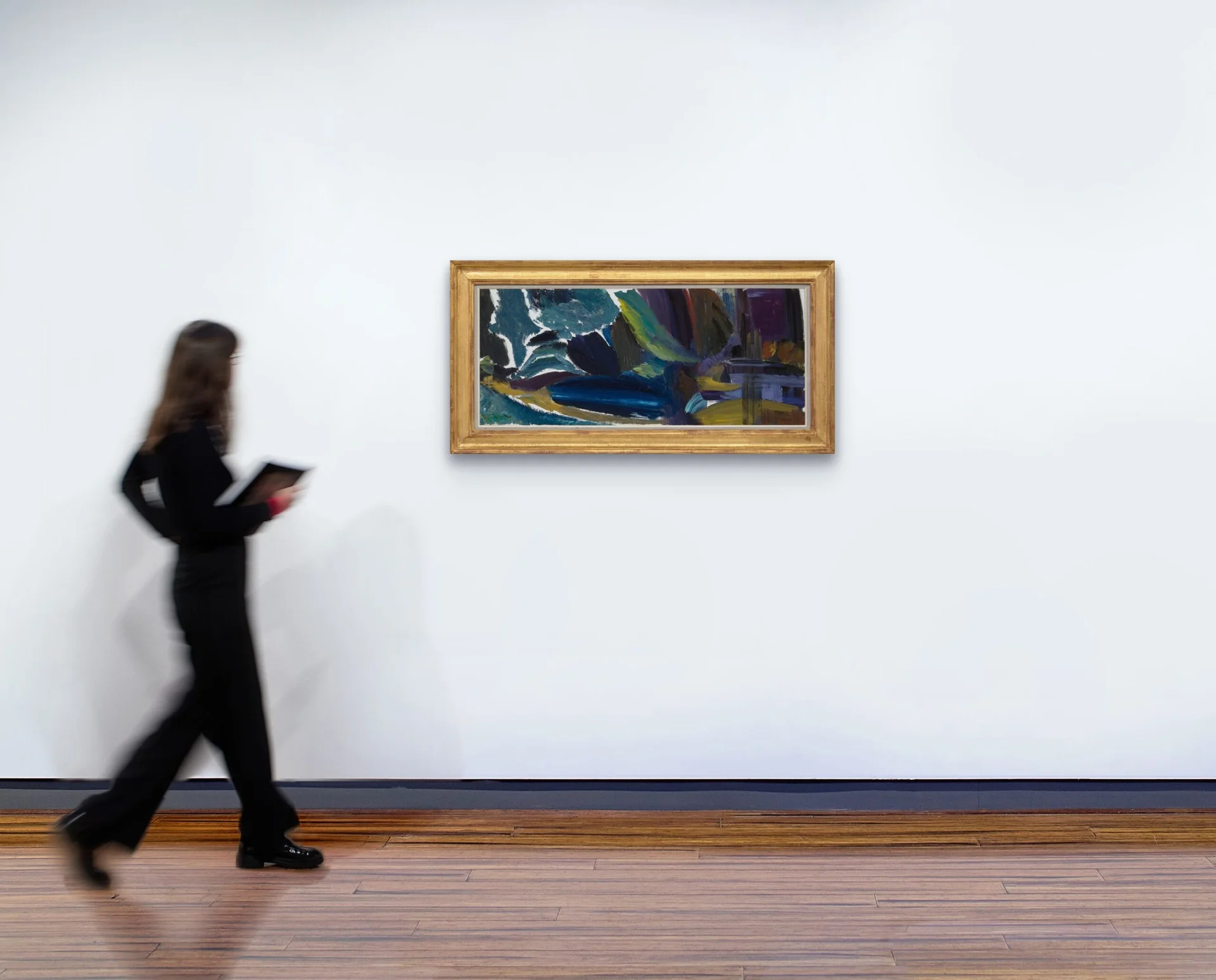
46.0 x 109.0 cm
signed lower left: Hitchens
inscribed on label verso: Warnford Water / Pool and dark distance / By Ivon Hitchens / Greenleaves / Petworth Sussex
bears inscription on label verso: The property of Compassion in World Farming / Copse House. Greatham. Liss Hants 1970/ Warnford Water, Pool + Dark Distance – 1960
Estimate:
$60,000 - $80,000
Sold:
$115,364 (inc. BP)
© The estate of Ivon Hitchens
lot details
inscribed on label verso: Warnford Water / Pool and dark distance / By Ivon Hitchens / Greenleaves / Petworth Sussex
bears inscription on label verso: The property of Compassion in World Farming / Copse House. Greatham. Liss Hants 1970/ Warnford Water, Pool + Dark Distance – 1960
The Waddington Galleries, London
Howard Bliss, London
Compassion in World Farming, Hampshire, England, by 1970
New Art Gallery, London
Michael Gleeson-White AO, Sydney, acquired from the above in 1984
Estate of the above, Sydney
Exhibited
The Warnford Water Series and Five Other Paintings, The Waddington Galleries, London, June 1960, cat. 10 (as ‘Pool and Dark Distance’, illus. in exhibition catalogue)
Literature
Wallis, N., ‘At the Galleries: Lagoon and Forest’, The Observer, London, 5 June 1960, p. 17
Khoroche, P., Ivon Hitchens, André Deutsch Limited, London,1990, pl. 60, pp. 168 (illus.), 270
‘Landscape painting is no joke – so wearing on the nerves in England. The work itself is enough worry without the uncertainties of English weather.’1
For a good proportion of his long and celebrated career, British painter Ivon Hitchens drew creative inspiration from the same place – a small area of woodland on Lavington Common near Petworth in Sussex. Hitchens, his wife Mary (Mollie) and their young son, John, fled London during World War II after the artist’s Hampstead studio was bombed. They initially lived in a caravan, without electricity and running water, which was slowly augmented by a studio, and then a house. Over the next four decades, Greenleaves, as the property was known, gave rise to an extraordinary body of work that was international in outlook while remaining deeply embedded in the English landscape. Carting his painting supplies across the Common in a wheelbarrow, Hitchens worked en plein air in all weather, finding endless stimulus in the light, colour, sounds and changing seasons of an environment he knew so well.
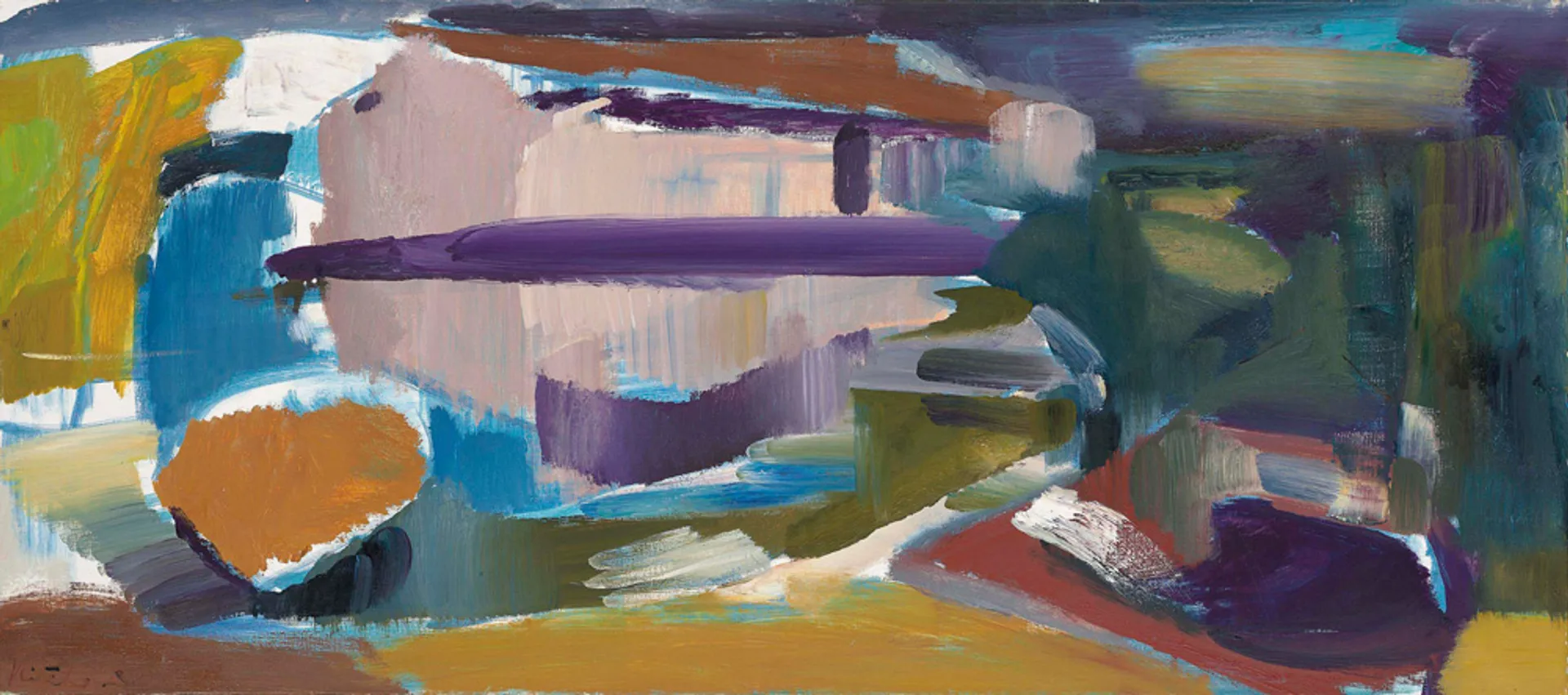
Hitchens commenced his art education at St John’s Wood School of Art, London, in 1911, followed by training at the Royal Academy Schools from 1912 – 16. After serving for two years in hospital supply during WWI, and being declared unfit for service in 1916, he returned to the RA Schools in 1918 – 19. After graduation, he became a founding member of the Seven and Five Society2, a conservative group which became decidedly pro-modernism after Ben Nicholson joined in 1924 and was followed by artists such as Henry Moore and Barbara Hepworth. Renamed the Seven and Five Abstract Group, they went on to hold the first entirely abstract exhibition in London in 1935. Importantly, as Peter Khoroche has noted, the Seven and Five offered a sense of solidarity without compromising Hitchens’ independence.3 Accordingly, the artist’s work was transformed during this time, as he strived to unlearn his formal academic training and discover his own distinctly modern voice. While being aware of the work of other young painters, and influenced, early in his career, by Cézanne, Braque and André Lhote, Hitchens was ‘apprehensive that he might be swamped, or thrown off his natural course, by artistic influences whose very attractiveness made them all the more dangerous.’4
Created after the artist’s international success as a representative of Britain at the Venice Biennale in 1956 – where he was invited to show twenty paintings – Warnford water, pool and dark distance, 1960, is Hitchens at his commanding best. In this majestic work, we see the artist assert himself over his subject matter, using the landscape of Warnford Estate in the county of Hampshire – an area at ‘the westernmost point of Hitchens’ painting territory’5 – as a source of inspiration, full of visual and emotional power, rather than something to be depicted literally. Together, the artist’s sweeping brushstrokes and imaginative use of colour create both space and form, as the viewer is presented with a suggestion of the water’s edge and pool beyond – achieved, with incredible economy, by strong arcs of paint in a range of blues and greens. These are offset by the white spaces of the primed canvas, which allow the eye to settle and the painting itself to ‘breathe’. As Hitchens explained, ‘The white areas or lines of white canvas… are to provide channels isolating the areas of paint so that these can be felt relatively to each other in their shape, area, weight and meaning… The intention is that the spectator’s eye can travel along these areas from ‘floe to floe’, over the picture surface instead of being engulfed or drowned in a morass of paint representing or aping realism.’6 Hitchens’ trademark use of the elongated format of the horizontal double square also encourages the viewer’s eye to naturally range across the canvas from left to right.
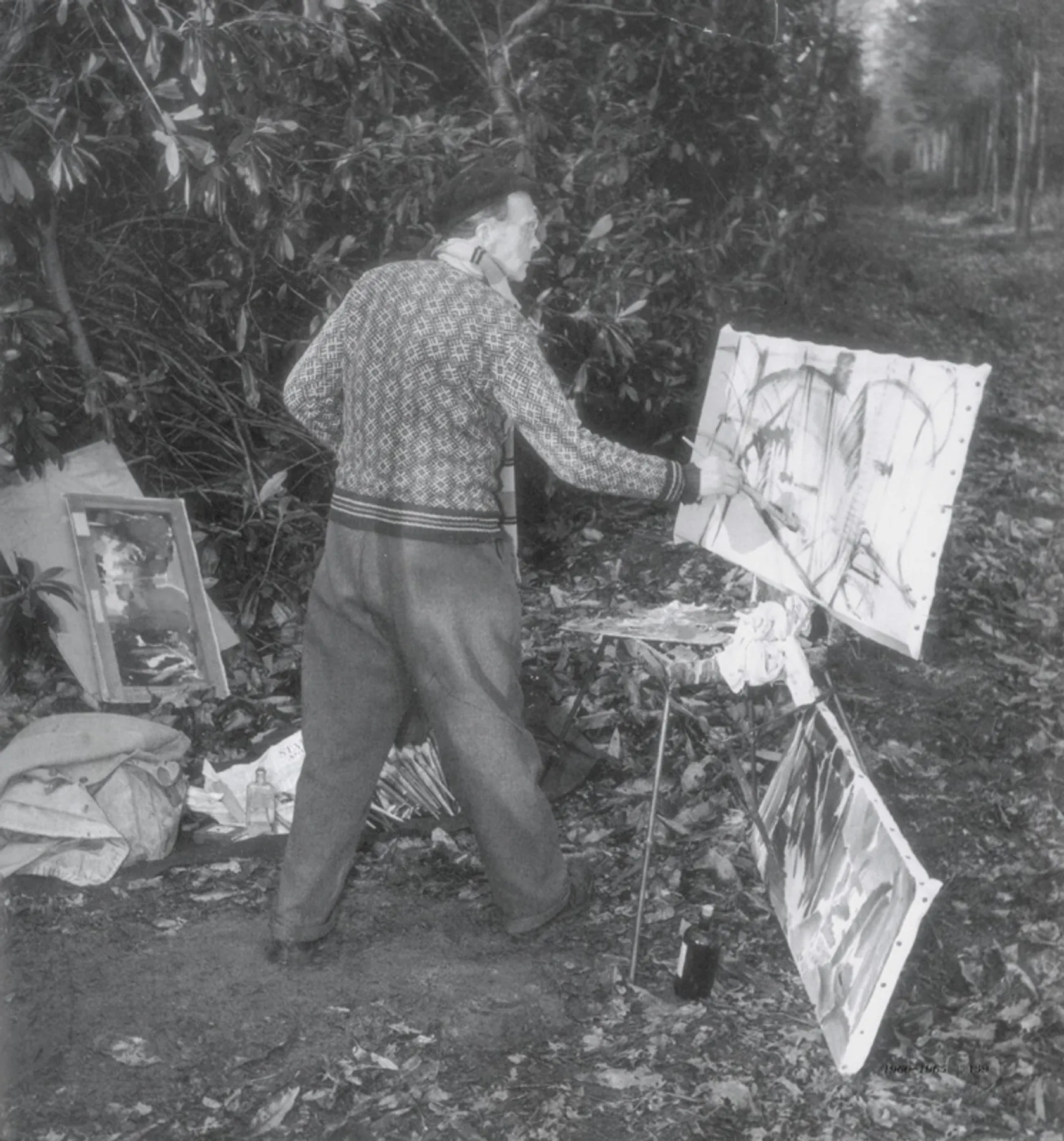
Music was vitally important to the artist, and his role in a work such as Warnford water, pool and dark distance is to act as a conductor, leading the way into and around his canvas: ‘My pictures are painted to be listened to’, he said. ‘I seek to recreate the truth of nature by making my own song (in paint)… I try to use notation of tones and colours so that the design flows from side to side, up-down, and in and out. I am not interested in representing the facts as such until this visual music had been created. But this creation must satisfy me as being true to life, though not naturalistically accurate.’7
1. Ivon Hitchens in a letter to his patron Howard Bliss, 7 November 1961, cited in Khoroche, P., Ivon Hitchens, new edition, Lund Humphries, Hampshire, 2007, p. 142
2. As the catalogue of the group’s first exhibition in 1920 stated, the Society was not formed ‘to advertise a new “ism” – [we] feel that there has of late been too much pioneering along too many lines in altogether too much of a hurry.’ See The Seven and Five Society, Tate, https://www.tate.org.uk/art/art-terms/s/seven-and-five-society (accessed 16 July 2026)
3. Khoroche, op. cit., p. 23
4. ibid., p. 27
5. ibid., p. 132
6. Hitchens was writing about his painting Divided Oak Tree No. 2, 1958, here, but it equally applies to Warnford Water, Pool and Dark Distance; see Khoroche, op. cit., p. 120
7. Hitchens, I., ‘Notes on Painting’, 7, pp. 51 – 52, cited in Benson, L., ‘Ivon Hitchens’, in Gott, T., Matthiesson, S. and Benson, L., Modern Britain 1900 – 1960: Masterworks from Australian and New Zealand Collections, National Gallery of Victoria, Melbourne, p. 261
KELLY GELLATLY