
William Robinson
(1936 - 2025)
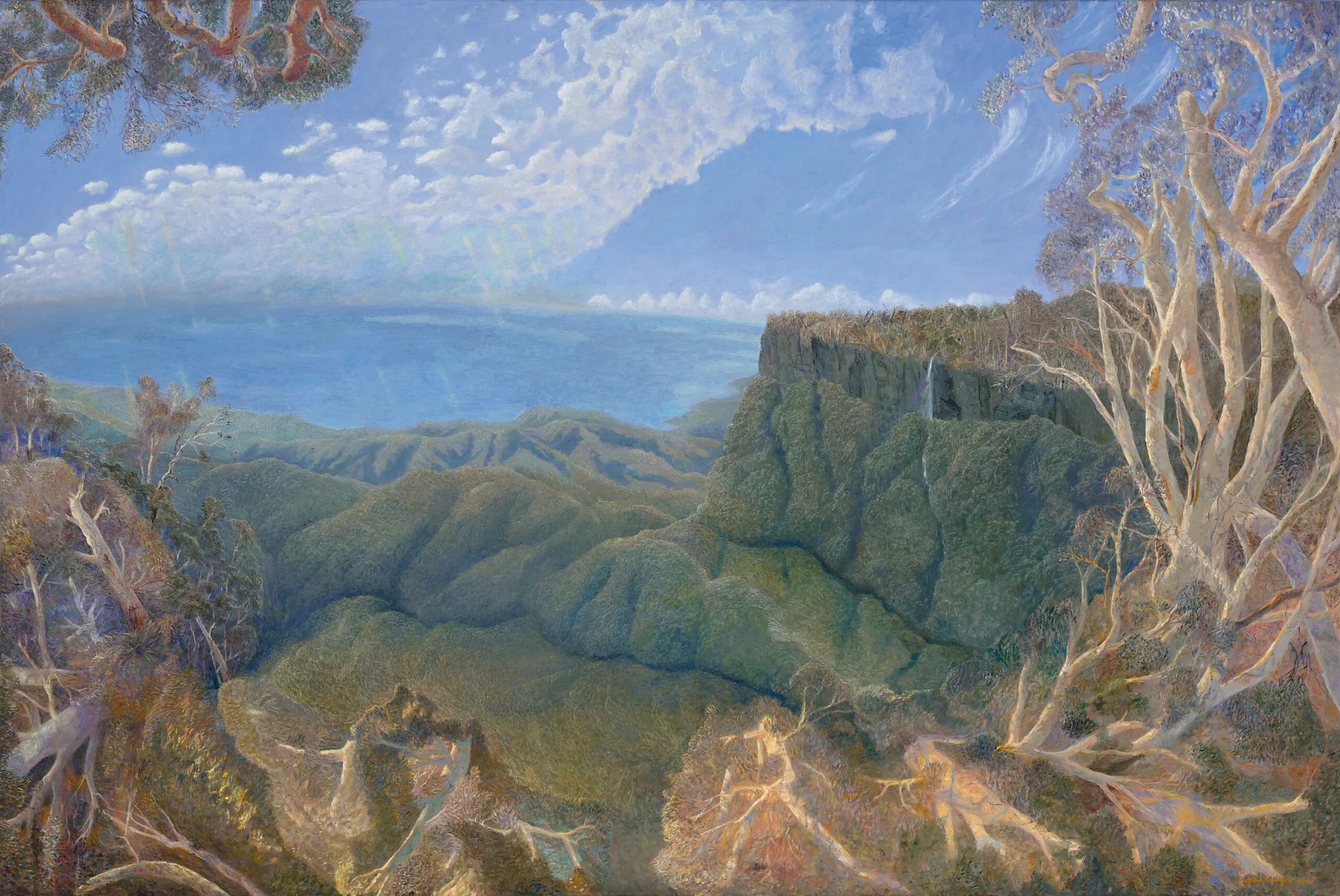
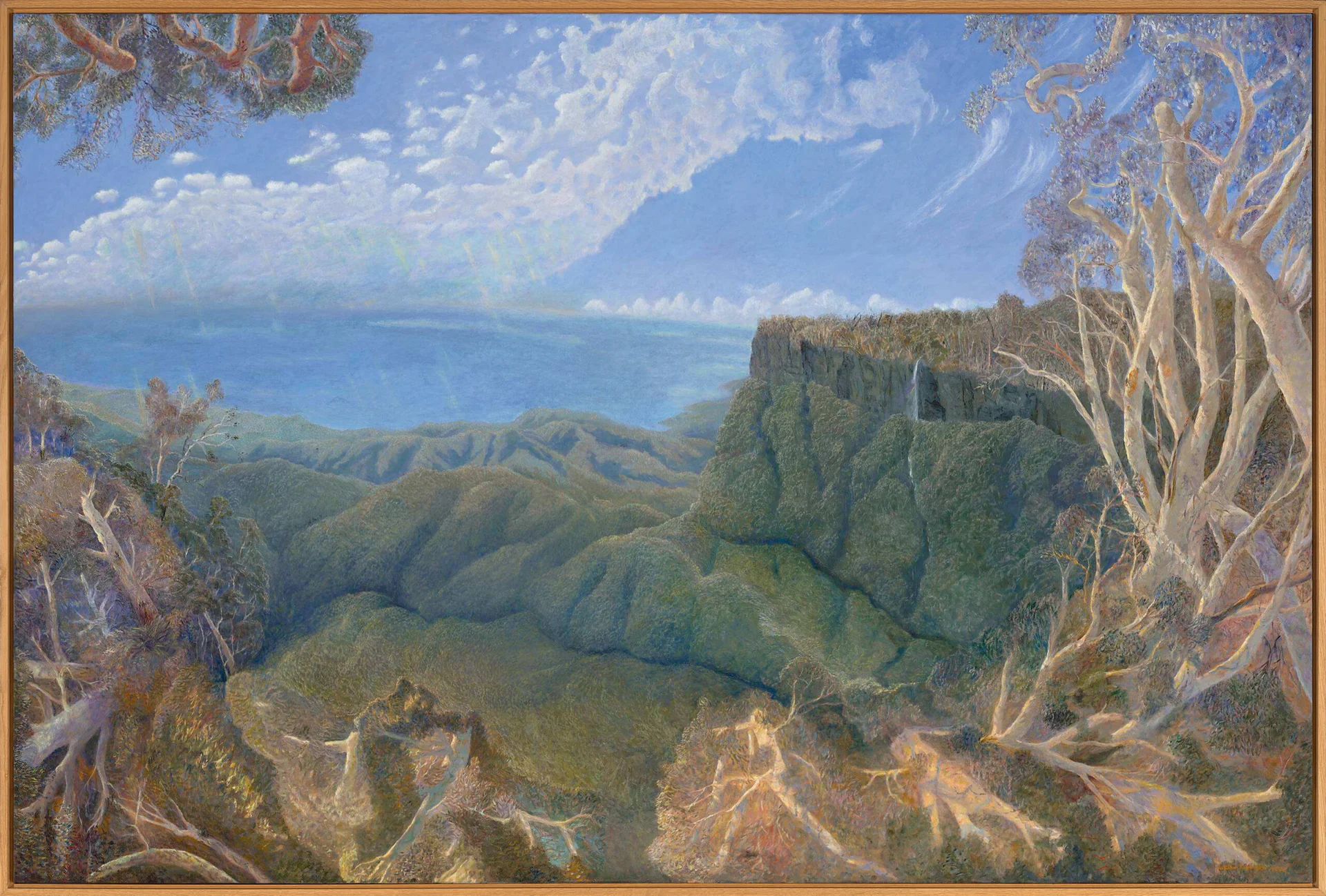
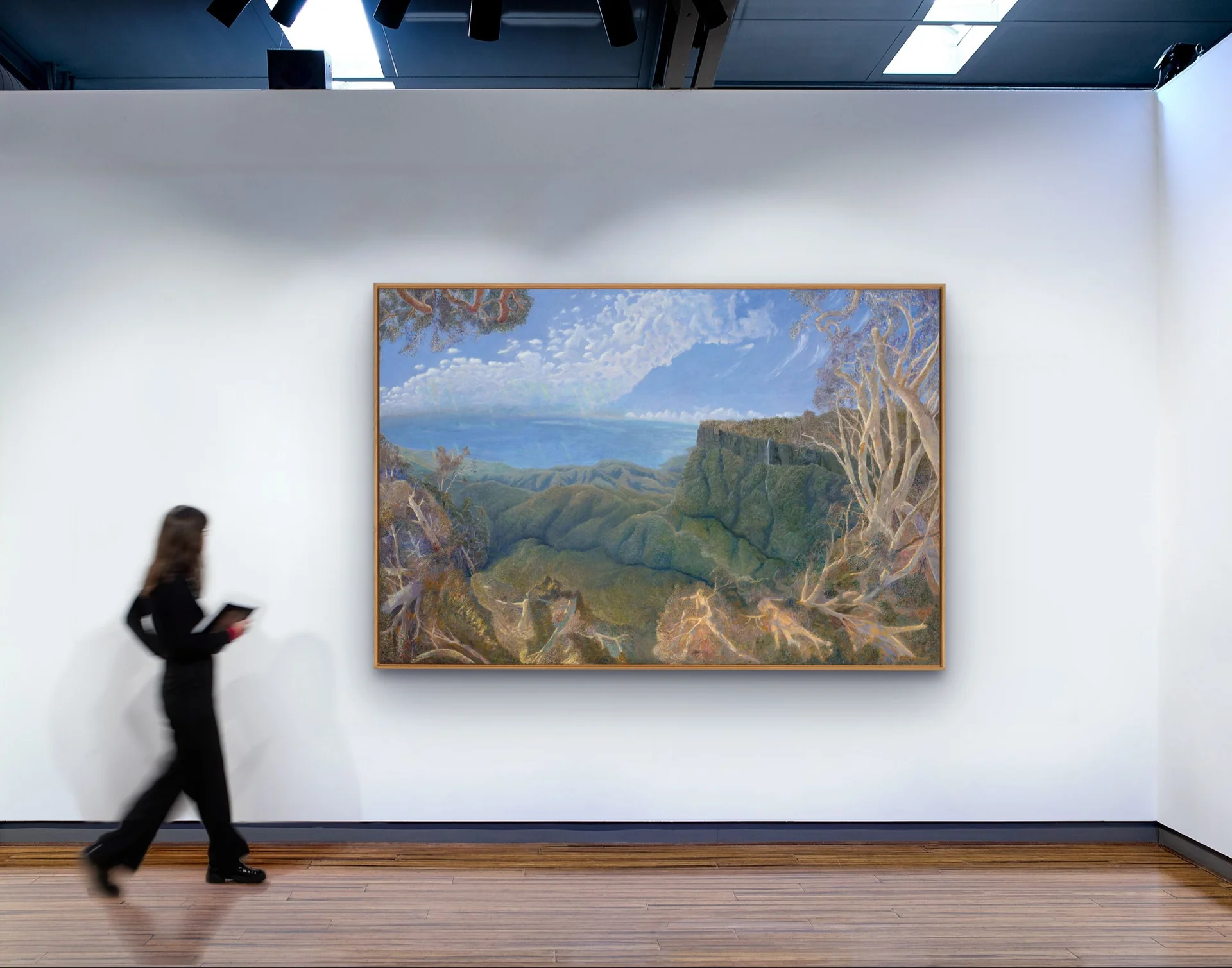
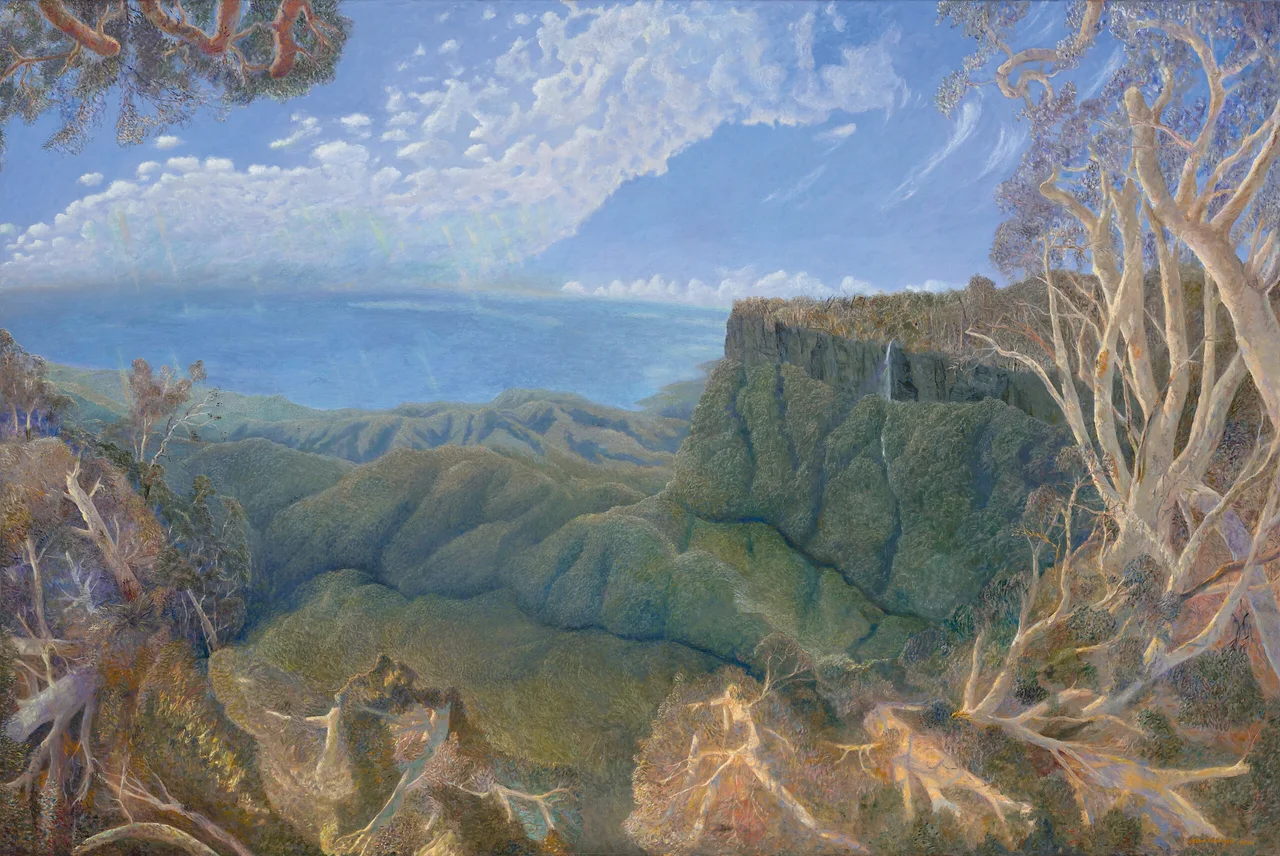
The bright sea, Springbrook, 2000
oil on Belgian linen
153.0 x 228.5 cm
signed and dated lower right: William Robinson 2000
bears inscription on gallery label verso: The Bright Sea / Springbrook
Estimate:
$250,000 - $350,000
© William Robinson
lot details
bears inscription on gallery label verso: The Bright Sea / Springbrook
Philip Bacon Galleries, Brisbane (label attached verso)
Private collection, Melbourne
Deutscher~Menzies, Sydney, 4 March 2003, lot 34
Feneley Fine Art Consultants, Sydney
Private collection, Canberra, acquired from the above in August 2004
Exhibited
William Robinson: Paintings and works on paper, Philip Bacon Galleries, Brisbane, 16 June – 24 July 2001, cat. 3 (illus. in exhibition catalogue, p. 10)
Literature
Klepac, L., William Robinson: Paintings 1987 – 2000, The Beagle Press, Sydney, 2001, pp. 172 (illus.), 203
‘…To see one of Robinson’s landscapes is to be in it as well, to walk, and maybe to forage, with the painter through gum-thicketed gullies where any difference between the sky and its reflection is hard to tell – and probably unnecessary to know. The viewer is required to take a leap of faith, and execute something akin to a cartwheel, before penetrating Robinson’s dizzy realms. The resulting experience is partly aesthetic, partly athletic…’1
With its multiple viewpoints and sweeping panorama of earth, sea and sky, The bright sea, Springbrook, 2000 offers a magnificent example of the highly original landscapes for which William Robinson became so widely acclaimed and admired. Departing from predecessors such as Streeton, Drysdale and Williams who focused their attention either inland or on more urban landscapes, Robinson was unique in his devotion to an environment hitherto neglected by artists – the ancient, labyrinthine rainforests of his immediate surroundings in the coastal hinterland of southern Queensland and northern New South Wales. Similarly, where the Australian landscape tradition had been characterised by a strong horizontality, Robinson deliberately eschewed established figure-ground relationships and conventional one-point perspective to transform landscape into a multi-view experience – allowing every fold and fissure to be explored yet still preserving a sense of panoramic continuity.
William Robinson
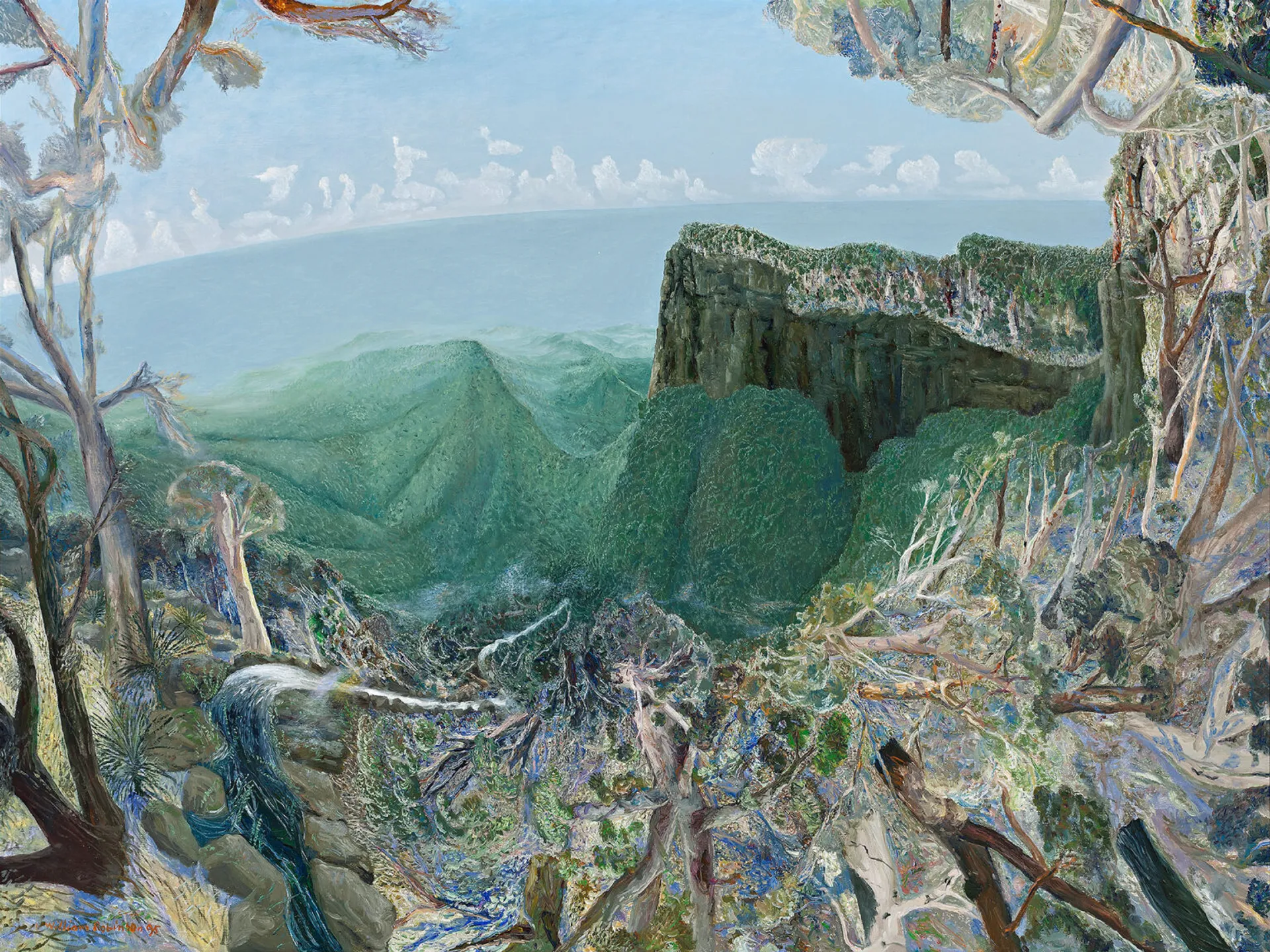
Towards the sea, from Springbrook, 1995
oil on linen
137.5 x 183.0 cm
Private collection
Sold Deutscher and Hackett, 27 November 2019, lot 8, for $248,400 (inc. BP + GST)
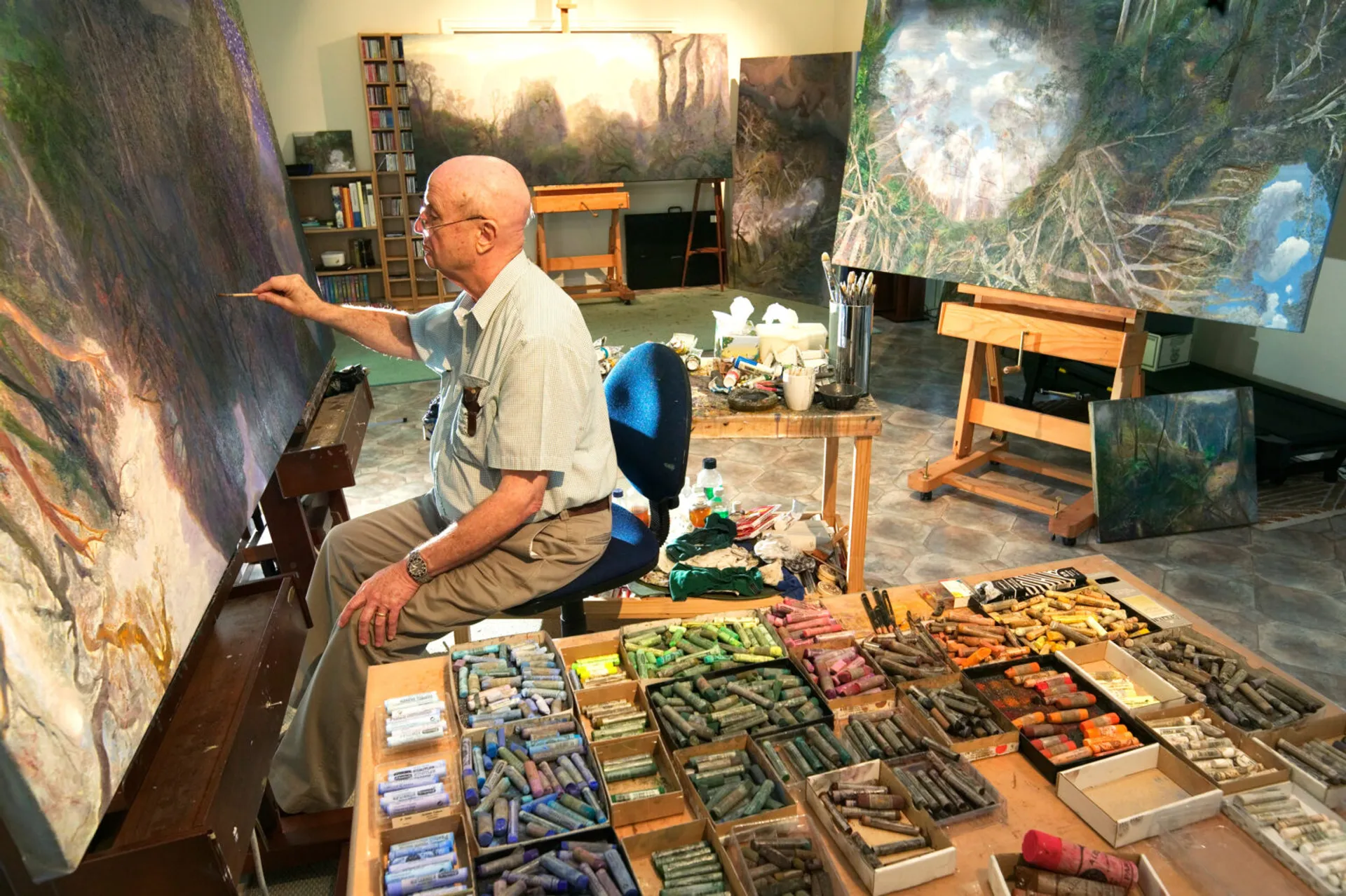
William Robinson in his studio at Manly in Brisbane, Queensland, Australia
photographer: Ian Lloyd
© R.Ian Lloyd
Immortalising those elements of nature which seem eternal – luminous sea and vast, cloud-filled sky to the ancient forest, teeming with life – the present work powerfully encapsulates the artist’s enduring interest in the relationship between man and the cosmos. In stark contrast to his earlier bucolic farmyard scenes and landscapes which featured the genial folk figures of Bill and his wife Shirley, here the viewer is confronted with an expansive wilderness in which the brilliant light of the distant sea and sky is framed by the dense, primeval vegetation of Springbrook. Throughout his life, Robinson asserted that the artist reveals himself through his pictorial absence. Thus, for Robinson, ‘finding himself’ as a painter, appreciating the landscape and becoming closer to God were all inextricably linked. Indeed, describing the experience of walking through the forest of 2000-year-old beech trees near his property at Springbrook (which he famously captured in the highly acclaimed five-panel masterpiece Creation Landscape – Darkness and Light I – V, 1988, Art Gallery of Western Australia), the artist poignantly evoked his visit to one of the world’s greatest pilgrimage destinations: ‘I wanted to show the presence of God somehow, not only through the mystery of walking through Chartres Cathedral and walking through this forest, but also something about the nature of providence.’2
Transcending descriptive landscape for more universal and metaphysical concerns, The bright sea, Springbrook thus celebrates the sheer wonder of creation itself with a panorama that is at once intimate and immense, earthbound and transcendent – a place in which nature, memory and faith coalesce to offer one of the artist’s most profound meditations on the sacredness of the natural world. Capturing the luminous, enduring beauty of this ancient landscape, Robinson seeks to convey not merely what he observes, but what he perceives within himself in his lifelong quest for meaning and spiritual truth. Like Wordsworth’s ‘emotion recollected in tranquillity’, for Robinson painting is ultimately an act of contemplating ‘things felt or remembered’; as Hannah Fink astutely observes, ‘…wholeness resides in the experience of the landscape itself – as such, his paintings may be considered both compelling approximations of, and poetic tributes to, that sacred moment in which the physical and spiritual become synonymous.’3 Indeed, it is precisely this rare fusion of observation and contemplation, of physical reality and spiritual revelation, that distinguishes The bright sea, Springbrook as one of Robinson’s most compelling achievements.
1. James, B., ‘A Landscape We Thought We Knew’, Sydney Morning Herald, Sydney, 29 January 2003, p. 15
2. William Robinson, cited in Fink, H., ‘Light Years: William Robinson and the Creation Story’, Artlink, 2001, vol. 21, no. 4 at: www.artlink.com.au/articles/2555/light-years-william-robinson-andthe-creation-story/
3. Fink, ibid.
VERONICA ANGELATOS