
Fred Williams
(1927 - 1982)
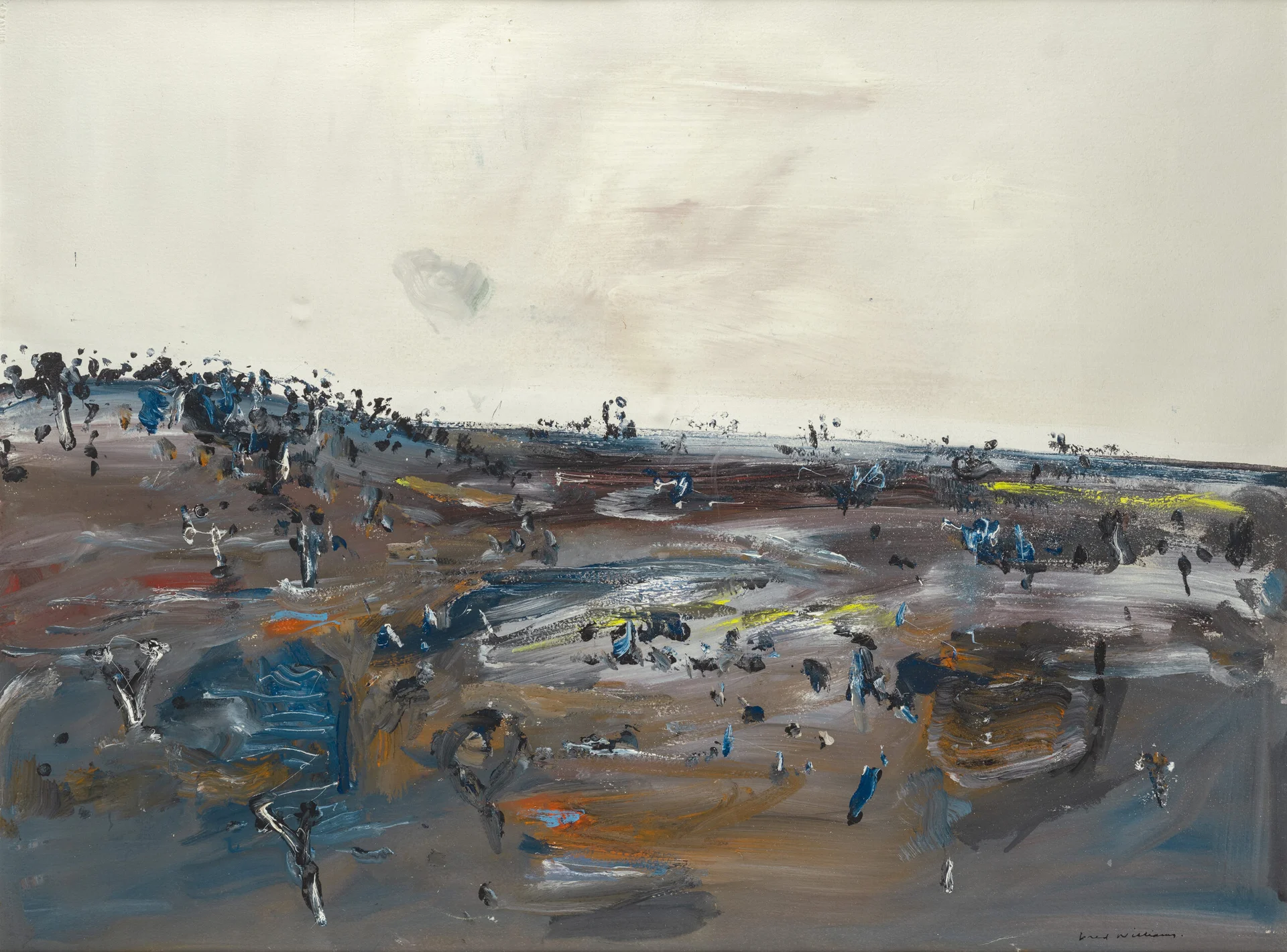
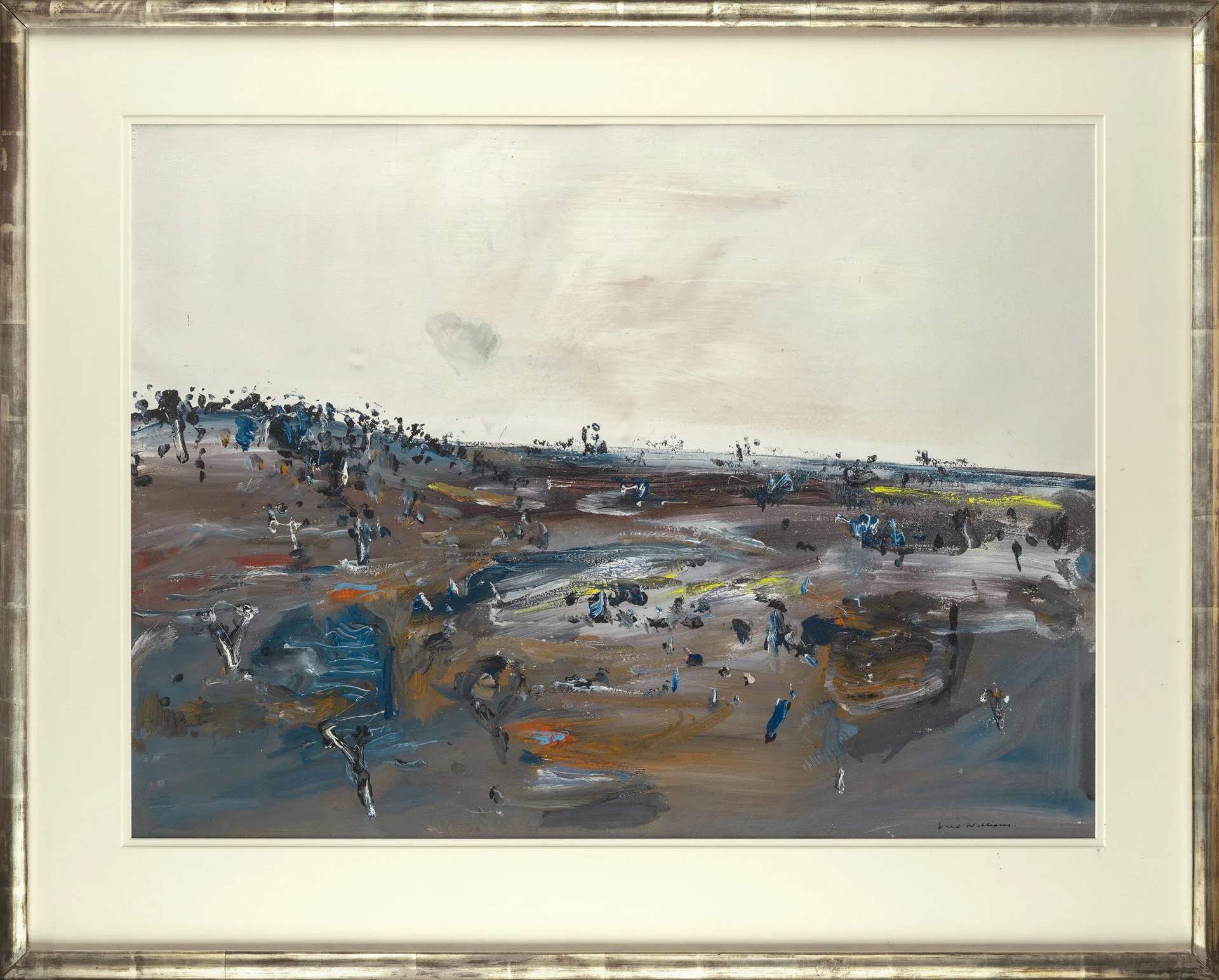
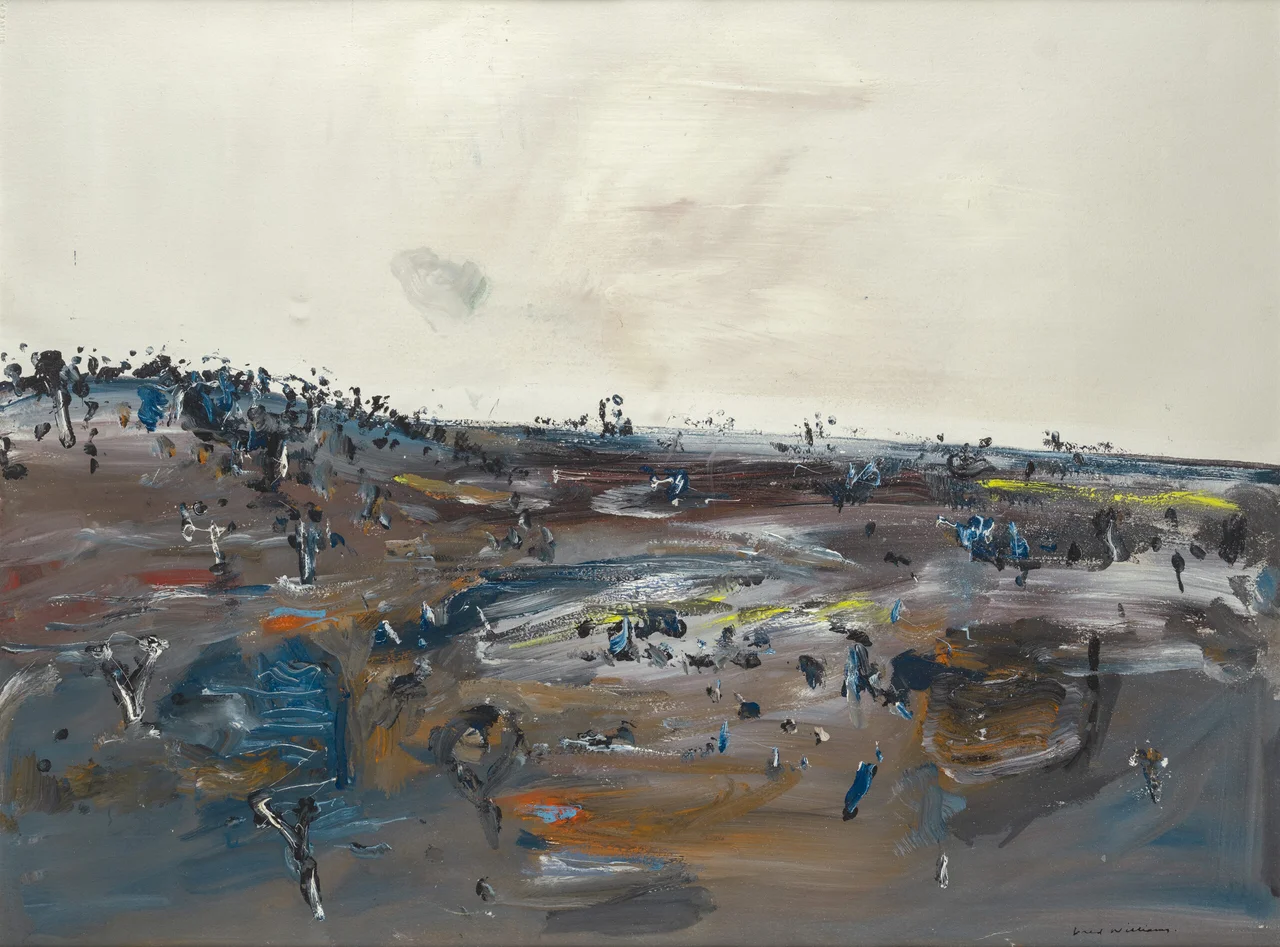
After the fire, Upwey, 1968
gouache on paper
57.5 x 76.0 cm
signed lower right: Fred Williams
Estimate:
$50,000 - $70,000
© Estate of Fred Williams/Copyright Agency 2026
lot details
Estate of the artist
Rex Irwin Art Dealer, Sydney (label attached verso)
Private collection, Sydney, acquired from the above in 2003
Exhibited
Fred Williams, Paintings and Gouaches, Rex Irwin Art Dealer, Sydney, 19 August – 13 September 2003, cat. 11 (illus. in exhibition catalogue)
We are grateful to Lyn Williams for her assistance with this catalogue entry.
One of the most important Australian artists of the twentieth century, Fred Williams transformed the tradition of landscape painting in this country. His unique vision of the natural environment – from areas of scrubby bush on the edges of suburbia, to the vast inland country – captured its essence and created archetypal images that have become part of our collective visual memory. Produced during the mid-1960s at a time when Williams had emerged as a confident and mature key figure in contemporary Australian art, the Upwey Series sits alongside the preceding You Yangs works as ‘classic’ Williams. Articulating their significance both within Williams’ oeuvre and the broader context of Australian landscape painting, Patrick McCaughey wrote, ‘They were clearly paintings of substance, well-made and fully fashioned and yet they still allowed [his] touch to operate. They made of the drab and featureless bush, a landscape of enduring, even monumental proportions and dignity. They revalued Australian landscape painting… and renewed hope in the genre.’1
While Williams had previously painted in and around Upwey, in the Dandenong Ranges to the east of Melbourne, it was the experience of living there from 1963 that provided the impetus for a major series. With the freedom to paint full-time, he established a studio in the house by joining two rooms together. The view from the valley up the hillside towards the sky informed the composition of these images, which are characterised by a narrow band of sky running across the top of a steep, treed slope.2 The strength of the series was recognised early, with the National Gallery of Victoria acquiring Upwey Landscape III, 1965, directly from the studio in the year it was painted. Major Upwey paintings are also held in the collections of the National Gallery of Australia, Art Gallery of New South Wales and Tate, London.
Until the late sixties, Williams’ preferred medium for painting outdoors was gouache, a quick-drying medium composed of watercolour mixed with white pigment (which renders it opaque).3 In this example he used it to record the landscape following the devastating bushfire of February 1968, depicting blackened trees in open country – where scrubby undergrowth had been cleared as a result of the fire – beneath a pale overcast sky. Touches of yellow in the centre of the scene and on the distant right suggest new growth. Indeed, this may be one of the works painted in the months following the fire, when Williams, fascinated by the transformation of the landscape he knew so well, documented its regeneration. The bushfire had begun in the heavily treed Dandenong Ranges, spreading to Upwey and Ferntree Gully, destroying many acres of land and houses. Williams described the fire’s approach in his diary as ‘a huge pall of orange flame & enormous black clouds coming over the hill’ and although his own house was spared, some of the paintings he had moved outside as a precaution were damaged by the intense radiating heat.4 Recording the experience of helping neighbours put out fires on 20 February, he wrote ‘It was really hair-raising – wires down & trees falling all around… the last days are ones we will never forget – it’s like being in the mid[st] of a war.’5
1. McCaughey, P., Fred Williams 1927 – 1982, Murdoch Books, Sydney, 1996, p. 170
2. See Mollison, J., A Singular Vision: The Art of Fred Williams, Australian National Gallery & Oxford University Press, Canberra, 1989, p. 89
3. In the late 1960s Williams began to make small outdoor oil sketches, adding acrylic paint to his repertoire of outdoor materials in 1971.
4. Fred Williams diary, 19 February 1968, cited in Mollison, op. cit., p. 124
5. Fred Williams diary, 20 February 1968, cited in Mollison, op. cit., pp. 124 – 25
KIRSTY GRANT