


Gali Yalkarriwuy Gurruwiwi
(born c1942)
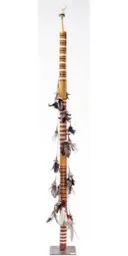
BANUMBIRR (MORNING-STAR POLE), 2000
synthetic polymer paint, feathers, bush string and cotton on carver wood
bears inscription on label verso: artist's name, title and Elcho Island Art and Craft cat. 23/3719/Yal.
186.0 cm height
Estimate:
$1,200 - $1,800
Sold:
$1,586 (inc. BP)
lot details
bears inscription on label verso: artist's name, title and Elcho Island Art and Craft cat. 23/3719/Yal.
Elcho Island Art and Craft, Galiwin’ku (Elcho Island), Central Arnhem Land, Northern Territory
Private collection, Melbourne, acquired from the above in 2000
This work is accompanied by a certificate from Elcho Island Art and Craft, Galiwin’ku (Elcho Island), Central Arnhem Land, Northern Territory that states: ‘The morning star pole (Banumbirr) is a ceremonial emblem and an essential part of ritual.
The morning star pole is most commonly used in mortuary ceremonies and is held by men whilst dancing.
The individual poles can differ, depending on the ceremony, the artist’s clan and their stories.
The poles are statements about identity and can represent specific stretches of country and the aboriginal (yolngu) people it belongs to. They are also a part of spiritual/religious statements that binds the people in life and death.
One story told is an old woman releases the stars (feather ‘arms’) on the pole before dawn and they fly away like a kite. They act as a guide for the dead spirit to find it’s way “home”, before being pulled back at daylight.
The first lone star in the sky (Venus) is said to be the Banumbirr star.
This work is accompanied by a certificate from Elcho Island Art and Craft, Galiwin’ku (Elcho Island), Central Arnhem Land, Northern Territory that states: ‘The morning star pole (Banumbirr) is a ceremonial emblem and an essential part of ritual.
The morning star pole is most commonly used in mortuary ceremonies and is held by men whilst dancing.
The individual poles can differ, depending on the ceremony, the artist’s clan and their stories.
The poles are statements about identity and can represent specific stretches of country and the aboriginal (yolngu) people it belongs to. They are also a part of spiritual/religious statements that binds the people in life and death.
One story told is an old woman releases the stars (feather ‘arms’) on the pole before dawn and they fly away like a kite. They act as a guide for the dead spirit to find it’s way “home”, before being pulled back at daylight.
The first lone star in the sky (Venus) is said to be the Banumbirr star.