

Menga Mununggurr
(born 1959)
GURRTJPI, 2004
natural earth pigments on eucalyptus bark
bears inscription verso: artist's name, date and Buku-Larrngay Mulka Arts cat. 2178D
215.0 x 64.0 cm
Estimate:
$4,000 - $6,000
lot details
bears inscription verso: artist's name, date and Buku-Larrngay Mulka Arts cat. 2178D
Buku-Larrngay Mulka Arts, Yirrkala
Private collection, Sydney
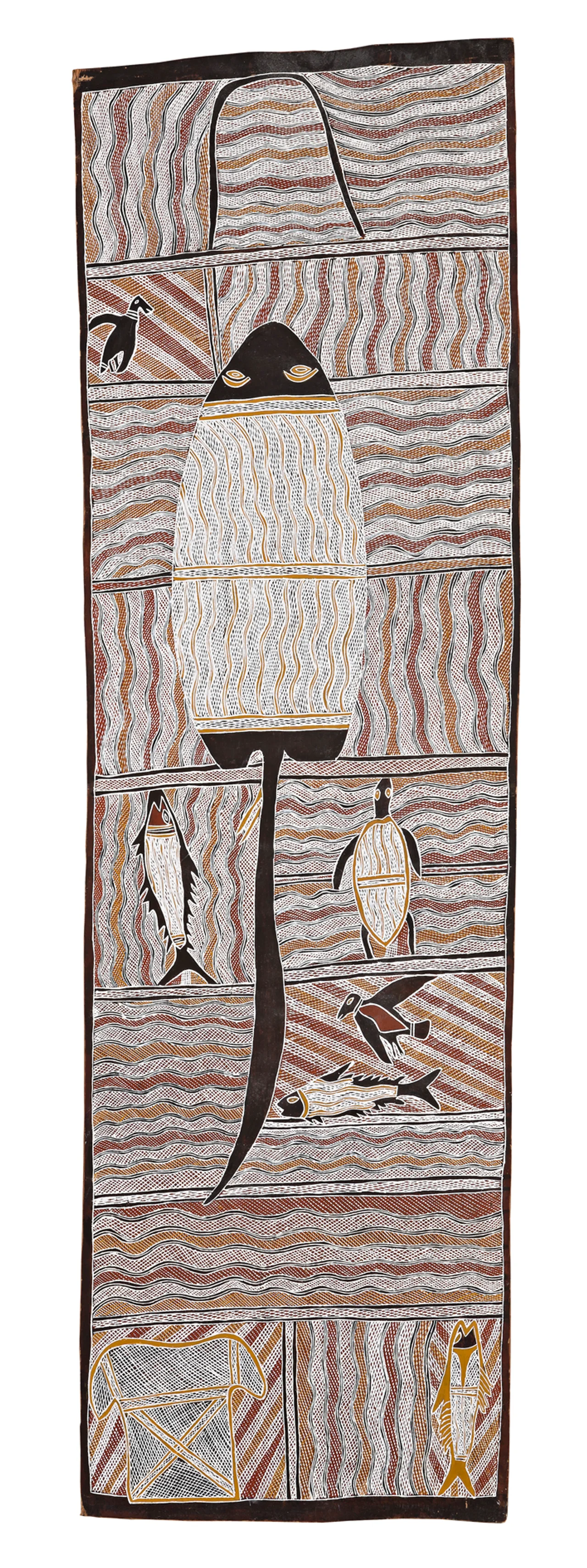
This work is accompanied by a certificate of authenticity from Buku-Larrngay Mulka Arts which states in part: ‘The depicted Gurrtjpi is the stingray hunted much on the shallow shores of Blue Mud Bay. It is also a totem for the Madarrpa at Baniyala as they talk of Gurrtjpi having a path of creation at Baniyala. A few hundred yards down the beach at Baniyala, a small tidal creek cuts through the dunes to the flat country immediately behind. This small creek named Mawangga was used by Gurritjpi to track back into the bush. Here he bit into the ground forming several small billabongs, a source of water for Yolngu living there. His path continued along the direction that is now the Baniyala air strip to flat sandy country before heading out to the point Lulumu to become a white rock surrounded by the slow tides.
‘During the days of Wonggu the Djapu warrior (and Menga’s paternal grandfather), an area in the shape of the stingray was cleared by him and others who came to country to hunt Gurrtjpi mid way through the dry season. The area is still clear today, his two eyes holes in the ground where the current inhabitants pick sand to throw in the direction of the rock at Lulumu for good luck and plentiful fishing. The stingray Gurrtjpi has been depicted in these waters. The rock at its head. At its tail Wangupini the Wet Season Thunderhead, feminine with life giving rain bearing the possum string girdle of ancestral woman Nyapilingu. It exemplifies the life cycle of the spirit changing from physical to ephemeral and so on as the rain falls in the hinterland “sings” its various identities through the creeks until meeting a saltwater tidal surge mingling to the horizonal ocean and vapourising to return again borne by the mother cloud. Getkit the Yirritja tern reels in these ocean breezes.
‘Makani the Queenfish whose shore hugging ancestral activities shaped some of this coastline is also shown along with Garun the loggerhead turtle perhaps an analogue of the rock itself.’
CONDITION REPORT:
This work is in excellent, stable and near original condition overall, consistent with age, materials and the artist’s working methods.
There is a vertical hairline crack (8 cm) to the fish to the lower right and two other hairline cracks to the lower centre are of (6 cm and 4 cm) of the bark. These occur naturally, are barely discernible and not visually distracting. There is minor surface abrasion to the top left corner edge that is not visually distracting
The work has been placed in an aluminium support brace.