3 September 2026
Auction, News and Stories
Women artists rode to the rescue of the mid-year auction market, delivering strong results in Melbourne after an underwhelming two nights in Sydney, causing one insider to remark that maybe we were watching “a tale of two cities” unfold.
Saleroom reported last week that the winter auction season had begun in Sydney with Smith & Singer taking 97 lots of Australian and international art to market on August 25, and Bonhams offering 94 lots the day before. We reported that Smith & Singer’s auction cleared $8,403,750, making it the lowest-grossing August sale by the auction house in years.
But the firm subsequently reported to Australian Art Sales Digest – the online auction results archive – that its sales total was $10,630,625, meaning Smith & Singer had been able to negotiate with bidders for some of the passed-in works and ultimately make the sales.
Brett Whiteley’s San Gimignano, Tuscany, 1989–1990 carried an estimate of $1.5 million to $2.5 million at Smith & Singer, but bidding stopped at $1.4 million.
These included Brett Whiteley’s San Gimignano, Tuscany. Estimated at $1.5 million to $2.5 million, the work reached $1.4 million in the bidding and was passed in. It sold afterwards for $1,418,750 (including buyer’s premium, as will all sold prices in this report). In effect, that’s a “hammer price” of $1,135,000, plus the 25 per cent buyer’s premium.
But wait, didn’t a bidder just offer $1.4 million for the same work?
It’s a salutary tale about what can happen when the consignor and auction house set the low estimate – the reserve price – above the market, and when the competitive tension of a live auction is no longer there. If the work had sold at the $1.4 million hammer, the eventual price would have been $1,750,000 – about an extra $265,000 for the consignor, and $65,000 for Smith & Singer.
So a good result for the buyer, but not so good for the vendor or auction house.
Depot workers, c1940-42, by Dorrit Black, fetched $168,750 including buyer’s premium in Deutscher and Hackett’s Important Australian and International Fine Art auction in Melbourne on August 26.
The results from Melbourne’s two auctions that rounded out the season were more upbeat. Deutscher and Hackett went to market on August 26 with 85 lots, followed the next evening by Menzies with 78 lots.
Art changed hands for a total of $11.7 million including buyer’s premium at the Deutscher and Hackett sale, with clearance rates of 93 per cent by value and 89 per cent by volume.
Veteran auctioneer Roger McIlroy was keen to maintain the momentum of the sale. Director Damian Hackett was fielding telephone bids on the night, and at one point was stalled when he found he was talking to a new kid on the block.
“If you want to bid, this would be a good time,” McIlroy remarked dryly, looking at Hackett but addressing the bidder.
Hackett recalled the moment a little ruefully.
Music, 1927-28, a colour linocut by Dorrit Black, fetched $137,000 including buyer’s premium at Deutscher and Hackett.
“I was having a bit of an animated conversation with my bidder, who seemed to be misunderstanding how an auction works: that you actually have to bid higher than the last number, not lower,” he told Saleroom. Needless to say, the lot in question went to another bidder.
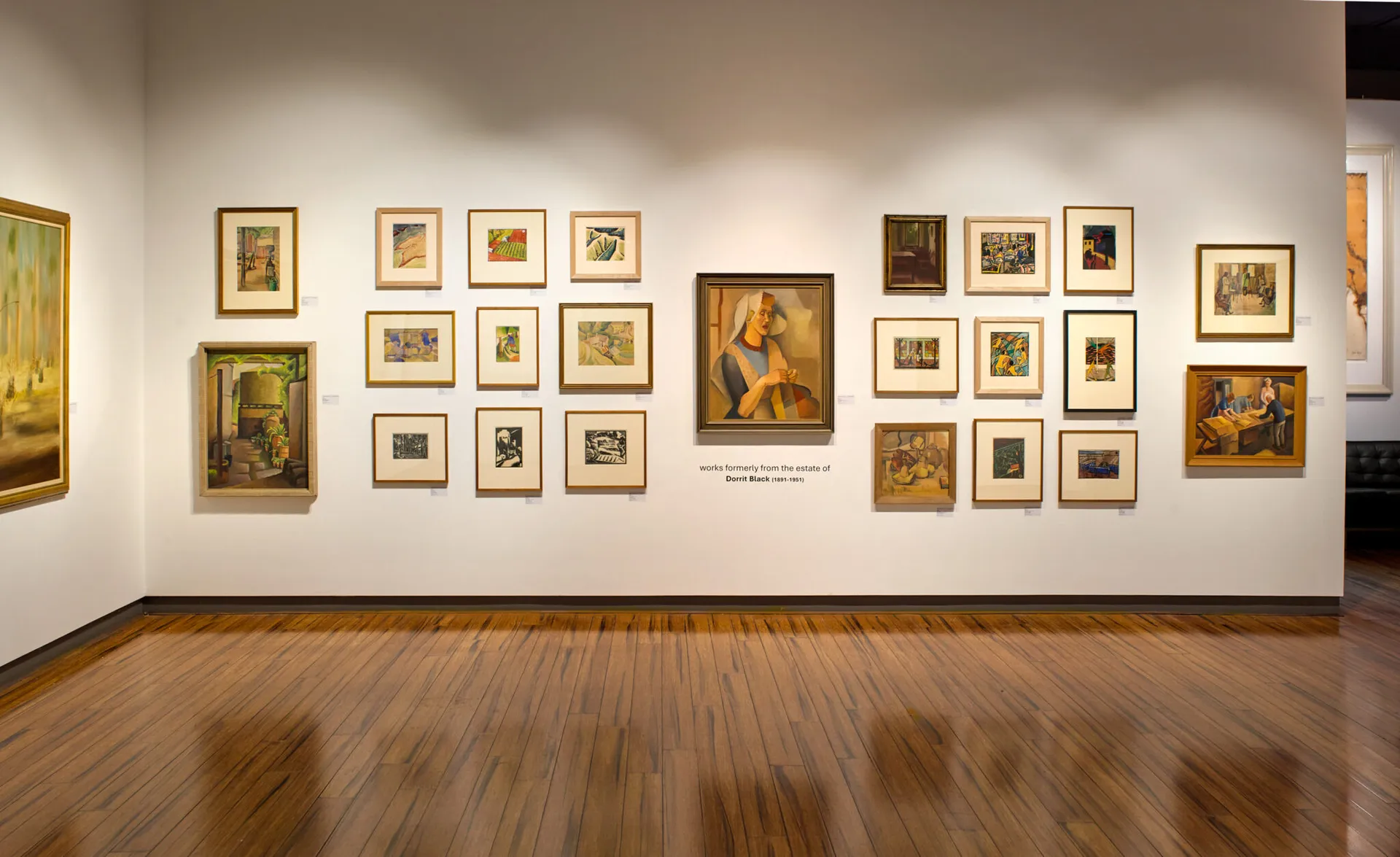
The sale kicked off with 12 pictures by Dorrit Black (1891-1951), one of the most popular artists on the auction market today. All of the “Dorrits”, and another tranche of 10 works by the artist at the end of the catalogue, were consigned by descendants of the artist’s sister Helen Finlayson.
“Wonderful provenance,” remarked McIlroy as he dealt briskly with these lots.
Lot 1, Dutch peasant, c1931-32, was painted by Black in Sydney but was inspired by the two years she had spent in Europe. Depicting a woman of stolid appearance, Dutch peasant was estimated at $100,000 to $150,000 and sold for $168,750. (Estimates do not include the buyer’s premium.)
Lot 2, Black’s painting Depot workers, c1940-42, was estimated at $80,000 to $120,000 but flew away to fetch $168,750.
Margaret Preston, Still Life with native rose, 1920, sold for $500,000 on an estimate of $350,000 to $450,000 at Deutscher and Hackett.
Lot 3, Under the pergola, 1951, was a prettier painting, but it fetched less than the historically interesting Depot workers of World War II. Under the pergola, which fetched $125,000, is thought to be Dorrit Black’s final painting. It was found on her easel, still wet, after she died in a car accident aged 59.
The next lot in the sale exceeded the price for Under the pergola despite being a work on paper rather than an oil painting. Titled Music, 1927-28, the colour linocut on paper was estimated at $50,000 to $70,000 but was bought for $137,500, setting a new auction record for Black’s renowned linocuts.
Hackett said Music is an icon of Black’s oeuvre, with other works from the edition to be found in the collections of the National Gallery of Australia, the Art Gallery of New South Wales and the Art Gallery of South Australia.
He said the Black selection of works had attracted bidding from private and institutional collectors alike but would not be drawn on whether any museums had bid successfully. It will all come out in their annual reports, he said.
All that jazz, 1989, by Rosalie Gascoigne, made from softdrink cases, fetched $350,000 including buyer’s premium at Deutscher and Hackett.
The mixed vendor section of the auction was opened by lot 13, Margaret Preston’s stunningly beautiful oil painting Still life with native rose, 1920, which fetched $500,000 (estimate $350,000 to $450,000) and earned seventh spot in the list of top sales on the night.
As the National Gallery of Australia prepares to open its big Rosalie Gascoigne retrospective on October 24, the Deutscher and Hackett auction brought forward a work the artist made in 1989 from sawn and split soft drink crates.
Eugene Von Guérard, The Mitre Rock and lake from Mt Arapiles, 1874, sold for $1.5 million, including buyers premium, on an estimate of $1.5 million to $2 million at Deutscher and Hackett.
Titled All that jazz, the roughly geometric piece fetched $350,000 against its estimate of $320,000 to $420,000. This was the ninth-highest price in the auction.
Criss Canning is popular for her vivid colouration and the beauty of her still life paintings, and the two offered in this sale performed well. Poppies with Venetian silks, 2012, realised $52,500. Zinnias, 2007, fetched $40,000, both well above their high estimates.
The highest price of the sale was $1.5 million for lot 16, Eugene von Guerard’s sublime landscape, The Mitre Rock and lake from Mt Arapiles, 1874. Given the estimate was $1.5 million to $2 million, this is another high-priced sale that had to be negotiated after the fact.
Two green clouds, 1967, by Fred Williams, fetched $1.25 million including buyer’s premium at Deutscher and Hackett.
Second top price was $1,250,000 for lot 20, Two green clouds, 1967, by the landscape maestro Fred Williams, which hammered at the low estimate of $1 million.
Labourers after dinner, 1884, by the British artist George Clausen fetched $687,500.
Works from the estate of Sydney arts and business identity Michael Gleeson-White sold well, with the top price of $593,750 (the sixth-highest price in the auction) paid for Jeffrey Smart’s Municipal car park, 1983.
Menzies also elected to warm up their winter sale with a preponderance of work by women artists, and they delivered. Lot 1 was Ida Rentoul Outhwaite’s watercolour, (Fairy and Water Lilies), which set a new auction record for the artist at $52,500. The watercolour’s estimate was $20,000 to $30,000.
Jeffrey Smart’s Municipal Car Park, 1983, sold for $593,750 on an estimate of $300,000 to $400,000 at Deutscher and Hackett.
Lot 5, Cressida Campbell’s early handpainted woodblock print, The Front Room, 1987, fetched $45,000 against its estimate of $20,000 to $30,000. The same work sold at auction for $9375 in 2002.
The Front Room, 1987, a hand-painted woodblock print by Cressida Campbell, fetched $45,000 including buyer’s premium, on an estimate of $20,000 to $30,000 at Menzies’ Important Australian and International Art auction in Melbourne on August 27.
Lot 7, Clarice Beckett’s Stormy Seas, Beaumaris, soared away to $83,750 (estimate $30,000 to $40,000).
A work by Gaypalani Wanambi also set a record for the artist at auction. Lot 19, Ḏawurr (6770-22), 2022, went for $15,000. Wanambi is this year’s Wynne Prize winner.
Gaypalani Wanambi’s Ḏawurr (6770-22), 2022, on etched found metal, sold for $15,000 on an estimate of $8000 to $12,000 at Menzies.
In a major result, the eccentric contemporary assemblage by Tennant Creek Brio, titled One Eyed Man, 2020, sold handsomely at $106,250. The work, estimated at $40,000 to $60,000 went to a private buyer, Menzies head of art Asta Cameron told Saleroom. One Eyed Man incorporates a poker machine, so it could be a challenge to find a suitable spot for it.
One Eyed Man, 2020, by Tennant Creek Brio, sold for $106,250, well above its estimate of $40,000 to $60,000, at Menzies.
A work by the late grunge artist Adam Cullen also set an artist auction record. Outside Glenrowan, 2011, depicting bushranger Ned Kelly, fetched $104,318 (estimate $50,000 to $70,000). The top price of the Menzies sale was $437,500 for Lin Onus’s Bulla Goonya, 1993.
Bulla Goonyah, 1993, by Lin Onus, was the top sale at Menzies, going for $437,500 on an estimate of $350,000 to $500,000.
In second place was Brownyn Oliver’s sculpture, Horn, 1992, which achieved $275,000. Just behind was John Olsen’s Wattle and the Chasing Bird Landscape, selling for $237,500.
Albert Namatjira’s Ghost Gum near Haasts Bluff, c1945, fetched $137,500, continuing a strong run for the artist. The work was painted on beanwood, making it rare in Namatjira’s oeuvre, Cameron said.
Menzies sold $3,872,500 worth of art on the night, much less than the $8,071,500 it sold in its equivalent sale in August 2025. Last year’s sale offered 114 works against this year’s 78.
Ghost Gum near Haasts Bluff, c1945, fetched $137,500 including buyer’s premium at Menzies.
Did Menzies’ decision to sell its Sydney headquarters and hold its viewings only in Melbourne come to bear on this?
“It may have impacted slightly on the consignment side, but it’s hard to tell because it was a slightly shorter consignment period,” Cameron said.
The narrower consignment window resulted from the firm’s April sale having been held in May. Cameron pointed out that 92 per cent of lots sold on the night.