
Lin Onus
(1948 - 1996)
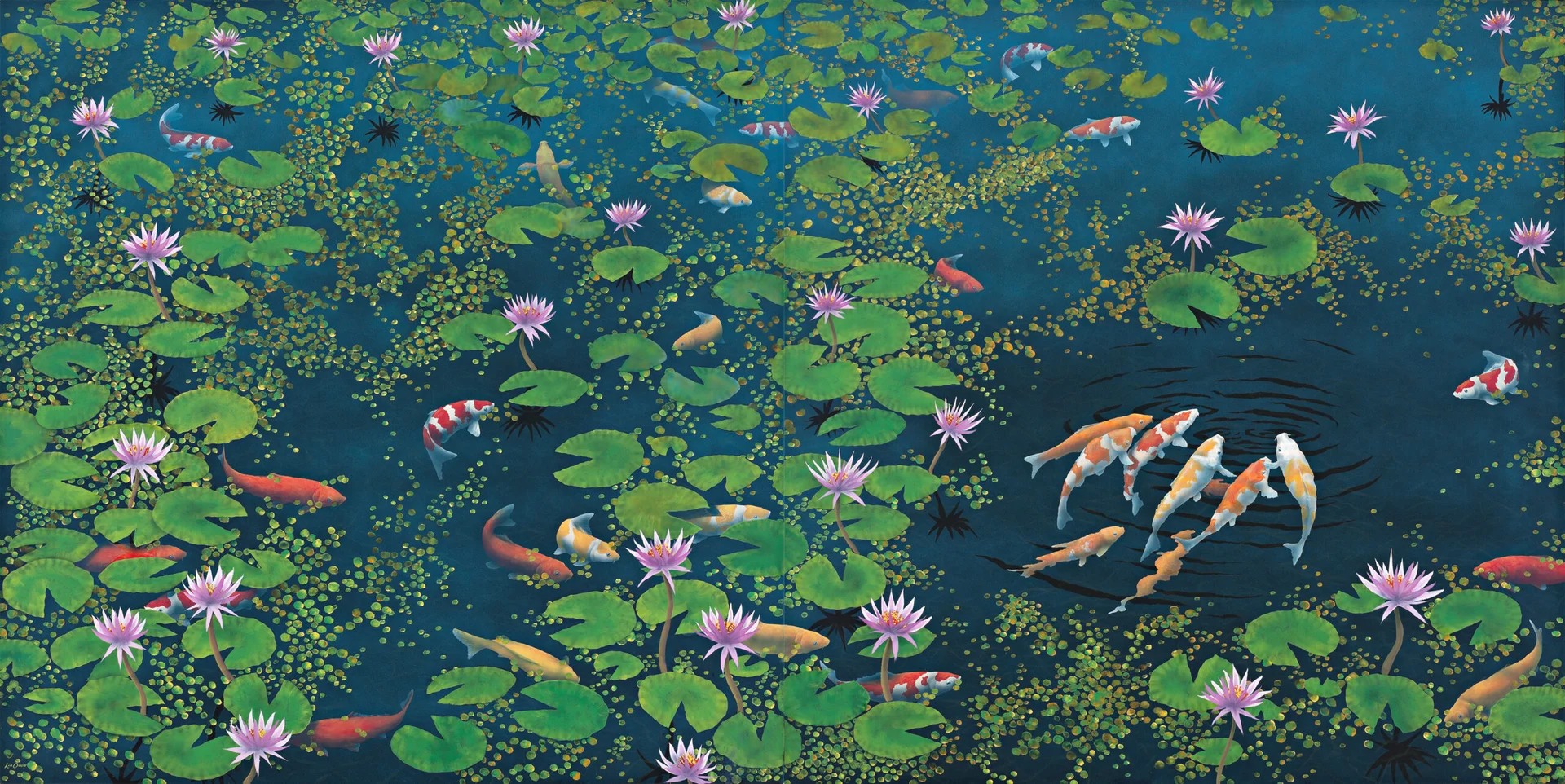
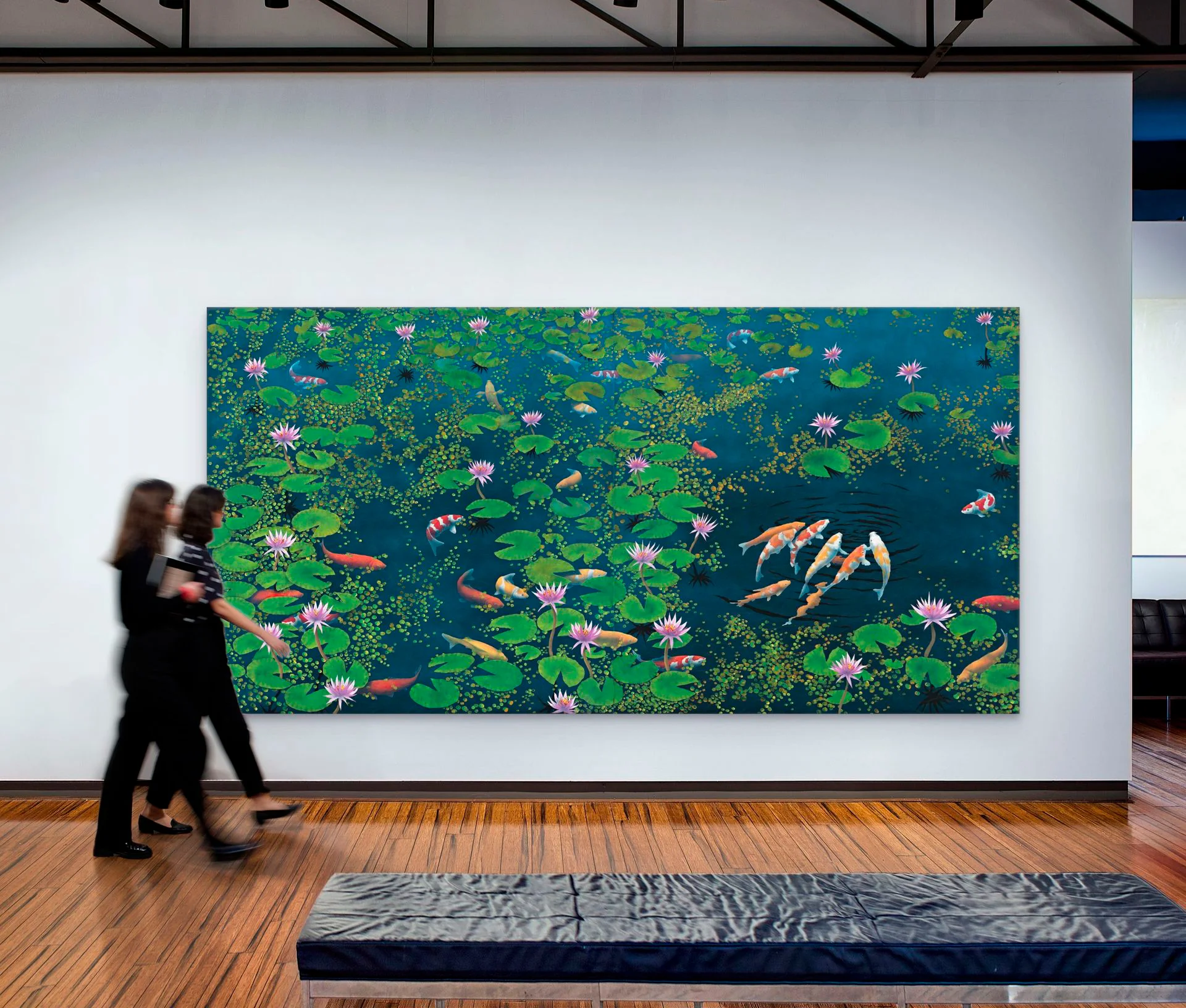
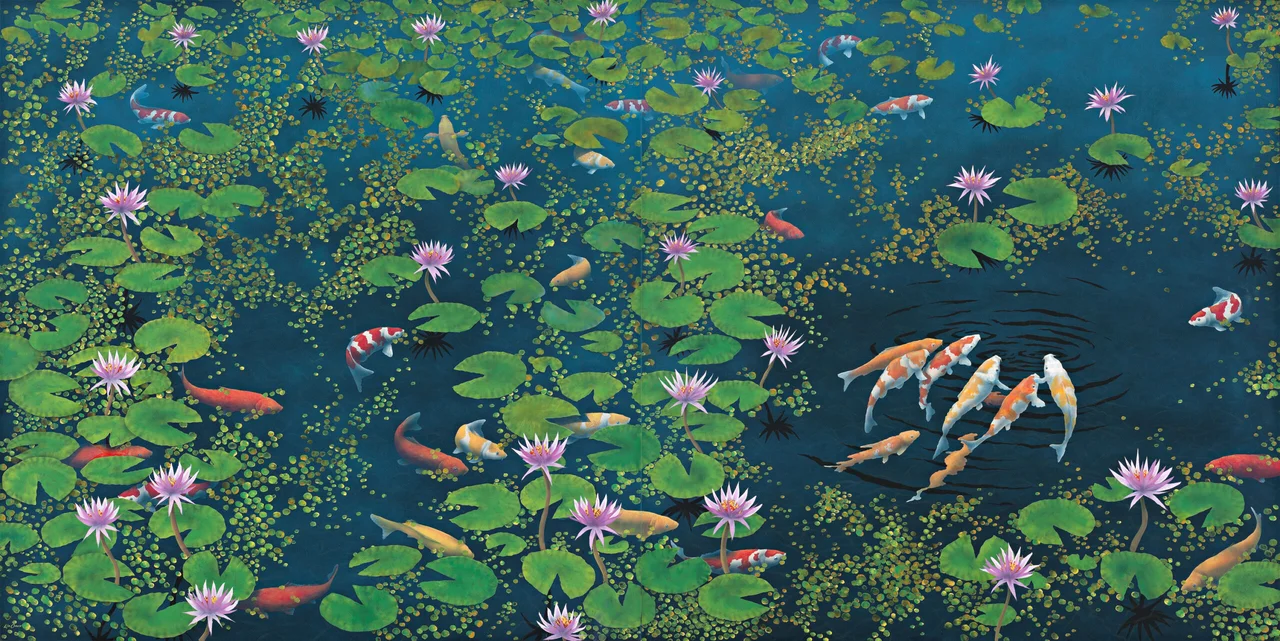
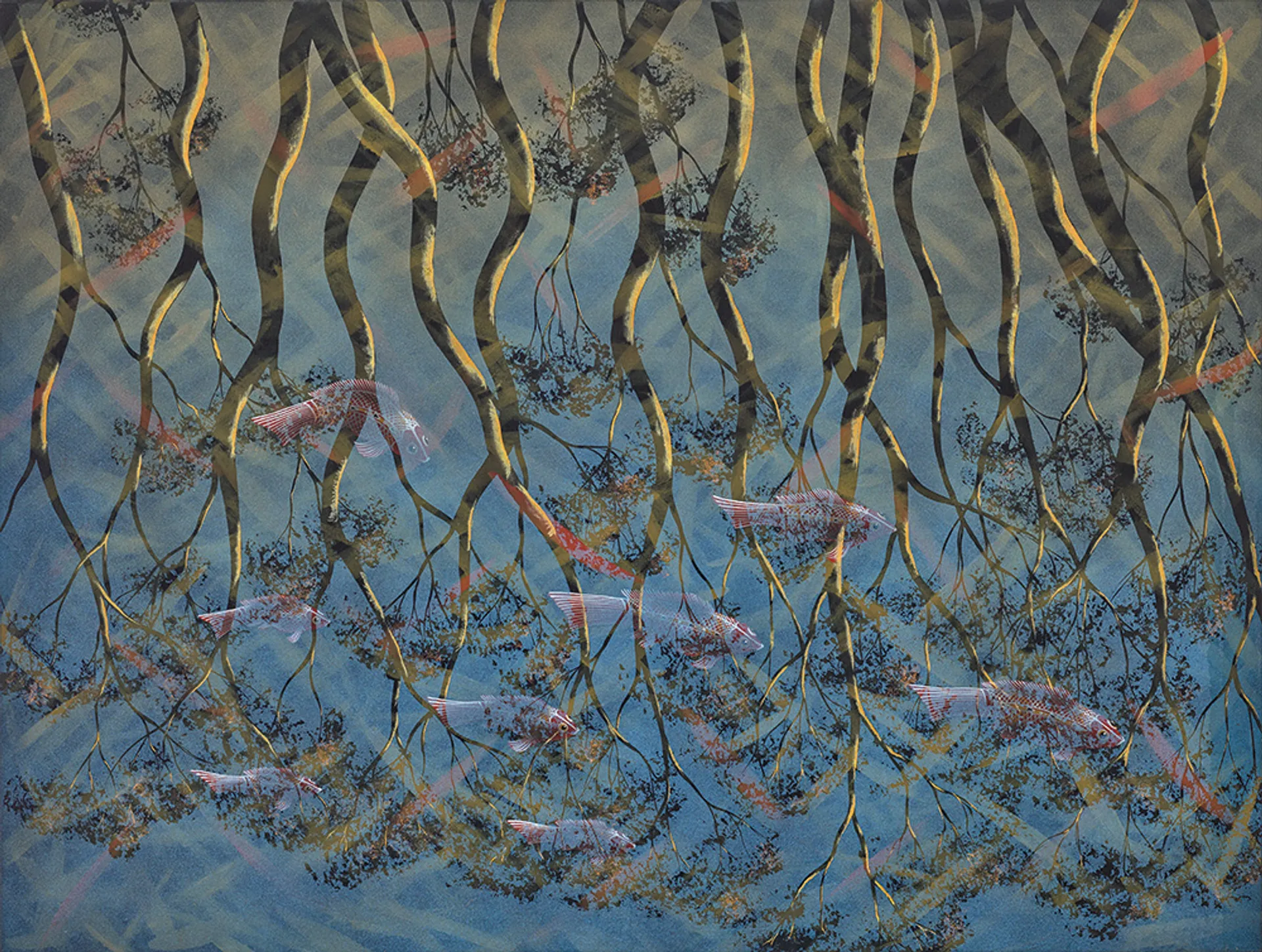
Riddle of the Koi, 1994
synthetic polymer paint on canvas
diptych
200.0 x 400.0 cm (overall)
signed lower left: Lin Onus
Estimate:
$550,000 - $750,000 (2)
© Estate of Lin Onus/Copyright Agency 2026
lot details
diptych
Estate of the artist, Melbourne
Mossgreen Gallery, Melbourne
Private collection, Sydney
Deutscher and Hackett, Sydney, 10 May 2017, lot 10
Private collection, Canberra
Exhibited
Lin Onus, Gallery Gabrielle Pizzi at ARCO 94, Madrid, Spain, 9 – 15 February 1994 (illus. in exhibition catalogue, as ‘El Enigma del pez Koi, 1994; (Dipitco)’)
Lin Onus: Yinya Wala (Light/Water), Jan Manton Art and Mossgreen Gallery, and touring to: Messum’s, London, 28 June – 3 July 2016, Melbourne, 4 – 28 August 2016, Brisbane, 9 – 24 September 2016 and Sydney, 8 – 30 October 2016 (illus. in exhibition catalogue, pp. 18 – 19)
Literature
Gallery Gabrielle Pizzi advertisement, Art and AsiaPacific, Fine Arts Press Pty Limited, Sydney, vol. 2, no. 3, July 1995, p. 11 (illus., detail)
Curtin, P. and Curtin, T., Blooms and Brushstrokes: A floral history of Australian art, Wakefield Press, Mile End, 2019, pp. 184, 185 (illus.), 196, 206
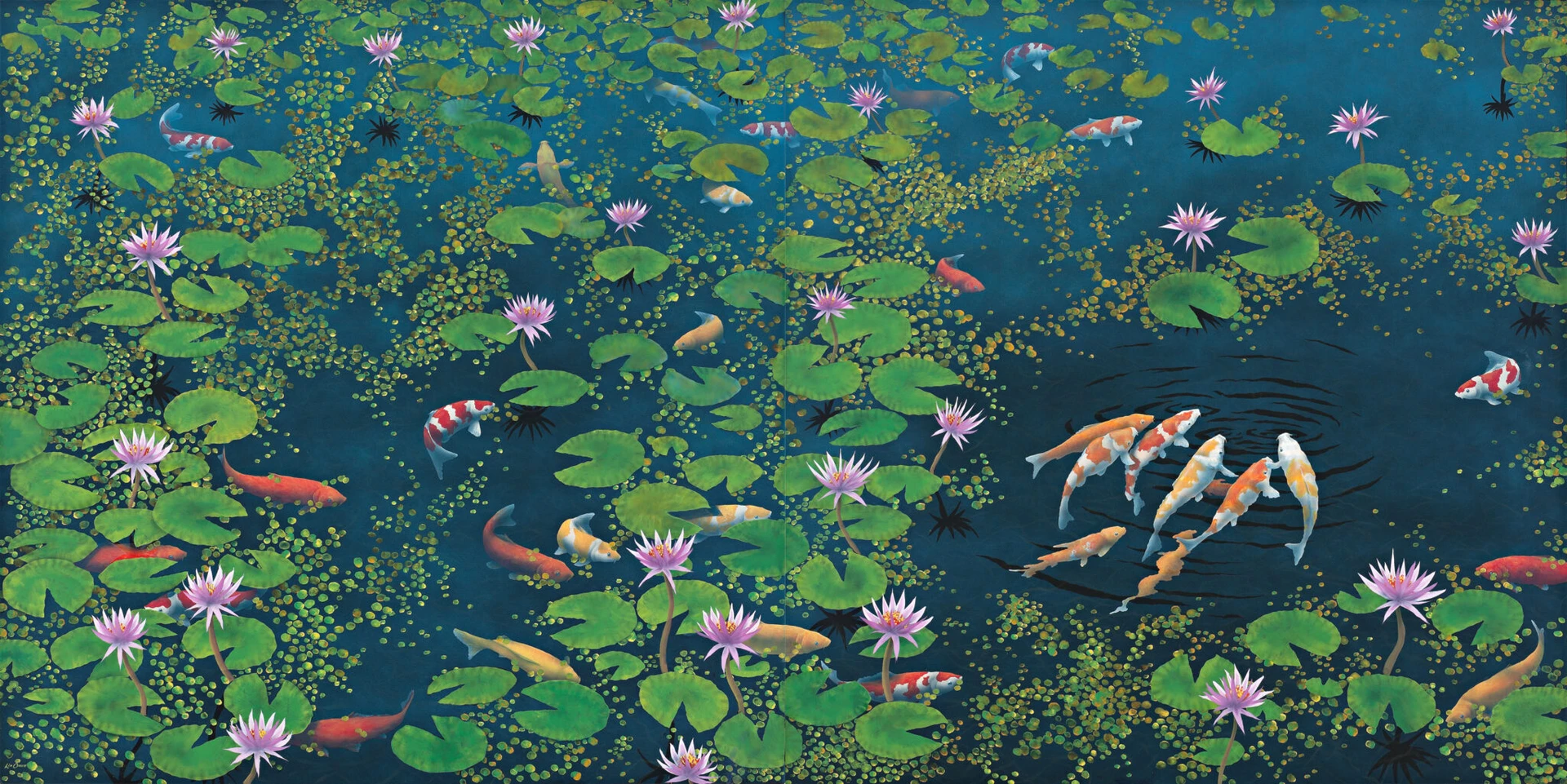
Extraordinarily beautiful and technically flawless, the paintings of Lin Onus exhibit a complex mixture of ideas centred on place, ownership and history, occupying a distinctive position in the broader setting of Australian art. Paintings such as the monumental Riddle of the koi, 1994 have the capacity to transfix the viewer and are full of meaning, exemplifying what Michael O’Farrell observed as ‘the sheer tactility of Lin Onus… imagery that establishes a carefully balanced dialogue of sensory and mental elements’1. Having incorporated satire and humour into early political installations and paintings that challenged cultural hegemonies, Onus demonstrated in these later works his Indigenous connection to country. Poetic landscapes of the natural world combined with subtle traditional iconography confirmed Onus’ relationship to both his adopted homeland in Arnhem Land and to his own ancestral sites at the Barmah Forest on the Murray River.
Growing up in a culturally productive and politically engaged household in Melbourne, Lin Onus could not help but be influenced by the activism of his family. His mother, Mary Kelly, was of Scottish origin and an active member of the Australian Communist party, and his father, Bill Onus, a Yorta Yorta man from the Aboriginal mission of Cummeragunja near Echuca, was an important figure in the Aboriginal civil rights movement, whose Aboriginal Enterprises (1952 – 1968) provided an outlet for Aboriginal art and craft in defiance of the then national goal of assimilation. In 1957, Bill Onus, together with Doug Nicholls, established the Aboriginal Advancement League in Victoria with the goal of ‘promot[ing] cultural renewal and reawaken[ing] aboriginal pride.’2 Onus’ cultural education on his Aboriginal side was provided by visits to Cummeragunja with his father. There they would sit with his uncle Aaron Briggs (who gave Lin his Koori name – Burrinja, meaning ‘star’3), on the banks of the Murray River within view of the Barmah Forest (Onus’s spiritual home and the subject of many of his paintings), listening to stories of family and history. Leaving school at 14, Lin Onus began his largely self-taught artistic career assisting his father in decorating artefacts. After embarking on a panel-beating apprenticeship, he developed skills working with metal and painting with an airbrush. By 1974 he was painting watercolours and photorealist landscapes, and in 1975 he held his first exhibition and began a set of paintings based on Musquito, the first Aboriginal guerrilla fighter, which still hang on the walls of the Aborigines Advancement League in Melbourne.
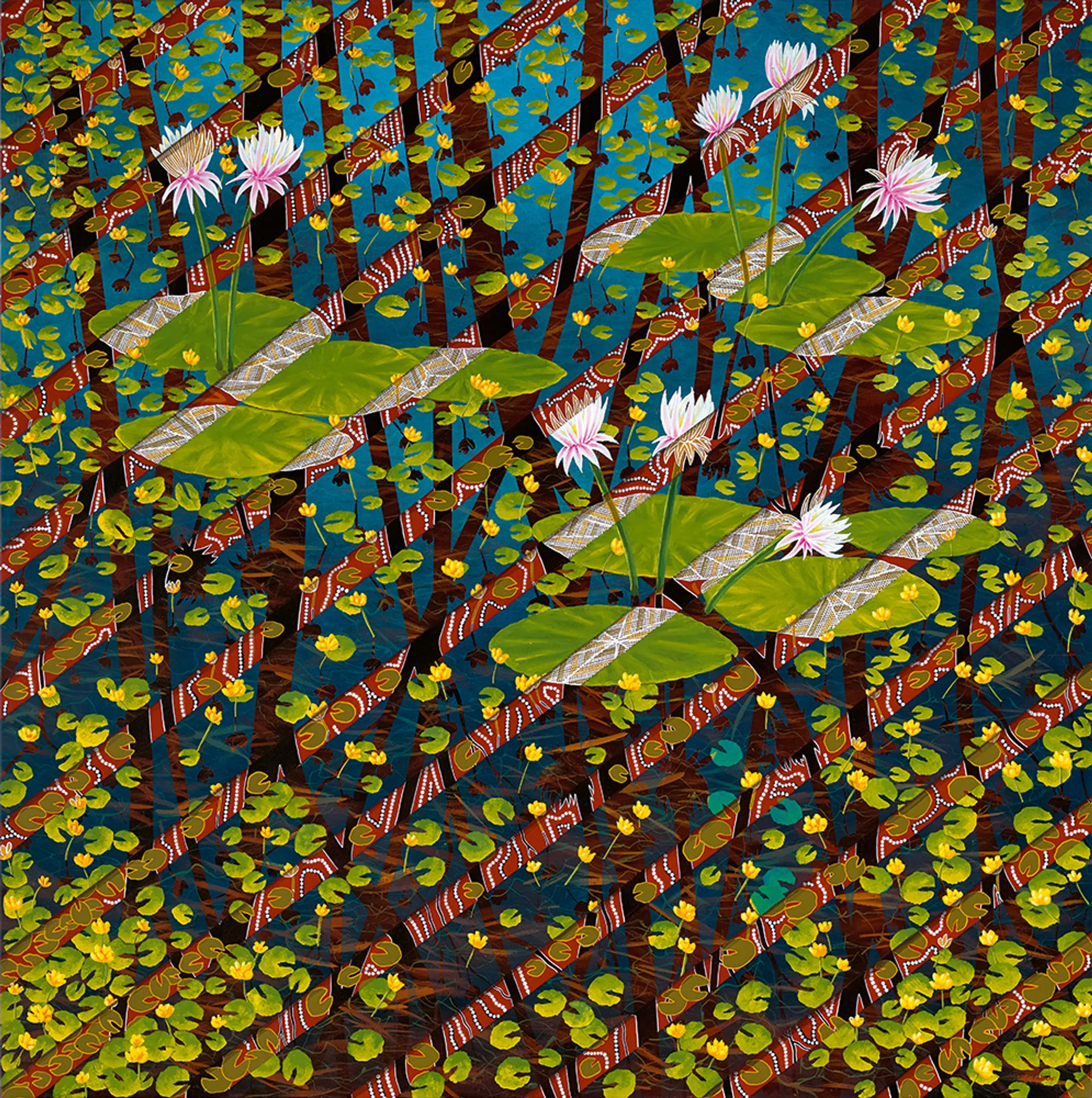
Lin Onus
Yellow Lilies, 1993
synthetic polymer paint on canvas
182.0 x 182.0 cm
Private collection
© Lin Onus/Copyright Agency 2026
Sold Deutscher and Hackett, 24 April 2024, lot 20, for $562,500 (inc. BP + GST)
While the bullying and racism experienced by Onus in 1960s suburban Melbourne influenced much of his art, the cultural revelations that came from his friendship with respected Arnhem Land artist Jack Wunuwun (1930-1991), enabled Onus to embrace both his Indigenous and non-Indigenous heritage. From meeting Wunuwun at Maningrida in 1986 while travelling in his role as the Victorian representative for the Aboriginal Arts Board, Onus’ life was deeply influenced by the Yolngu elder, who adopted Onus as his son.
Over the next decade, Onus made sixteen ‘spiritual pilgrimages’ to the outstation of Garmedi, the home of Jack Wunuwun in Central Arnhem land.4 Wunuwun was able to offer Onus a kind of cultural sanctuary by welcoming him into the Yolngu kinship system and adopting him into the Murrungun Djinang clan. This relationship provided Onus with the opportunity to learn Aboriginal traditional knowledge, which enhanced his own Yorta Yorta experience of the world. Through Wunuwun, Onus was given creation stories that he was permitted to paint and access to an Aboriginal language. As Onus noted, ‘going to Arnhem Land gave him back all the stuff that colonialism had taken away – Language and Ceremony.’5 Onus acquired his knowledge of symbols, patterns and designs from the community elders, and it seemed to him that this experience of tradition was ‘like a missing piece’ of a puzzle which ‘clicked into position’ for him culturally.6 The resulting personal style juxtaposed the traditional clan patterns of Maningrida, learnt from the older artist, with a photorealist style of landscape, integrating Indigenous spirituality and narrative with Western representation.
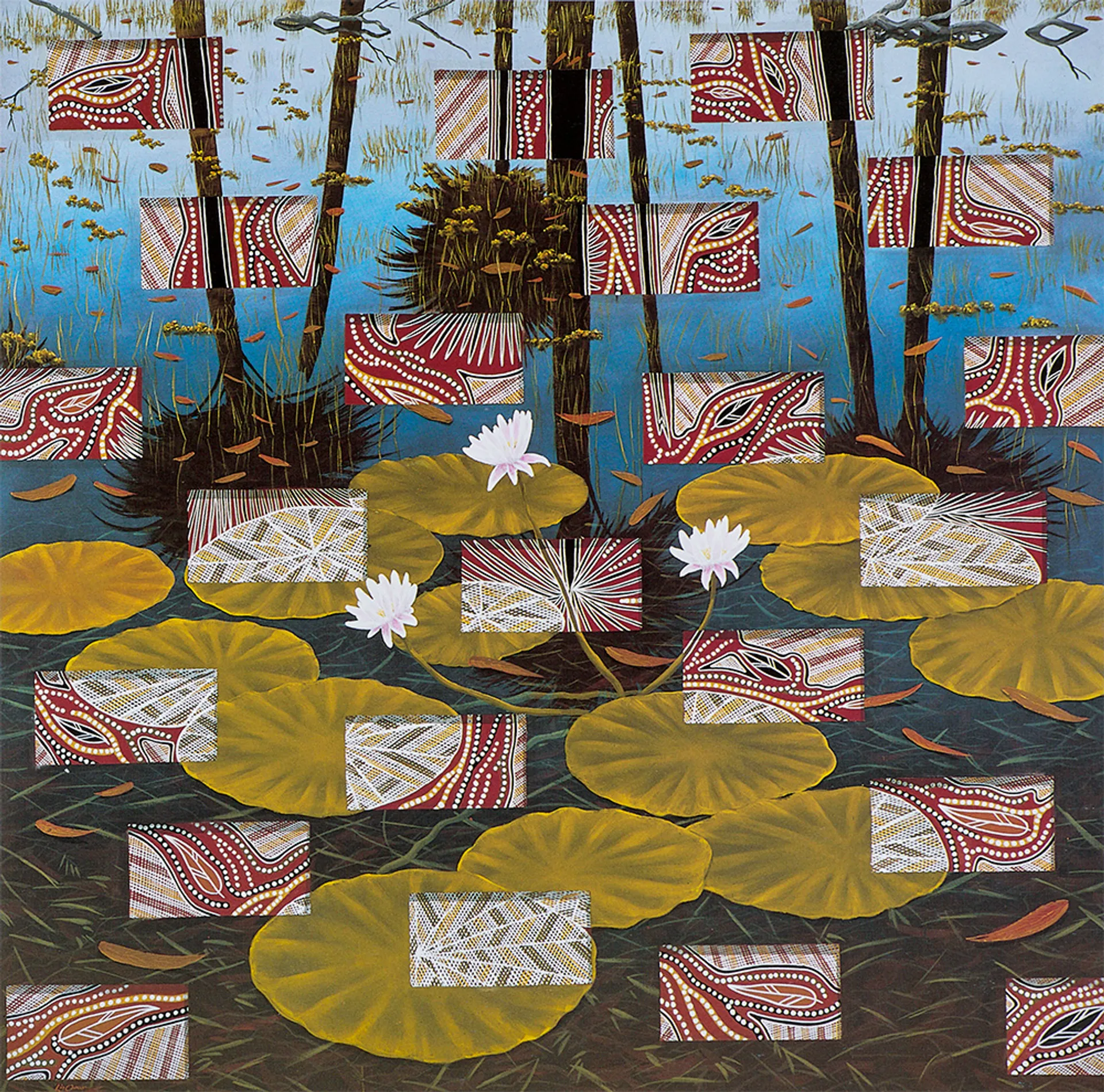
Lin Onus
Arafura Swamp, 1990
synthetic polymer paint on linen
182.0 x 182.0 cm
Baillieu Myer Collection
© Lin Onus/Copyright Agency 2026
Lin Onus
Malwan Pond – Dawn, 1994
synthetic polymer paint on canvas
91.5 x 122.0 cm
Private collection
© Lin Onus/Copyright Agency 2026
Sold Deutscher and Hackett, 1 December 2022, lot 9, for $387,500 (inc. BP + GST)
In 1989, Onus undertook an artist residency at the Fuijin Kaikan and Kyoban Centre in Yokohama, Japan, facilitated by the Yokohama City Board of Education. His residency coincided with the presentation of a tapestry, Suns and waters by Onus, to the Port of Yokohama (the artist’s first commission) that had been commissioned by the Port in the previous year. Riddle of the koi, 1994, can be seen as the culmination of Onus’ watery landscapes, with his signature motifs of lily pads and fish alluding to the beauty and fragility of the land and our relationship to it. No doubt partly inspired by the artist’s experience of Japanese society gleaned from his residency in Yokohama in 1989, this painting highlights the contrast between the refined Japanese aesthetic, which extended to carefully conceived and manicured gardens, and the highly industrialised nature of the large cities, a dichotomy which intrigued the artist. Onus reflected that, ‘…these paradoxes were interesting, particularly in relation to their environment which was full of smog, chromium and glass and yet people were really into gardens… A garden isn’t complete without a pond and much less complete without fish.’7 Both mesmerisingly beautiful and multifaceted in its meaning, Riddle of the koi illustrates well Onus’s desire to create an art that could be appreciated on numerous levels by everyone, not just an elite few. Onus’ watery landscapes embrace what Wunuwun described as ‘seeing below the surface’8 and function on a number of levels. As Margot Neale elaborates, these paintings are ‘deceptively picturesque, for things are not always what they seem. Laden with cross-cultural references, visual deceits, totemic relationships and a sense of displacement, they, amongst other things, challenge one’s viewing position: Are you looking up through water towards the sky, down into a waterhole from above, across the surface only or all three positions simultaneously?’9
Reflections are essential to the art of Lin Onus, literally and metaphorically. Both his painting and his social activism address issues of identity, racism and the uneven power relationship between Indigenous and non-Indigenous Australians. Onus held a mirror to unresolved social inequality within this country and explored what it meant to be Australian. His luminous paintings, meanwhile, reflect Onus’s desire to create an art that could be appreciated on numerous levels by everyone. His series of watery landscapes of the Arafura Swamp or Barmah Forest, rich in reflections and ambiguities, substituted the traditional European panoramic view with one of cross-cultural imagery, thus, undermining the primacy of Western modes of representation.
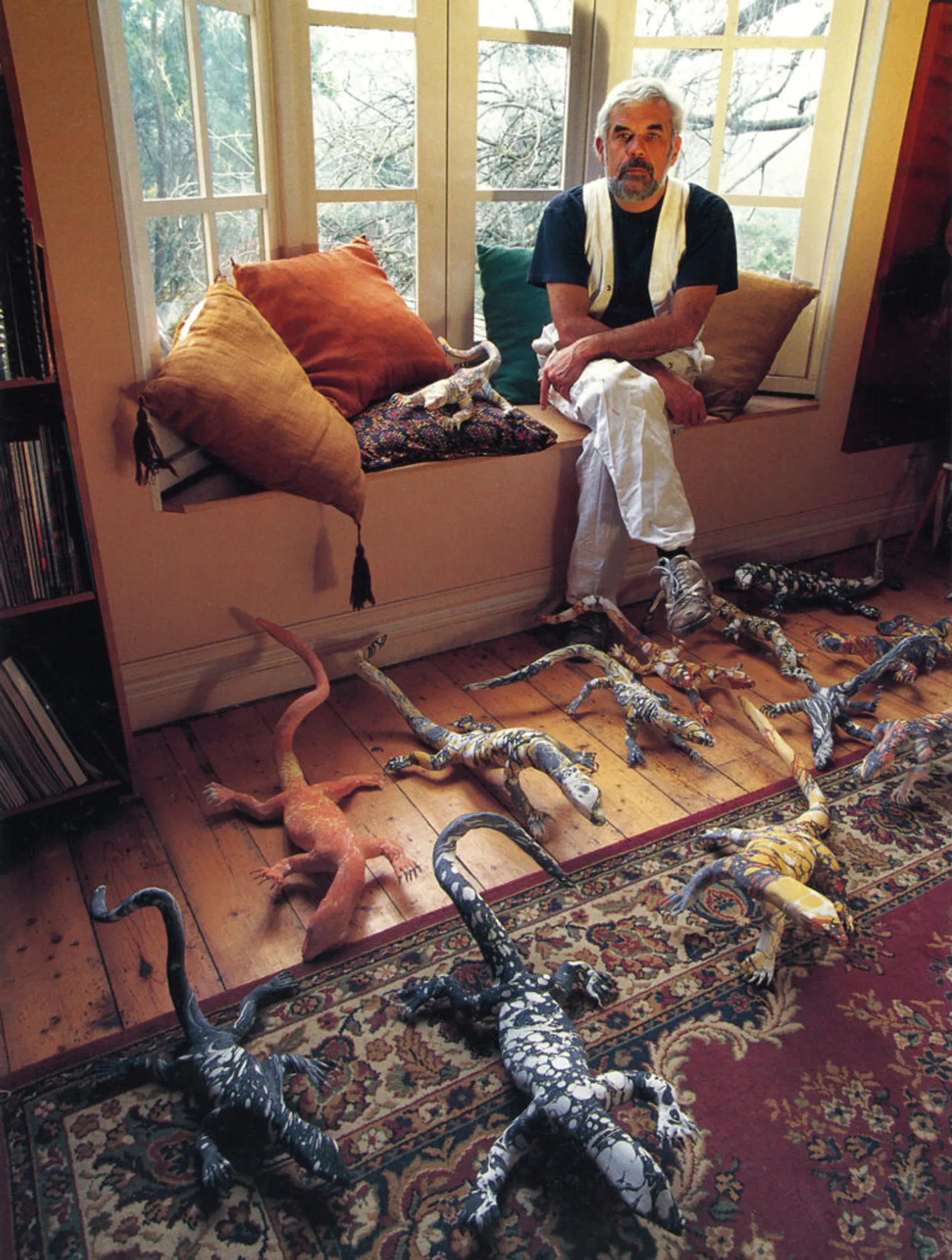
Portrait of Lin Onus
photographer: David Johns
© David Johns
Lin Onus hoped that ‘history would see him as some sort of bridge between cultures’10 and, as articulated by Ian McLean, ‘[he] successfully used postmodern strategies to infiltrate issues of Aboriginality into everyday Australian life.’11 The convergence of different cultures, languages and visual perspectives reflects Onus’ personal and artistic journey. His distinct and celebrated work reflects both his activism and creative ambitions, with his activism finding its greatest voice through his prodigious talent for painting and his ability to stop people in their tracks with his beautiful yet powerful image-making. A self-taught artist living between cultures and communities, Onus found a way to bring together Indigenous and non-Indigenous understandings of landscape and, in a spirit of reconciliation, articulate the intersection of two sets of values and points of view.
1. O’Ferrall, M., ‘Lin Onus’ in Australian Perspecta 1991, Art Gallery of New South Wales, Sydney, 1991 p. 80
2. Kleinert, S., ‘Aboriginal Enterprises: negotiating an urban Aboriginality’, Aboriginal History, vol. 34, 2010, at: http://press-files.anu.edu.au/downloads/press/p170581/html/ch07.xhtml?re… (accessed August 2026)
3. Neale, M., Urban Dingo: The Art of Lin Onus 1948 – 1996, Queensland Art Gallery, Brisbane, 2000, p. 14
4. ibid., p. 15
5. ibid. p. 15
6. Leslie, D., ‘Coming home to the land’, Eureka Street, March – April 2006, at: https://www.eurekastreet.com.au/article/coming-home-to-the-land# (accessed August 2026)
7. Lin Onus, cited in ‘Australia’s great crossover indigenous artist comes to London for a one-man show at Messum’s’, 29 June 2016, at http://artdaily.com/news/88448/Australias-great-crossover-indigenous-artist-comes-to-London-for-a-one-man-show-at-Messum-s#.WOlVpFOGPR0 (accessed August 2026)
8. Neale, M. et al, Lin Onus: A Cultural Mechanic, Savill Galleries, Melbourne, 2003, p. 1
9. ibid.
10. Neale, op. cit., 2000, p. 21
11. ibid., p. 41
CRISPIN GUTTERIDGE