

James Howe Carse
(1818 - 1900)
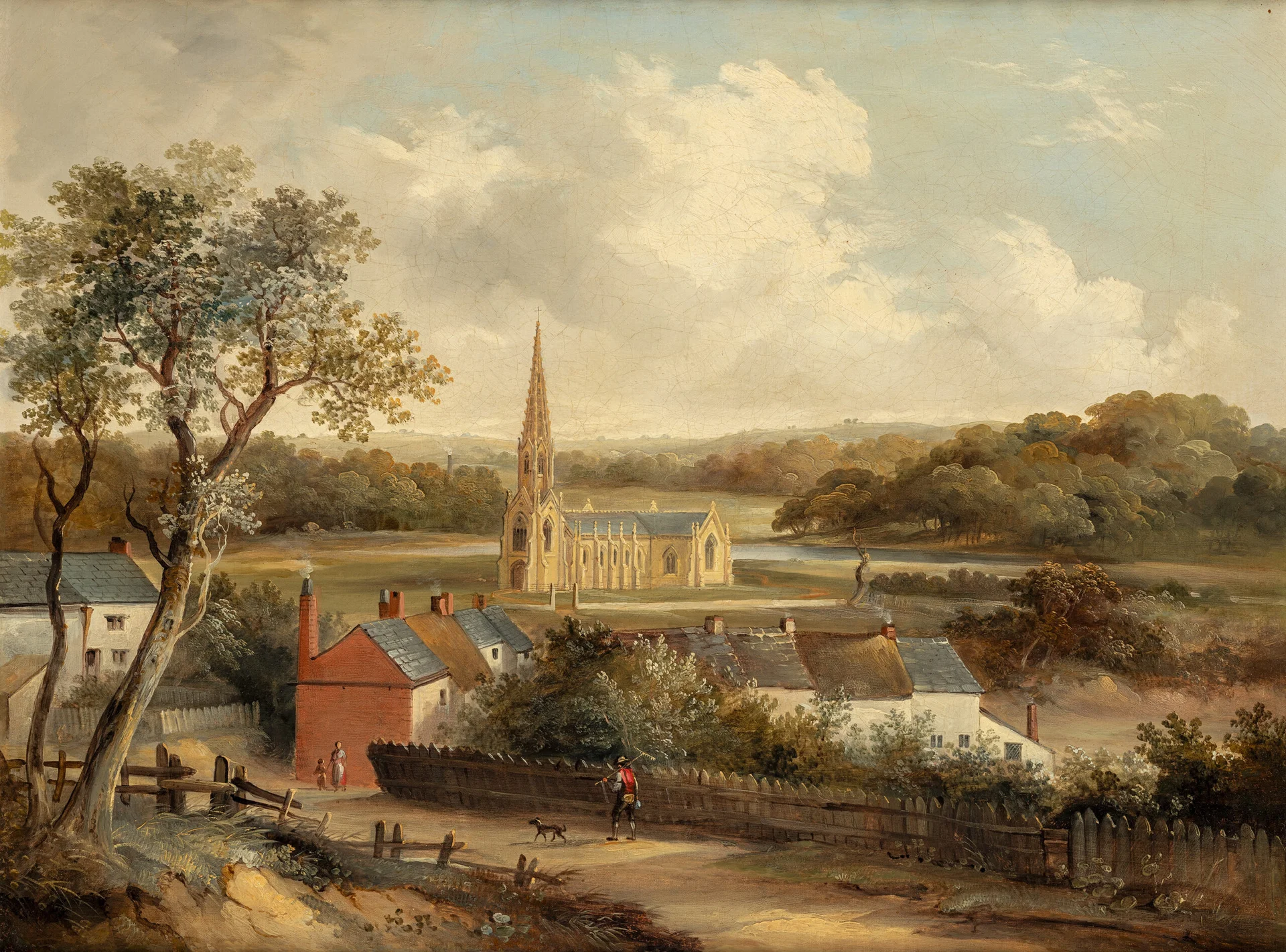
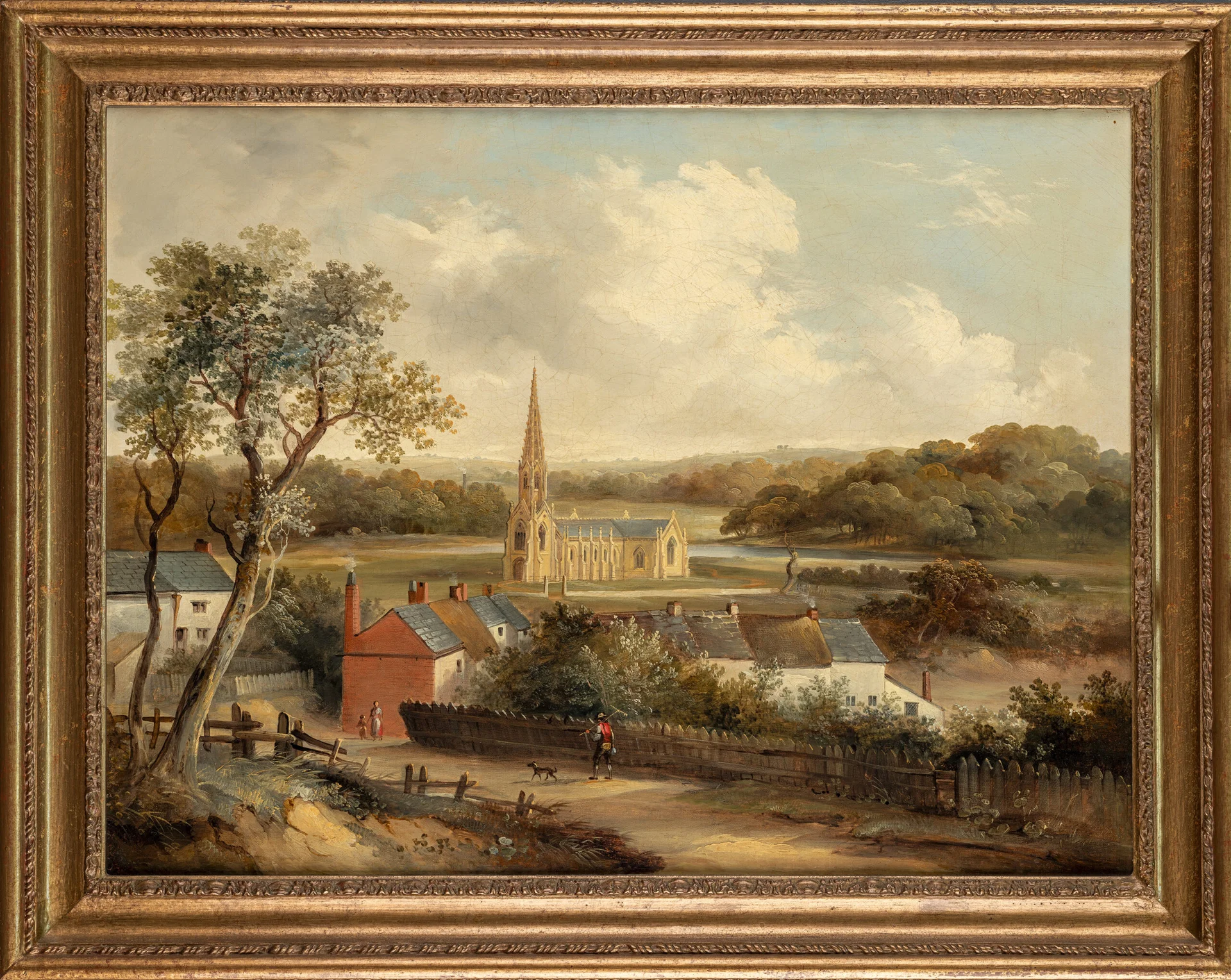
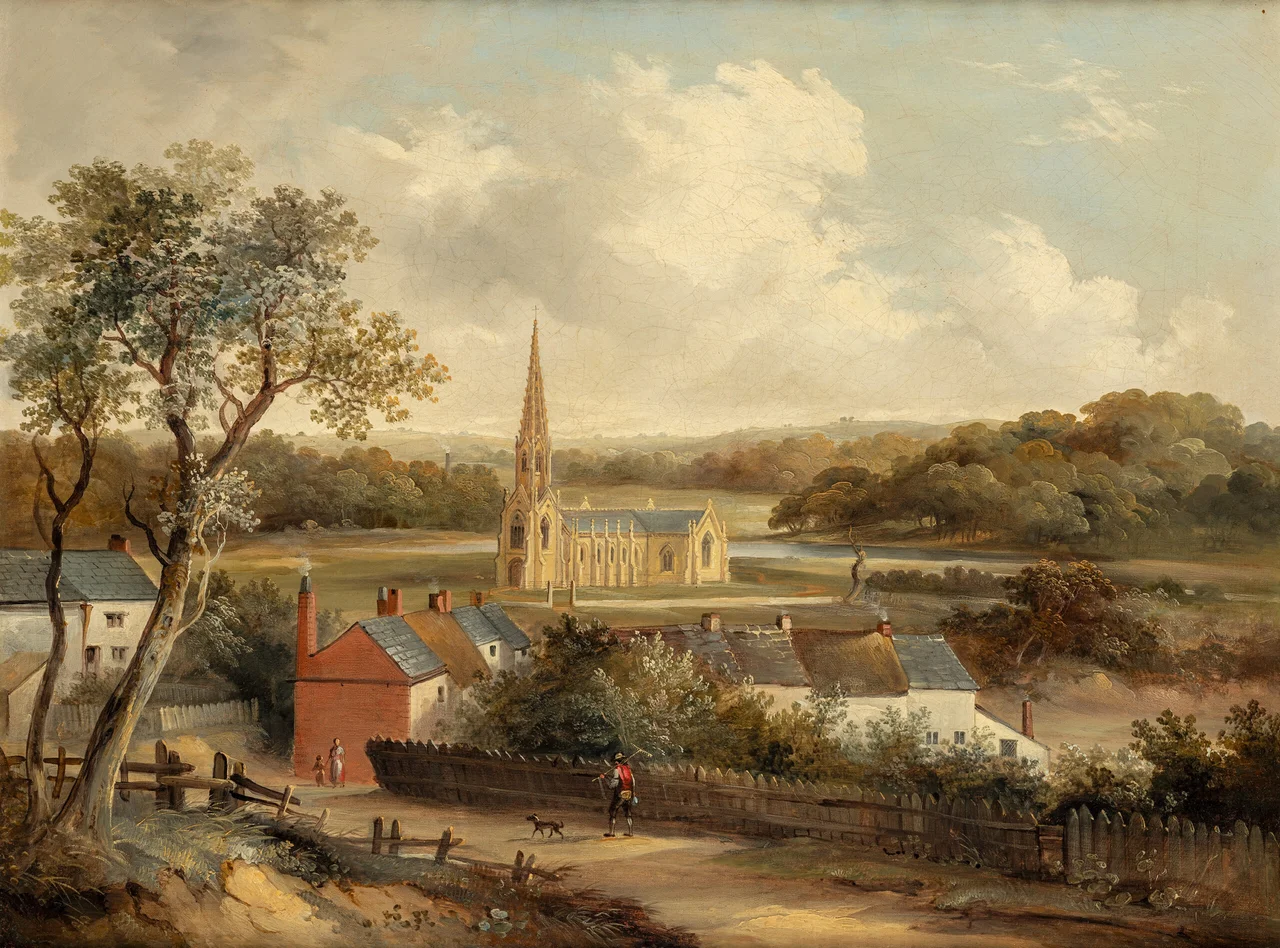
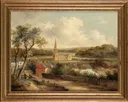
LANDSCAPE NEAR BOLTON – THE NEW CHURCH AT LEVER BRIDGE, c.1844
oil on canvas
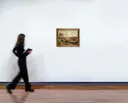
44.5 x 59.0 cm
57.0 x 71.5 cm (frame)
bears inscription verso: Landscape near Bolton / the New Church at Leve... / By J. Carse / Bought Sept. 1844
Estimate:
$4,000 - $6,000
Sold:
$3,682 (inc. BP)
lot details
57.0 x 71.5 cm (frame)
W.H. Patterson Fine Arts, London (label attached verso)
Chilmark Manor Estate, Salisbury, United Kingdom
Semley Auctioneers, Shaftesbury, 23 January 2016, lot 87
Private collection, Sydney
Catalogue text:
This is one of the finest works from Carse’s pre-Australian period. It depicts the Church of St Stephen and All Martyrs at Lever Bridge, Bolton, Greater Manchester, which was built 1842-1844 at a cost of £2,600 and consecrated in 1845. Designed by architect Edmund Sharpe, and constructed largely of terracotta, indeed it was one of only three such terracotta churchesdesigned by Sharpe -the others being Holy Trinity, Rusholme, and St Paul’s, Scotforth. Originally the church had an openwork spire, as shown in the painting, but by the 1930s the spire had become unsafe and was dismantled in 1937.
Prior to Carse’s departure for Australia, where he played a significant role in the history of Australian art, he appears to have been working in and around Bolton for about twenty years. Accordingly, both the Bolton Museum and Art Gallery, and Gallery Oldham today hold multiple works by the artist.
Interestingly, an article on Oldham artists published in the local newspaper (the Oldham Express) in April 1882 describes James Howe Corse [sic.] as an erratic genius who produced many local landscapes and also excelled in ‘glass staining’. It states that he ‘died in Australia in wretched circumstances some 10 years ago’, that is, in about 1872. While Carse left for Australia around 1869, the information regarding his death in about 1872 is erroneous, as it is well-documented that he died in Sydney in 1900. (Such misinformation may have been circulated when his wife Harriet realised he would not be coming back from Australia.)
James Howe Carse had married Harriet Hannah Gould in Manchester on 10 May 1852. In census records he identifies himself as an artist and gives his father as Alexander Carse, the well-known Scottish artist. In the 1851 census James and Harriet had been living together at 35 Brunswick Street in Hulme, Manchester (they claim to be married at this point which was not correct) and to have two children Sarah Jane (3) and Georgina (1). In this census, Carse specifies his occupation as ‘Landscape and Portrait Painter’. However, by the 1861 census, Harriet is living at a new address in Hulme with four children – Sarah Jane, Georgina, James (7) and Angelica (4). But there is no mention of James Howe at this point.And similarly, by 1871 Harriet (aged 50) is now living in Blackley with just Angelica for company. She gives her profession as Seamstress & Embroiderer.
It is not known why Carse separated from his family and headed to Australia, nor why he never reconnected. No references have been found to him having a wife or family between the time of his arrival in Australia and his death in 1900.
For a biographical essay on the artistsee’James Howe Carse’, by Stephen Scheding, in ‘Art and Australia’, vol. 17, no. 1, 1979.