

Cressida Campbell
(born 1960)
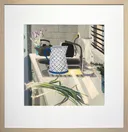
Kitchen sink, 1993
hand-painted unique woodblock print
59.0 x 59.0 cm (image)
signed lower left: Cressida Campbell
signed below image lower right: Cressida Campbell
Estimate:
$60,000 - $80,000
© Cressida Campbell/Copyright Agency 2026
lot details
signed below image lower right: Cressida Campbell
Philip Bacon Galleries, Brisbane (label attached verso)
Private collection, Sydney, acquired from the above in 1994
Exhibited
Cressida Campbell, Woodblock prints and woodblocks, Philip Bacon Galleries, Brisbane, May 1994, cat. 12
Literature
Crayford, P., The Woodblock Painting of Cressida Campbell, Public Pictures Pty Ltd, Sydney, 2008, cat. P9308, p. 344
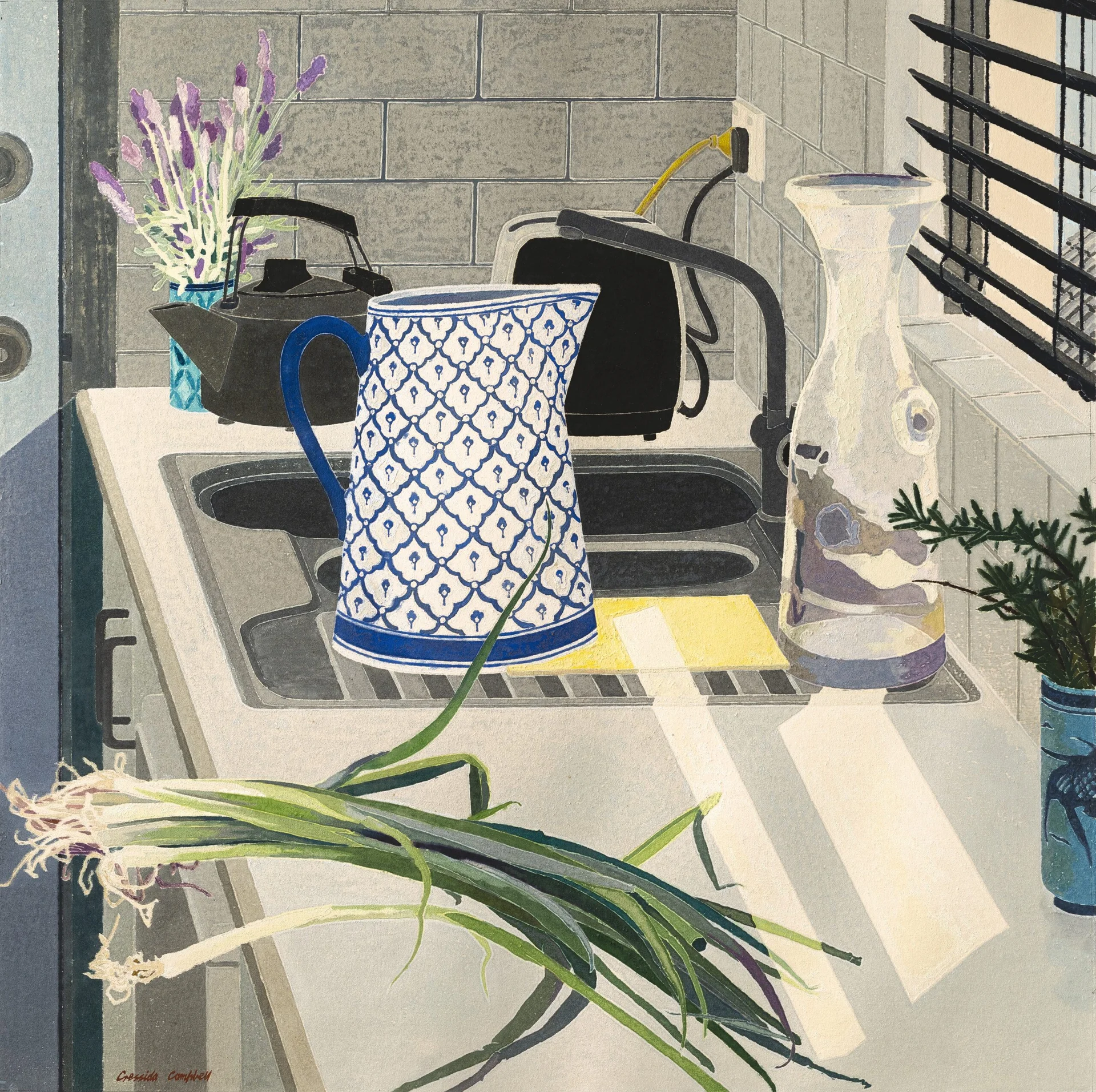
Arguing the case for ‘ordinary beauty’, many of Cressida Campbell’s celebrated prints and painted woodblocks depict familiar and everyday domestic items. In these unglamorous subjects, the artist has continued to look for and recognise beauty, even in the ‘most mundane aspects of human experience’ – elevating a mass-produced kitchen appliance or a corner of the laundry to an icon of domestic bliss.1 Writing a review of Campbell’s solo exhibition in November 1992, critic Bronwyn Watson identified a ‘clarity, and sometimes even a meditative calm’ in her work.2 Kitchen sink, 1993, presents one such quiet and meditative interior, a still life of pause and anticipation before the preparation of a shared meal has begun.
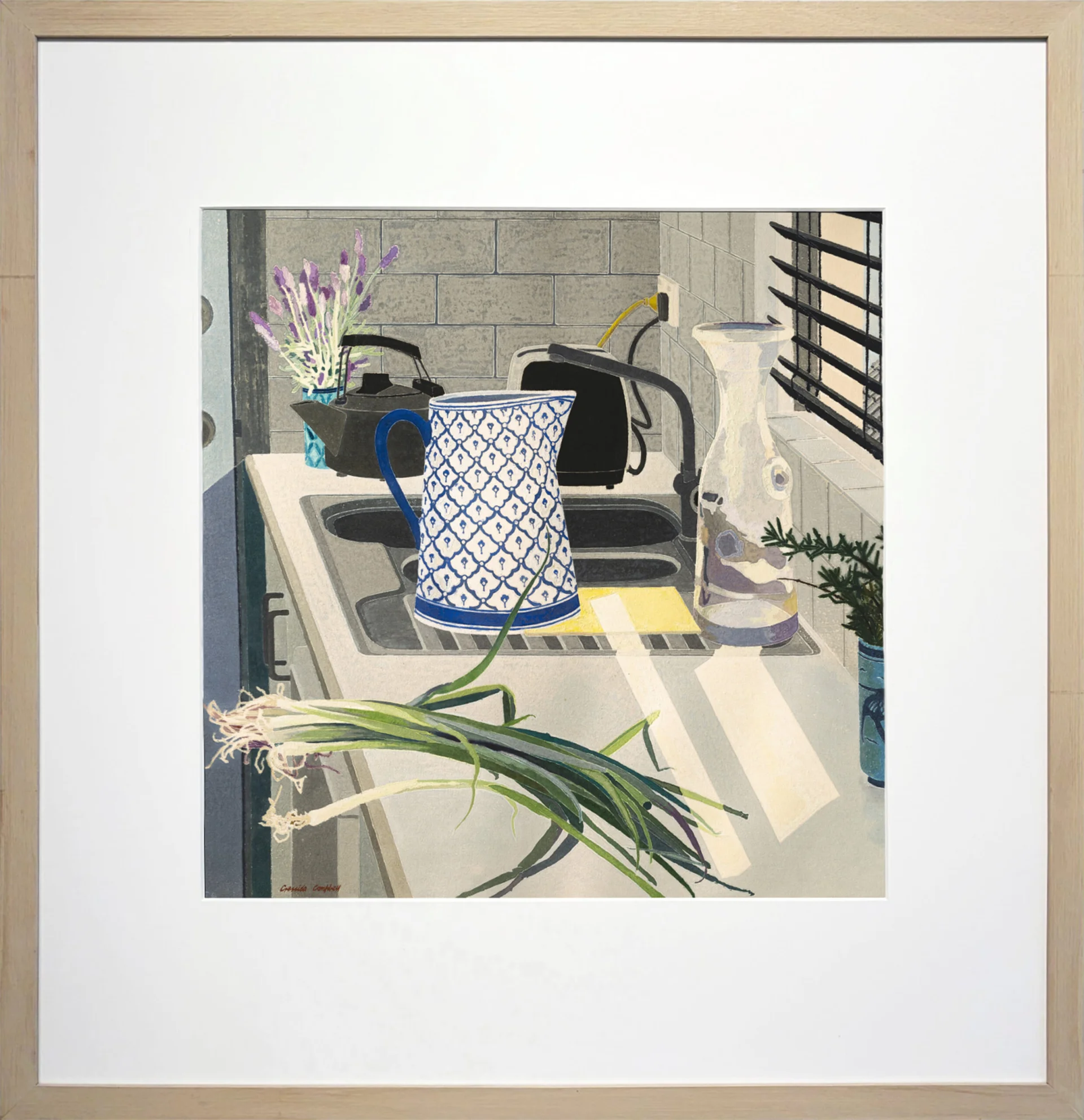
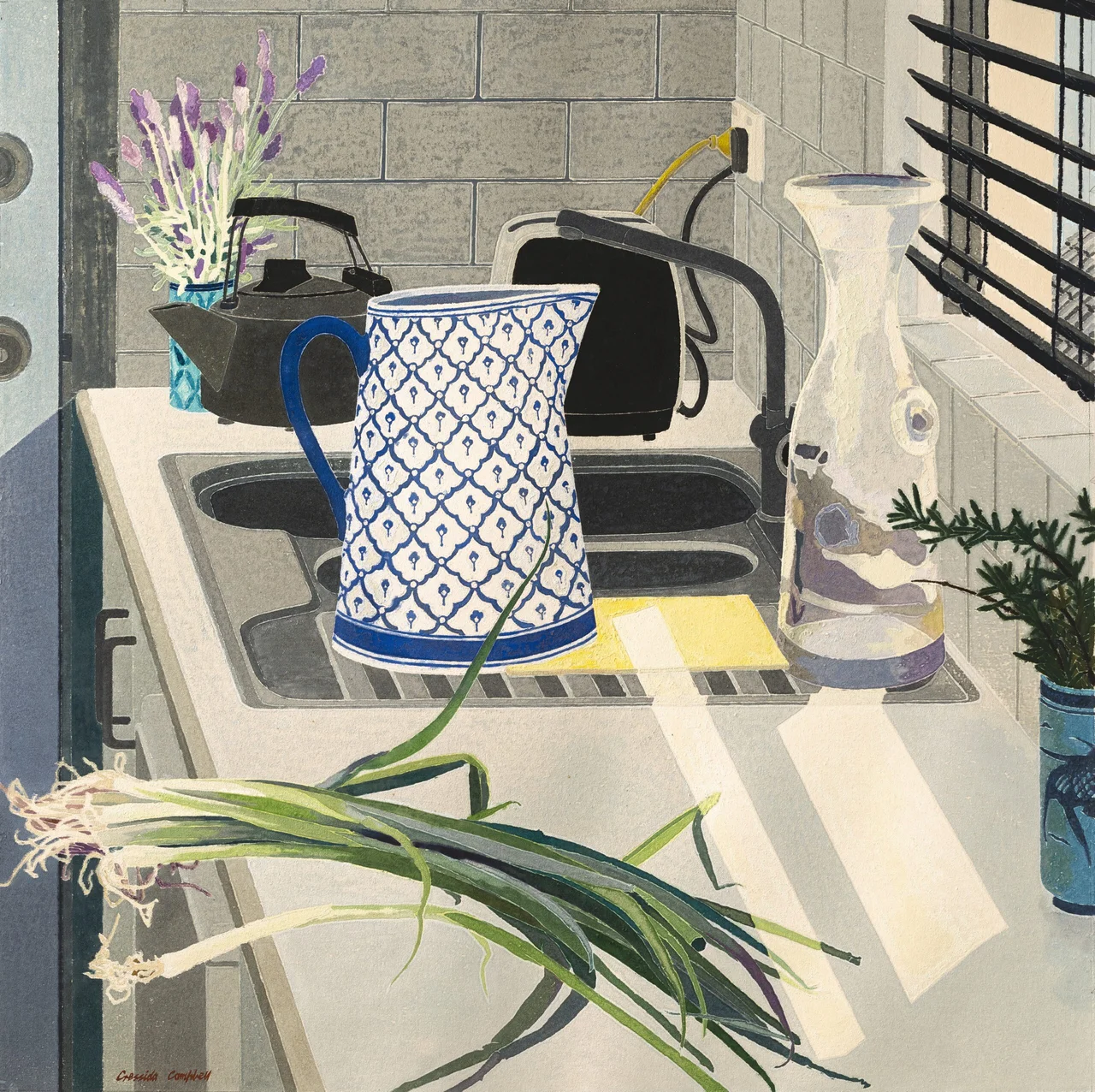
While Campbell’s other compositions of similar subject matter, Kitchen objects, 1990, Kitchen Utensils, 1993, and, Washing up, 2005, each made a focal point of the striking graphic silhouettes of piled dishes or a tangle of utensils – the real subject of Kitchen sink is not the objects themselves but the quality of the light. It lands on the clean countertop through the blinds in pale yellow parallelograms, then bounces around in the reflections of the glass carafe. This bright morning sunshine highlights the brief flashes of colour throughout Campbell’s symphony of utilitarian greys.
Cressida Campbell’s meticulously detailed still-life paintings are not artificial or traditionally staged tableaux. Her predilection for oblique views, casual arrangements and flattened pictorial planes generates the candid feeling of peeking into someone’s lived experience. The domestic views within her artworks are autobiographical, showing corners of her own home. Building on the comfort of this intimate and familiar subject matter, Campbell creates unique impressions through considered and often unconventional compositions, and subtle and harmonious renditions of colour and texture. Presenting an aura of careful casualness, her scenes appear to have been stumbled upon, the presence of the artist and her friends revealed only through dented cushions and abandoned plates.
The artist is herself an inveterate collector, her house filled with personal collections of seashells and Japanese prints, imported Indian textiles, lacquerware and blue-and-white Chinese ceramics. The more precious examples are proudly displayed on shelves within the artist’s home, becoming the subjects of artworks such as Shell collection, 2010, and Celadon with ceramics and lacquerware, 2018. Although utilitarian rather than antique, the pitcher in the centre of Kitchen sink, provides a decorative addition to Campbell’s scene with its visually arresting blue-and-white lattice pattern. Precariously teetering on the edge of the countertop, a bunch of unruly spring onions gaily contrasts with the smooth planes and cold surfaces of the kitchen and its objects. In the absence of other ingredients, this bunch almost takes the place of a bouquet of cut flowers waiting to be arranged decoratively in the pitcher, like the lavender in a turquoise cup tucked behind the kettle in the background.
1. Rae, J., ‘Ordinary Beauty’, in Noordhuis, S., Cressida Campbell, National Gallery of Australia, Canberra, 2022 p. 107
2. Watson, B., ‘The Challenge of the Beautiful’, Sydney Morning Herald, Sydney, 2 November 1992, p. 12
LUCIE REEVES-SMITH