



Dorrit Black
(1891 - 1951)
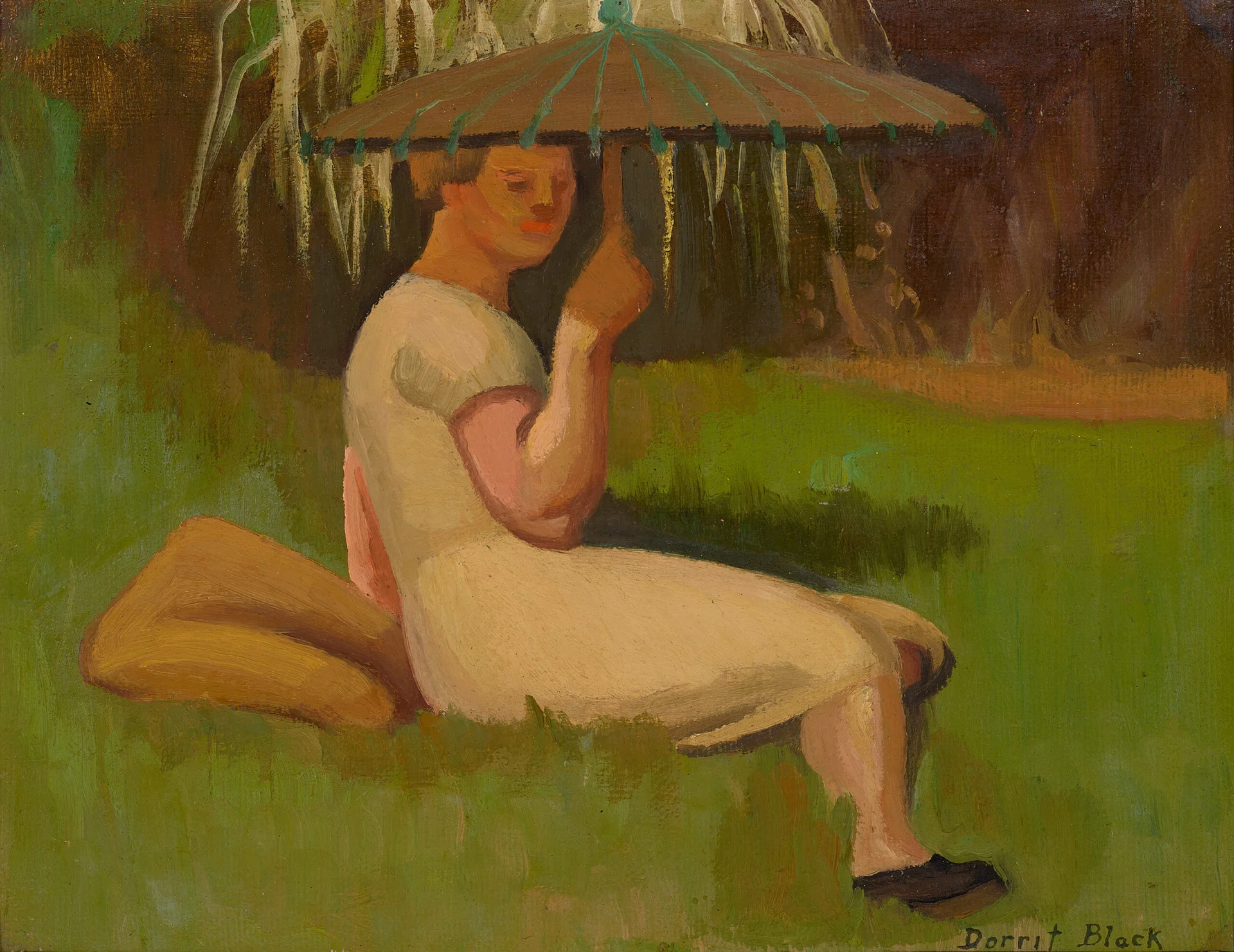
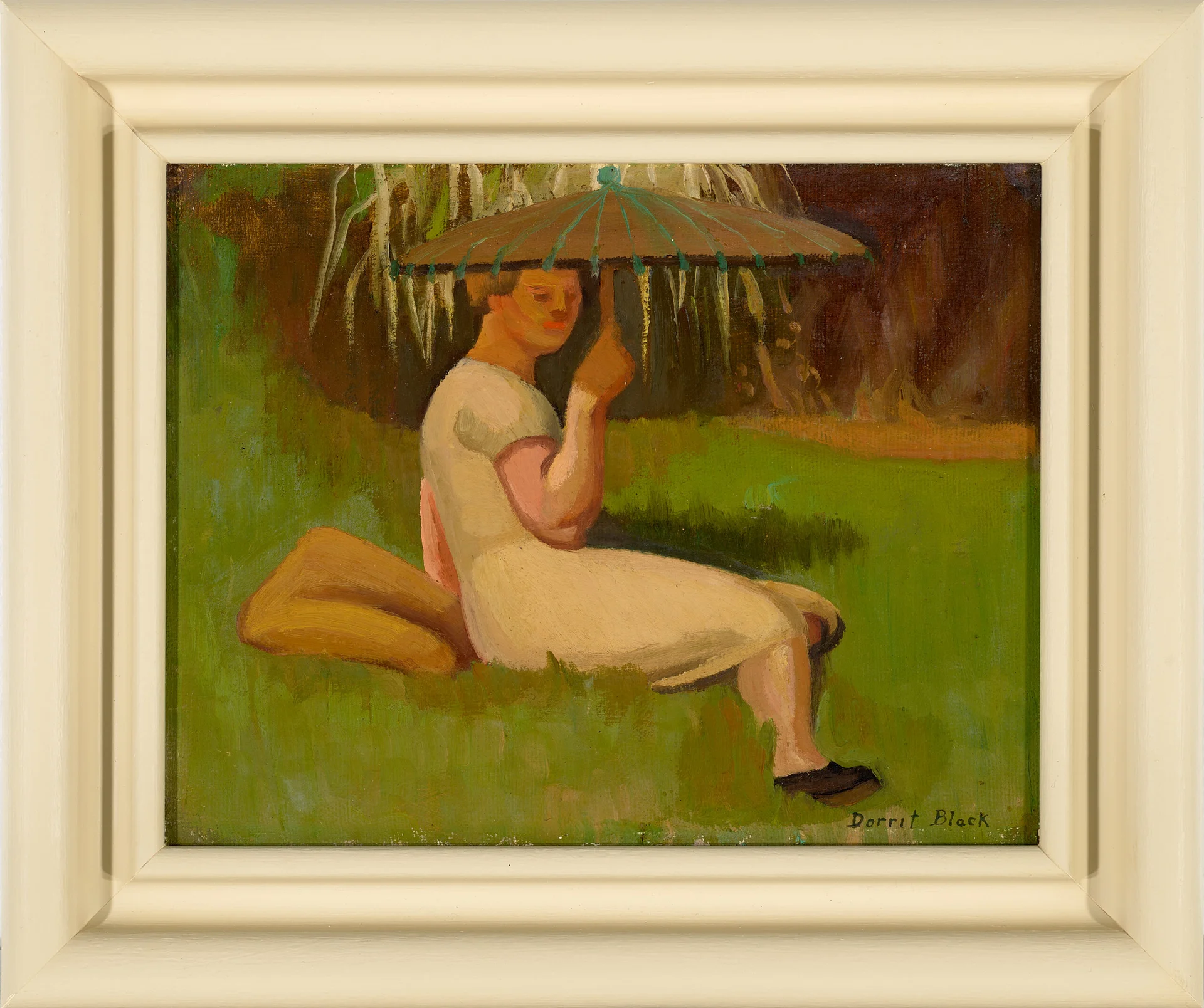
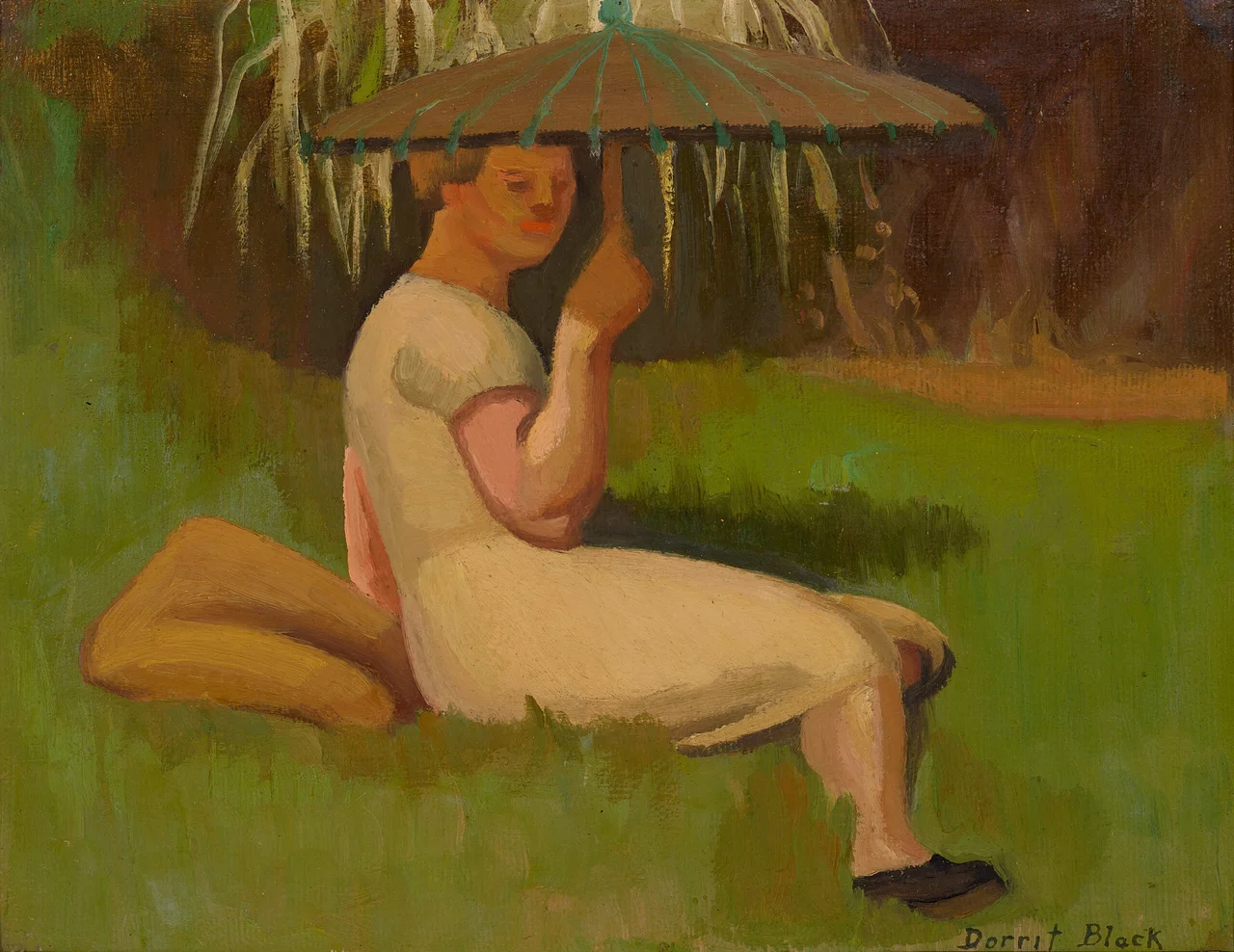
Lady with sunshade, c.1940 - 45
oil on canvas on cardboard
24.0 x 30.5 cm
signed lower right: Dorrit Black
bears inscription verso: 096 Lady with Sunshade / c.1940 - 45
Estimate:
$50,000 - $70,000
lot details
bears inscription verso: 096 Lady with Sunshade / c.1940 - 45
Estate of the artist
Thence by descent
Mary Leask, Salisbury, England
Thence by descent
Private collection, Perth
Literature
North, I., The Art of Dorrit Black, Art Gallery of South Australia, Adelaide, and Macmillan, South Melbourne, 1979, cat. O.96, p. 124
At the onset of World War Two, Dorrit Black had already been back in Adelaide for some years. After two decades of living abroad and interstate, in the mid-1930s, she settled back into the relative anonymity of the quiet suburbs of her childhood. In her art, she also experienced something of a ‘retour à l’ordre’. While continuing to paint and exhibit, she now strove to reconcile her years of training in modern Cubist art with a desire to return to a more representational mode of painting. Reflecting on the development of her practice in the catalogue of her major retrospective exhibition in 1945, Black wrote, ‘my interest in realistic painting has been reviving; but it is a different kind of realism, based on all I have learned in the interval of constructive and rhythmical design.’1
In her late forties, and having recently inherited from both her parents, Black retained her privileged position of having private means, independent of employment or the sale of artworks, allowing her to purchase a house with a studio space for painting. Feeling relatively isolated from the centres of modernist Australian art in Sydney and Melbourne, Black devoted herself to integrating with the local art community. Throughout the 1940s, she joined the Royal South Australian Society of Art and served on its council, later becoming vice-chairman of the local branch of the reactionary Contemporary Arts Society. Taking over the landscape painting class from Louis McCubbin in 1940, Black began mentoring young artists at the School of Arts, sharing her rare first-hand knowledge of Cubism and other related European avant-garde movements with the next generation of Australian artists.2
The radiant Lady with sunshade, c.1940 – 45, belongs to a period of figurative works created from studies en plein air, often alongside her students from the school and the Society’s weekly sketch club – ‘on Saturday and Sunday afternoons, she [Black] would still expect us to go out painting with her’, one student later recalled.3 Here, Dorrit Black presents a posed scene of sunny serenity, with a lady of leisure lounging in the outdoor environment of a park or garden. The pose of the reclining lady, boldly and clearly outlined in shapes of uniform colour, dominates the composition, leaving little room for further detail in Black’s garden setting. The background is simplified into flat areas of tender spring green and burnt umber shade. The pale drooping leaves of a willow tree become tassels for the lady’s paper parasol, providing a delicate decorative element animating the composition. Underpinned by a modernist pattern of flat shapes and block colours inherited from her linocuts, Black’s Lady with sunshade is a contemporary update of the theme of Belle Époque ladies in sunlit gardens, now transposed to the peaceful remoteness of Adelaide throughout World War Two.
Curator Tracey Lock wrote in the catalogue of Black’s most recent retrospective in Adelaide in 2014 that the artist’s ‘characteristic response’ to war was to ‘retreat to her own personal or local space.’4 The sweetness of Black’s prosaic figure studies, landscapes and still lifes, however, was counterbalanced by the artist’s activism in the local war effort (where she served as an Air Raid Warden) and her concurrent, politically charged paintings of people at work in the vein of social realism, such as The wool shed, 1939 and The wool quilt makers (Red Cross Wool Fleece Quilts Relief Committee), c.1940 – 41, (both Australian War Memorial, Canberra). The sober industry of these paintings of the collective war effort makes little vignettes of joyful and safe mundanity such as Lady with sunshade all the more poignant.
1. Dorrit Black, cited in Dorrit Black, 1945, RSASA Gallery, Adelaide, cited in Lock, T., Dorrit Black: unseen forces, Art Gallery of South Australia, Adelaide, 2014, p. 134
2. North, I., The Art of Dorrit Black, Art Gallery of South Australia, Adelaide, and Macmillan, South Melbourne 1979, pp. 86, 88
3. See North, ibid, p. 87
4. Lock, op. cit., p. 126
LUCIE REEVES-SMITH