

Weaver Hawkins
(1893 - 1977)
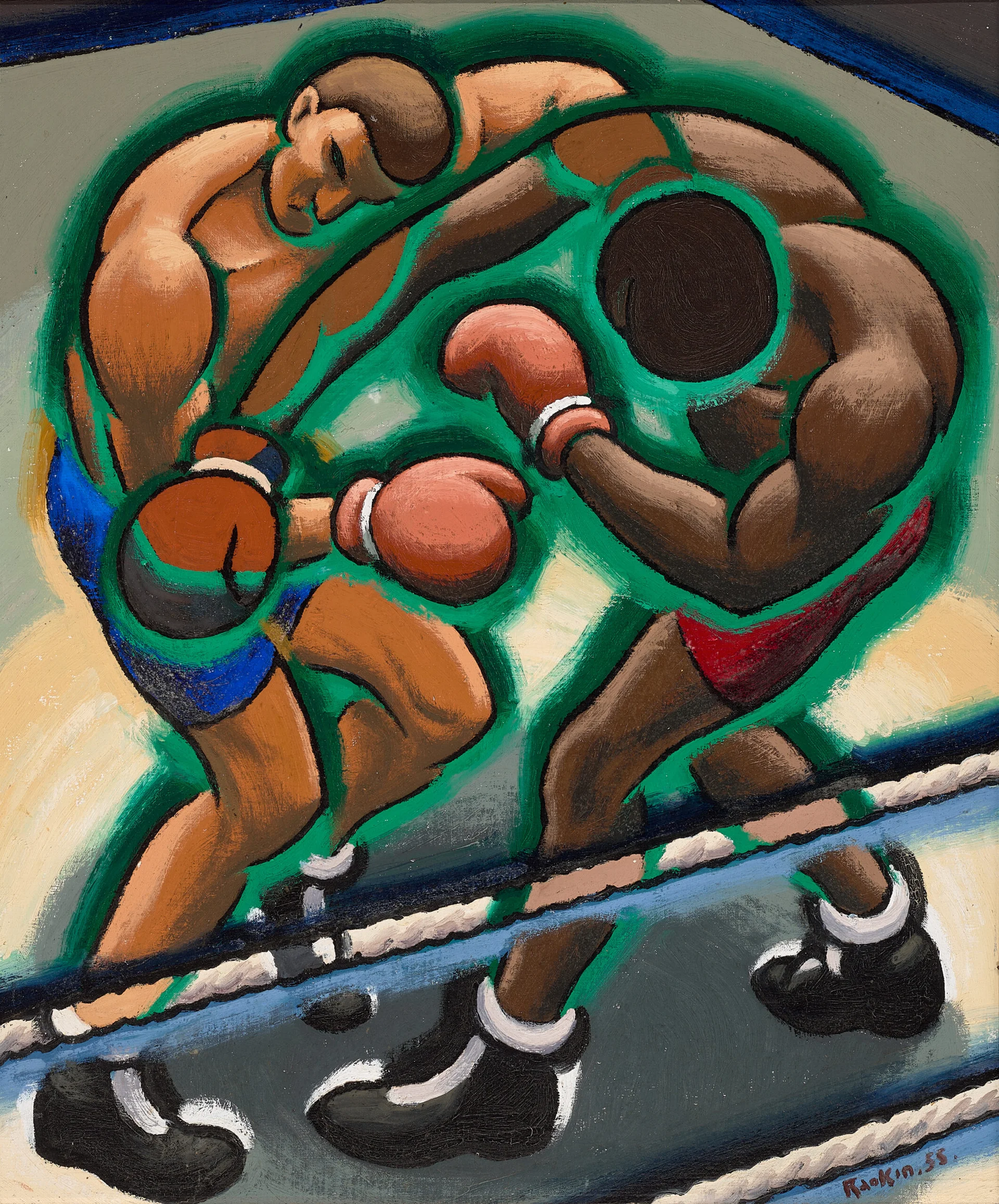
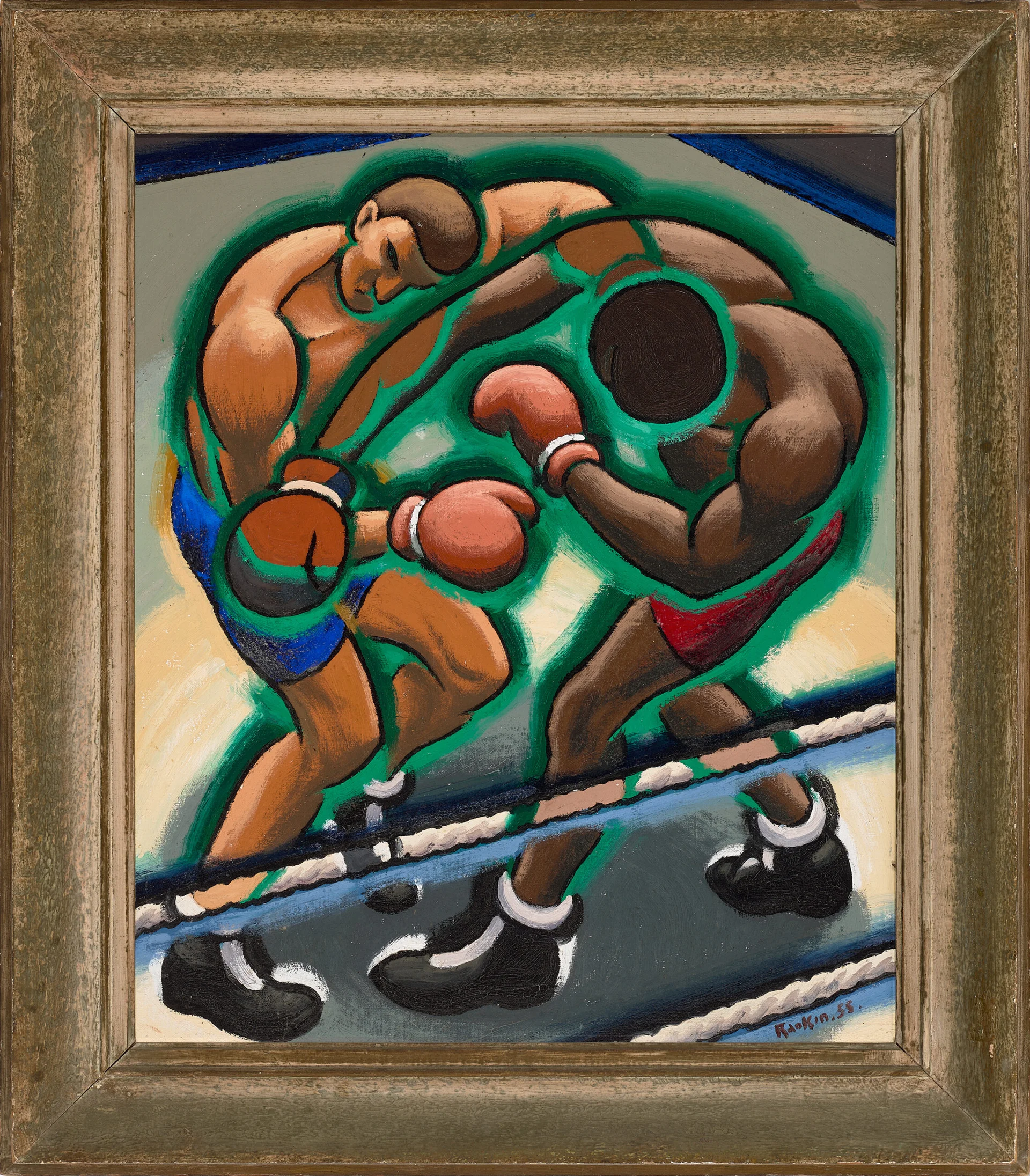
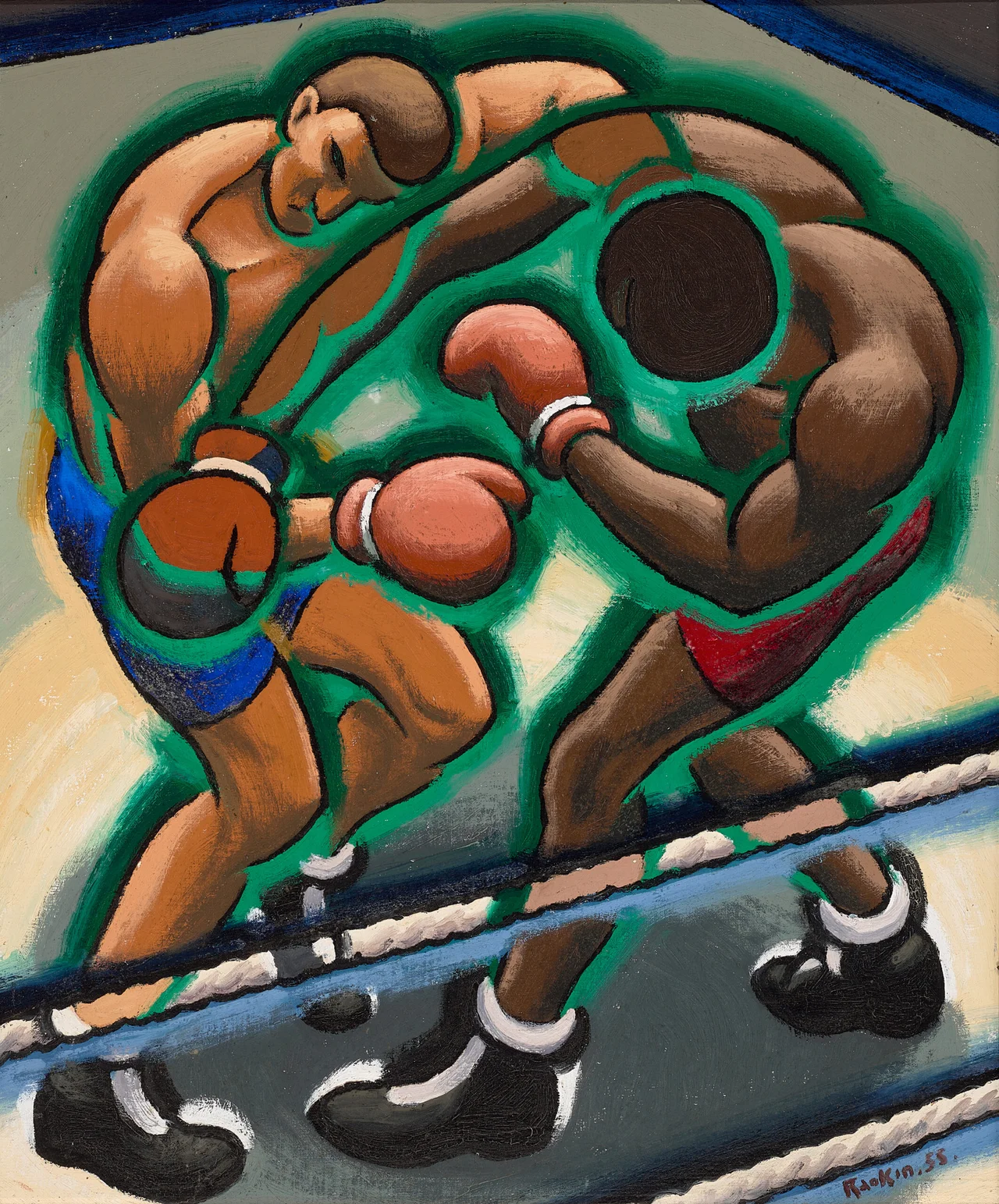
Boxers, 1955
oil on canvas board
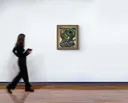
60.5 x 50.5 cm
signed and dated lower right: Raokin. 55.
bears inscription verso: WEAVER HAWKINS / 'BOXERS'
Estimate:
$20,000 - $30,000
© Weaver Hawkins Estate, 2026
lot details
bears inscription verso: WEAVER HAWKINS / 'BOXERS'
Private collection, Sydney, acquired in December 1975
Estate of the above, Sydney
Exhibited
Artists For Whitlam, Paddington Town Hall, Sydney, 1 – 3 December 1975
Harold Weaver Hawkins and William Frater, Campbelltown City Art Gallery, Sydney and touring to: The Lewers Bequest & Penrith Regional Art Gallery, Sydney; Goulburn Regional Art Gallery, New South Wales; Dubbo Regional Art Gallery, New South Wales; Bathurst Regional Art Gallery, New South Wales and New England Regional Art Museum, New South Wales, February – November 1992
Weaver Hawkins, Newcastle Region Art Gallery, New South Wales, 25 October – 20 December 1994, cat. 37
Weaver Hawkins 1893 – 1977, S.H. Ervin Gallery, Sydney, 2 June – 16 July 1995, cat. 44 (label attached verso)
A Century of Collecting 1901 > 2001, Ivan Dougherty Gallery, Sydney, 29 March – 28 April 2001, cat. 18 (illus. in exhibition catalogue, p. 12)
Weaver Hawkins was already a trained artist when he enlisted in World War One, only to be horribly maimed on the Western Front. Left with two withered, elbow-less arms, the right hand slightly stronger than the left, he had to re-train. Extraordinarily, he began with etchings, filled with precision lines and closely hatched tones, an almost unbelievable feat under the conditions. He then resumed painting and in the early 1920s his work appeared in the same English exhibitions as that of David Jones, Bernard Meninsky and the founder of Vorticism, Wyndham Lewis.1 Hawkins’ regard for the rhythm of lines, as expressed in the etchings, underpinned his resulting career, and in Boxers, 1955, the fluid, compact design is similarly based around curves and arcs filled with dynamic expression.
In 1923, Hawkins married and, with his wife Rene, settled in St Tropez, France. They travelled constantly over the next decade to Italy, England, and Malta before journeying by yacht to Tahiti and New Zealand. In March 1935, the family (with their children) arrived in Australia, and established a permanent residence in Sydney, in the northern beaches suburb of Mona Vale, on a street where a number of other artists, actors and musicians were neighbours, gaining it the nickname of ‘the mad half mile’ in the popular press. They became close friends with fellow artists Frank and Margel Hinder, who ‘shared an ‘intellectual’ approach to their work. Composition, as the ‘orderly expression of an idea’ remained fundamentally important.’2 The Hawkins family were ‘rationalists, socialists and nonconformists’, and he wore hand-made leather sandals but never a tie.3 His art too expressed such ideals and Hawkins’ wide-ranging interests included Dynamic Symmetry, Platonic Solids, Magic Squares and the Modular, as well as the intricacies of Islamic patterning. Through these studies, he was able to find sense within the tumult of the world, creating ‘order out of chaos in works which he hoped might help to make the world a better place (stating that) ‘I hold that it is possible to create beauty with the intellect.’4
Hawkins defied and conquered much of his disability, but one thing he could not do was participate in rigorous sports. It may well be why a number of his paintings focus on intensely physical sports such as Football, 1952 (private collection); the companion horseracing images Going round, 1954 (Art Gallery of New South Wales), and Full tilt, 1954 (see Deutscher and Hackett, Important Australian and International Art, Melbourne, 26 August 2026, lot 59); and the ink and pencil Tennis, 1961. Similarly, the iconic Jitterbugs, 1945 (Art Gallery of New South Wales), depicting frenetic jazz dancers, is ‘a composition worked out by magic squares.’5 In Boxers, as in the other sports-related paintings, Weaver employs bold outlines which both delineate the pattern and emphasise directional forces. Known as ‘Lines of Force’, this was a Vorticist tactic which causes the image to ‘jump out dramatically from the flat picture plane.’6 Hawkins became a fine exponent, as can be seen clearly in Boxers, with its two protagonists entwined in their brutal dance, cycling and circling until the final round.
1. Thomas, D., ‘Weaver Hawkins’, Project 11: Weaver Hawkins, Art Gallery of New South Wales, Sydney, 7 February – 14 March 1976.
2. Chanin, E. & Miller, S., The art and life of Weaver Hawkins, Craftsman House, Sydney, 1995, p. 83
3. See Thomas, D., ‘Hawkins, Harold Frederick (1893 – 1977)’ in Australian Dictionary of Biography, National Centre of Biography, Australian National University at: https://adb.anu.edu.au/biography/hawkins-harold-frederick-10457/text18547
(accessed online 5 November 2026)
4. ibid.
5. Chanin & Miller, op. cit., p. 67
6. McIntyre, A., ‘Weaver Hawkins – a tribute to a pioneer’, The Weekend Australian Magazine, Sydney, 15 – 16 April 1978, p. 7
ANDREW GAYNOR