
John Peter Russell
(1858 - 1930)
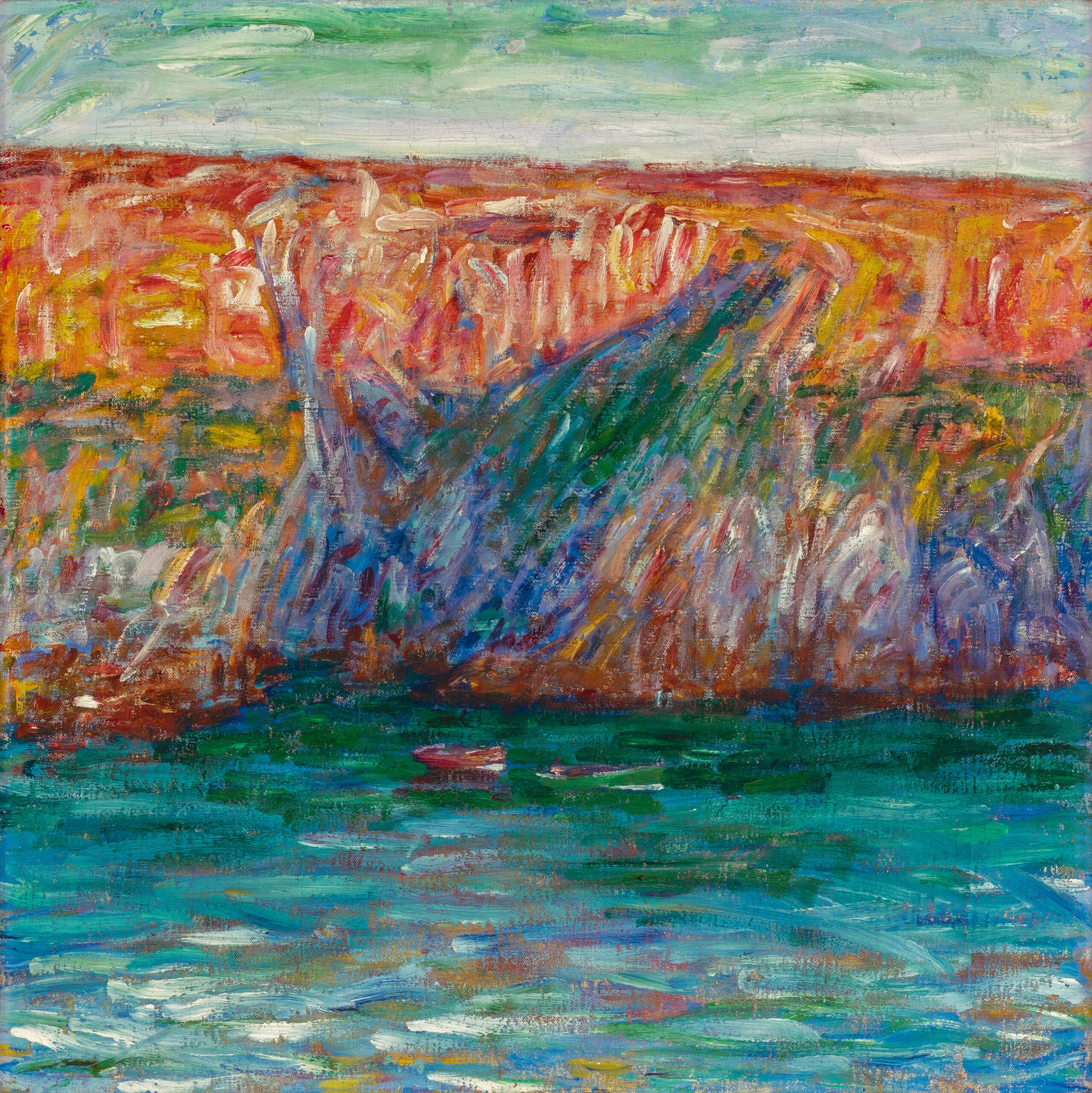
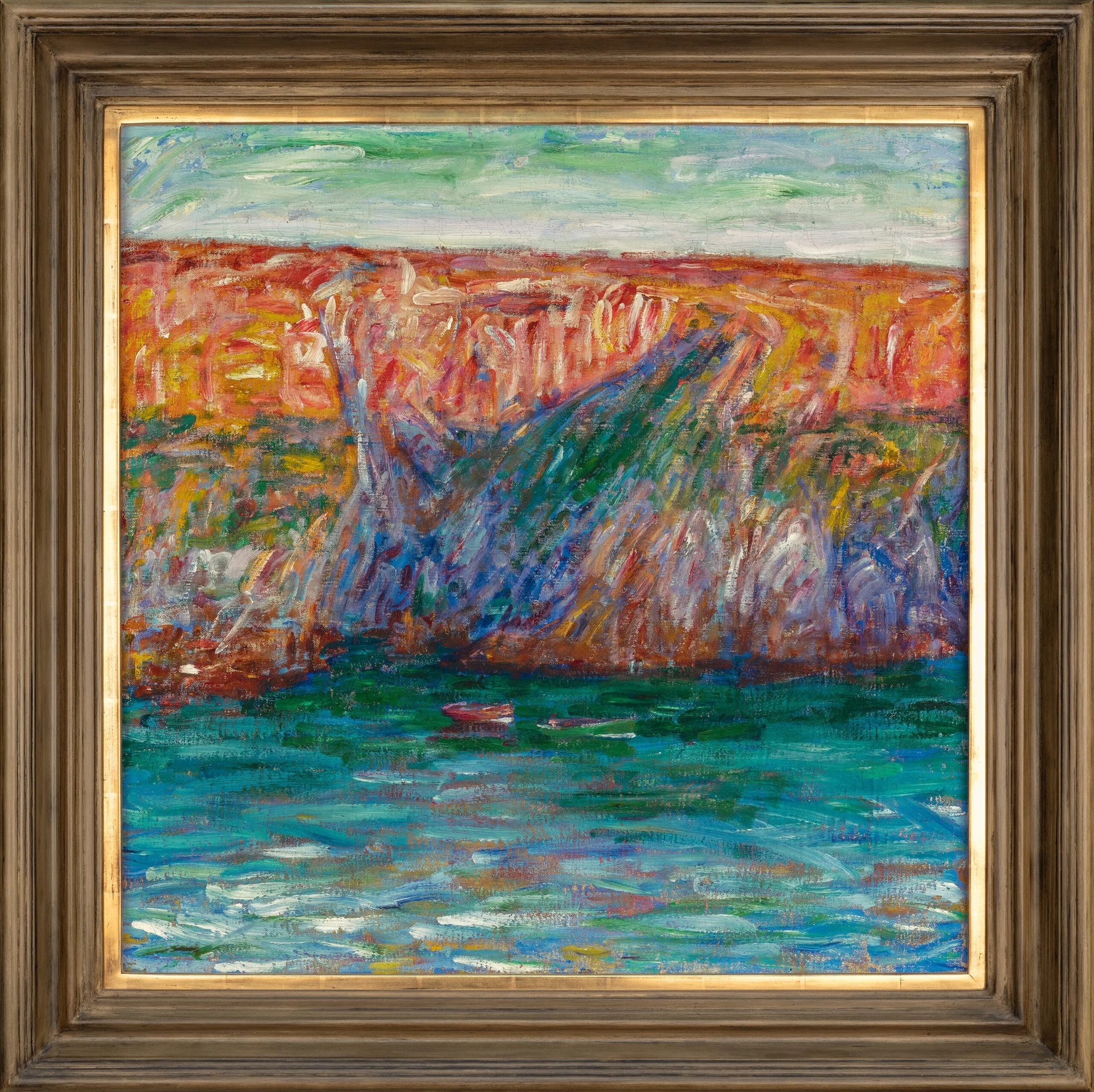
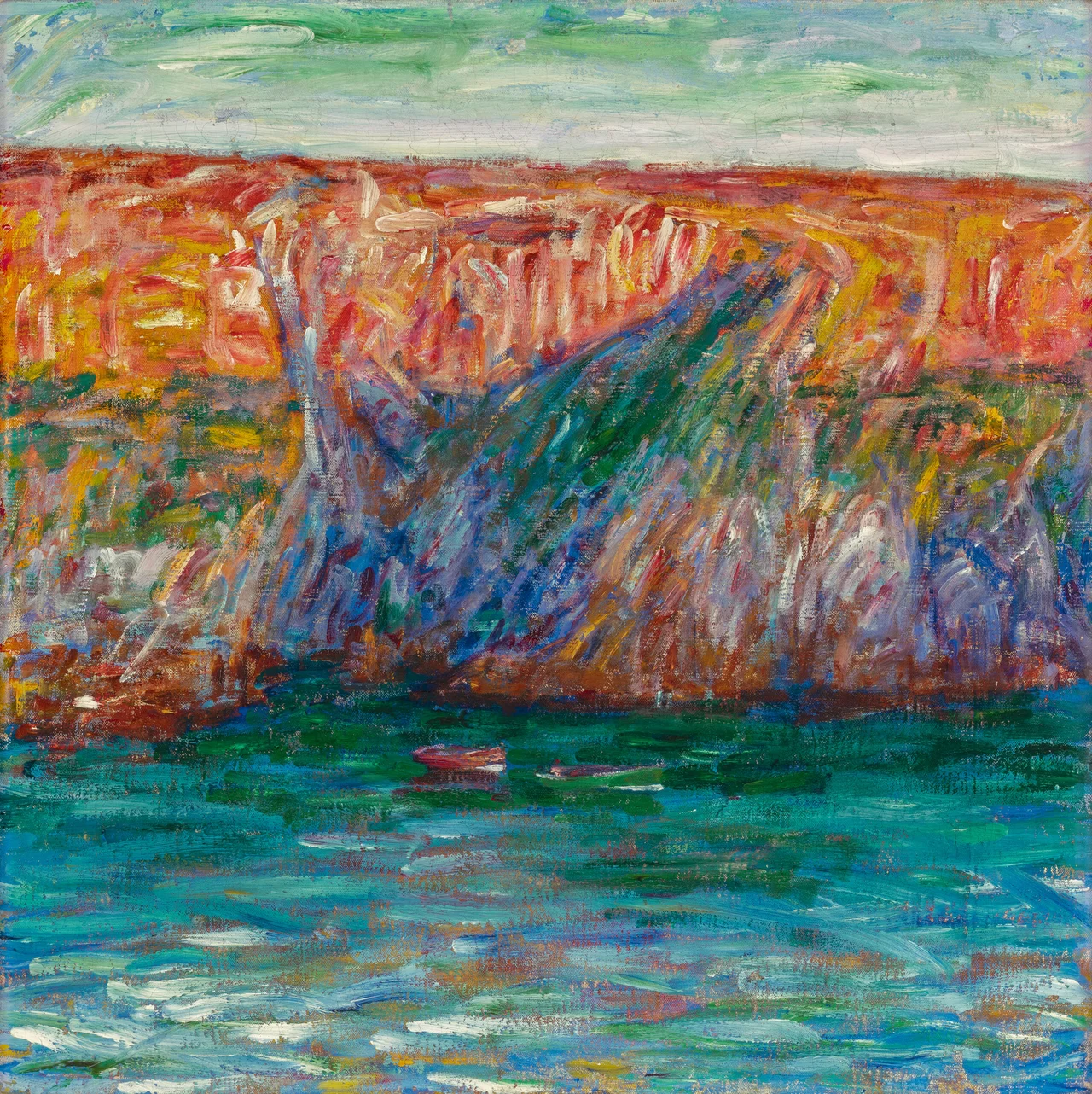
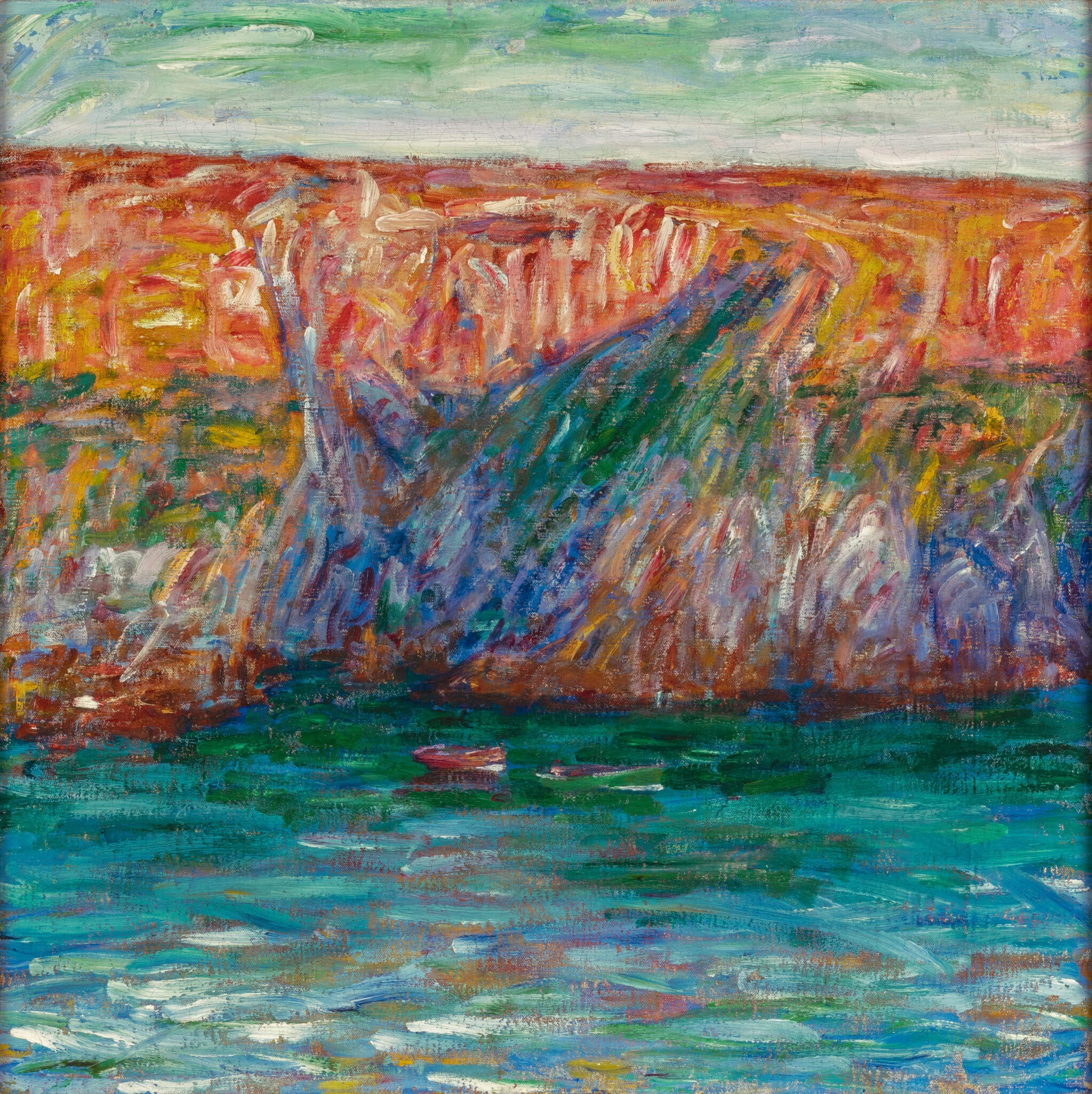
Baie de Goulphar (Belle Île), c.1900
oil on canvas
65.5 x 65.0 cm
bears inscription on old label verso: 4
bears inscription on stretcher verso: 18 / 32
Estimate:
$800,000 - $1,200,000
lot details
bears inscription on stretcher verso: 18 / 32
Estate of the artist, Brittany, France
Thence by descent
Jeanne Jouve, the artist’s eldest child and only daughter
Madame P. Lecoin, Brittany, France
Thierry-Lannon & Associés S.A.R.L., Brest, France, 2 May 2009, lot 211
Private company collection, Sydney
Exhibited
John Peter Russell, Galerie G. Denis, Paris, 1941 / 1943 (?), cat. 32 (label attached verso)
John Peter Russell 1858-1931: Australian Impressionist, Wildenstein & Co. Ltd, London, July – August 1965, cat. 30, lent by Madam Lecoin (label attached verso)
John Peter Russell: Australian Impressionist, Rijksmuseum Vincent van Gogh, Amsterdam, 10 January – 12 February 1978; University Art Museum, University of Queensland, Brisbane, 25 February – 19 March 1978; National Gallery of Victoria, Melbourne, 30 March – 6 May 1978 and Art Gallery of New South Wales, Sydney, 21 May – 26 June 1978
John-Peter Russell: Un impressionniste australien, Musée des Jacobins, Morlaix, 27 June – 2 November 1997 and Musée de La Cohue, Vannes, 22 May – 13 September 1998, cat. 34 (illus. in exhibition catalogue, p. 51)
Literature
Galbally, A., The Art of John Peter Russell, Sunbooks, Melbourne, 1977, cat. 175, p. 108
In a letter to his friend, Tom Roberts, in 1887, John Russell described the landscape of Belle-Île in terms of colour: ‘The gorse & heather. Yellow & purple, orange boat sails, blue sea, Red rocks, Green sea.’ Continuing with what reads like a motivational challenge, he wrote, ‘All a matter of feeling. Tis in the man with brush & paint pot or it is not.1 The paintings Russell subsequently produced on Belle-Île bear testament to the strength of feeling that he found there. Depicting the rugged coastline of the island, the sea and rocks, as well as figure studies, they possess a visual intensity that reflects his painterly and chromatic experimentation while capturing the changing light and atmospheric conditions of the environment.
Russell’s inherited wealth afforded many freedoms, setting him on a unique path that brought him into direct contact with some of the great masters of European Impressionism and Post-Impressionism. No longer expected to join the family business following the premature death of his father in 1879, and now in possession of a substantial fortune, he sailed to England in 1880, enrolling at London’s Slade School the following year. Continuing his studies at Fernand Cormon’s atelier in Paris in the mid-1880s, he worked alongside Émile Bernard, Henri de Toulouse-Lautrec and later, Vincent van Gogh. Russell and van Gogh established an enduring friendship which is documented in their personal correspondence.2 Russell was also one of the few artists to paint van Gogh and the 1886 portrait, now in the collection of the Van Gogh Museum in Amsterdam, was treasured by the Dutchman who asked his brother Theo to ‘take good care of my portrait… which means a lot to me.’3
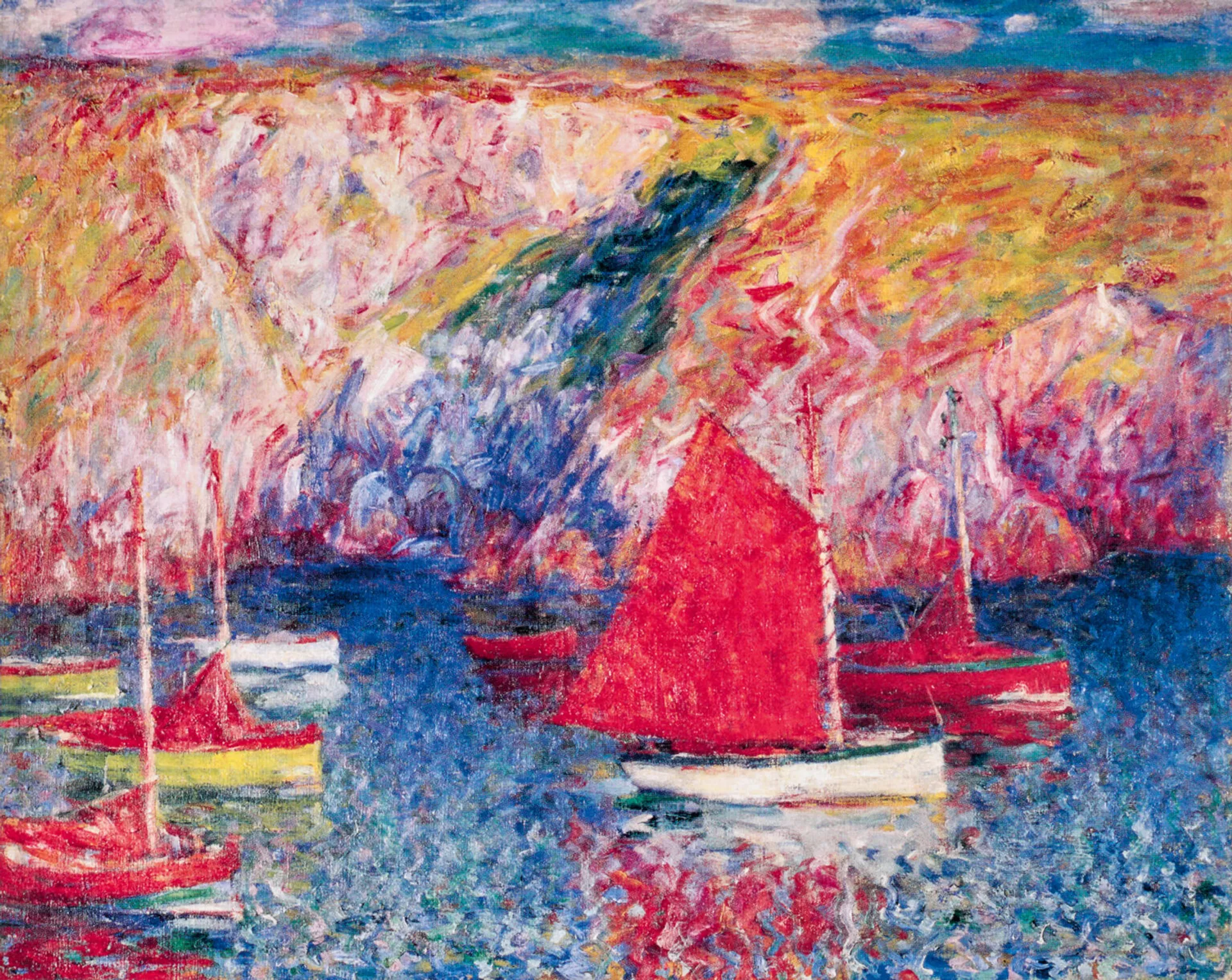
John Peter Russell
La Voile rouge, port de Goulphar, c.1900
oil on canvas
65.0 x 80.0 cm
Musée d’Orsay | Musée de Morlaix, France
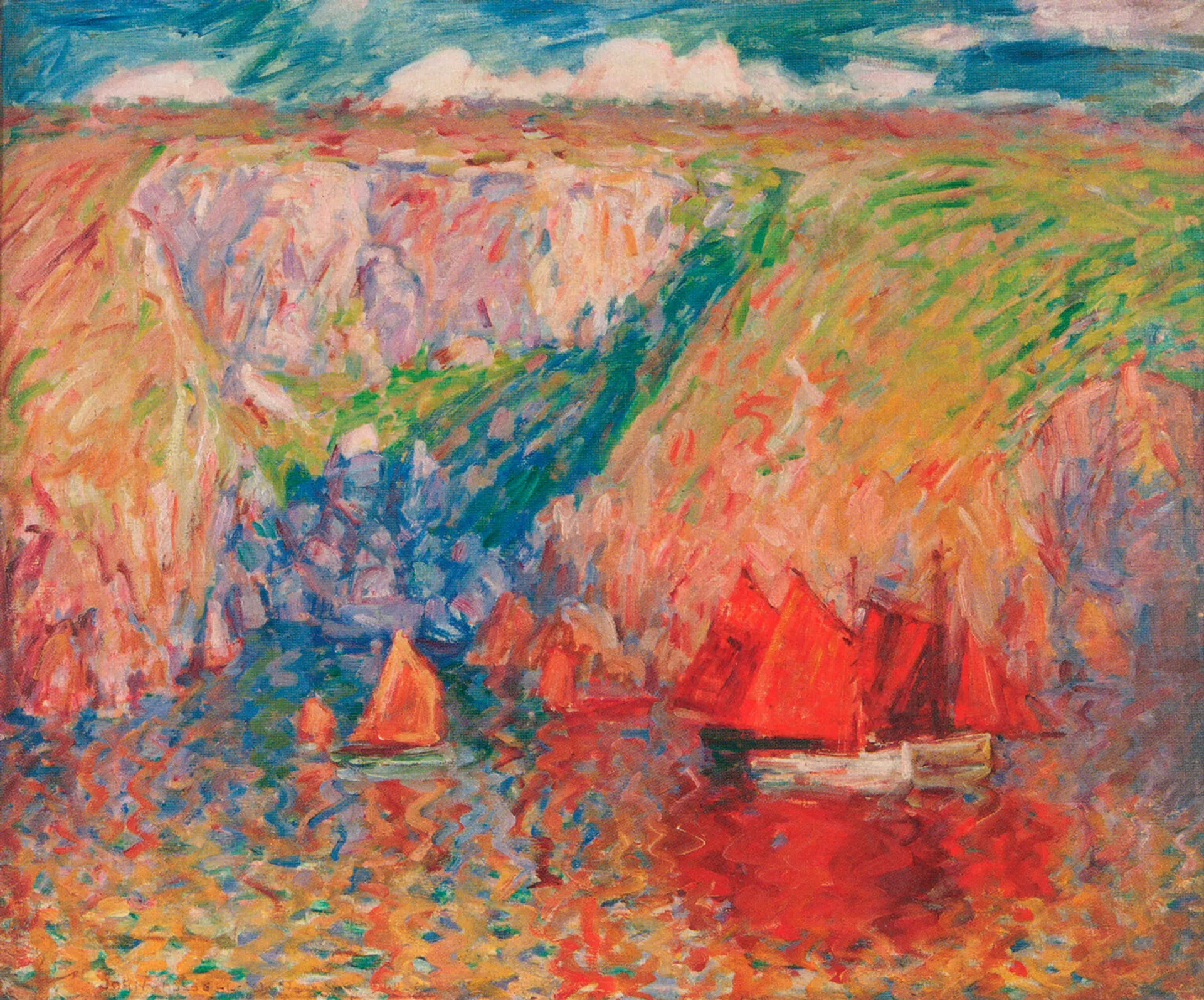
John Peter Russell
Fishing boats, Goulphar, 1900
oil on canvas
54.0 x 64.5 cm
Collection of Jeff, Ann, Jen and Joel Brown
Russell’s first experience of Belle-Île, one of a group of small islands off the coast of Brittany, took place in 1886. On a summer break from Paris, he and his wife-to-be, Sicilian-born Marianna Mattiocco, spent several months there, staying in the small village of Envag next to Port Goulphar. It was a momentous visit. The following year, he bought land overlooking the inlet of Goulphar, building a well-appointed home known as ‘Château de l’Anglais’ (or ‘Château de Goulphar’), complete with a large studio, workshop and expansive garden. Living there permanently until 1909 – 10, Russell came to know the geography of Belle-Île intimately and, as an accomplished yachtsman, he often sailed around the island experiencing the physical power and changing moods of the ocean. While Fishing boats, Goulphar, 1900 (Art Gallery of Ballarat) describes tranquil waters, Rough sea, Belle-Île, 1900 (National Gallery of Victoria), captures the opposite extreme in a luminous example of Russell’s painterly dynamism, the energy of his brushstrokes mirroring the turbulence of the ocean.
The first visit to Belle-Île also had a profound influence on the direction of Russell’s art. It was at this time that he met Claude Monet, whom he saw working en plein air and, recognising his painting style, famously introduced himself by asking if he was indeed ‘the Prince of the Impressionists’. Inevitably flattered, Monet, who was eighteen years Russell’s senior, took a liking to the young Australian and dined with him and Marianna, enjoying their hospitality and company during his stay on the island. Uncharacteristically, Monet allowed Russell to watch him work and, on occasion, to paint alongside him, experiences that provided the younger artist with an extraordinary insight into the techniques and working method of one of the founders of the Impressionist movement. The influence on Russell was significant, and the paintings he made in Italy and Sicily only a few months later show him working in a new style, using a high-keyed palette (from which black had been banished entirely) and composing his pictures with strokes of pure colour.4 In addition to showing him how to use colour as a means of expressing a personal response to the subject, Monet’s example also highlighted for Russell the importance of working directly from nature.5
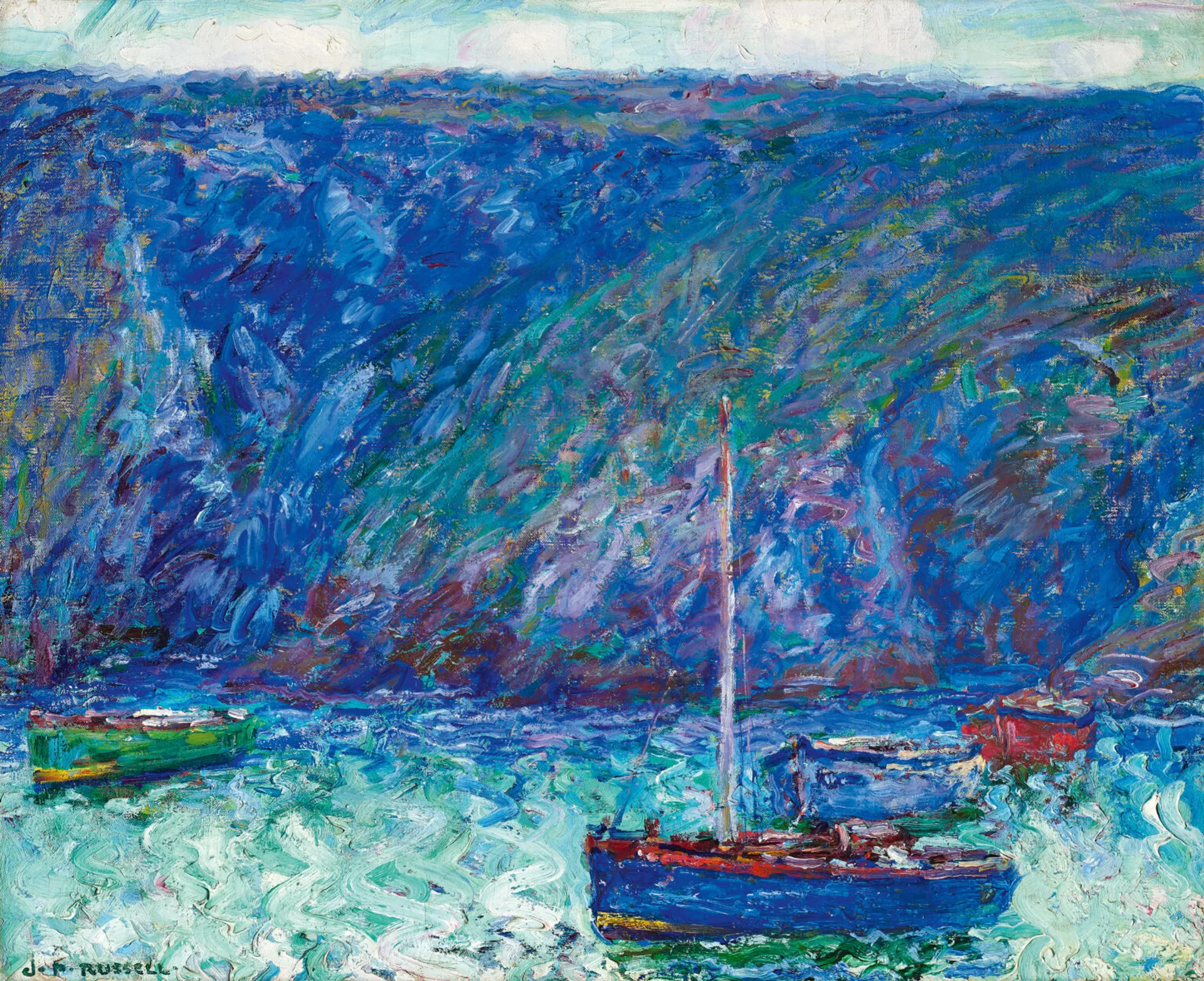
John Peter Russell
Cruach en Mahr, Matin, Belle-Île-en-Mer, c.1905
oil on canvas
60.5 x 73.5 cm
Private collection
Sold Deutscher and Hackett, 24 April 2024, lot 11, for $3,927,273 (inc. BP)
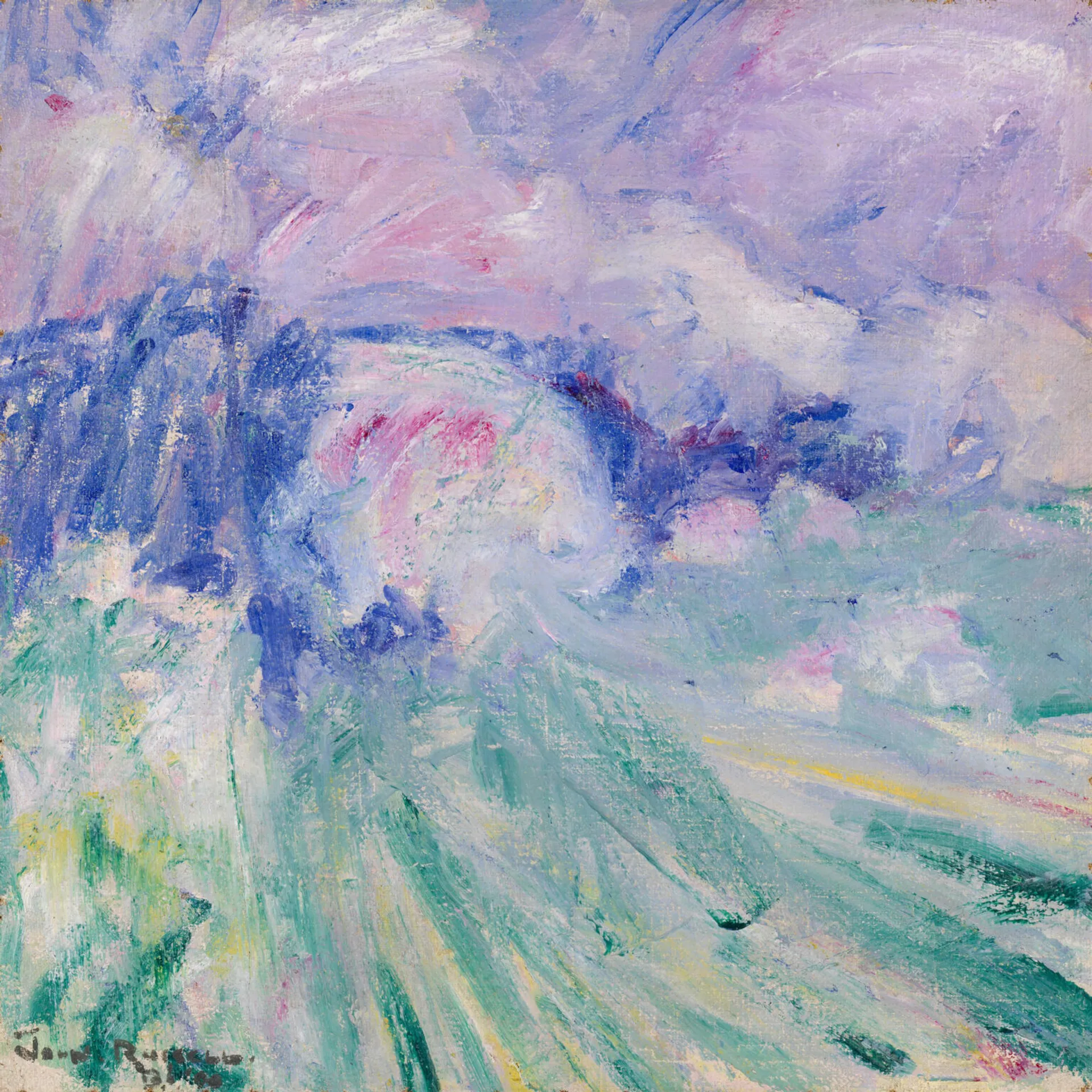
John Peter Russell
Rough sea, Belle-Île, 1900
oil on canvas
63.2 x 63.1 cm
National Gallery of Victoria, Melbourne
Both artists were liberated and excited by the landscape of Belle-Île which, as part of the accurately named La Côte Sauvage, is buffeted by almost constant westerly winds blowing in from the Atlantic Ocean. With a rugged landscape as yet untouched by tourism, it offered little in the way of obvious picturesque views but ‘instead… the challenge of a raw confrontation with nature for which there was no tradition of painterly representation.’6 During his visit to the island, Monet wrote to fellow artist Gustave Caillebotte, ‘I am in a superbly wild country, a heap of terrible rocks and an improbable sea of colours.’7 In July 1888, Russell wrote to van Gogh, ‘I am a painter of nature, of nature’s moods, of sunlight and (the) changing temper of the sea.’8 Similarly, Henri Matisse, who visited Belle-Île in 1895 and met Russell there the following year, said simply, ‘Here it is wildness in all its beauty and emptiness.’9 This encounter would have a similarly profound impact on the development of Matisse’s art, contributing to what his biographer, Hilary Spurling, described as ‘a way of seeing: the first inklings of the pursuit of colour for its own sake that would draw in the end on his deepest emotional and imaginative resources.’10
Painted from a location close to Russell’s home on the south-western side of the island, Baie de Goulphar (Belle Île), c.1900 is one of a group of paintings produced around the turn of the century depicting the tranquil waters of Port Goulphar, a view he knew well. Looking across the bay towards a small boat, it describes the rocky coastline and undulating hillside which takes up most of the canvas, and a narrow band of sky above. Cruach en Mahr, Matin, Belle-Île-en-Mer, c.1905 (private collection) depicts a similar view – with the same indentation in the hillside – although its cool, predominantly blue palette illustrates a morning scene, before the sun has fully risen and while the water’s edge is still cast in shadow. La Voile rouge, port de Goulphar, c.1900 (Musée d’Orsay) presents another view of this scene in which the bay is populated with sailing boats and the landscape glows with the vibrant colour of summer. Adopting the Impressionist practice of painting the same subject at different times of the day and during different seasons, Russell had an indefatigable interest in exploring the varied effects of light and weather and the resulting chromatic and atmospheric range of this familiar and yet ever-changing landscape.
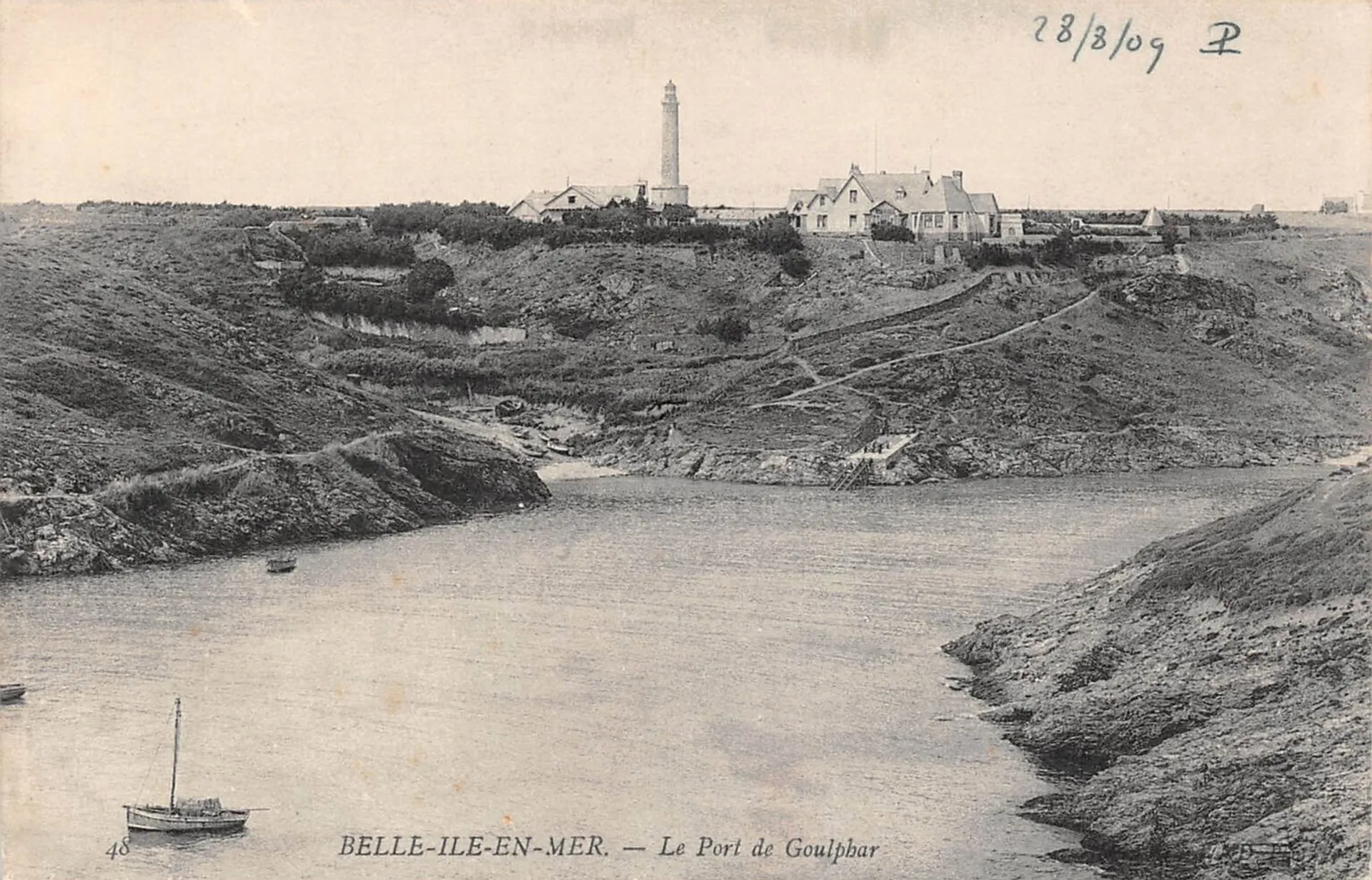
Belle-île-en-Mer, Le Port de Goulphar with Russell’s house ‘Le Chateau Anglais’ prominent above the cliff, c.1909
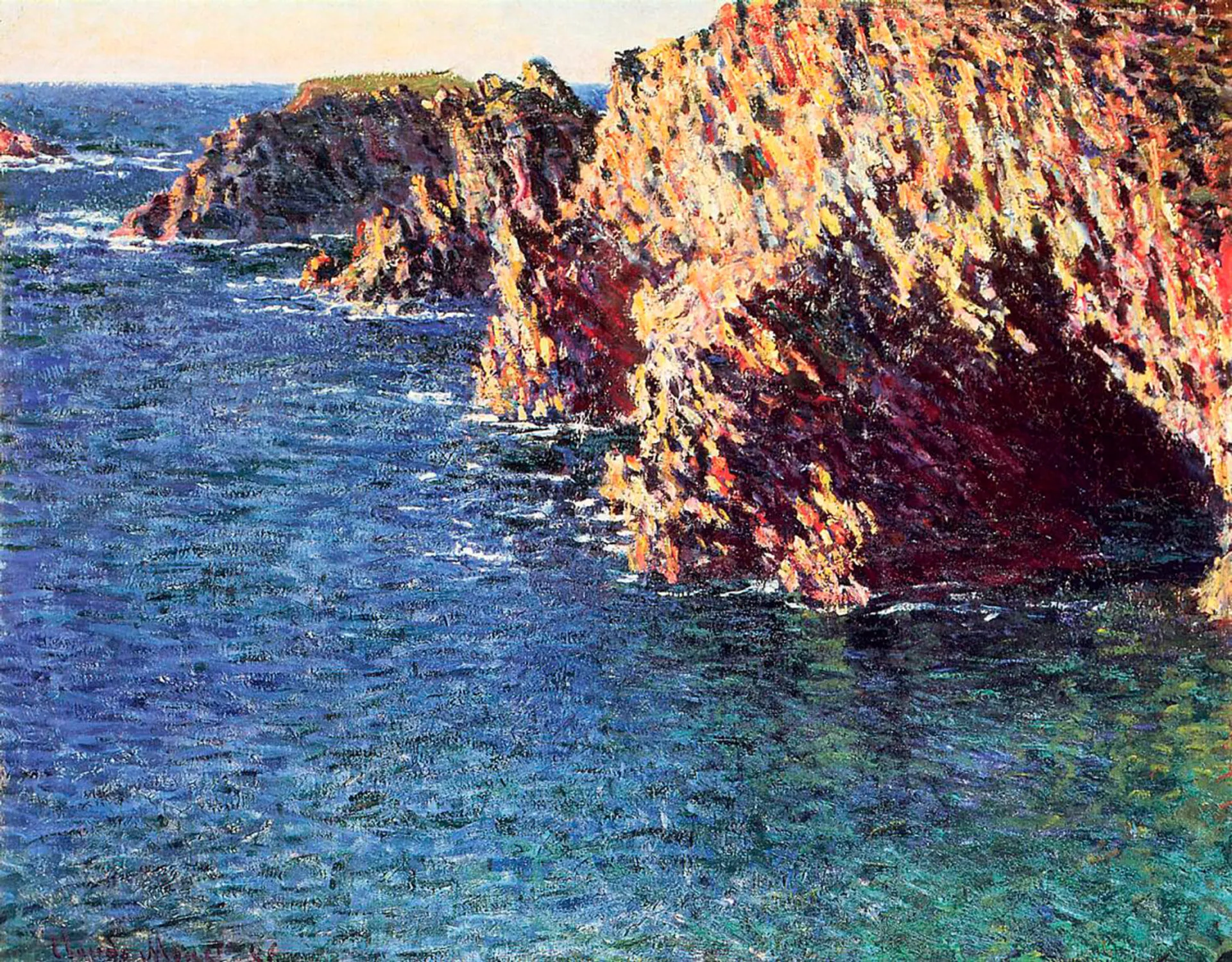
Claude Monet
Grotte de Port-Domois, 1886
oil on canvas
65.0 x 81.0 cm
Museum of Modern Art, Ibaraki, Japan
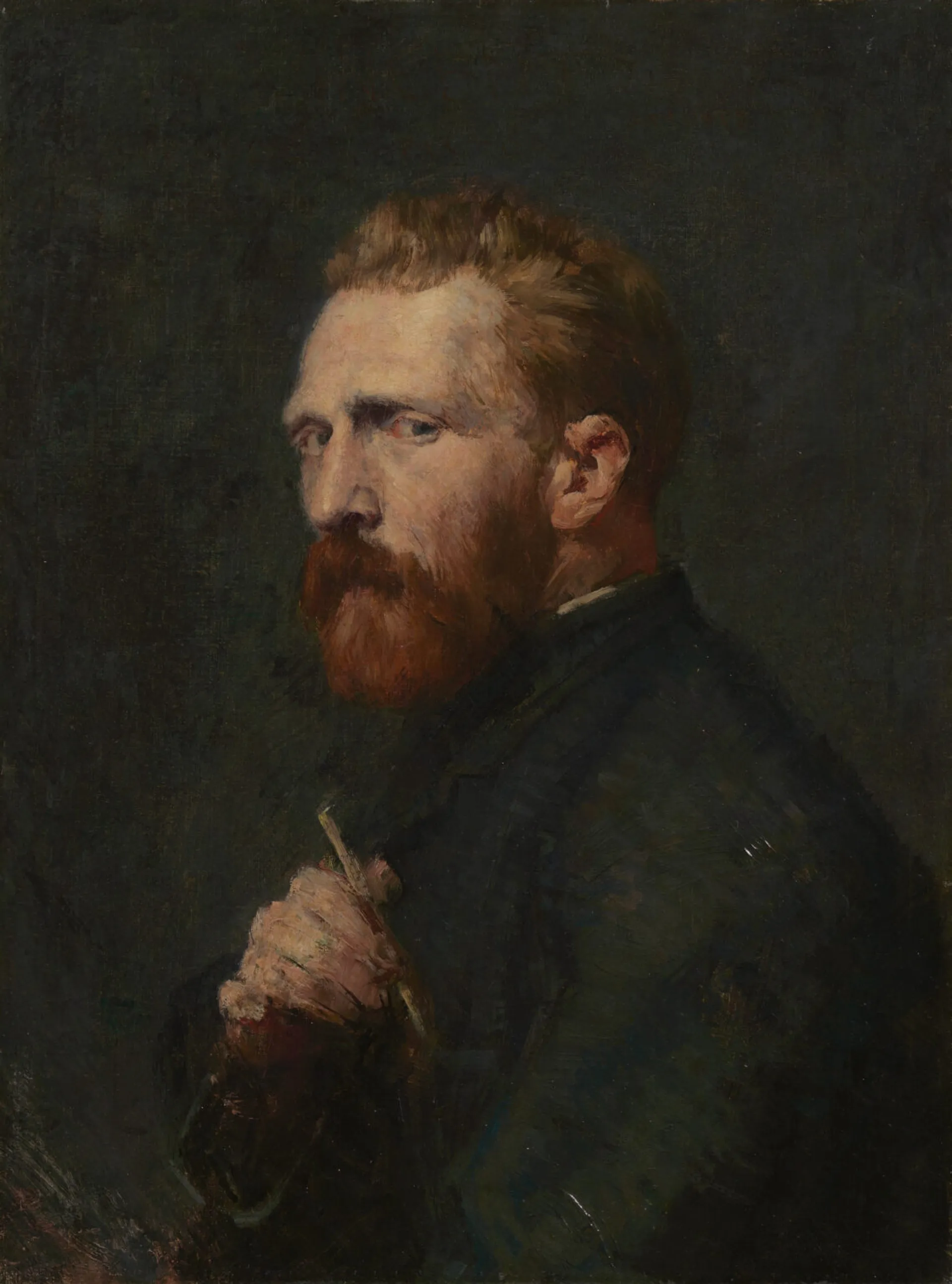
John Peter Russell
Portrait of Vincent Van Gogh, 1886
oil on canvas
60.1 x 45.6 cm
Van Gogh Museum, Amsterdam
Russell’s focus on his subject and pleasure in describing it are echoed in the dynamism of the paintwork work in Baie de Goulphar (Belle Île), which communicates both the creative energy involved in its making and the artist’s command of painterly gesture. But it is the vivid and unexpected palette that gives the painting its power: from the variegated hues of the calm water to the hillside which comes alive in brushstrokes of red, orange, pink and purple. The scene stimulates the senses in such a way that we comprehend both the appearance of the landscape and what it feels like to be in it; the sound of the water and the warmth of the sunshine are palpable. As Russell wrote, ‘the colours completely bowl me over. On some days here it’s ravishing but impossible for my poor palette.’11
1. Russell to Tom Roberts, Paris, 5 October 1887, cited in Tunnicliffe, W., (ed.), John Russell: Australia’s French Impressionist, Art Gallery of New South Wales, Sydney, 2018, p. 195
2. Although Russell did not see van Gogh again after he departed for Arles in the south of France in early 1888, their friendship continued via correspondence. See Galbally, A., A Remarkable Friendship: Vincent van Gogh and John Peter Russell, The Miegunyah Press, Carlton, 2008.
3. Taylor, E., ‘John Russell and friends: Roberts, Monet, van Gogh, Matisse, Rodin’, in Australian Impressionists in France, National Gallery of Victoria, Melbourne, 2013, p. 56
4. ibid., p. 60
5. Prunster, U., ‘Painting Belle-Île’, Prunster, U., et al., Belle-Île: Monet, Russell and Matisse, Art Gallery of New South Wales, Sydney, 2001, p. 31
6. Galbally, A., ‘Mer Sauvage’, in Prunster, ibid., p. 14
7. Prunster, ibid., p. 19
8. ibid., p. 29
9. ibid.
10. Spurling, H., The Unknown Matisse: A Life of Henri Matisse, Volume One: 1869 – 1908, Hamish Hamilton, London, 1998, p. 144, cited in Taylor, op. cit., p. 65
11. Russell to Auguste Rodin, April – May 1890, cited in Prunster, op. cit., p. 46
KIRSTY GRANT