
Tony Cragg
(British, born 1949)
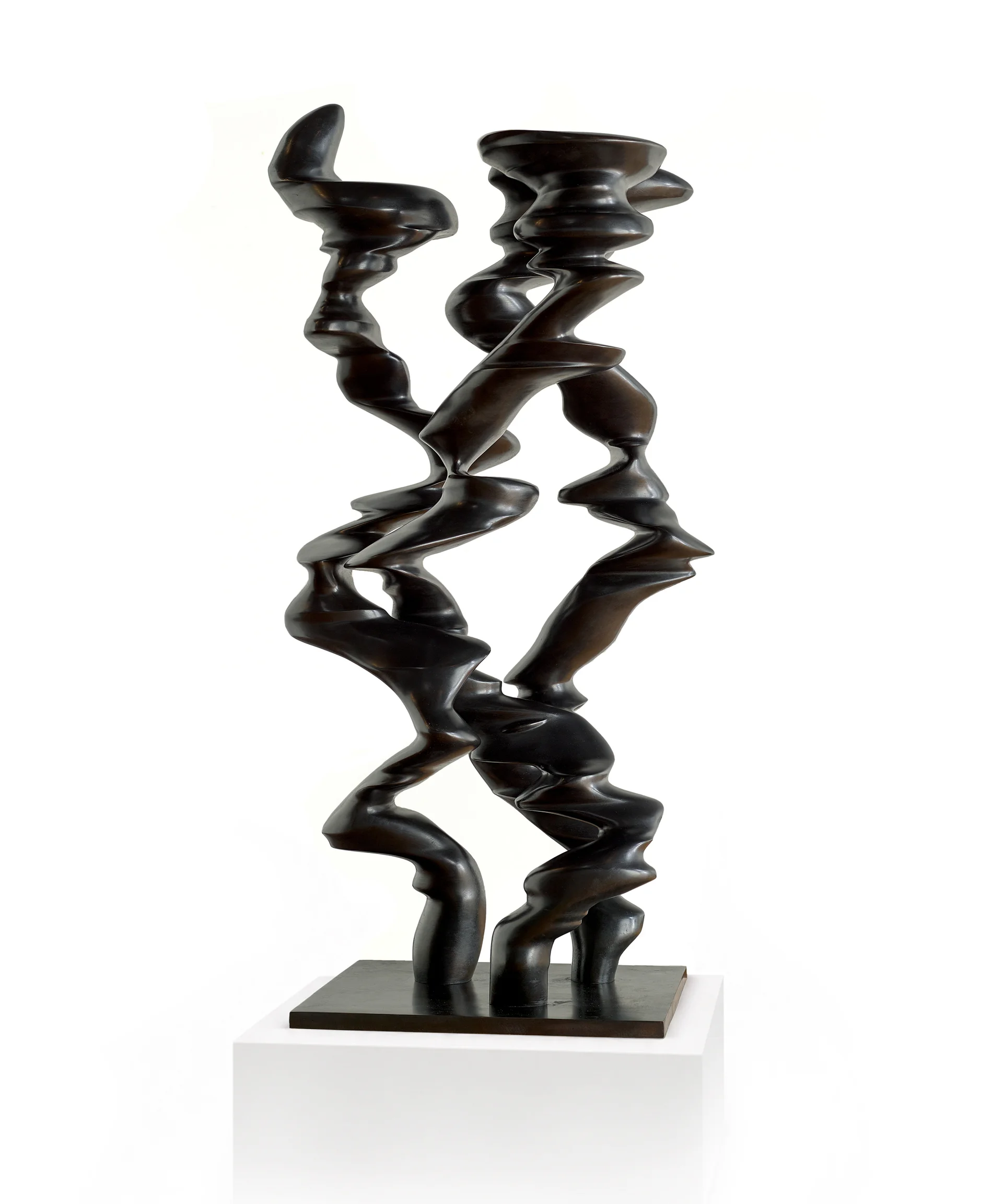
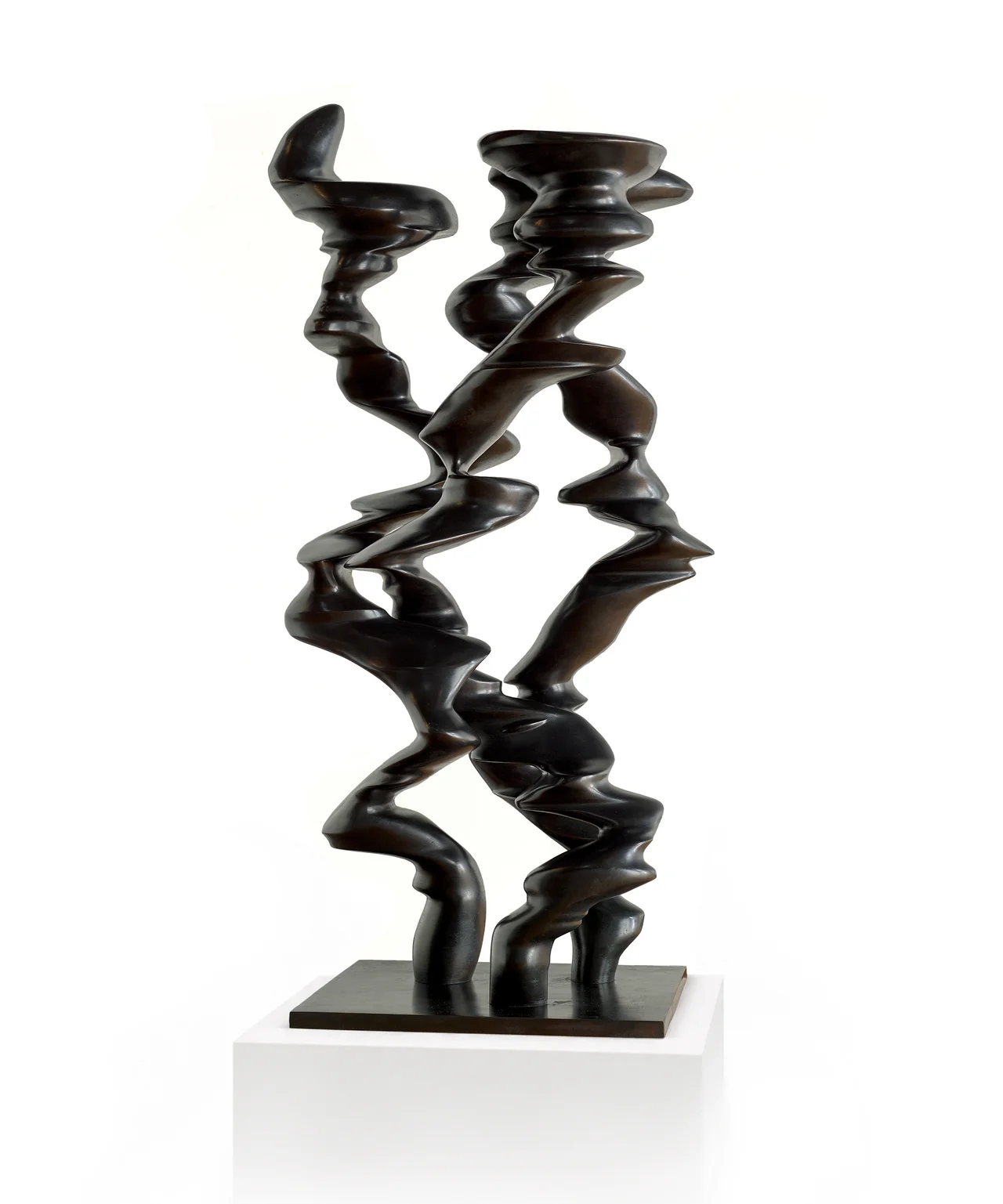
Point of view, 2019
bronze
110.0 x 55.0 x 55.0 cm
Estimate:
$200,000 - $300,000
© Tony Cragg/DACS, London. Licensed by Copyright Agency, Australia
lot details
Thaddaeus Ropac, London
Galerie Retelet, Monaco
Private collection, Melbourne, acquired from the above
Exhibited
Tony Cragg: Solo exhibition, Galerie Retelet, Monaco, 8 July – 31 October 2022
Related Works
Points of view, 2025, wood, 250.0 x 100.0 x 100.0 cm, private collection
Point of view, 2019, Corten steel, 205.0 x 62.0 x 75.0 cm, private collection
This work is accompanied by a certificate of authenticity from Galerie Retelet, Monaco.
Over almost fifty years of continuous exhibitions of his sculptural forms, the British-born artist Tony Cragg has become one of the best known internationally of the ‘New British Sculpture’ generation that emerged in the 1980s, alongside Anish Kapoor, Antony Gormley, Shirazeh Houshiary, and Richard Deacon. Sharing with these peers an emphasis on hand-made materiality and a return to figurative imagery, Cragg developed a sophisticated artistic philosophy centred around the poetic and psychological potential of physical matter and abstract forms. From the late 1980s, Cragg developed two ongoing sculptural bodies of work, which he calls families: Early Forms and Rational Beings, the former reimagining man-made vessels into complex configurations, and the latter based on anthropomorphic geometry hidden within fluid columnar constructions. From his earliest works, Cragg has toyed with the viewer’s perception, resisting the expectation of one valid point of view encoded in Western art since the introduction of single-point perspective during the Italian Renaissance. The esteemed Italian art historian Germano Celant in 1981 instead qualified Cragg’s attitude as Mannerist in its ideology, as it ‘tends to destroy the monolithic image in favour of a dynamic and non-organic, that is, pluralistic, totality.’1
Belonging to his Rational Beings series, Point of View, 2019 elegantly exemplifies Cragg’s core philosophy of multiple and malleable perspectives, featuring three intertwined columns whose irregular, layered silhouettes intermittently resemble the profiles of human faces as the free-standing sculpture is circumnavigated. Cast in bronze with a gleaming black colouration, Point of View is a perfect combination of conception, medium and finish. Cragg traps a writhing, whirling energy under his taut and rigid surface, zigzagging in defiance of gravity and slippery with reflections. His elliptical cylinders are stacked into towers of fractured planes, intermittently converging and diverging to create an impression of constant, asymmetric centrifugal gyration. With sharp, clearly defined contours, a polished machine-aesthetic and rhythmic geometry, Cragg’s Rational Beings share the formal sculptural vocabulary of mid-twentieth century Futurism. Cragg’s carefully worked surface tension creates in his stationary forms the impression of dynamic blurred movement arrested in time, recalling the intoxicating energy and power that the Futurists found within modern life.
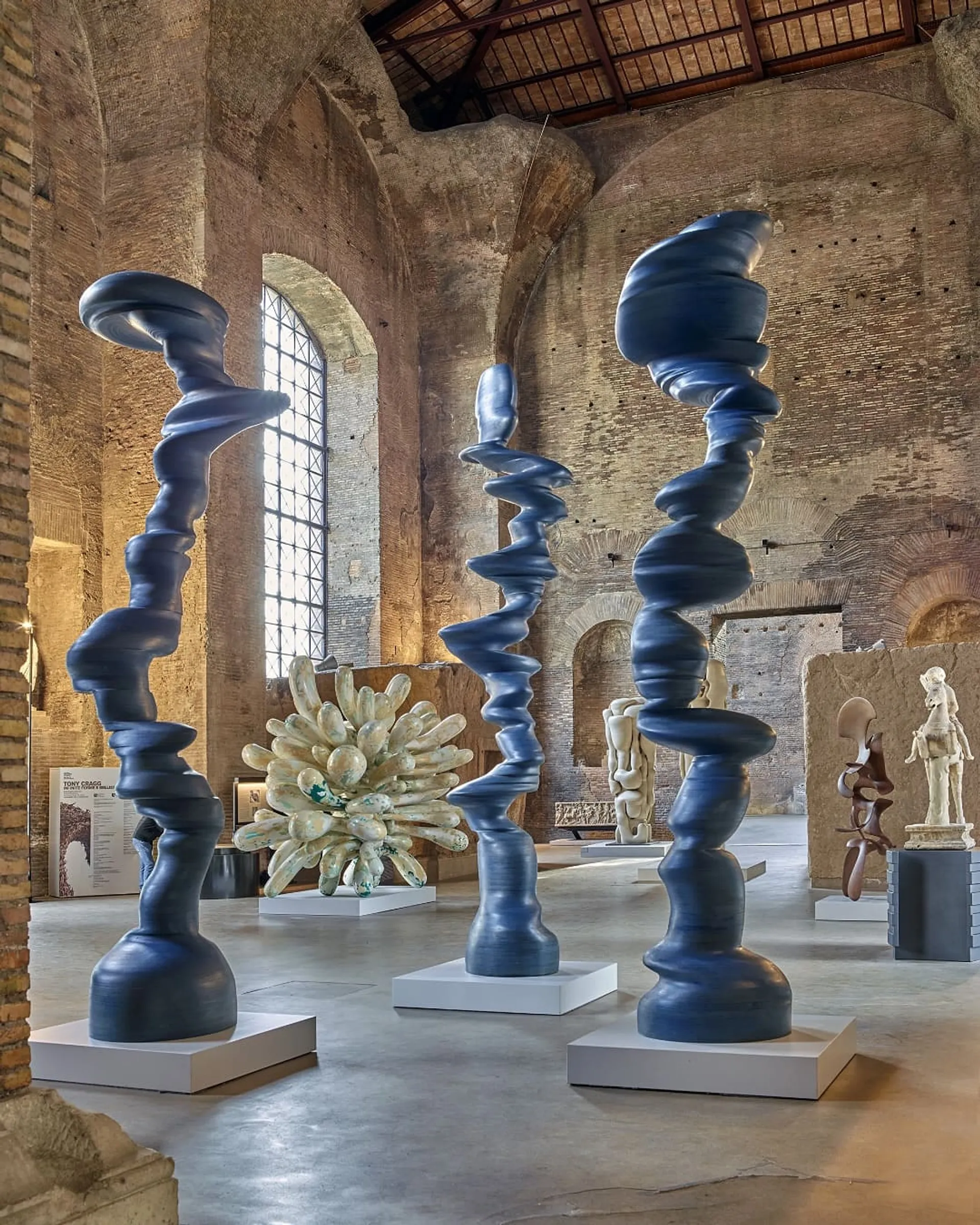
Installation view from solo exhibition Infinite forme e bellissime (Infinite and Beautiful Forms) held at the Baths of Diocletian (Terme di Diocleziano), part of the Museo Nazionale Romano in Rome, Italy, 9 November 2024 – 4 May 2025
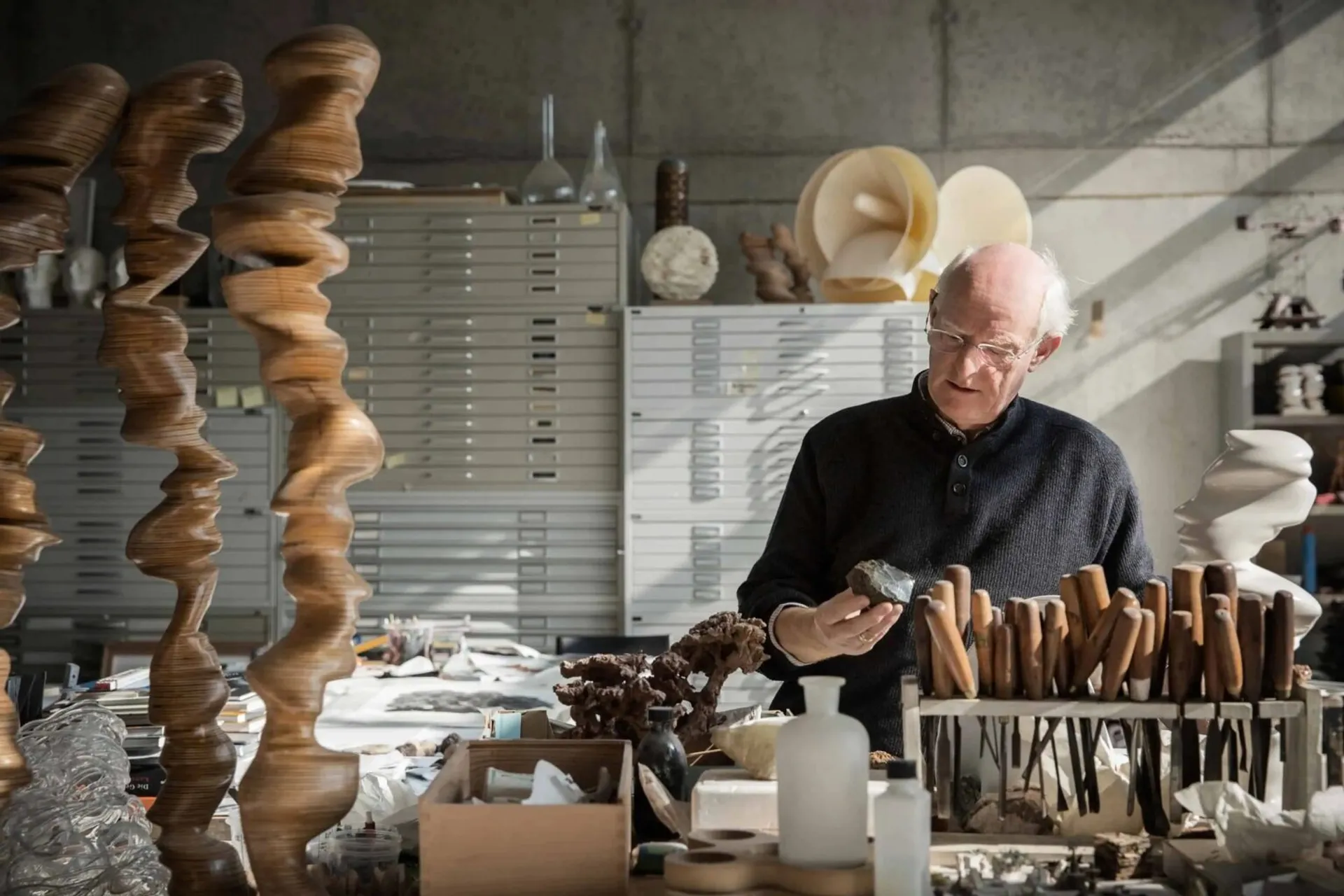
Sir Tony Cragg working in his atelier in Wuppertal, Germany
photographer: Markus J. Feger
Cragg’s Rational Beings begin with pencil drawings of dozens of superimposed anonymous facial profiles, turned this way and that. The outlines of this polymorphous entity are then simplified into a composite mass of fluid lines, vortices and sharp edges with organic references in lenticular clouds, geological stratigraphy and liquid eddies. From this, Cragg extrapolates the regular protrusions of foreheads, noses and chins, pulling them into smooth, continuous curves in a 360-degree arc along a central straight axis. Although appearing to contemporary audiences like the result of an ultra-modern algorithmic process of distortion along variables of scale, rotation and density, Cragg’s analog process finds much older, psychologically meaningful references. He uses the same figure/ground trick of perception based on a common outline as the famous Rubin Vase, an optical illusion of two facial profiles facing each other developed around 1915 by the Danish psychologist Edgar Rubin. The inverse of this form can be found in the ancient double-headed figure of Janus, the Roman god of motion, time, duality, and transition, often appearing in sculpture with a two-faced head looking in opposite directions. In 1933, the Italian Futurist Renato Bertelli notably adapted Janus into a terracotta bust of the dictator Benito Mussolini, rotating his distinctive profile through a full, 360-degree rotation of omniscience – Profilo Continuo del Duce (Imperial War Museum, London).
Cragg’s process of turning this complex visual concept of repeated and stacked profiles into a sculpture is a rigorous and accretive one. Continuing his early predilection for reusing modern man-made materials – which through his sculptures are then diverted into a poetic and non-utilitarian function – Cragg’s slender Rational Beings are constructed layer by layer from stacks of carved plywood discs, which are then cast in bronze or carved in marble. While the materials of these sculptures are artificial and everlasting, the perceptual experience of his artworks is open-ended, defined by a transience and slipperiness, with forms shifting in and out of abstraction according to a subjective experience different for everyone. Like the practice of finding shapes in clouds or the psychological phenomenon of finding faces within abstract arrangements (pareidolia), Tony Cragg engages in a unique and playful artistic dialogue with his viewers. He has elaborated: ‘for me, to make a sculpture or to make a painting is a radical political statement already. To work outside of the utilitarian system, to take some material and to transfer in a very special way some meaning and some life, some human significance onto the material, is quite a rare, very special and in some ways also, very mysterious process.’2
1. Celant, G., ‘Tony Cragg and Industrial Platonism’, Art Forum, vol. 20, no. 3, November 1981, p. 46
2. Tony Cragg, interview with Jon Wood, ‘Terms and Conditions – An Interview with Tony Cragg’, in Tony Cragg, Sculptures and Drawings, CAFA Art Museum, Chengdu, and touring, 2012, p. 235
LUCIE REEVES-SMITH