
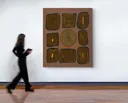
Ronnie Tjampitjinpa
(c.1943 - 2023)
Mangilypa, 1988
synthetic polymer paint on canvas
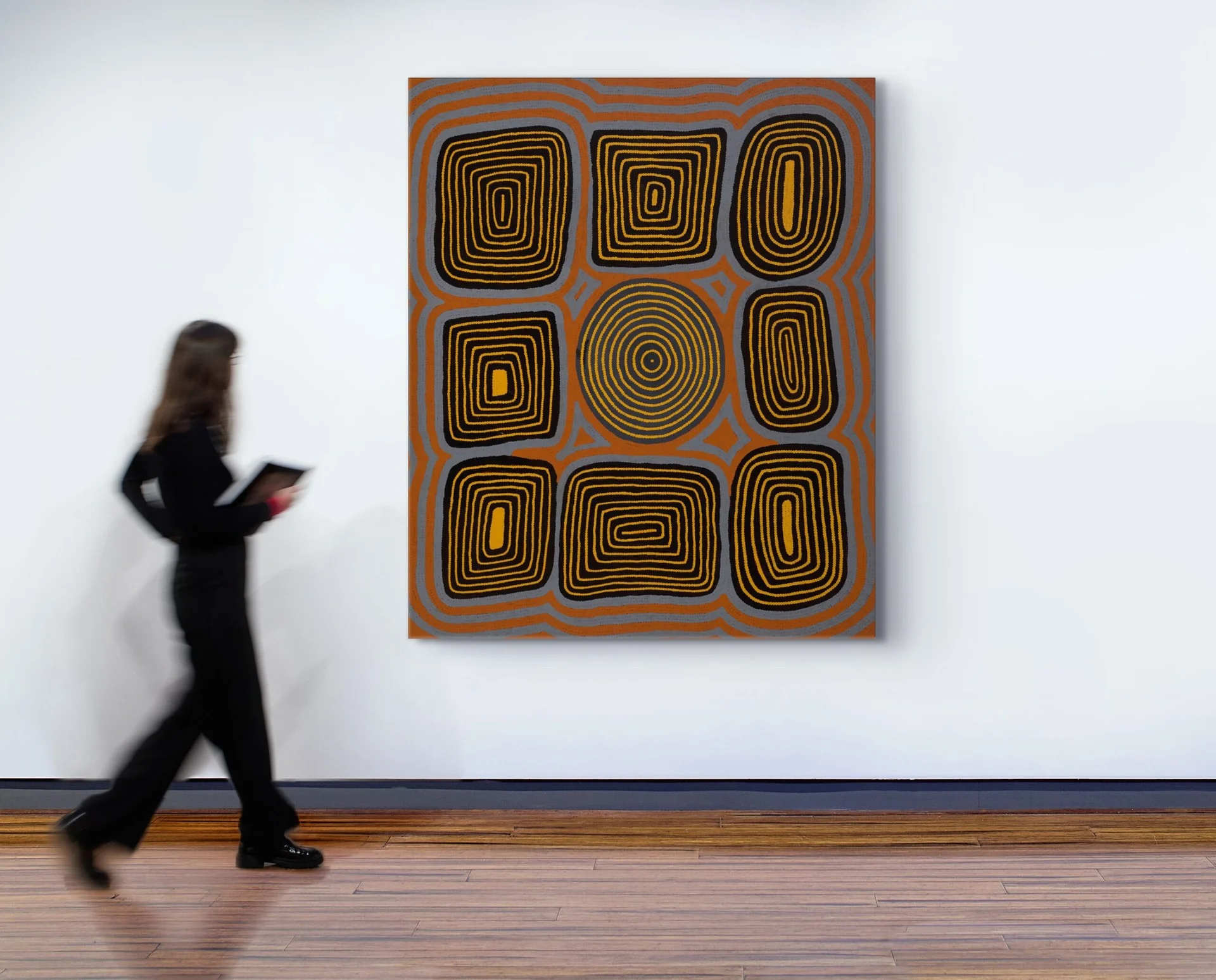
182.5 x 152.0 cm
bears inscription verso: artist's name and Papunya Tula Artists cat. RT881240
Estimate:
$40,000 - $60,000
© Ronnie Tjampitjinpa/Copyright Agency 2026
lot details
Papunya Tula Artists, Alice Springs, Northern Territory
Gallery Gabrielle Pizzi, Melbourne (label attached verso)
Private collection, Melbourne, acquired from the above in November 1999
This work is accompanied by a certificate of authenticity from Papunya Tula Artists which states:
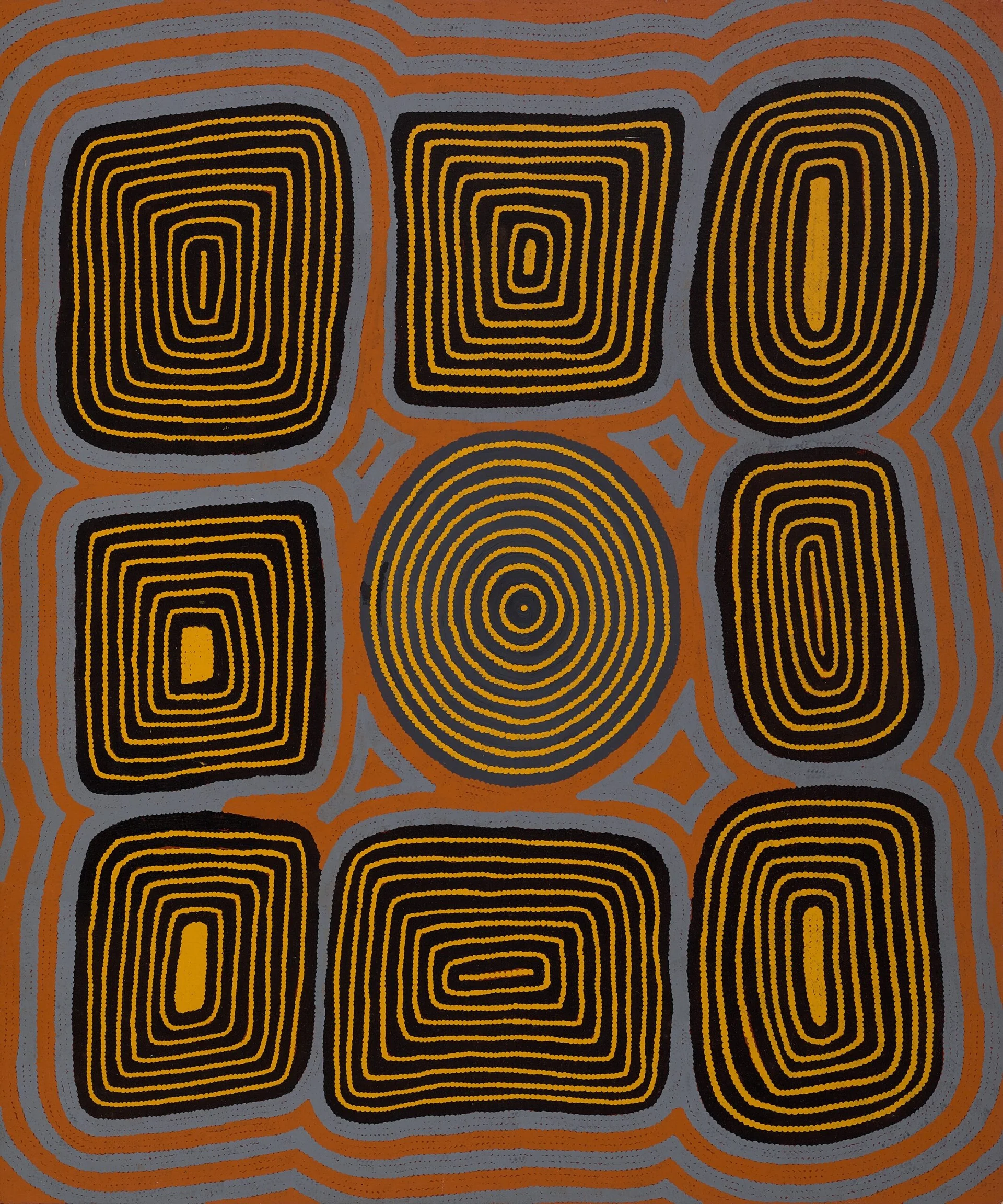
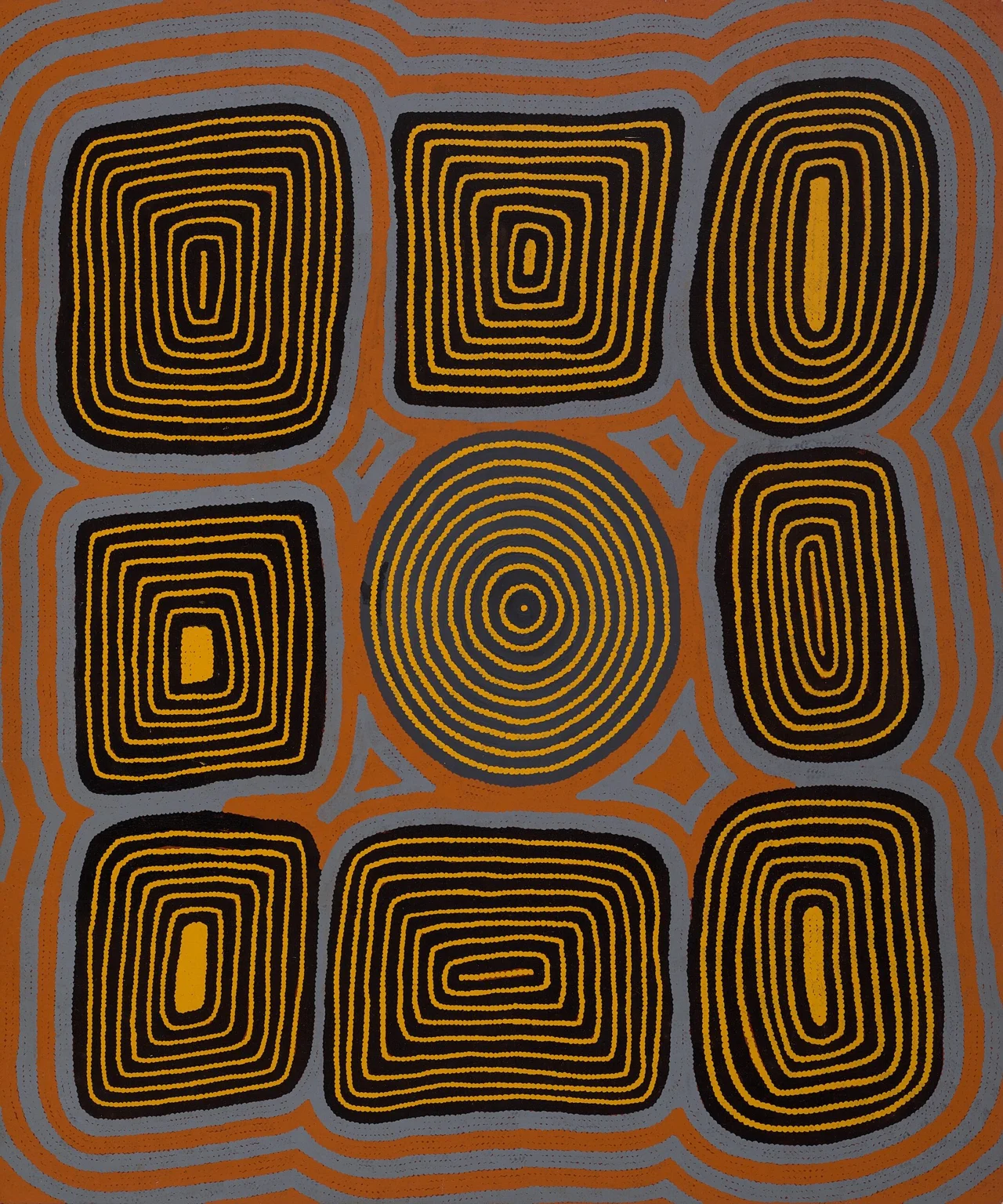
‘In this painting the artist has depicted the mythology associated with Mangilypa, a small black seed which grows on a low bushy plant in claypan areas. This particular claypan in Tjangirrinya near Lake Mackay. The seed is ground and formed into a type of damper or seed cake. The rectangular shapes in the painting depict the damper.’
The paintings by Ronnie Tjampitjinpa are among the most recognisable works of artists who emerged from the Papunya movement. Often composed of one or more geometric forms enlarged and repeated across the surface of the canvas, the simplicity of his paintings belies the complexity of what is depicted. Tjampitjinpa offers glimpses into the expansive geography and diverse flora and fauna of his homeland, together with fragments of the multi-layered stories of the Tingari – a mythical group of Ancestors who moved across vast stretches of the Western Desert sharing law and creating and naming places.
One of the youngest men to begin painting at Papunya in 1971 – 72, and one of the founders of the hugely influential Papunya Tula Artists group, Tjampitjinpa began painting under the tutelage of Uta Uta Tjangala and was encouraged by schoolteacher Geoffrey Bardon. Tjampitjinpa’s painting output for Papunya Tula during the 1970s was limited as his focus was directed towards the outstation movement and the return of the Pintupi to their homelands in the Western Desert. With the establishment of Walungurru (Kintore) in 1981, Tjampitjinpa could turn his attention to his art, and he soon emerged as one of the major painters of the movement. Seeking to establish himself as a serious painter, Tjampitjinpa pursued an independent direction and began to expand various elements of the Pintupi painting lexicon, increasing them in size and proportion, and developing what Vivien Johnson described as ‘the bold, scaled-up, linear style that came to dominate many of the Walungurru painters’ work during the 1990s.’1
Ronnie Tjampitjinpa’s paintings from the late 1980s are reductive and vivid optical works composed of alternating bands of bright colours that pulsate with energy. This distinctive aesthetic is exemplified in Mangilypa, 1988. Here, Tjampitjinpa has placed a single component from his visual lexicon, the roundel, comprising ever-larger ovoid bands of alternating colours, at the centre of his composition. This central roundel, representing Mangilypa (a small black seed from a low bushy plant that grows in the vicinity of claypans), is encircled by roundels that have been stretched and distorted to create elongated rectangular forms. The claypan depicted is Tjangirrinya, found adjacent to Lake Mackay (Wilkinkarra), a large salt lake straddling the Northern Territory – Western Australia border, close to his homeland of Walungurru. The Mangilypa seed is ground and formed into a type of damper or seed cake, which is represented by the rectangular shapes in the painting.2 The composition is the result of two decades of refinement by the artist in charting the vast terrain of the Western Desert in his own deft visual language.
Ronnie Tjampitjinpa has received a number of awards, including the 1988 Alice Prize. His first solo exhibition was held at Gallery Gabrielle Pizzi, Melbourne, in 1989, and his work was included in Dreaming at the Asia Society Gallery, New York, in 1988, and Australian Perspecta in 1993. More recently, an exhibition celebrating 40 years of the artist’s work was held at the Art Gallery of New South Wales, Sydney, in 2015.
His work is included in numerous Australian and international collections, including the National Gallery of Australia, Canberra; the Art Gallery of New South Wales, Sydney; the Musée du Quai Branly, Paris; Collection Fondation Opale, Lens, Switzerland; and the Seattle Art Museum, USA.
1. Johnson, V., ‘Ronnie Tjampitjinpa’, in Perkins, H., Tradition Today, Indigenous Art in Australia, Art Gallery of New South Wales, Sydney, 2006, p. 140
2. Taken from the accompanying certificate of authenticity from Papunya Tula Artists.
CRISPIN GUTTERIDGE