
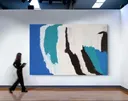
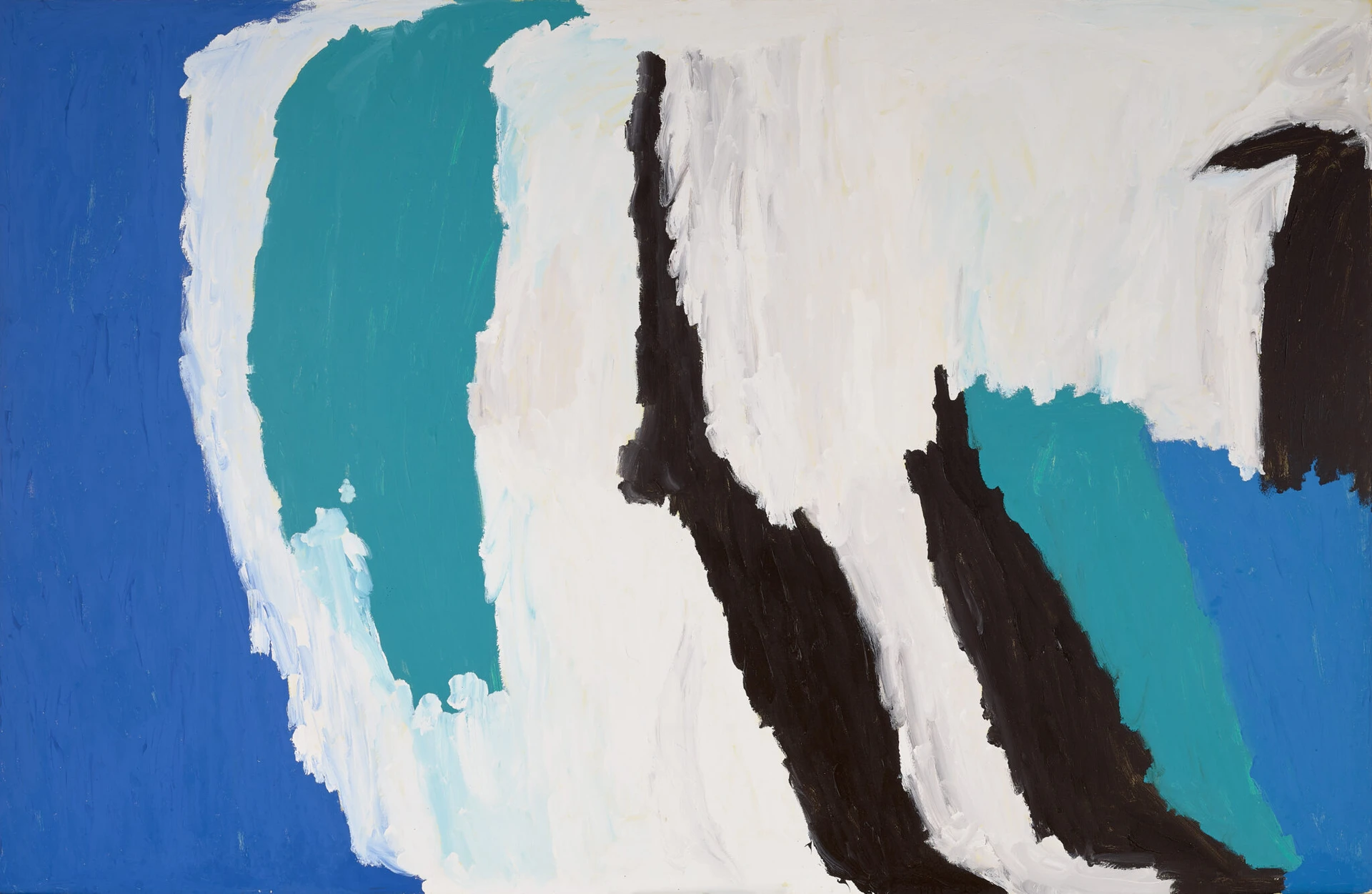
Mirdidingkingathi Juwarnda Sally Gabori
(c.1924 - 2015)
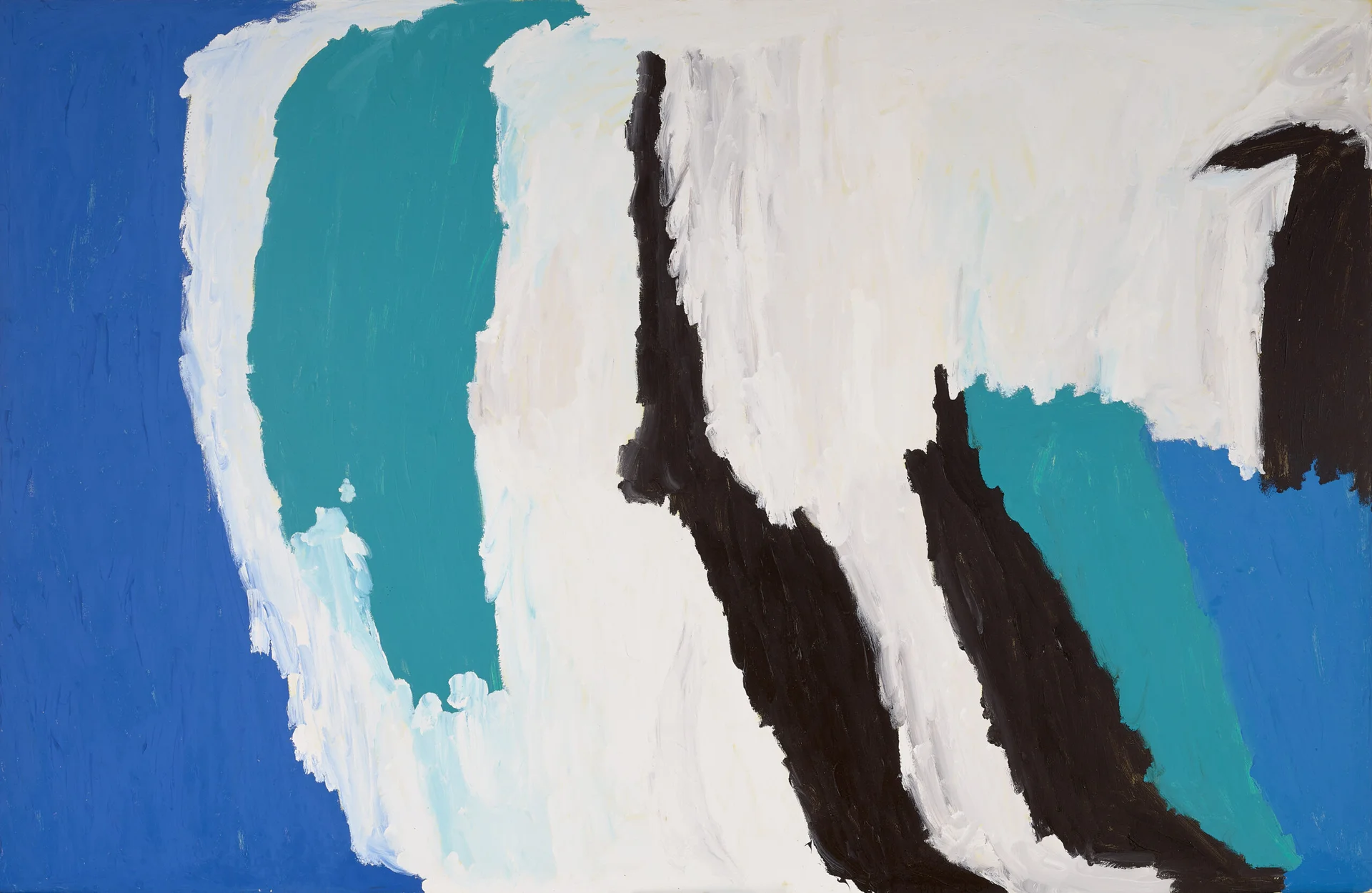
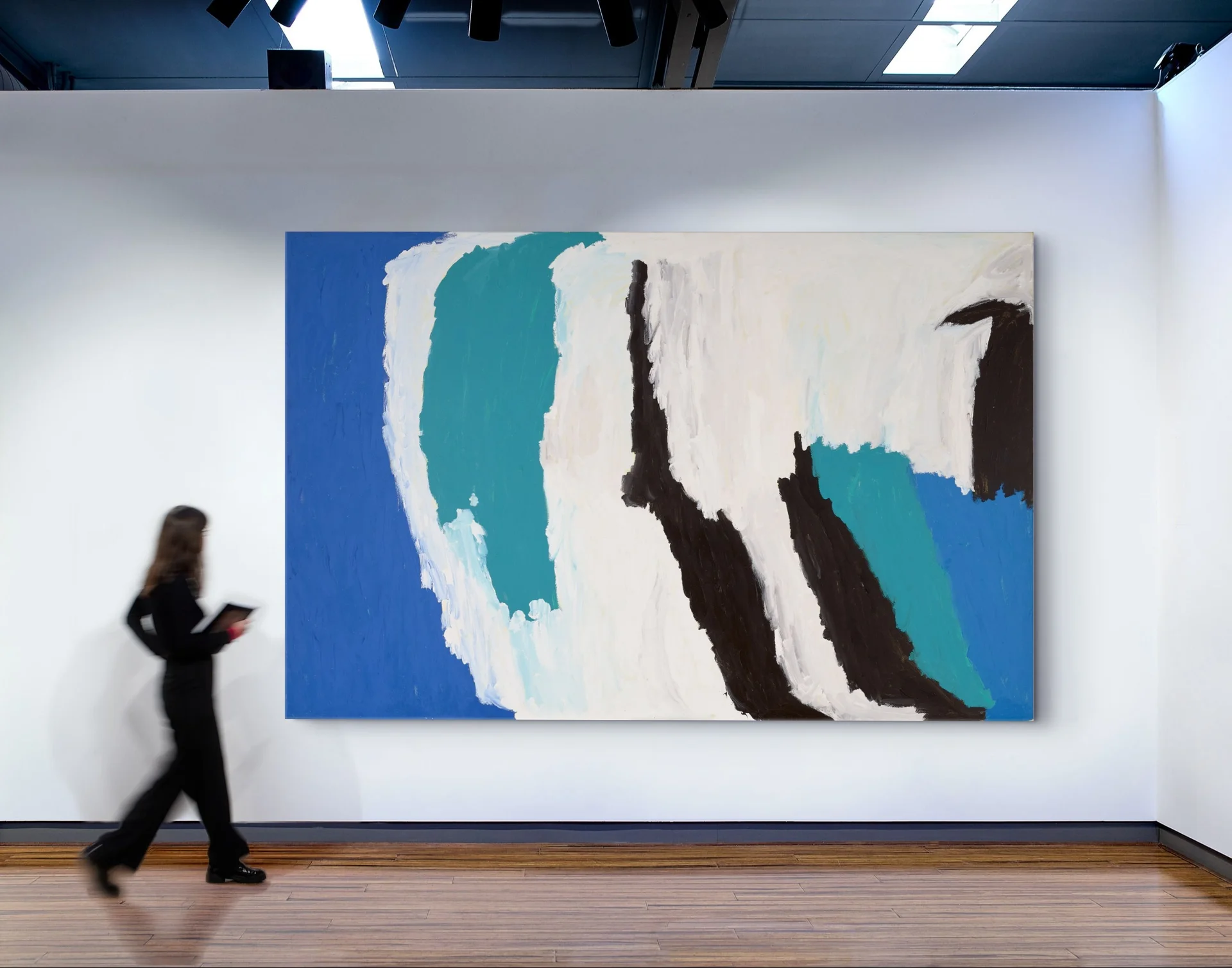
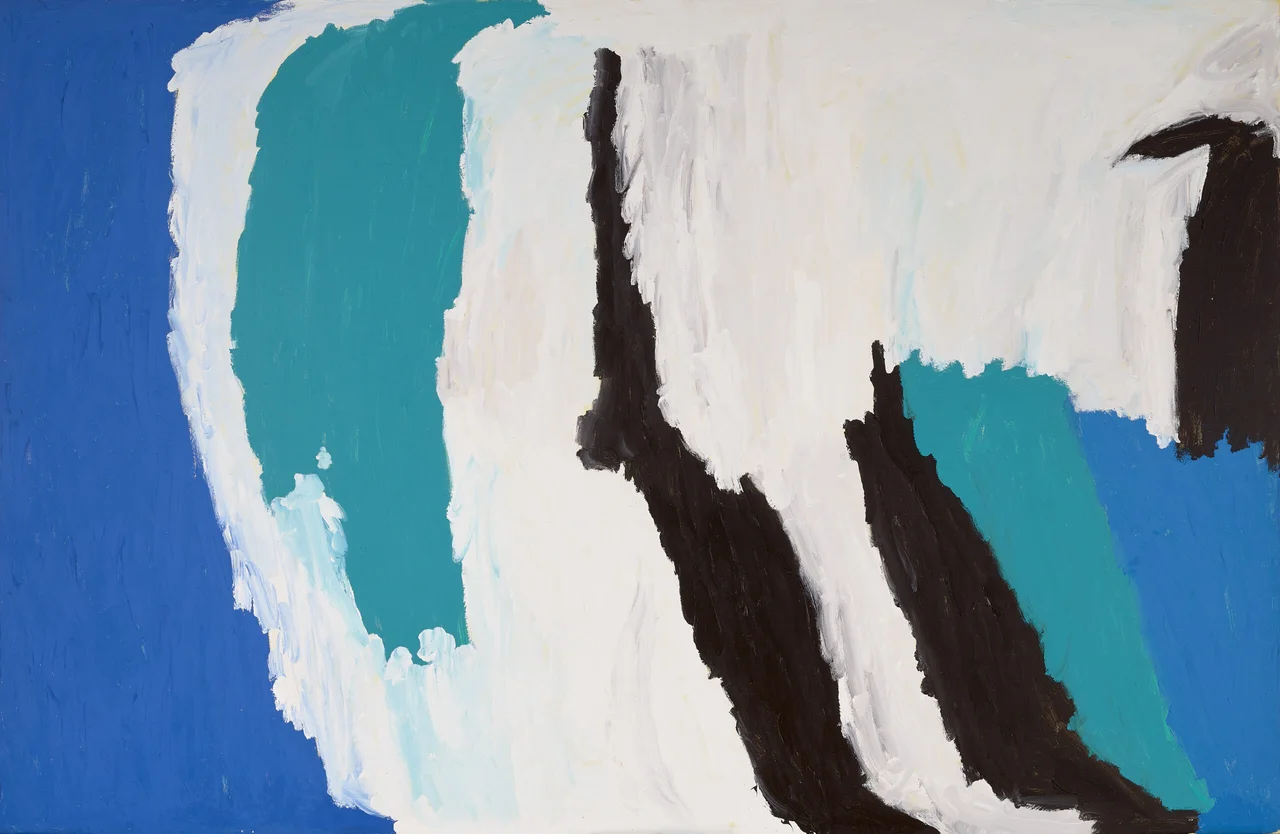
My Grandfather’s Country, 2008
synthetic polymer paint on linen
198.0 x 304.0 cm
bears inscription verso: artist’s name, title, medium, Mornington Island Arts and Crafts cat. 3583-L-SG-0908 and Alcaston Gallery cat. AK14720
Estimate:
$250,000 - $350,000
© Estate of Sally Gabori/Copyright Agency 2026
lot details
Mornington Island Arts and Crafts, Mornington Island, Queensland
Alcaston Gallery, Melbourne
Private collection, Victoria, acquired from the above in December 2009
This work is accompanied by a copy of the certificate of authenticity from Alcaston Gallery which states:
‘This is my grandfather’s country on Bentinck Island.’
Born beside a creek in one of Australia’s most remote regions, Mirdidingkingathi Juwarnda Sally Gabori grew up on Bentinck Island, in the southern Gulf of Carpentaria in northern Queensland. She was a member of the Kaiadilt people, whose lives were sustained almost entirely by marine resources and who had minimal contact with the outside world. In 1948, following a devastating drought and tidal surge that rendered the island uninhabitable, Gabori, then aged 24, was persuaded to relocate with her family and the other inhabitants of Bentinck Island to Gununa on nearby Mornington Island – a move that resulted in profound dislocation and loss for the Kaiadilt community.
Almost sixty years later, Gabori, then in her early eighties, was invited to participate with other Kaiadilt people in an art workshop at the Mornington Island Art Centre. After only a few visits, it became clear from her first paintings – often bold, seemingly crude abstract depictions of her physical world and the myriad fish found in the surrounding estuaries and sea – that Gabori possessed a unique and vibrant visual language through which to express her personal and family histories, drawn from memories of her early years on Bentinck Island.
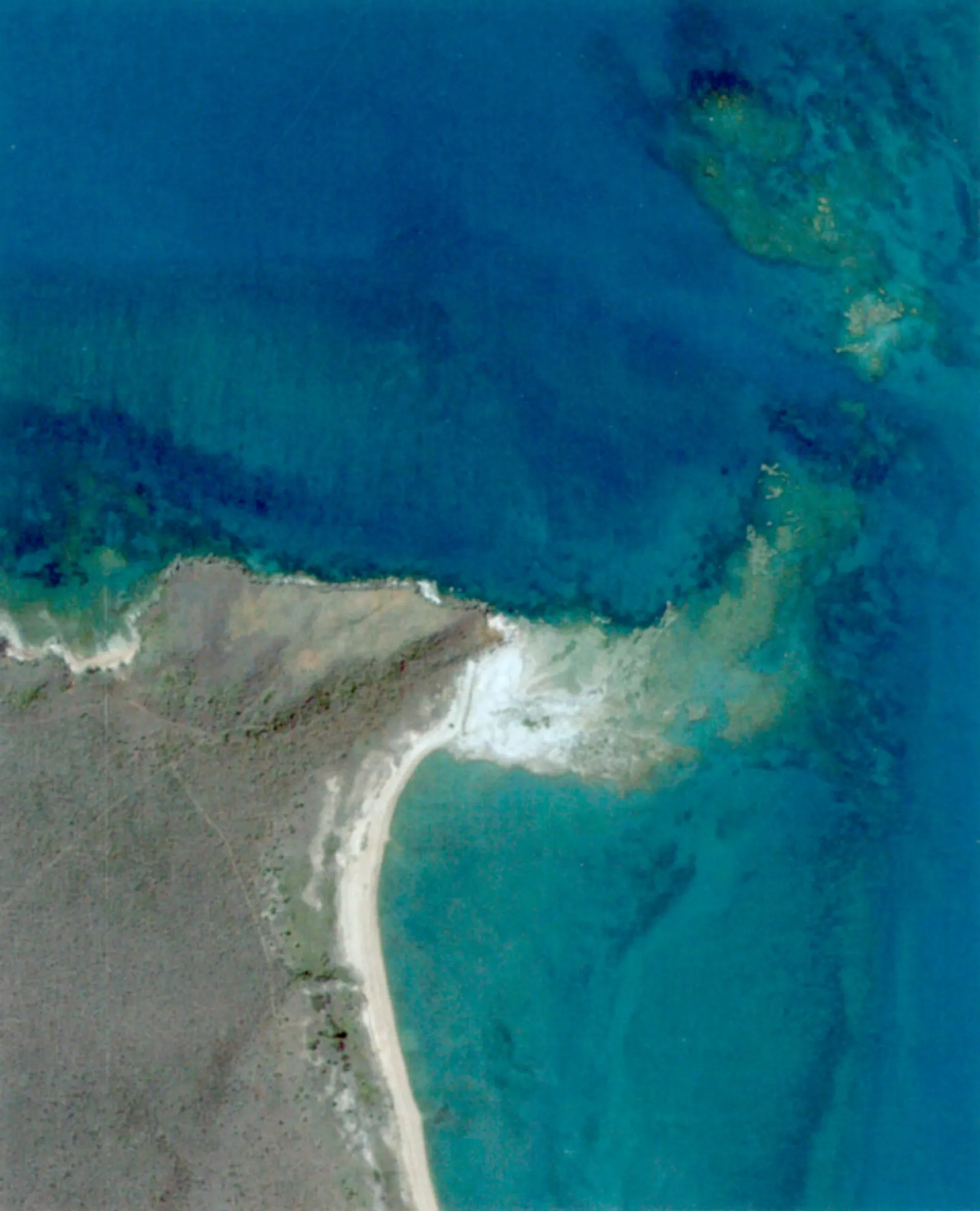
Google earth satellite image of Dingkari (rotated clockwise 90 degrees)
© DigitalGlobe 2016
Her names reflect her deep connection to place and ancestry: Mirdidingkingathi refers to her birthplace at the Mirdidingki River, while Juwarnda is her totem, the dolphin. Judith Ryan of the National Gallery of Victoria has compared her extraordinary innovation and meteoric rise to that of other celebrated late starters, including Emily Kam Kngwarreye and Lorna Fencer Napurrula.1 Yet unlike many other Aboriginal language groups, the Kaiadilt had no established tradition of mark-making on tools, objects, or bark. Given this cultural background, Gabori’s visual language was entirely self-fashioned – conjured from the mental maps she carried of Bentinck Island and the Country she loved.
My Grandfather’s Country (Dingkari), 2008, is a vibrant, gestural homage to the landscape and history of Dingkari, located at the southern tip of Sweers Island, south-east of Bentinck Island. This was the Country of Gabori’s grandfather, Dingkarringathi, and her brother, Makarrkingathi Dingkarringathi Thuwathu Bijarrb (King Alfred). The area is characterised by a small islet and an important tidal hunting ground to the south of Sweers Island, partially connected to Sweers by a long series of shallow rocky reefs called Karandjalt. These shoals extend into the waters of the Gulf like a long hook, connecting the islet to the base of Bardathurr, the highest hill on Kaiadilt Country and the final resting place of Dibirdibi, the Rock Cod Ancestor.2
Gabori is renowned for her luminous, brightly coloured canvases, of which the present work is a stunning example. Set against a buttery yellow ground, with a reduced palette comprising expansive fields of blue, white and black, the geometric forms that dominated her early work here dissolve, and subtle variations of colour and texture become the primary focus. The result is a luminous and expressive tribute to the landscape and history of her grandfather’s Country, Dingkari, a revered hunting area where the deep channels that flow at the edge of the reef attract dugong, turtles and large species of fish. Kaiadilt men would travel to Dingkari using walpu, Kaiadilt log rafts. Most of Sally Gabori’s Dingkari paintings feature circular, oval or rectangular shapes, reflecting the islet at different stages of tidal flux, while others, such as the present work, depict the interconnecting reefs between Sweers Island and Dingkari, with the islet alone and adrift in a sea of paint.
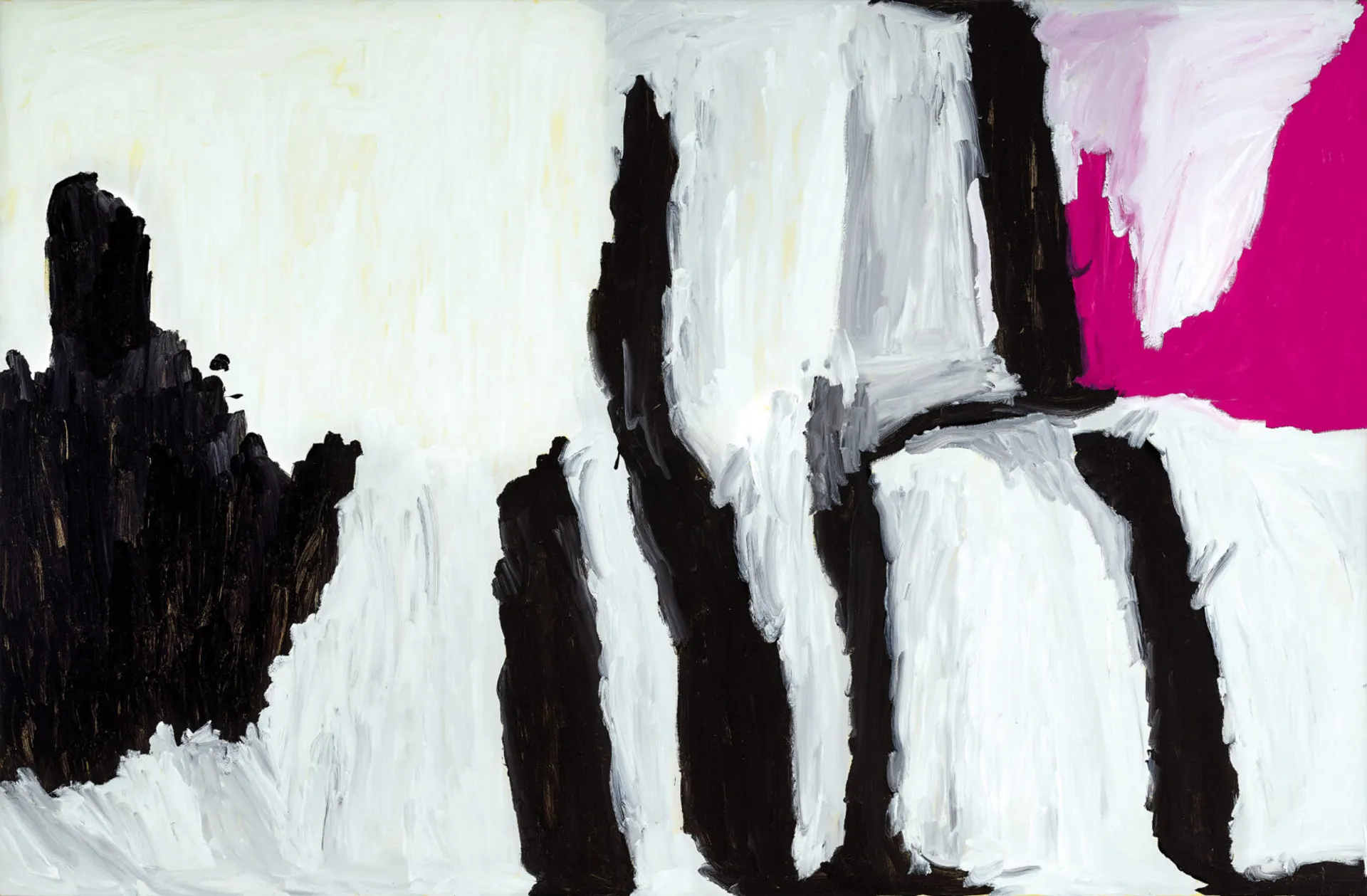
Mirdidingkingathi Juwarnda Sally Gabori
Ninjilki, 2008
synthetic polymer paint on linen
198.5 x 302.5 cm
Private collection
© Mirdidingkingathi Juwarnda Sally Gabori/ Copyright Agency 2026
Sold Deutscher and Hackett, 22 March 2023, lot 5, for $251,591 (inc. BP)
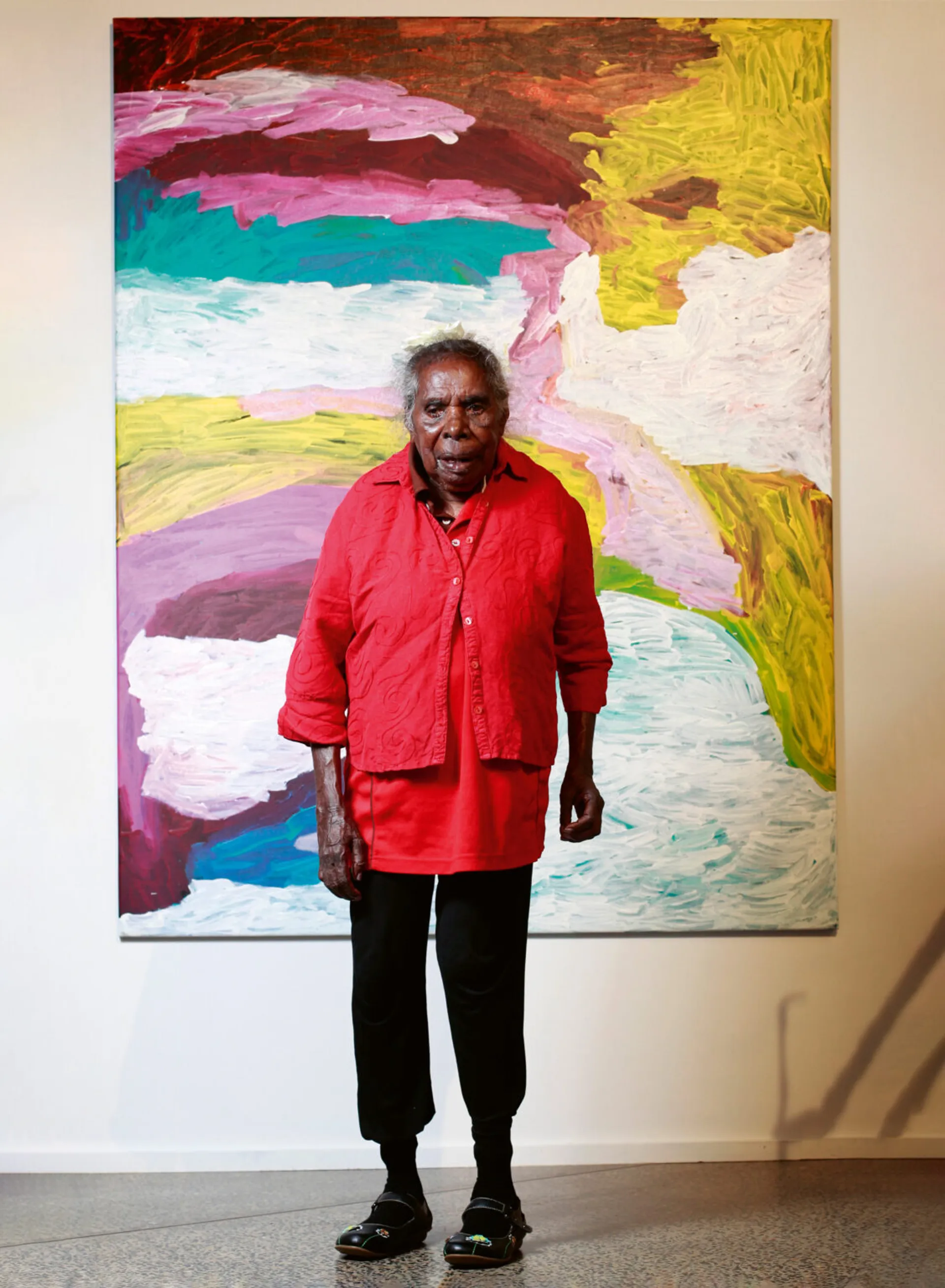
Artist Sally Gabori with her work titled ‘Mirdidingkingathi Juwarnda’ at the Cairns Indigenous Art Fair in Cairns, Queensland, 2012
Photographer: Brendan Francis / Newspix
Gabori’s expressive application of paint, laid down in thick brushstrokes and layered fields of colour, highlights both the immediacy of her process and the evident pleasure she took in mark-making. In My Grandfather’s Country (Dingkari), these qualities imbue the composition with a palpable vitality – each intuitive, gestural brushstroke boldly executed and purposeful. When Gabori paints her Country, the meanings layer in multitudes – she is at once painting the land, the Ancestor Dreaming of Country, and finally, her own longing, loss and memory.
1. Ryan, J., ‘Broken Colour and Unbounded Space’, Mirdidingkingathi Juwarnda Sally Gabori: dulka warngiid: Land of All, Queensland Art Gallery I Gallery of Modern Art, Brisbane, 2016, pp. 33 – 34
2. McLean, B., ‘Dulka Warngiid; The Whole World’ in Mirdidingkingathi Juwarnda Sally Gabori Dulka Warngiid: Land of All, in ibid., p. 24
CRISPIN GUTTERIDGE