
Roland Wakelin
(1887 - 1971)
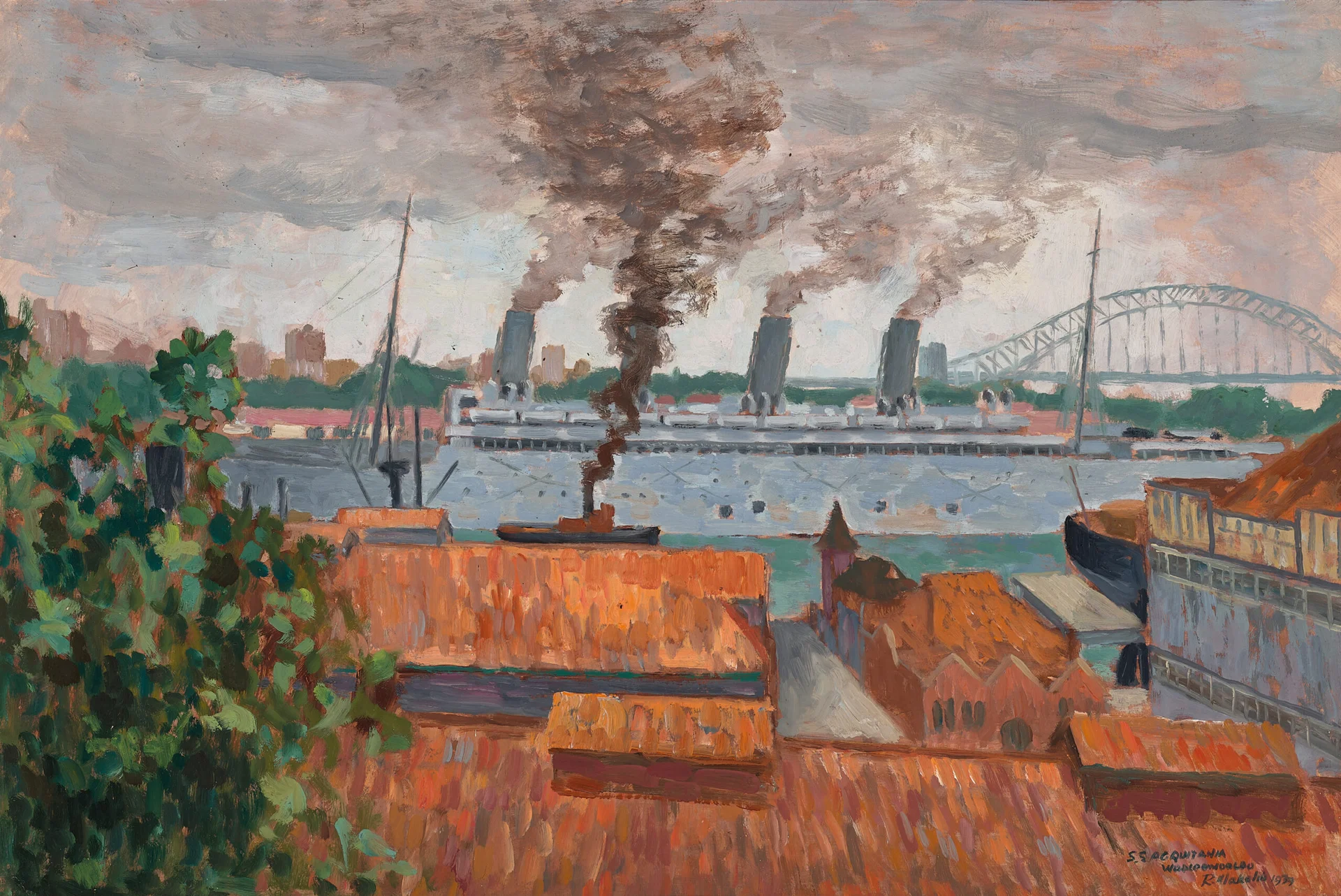
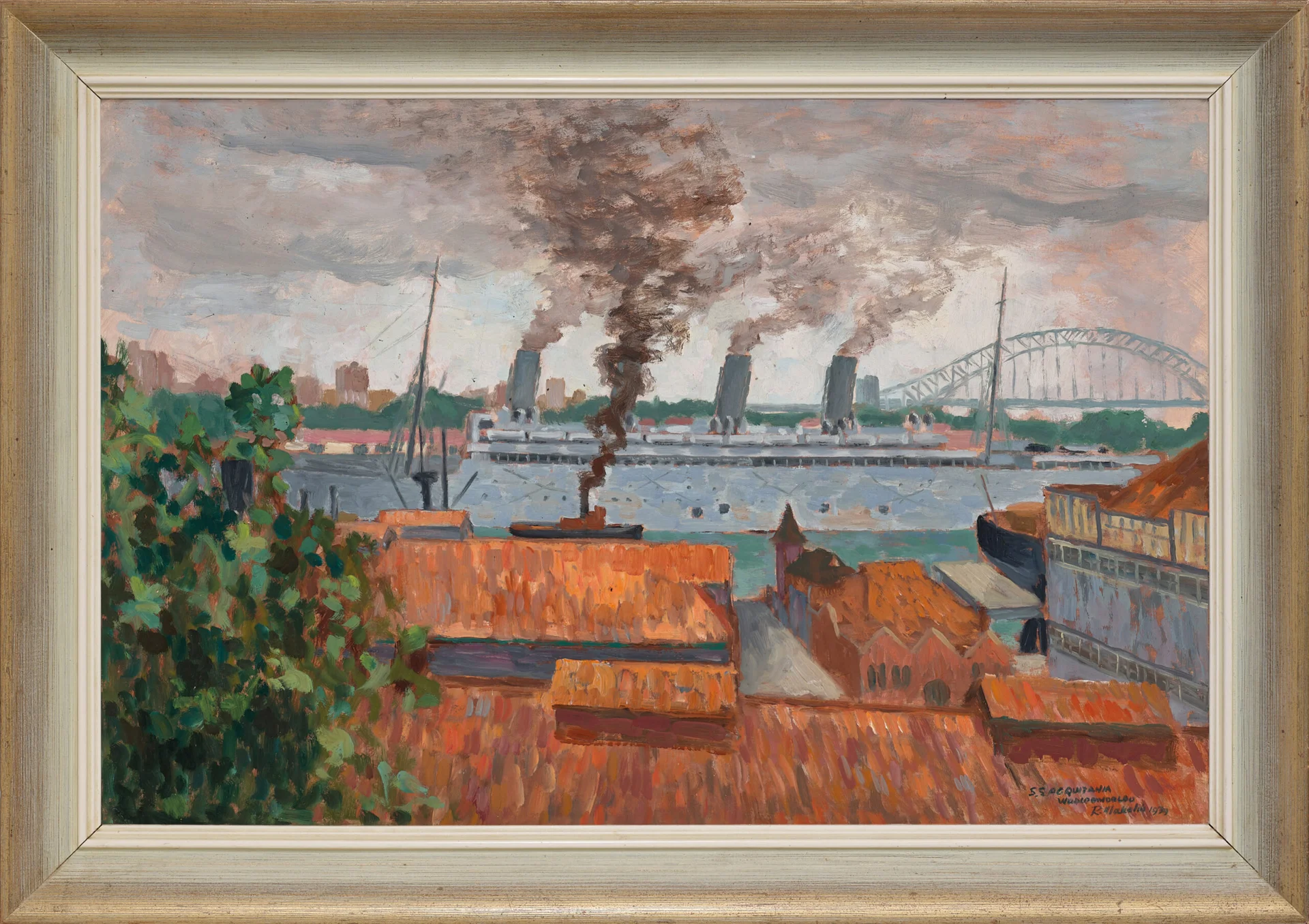
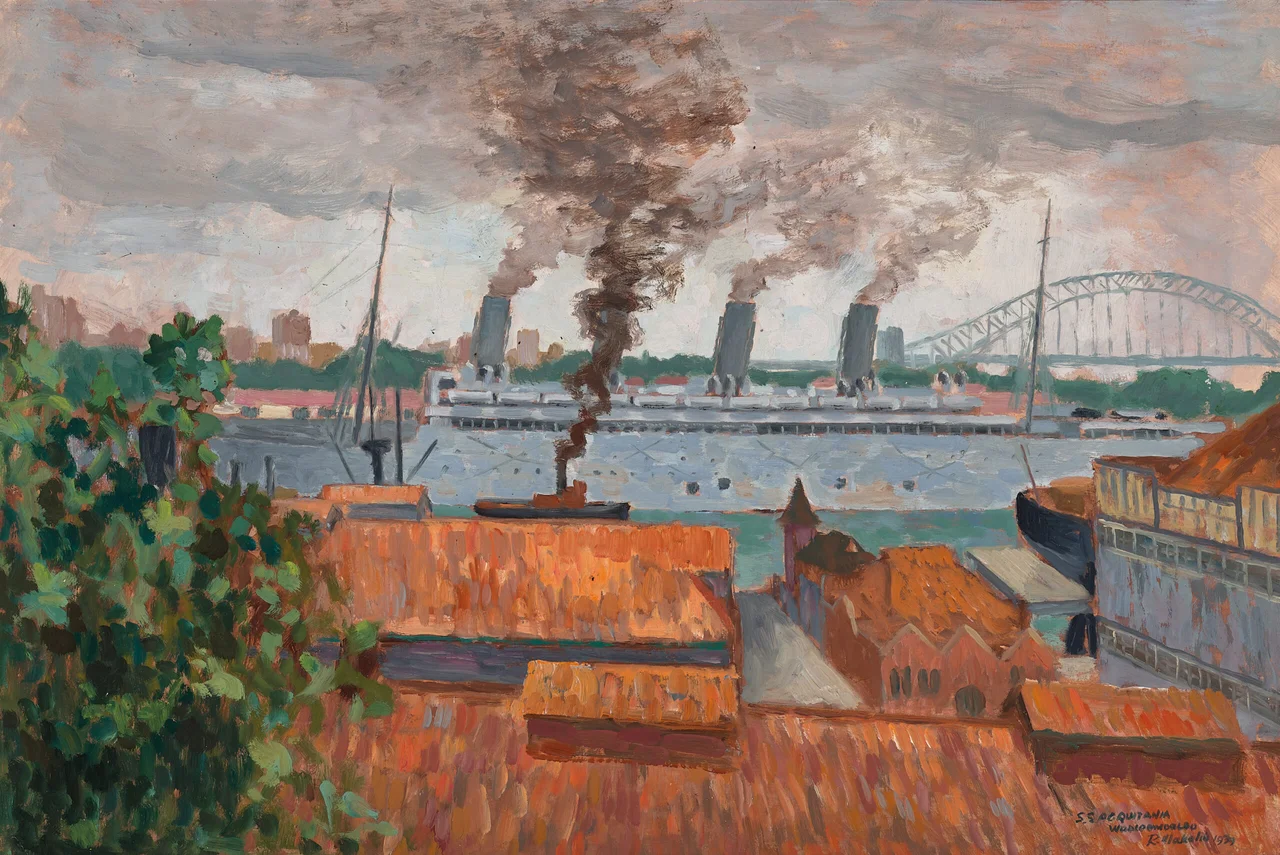
Underway at dawn, SS Aquitania, Woolloomooloo Bay, 1940
oil on cardboard
50.5 x 76.5 cm
signed, dated and inscribed with title lower right: S. S. ACQUITANIA [sic] / WOOLOOMOOLOO / R. Wakelin 1939 [sic]
inscribed verso: Underway [indistinct] at dawn
Estimate:
$40,000 - $60,000
lot details
inscribed verso: Underway [indistinct] at dawn
The Royal Blind Society of NSW, Sydney, a bequest from the artist
Macquarie Galleries, Sydney
John Andrews, Sydney
Private collection, Canberra, acquired from the above in October 2001
Exhibited
Toorak Art Gallery, Melbourne (label attached verso)
Royal Blind Society’s Collection of Roland Wakelin Works, Macquarie Galleries in association with Geoff K. Gray, Sydney, 18 April 1983, cat. 6 (as ‘S.S. Aquitania, Berthed at Woolloomooloo’, illus. in exhibition catalogue, p.11)
Related Works
RMS Aquitania, Sydney, 1943, oil on canvas, 60.0 x 38.5 cm, private collection
We are grateful to Meghan Adams, Historian, Department of Defence, for her assistance with this catalogue entry.
For some weeks during March and April 1940, Sydney played host to the Aquitania, once one of the largest ocean liners in the world. On 12 April, Roland Wakelin looked out from his Kings Cross apartment building to the astounding sight of the mighty vessel docked only 200 metres away at the Finger Wharf in Woolloomooloo, where it was now taking on troops headed to an uncertain future fighting in the Middle East.1 The title of Wakelin’s painting Underway at dawn, SS Aquitania, Woolloomooloo Bay, 1940, underscores the trepidation and significance of the ship’s impending voyage.2 Painted the day before departure, the Aquitania was already renowned in maritime history since its launch in 1914.3 When war was declared soon after, it was requisitioned by authorities and transformed into a hospital ship, seeing service in the Dardanelles campaign ferrying the wounded to the island of Lemnos, 110 kilometres away, where medical facilities had been established to support the fighting in Gallipoli.
At the war’s end, Aquitania assumed its former role as a much-favoured luxury liner plying the route between Southampton and New York, when it was known colloquially as ‘the beautiful ship.’ With the outbreak of World War Two, it was again requisitioned, though as a troop transport, as was the enormous Queen Mary, launched in 1934. The Aquitania arrived in Sydney on 16 March and spent some weeks moored at Cockatoo Island for refitting before sailing to Woolloomooloo. Several amateur photos of the ship at dock or in the harbour exist but, not surprisingly, media coverage was muted to comply with military censorship. Before settling in Kings Cross, Wakelin and his family had already moved a number of times in previous years due to a financial uncertainty which never quite matched his critical acclaim, with his then fifteen-year-old daughter estimating they had already occupied twelve homes by 1940. His home studio was now on an upper level of 10 Challis Avenue (flat 8) which afforded him a bird’s-eye view of the activities of soldiers and sailors at work on the docks or at play in the rowdy nighttime streets nearby, resulting in a small but lively group of works including Woolloomooloo and Potts Point, both 1940.4 In Underway at dawn, SS Aquitania, Woolloomooloo Bay, the ship dominates the scene with the distant Harbour Bridge operating merely as a cipher to indicate location. In the foreground, Wakelin uses emphatic and directional brushstrokes to articulate the richly coloured roofs of the Fitzroy Stevedore Company which occupied much of Cowper Wharf Road.5 The distinctive red building at the centre has been tentatively identified as an office building for the company with the small tower acting as a convenient lookout to follow the activity on the harbour. All of these buildings were demolished in the 1970s to make way for extensive Defence Personnel parking.
On 3 May 1940, the Aquitania and Queen Mary, which had arrived on 17 April, also for a refit at Cockatoo Island, joined a convoy outside the Heads and headed to Fremantle, then Bombay. One week later, the ‘phoney war’ in Europe was shattered by Germany’s blitzkrieg invasion of France and the Low Countries. The apprehension Wakelin had indicated in the title was now an unavoidable fact.6
1. Dates checked against multiple sources, including ‘12 April 1940, Arrival of Aquitania at Woolloomooloo’, National Archives of Australia (online), Series A11666, Item 4148377 at: recordsearch.naa.gov.au/SearchNRetrieve/Interface/ViewImage.aspx?B=4148377 (accessed 19 August 2026)
2. Wakelin’s date of ‘1939’ was applied later, incorrectly remembered by the artist.
3. The ship’s correct designation was RMS Aquitania.
4. See Deutscher and Hackett, Important Australian and International Fine Art, Melbourne, 30 November 2016, lot 68
5. Coincidentally, the buildings to the right of Fitzroy Stevedores were owned by the Dangar family, members of which were early collectors of Wakelin’s paintings.
6. The Aquitania revisited Sydney in October 1940, February 1943 and late November 1945.
ANDREW GAYNOR