
Jeffrey Smart
(1921 - 2013)
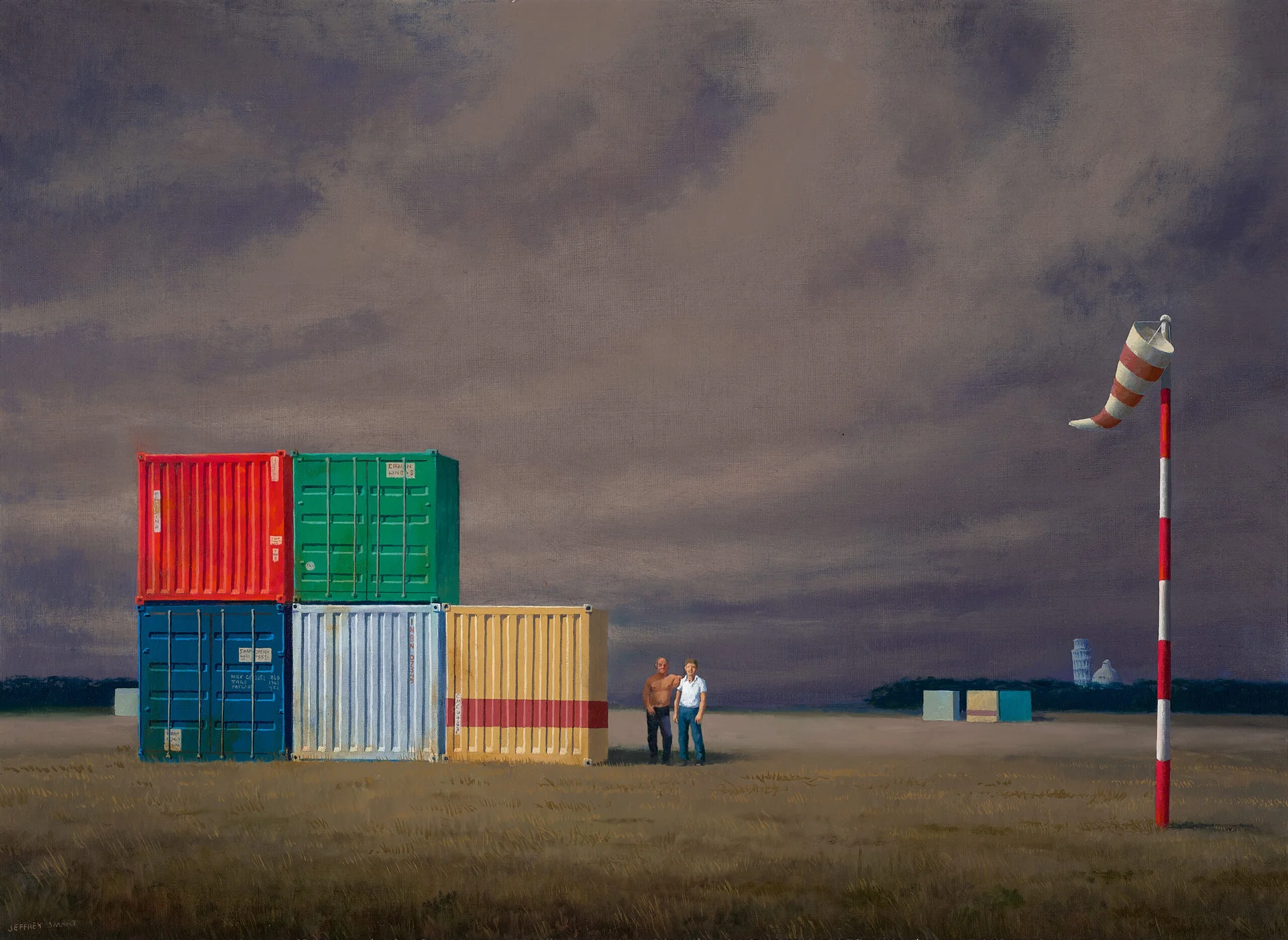
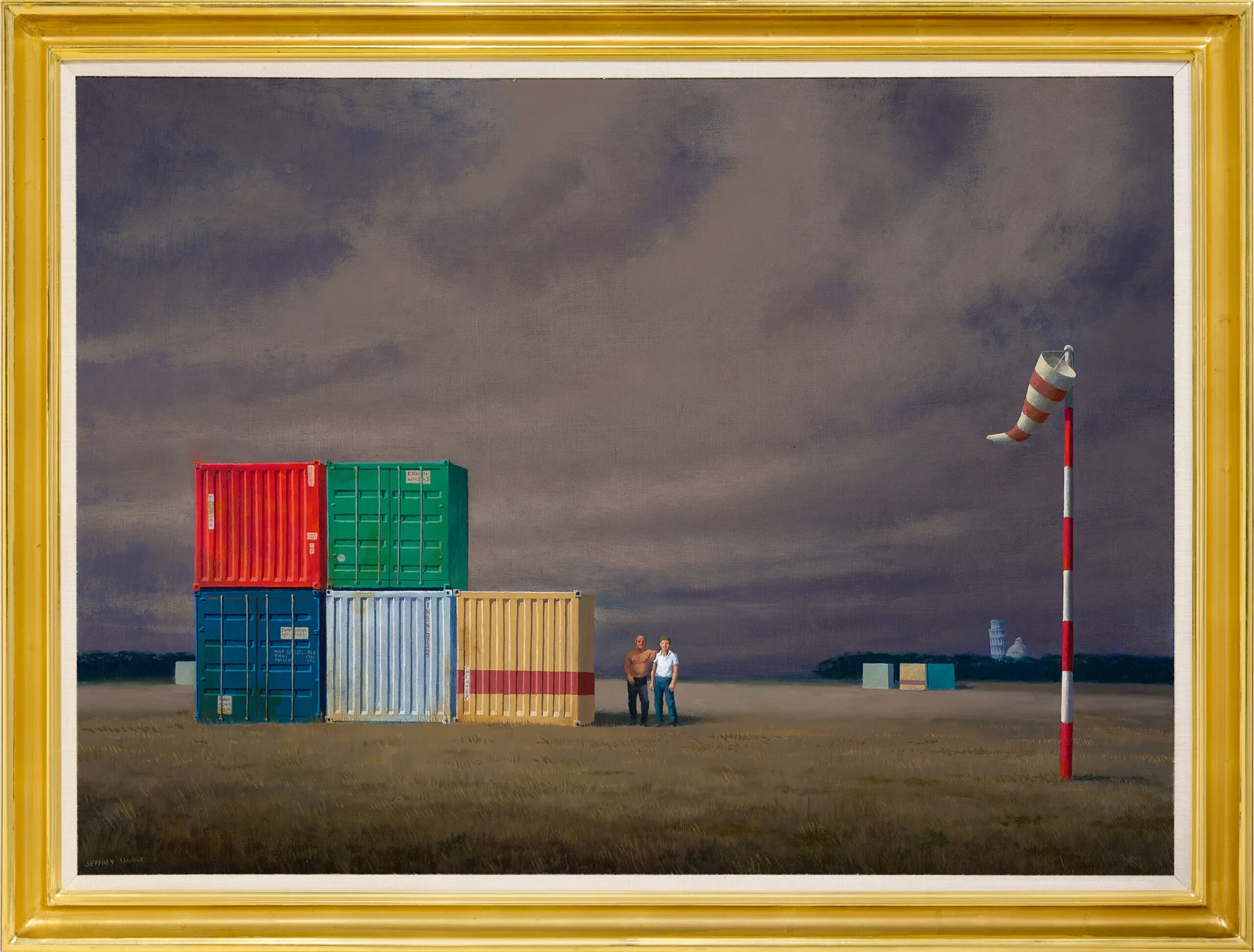
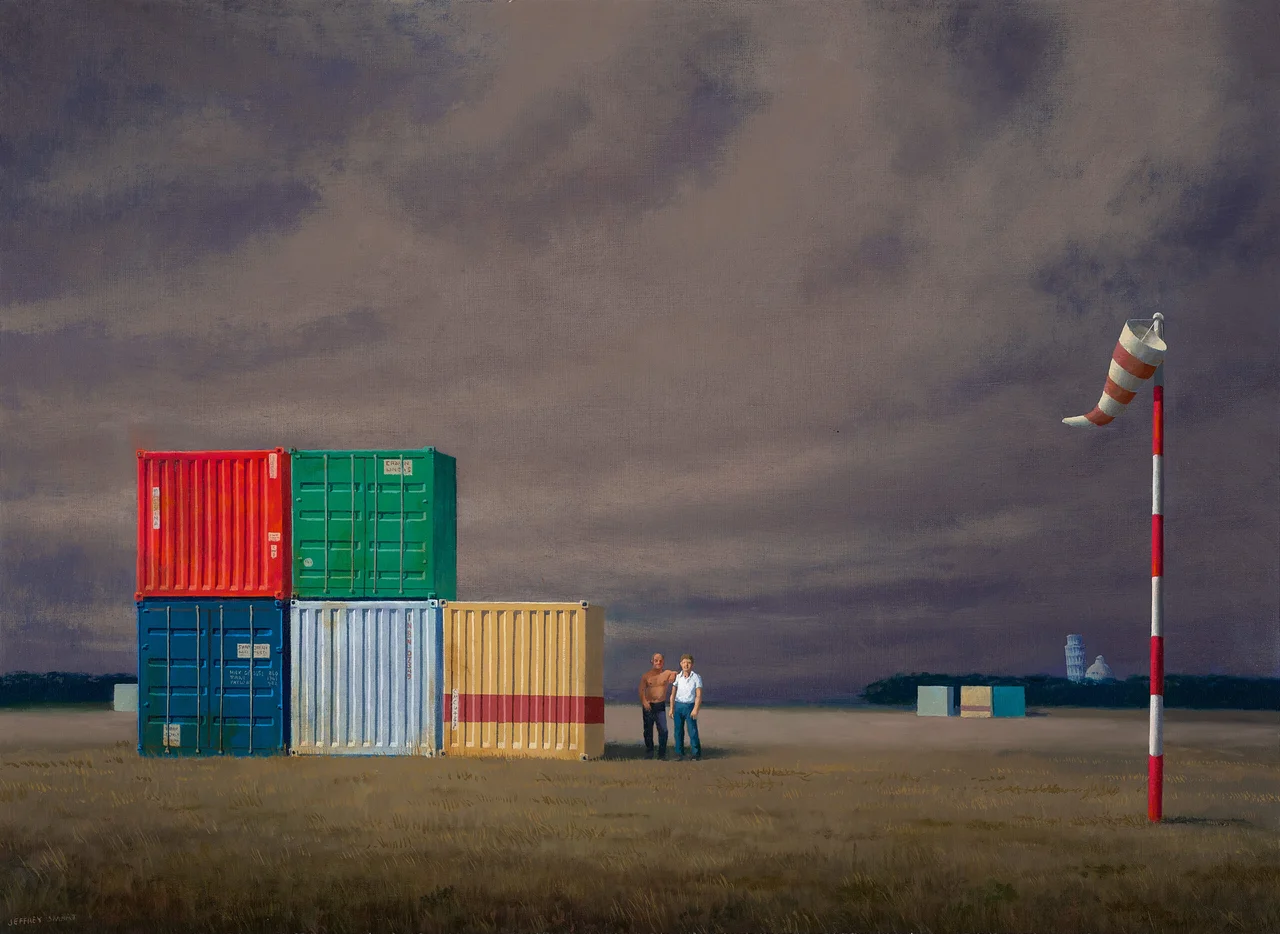
Containers at Pisa airport, 1998 – 99
oil on canvas
85.0 x 115.0 cm
signed lower left: JEFFREY SMART
Estimate:
$500,000 - $700,000
© courtesy of The Estate of Jeffrey Smart 2026
lot details
Australian Galleries, Sydney (label attached verso)
Private collection
Deutscher~Menzies, Melbourne, 28 August 2002, lot 49
Private collection, Canberra
Exhibited
Jeffrey Smart Paintings: 1958 – 1999 Including Seven New Works, Australian Galleries, Sydney, 27 August – 15 September 1999, cat. 1 (illus. in exhibition catalogue)
We are grateful to Stephen Rogers, Archivist for the Estate of Jeffrey Smart, for his assistance with this catalogue entry.
From Galileo Galilei Airport it’s impossible to view Pisa’s Leaning Tower and the Baptistery of San Giovanni, but this hasn’t prevented Jeffrey Smart from including them in this painting. The celebrated tourist attractions which may be glimpsed on the horizon, at the bottom-right corner, are overshadowed by a stack of brightly coloured containers that capture the viewer’s eye.
This is familiar territory for Smart: giving ironic precedence to the industrial products of the present day over the architectural masterpieces of the Renaissance. The tower and the Baptistery are tiny, distant presences in a landscape dominated by five large containers. It’s a perfectly ambiguous scene. We don’t know whether Smart is lamenting the neglect and devaluation of cultural heritage or suggesting we need to abandon our romantic attachment to the past and become alert to the unconventional beauties of the present. There is no hint within the painting itself as to how we should resolve this dilemma. The artist was famously unwilling to provide clues to his intentions.
Smart much preferred that we think for ourselves rather than pretend there is a ready-made explanation for every work of art. He knew that a large part of the allure of any painting lies in its capacity to stimulate the viewer’s imagination, letting us insert our own narratives into the scene depicted. We have no idea what the two men in the picture are doing, posing as if for a snapshot alongside the containers. Smart’s most likely comment would be that they’re only imparting a sense of scale, but we can’t help wondering: are they workers or tourists? What’s the relationship between these figures? Why did they choose to pose in this particular spot?
Jeffrey Smart
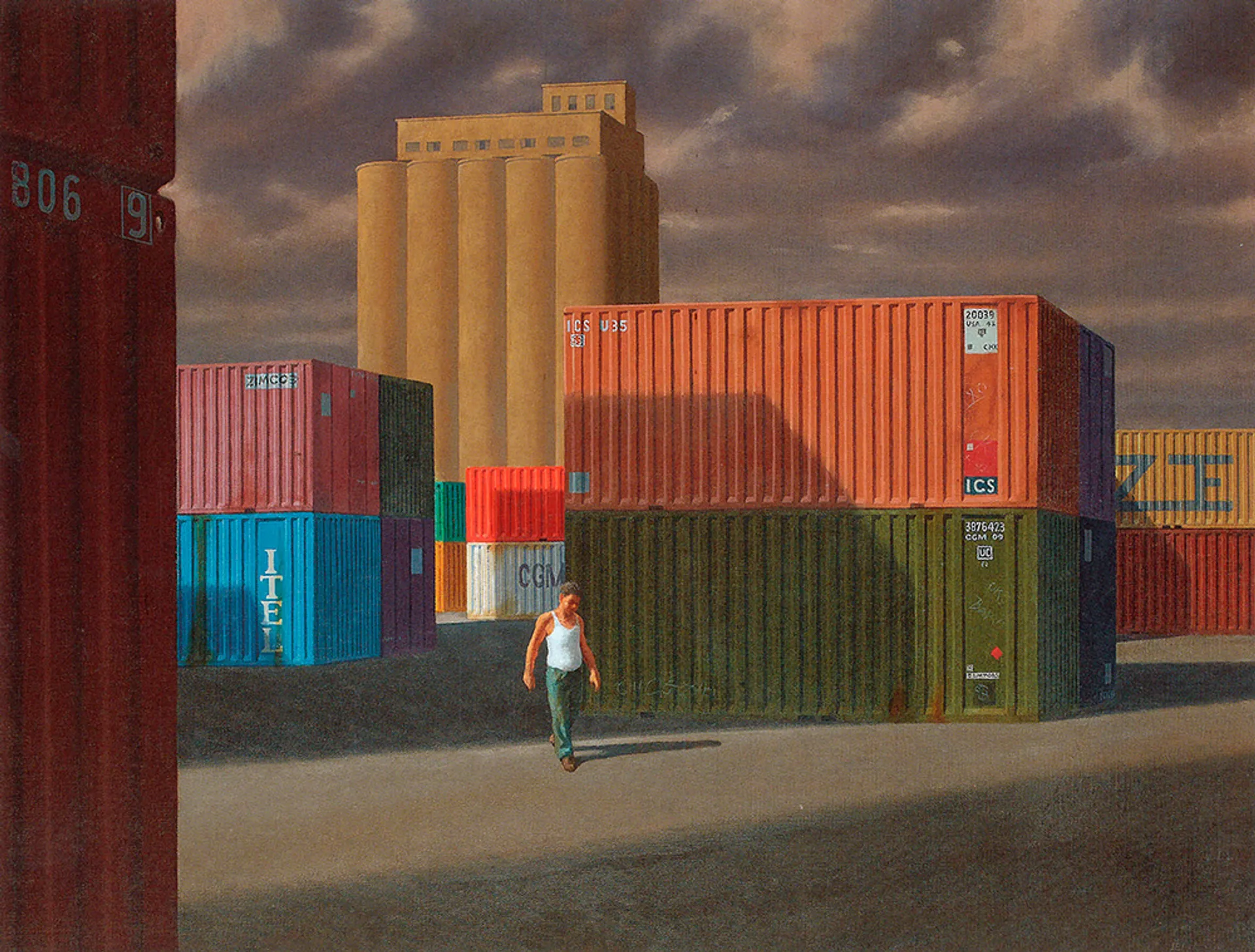
Containers and Silos at Livorno, 1990
oil on canvas
72.0 x 95.5 cm
Private collection
© The Estate of Jeffrey Smart
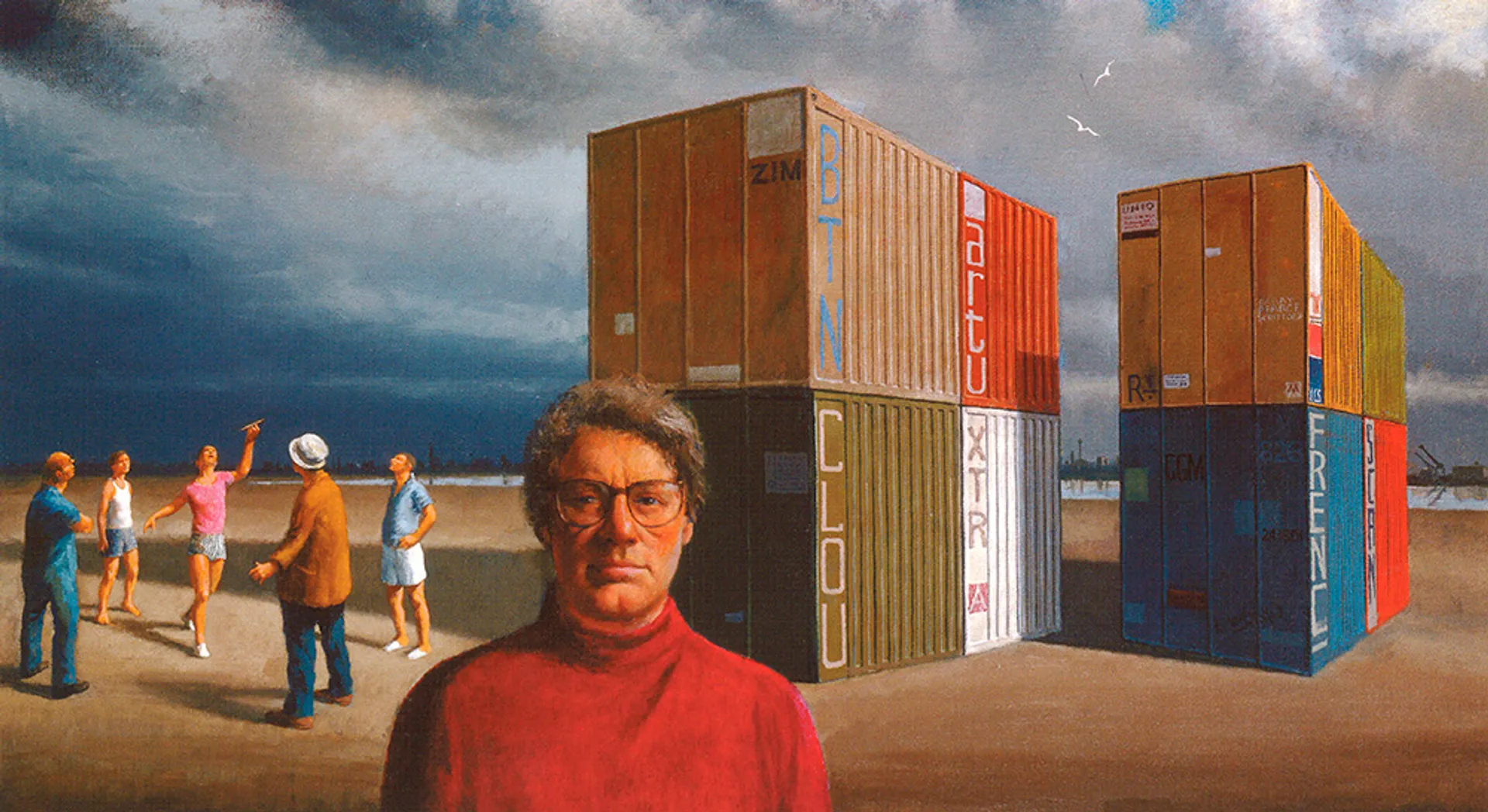
Jeffrey Smart
The two-up game (portrait of Ermes de Zan), 2006
oil on canvas
86.8 x 158.4 cm
TarraWarra Museum of Art, Victoria
© The Estate of Jeffrey Smart
There are no correct answers to such questions, but that doesn’t mean we can avoid asking them. Smart is continually prompting us to reflect on the way we respond to the ‘truth content’ of a painting. It’s the same paradox René Magritte posed in The Treachery of Images, 1929 – the famous painting of a pipe, labelled ‘Ceci n’est pas une pipe’. We habitually view a painting as if it were a window onto the world rather than a suggestive arrangement of colours on a flat surface. We want to know what’s really going on.
One of the secrets of this painting may be Smart’s use of the mathematical ratio known as the Fibonacci sequence, in which each number is the sum of the two preceding numbers. The sequence runs: 0, 1, 1, 2, 3, 5, 8… and so on. In Containers at Pisa airport, 1998 – 99 we can take the red and white pole on the right as 1, the tower and Baptistery as 2, the containers in the distance as 3, and the large containers in the foreground as 5. I’m only speculating, but it’s easy enough to imagine the famous Fibonacci spiral superimposed on this composition. If we add the five main containers to the two men and one small container on the far left, we get 8, which is the next number in the sequence.
With most artists it might seem far-fetched to divide up a painting with such mathematical precision, but in Smart’s oeuvre there is rarely a work that has not been planned with the ruler, set square and compass. Smart was addicted to the so-called Golden Ratio, closely associated with the Fibonacci sequence, using it to provide the underlying structure for most of his paintings. It’s one of the reasons an image that features objects as banal as metal shipping containers can project a profound sense of stability and monumentality.
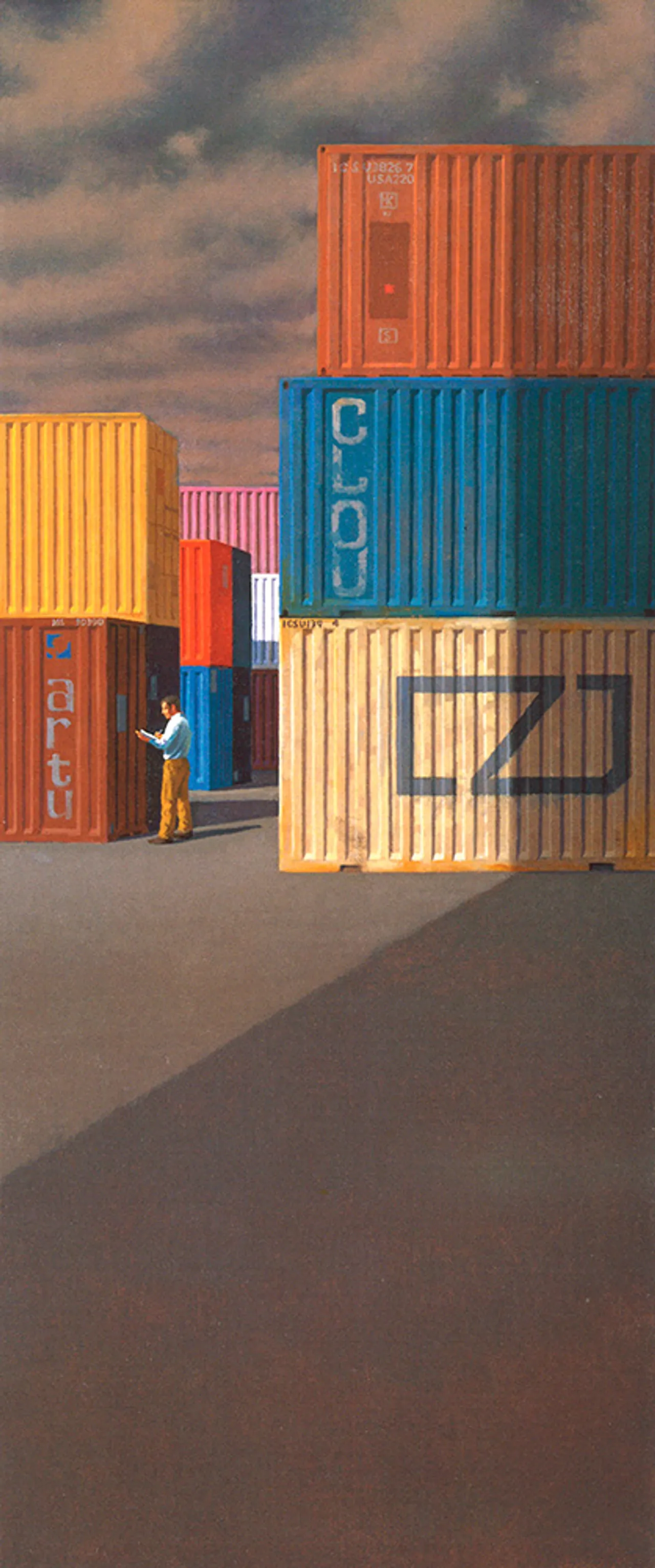
Jeffrey Smart
The waiting containers, 1990
oil on canvas
100.0 x 42.0 cm
Private collection
© The Estate of Jeffrey Smart
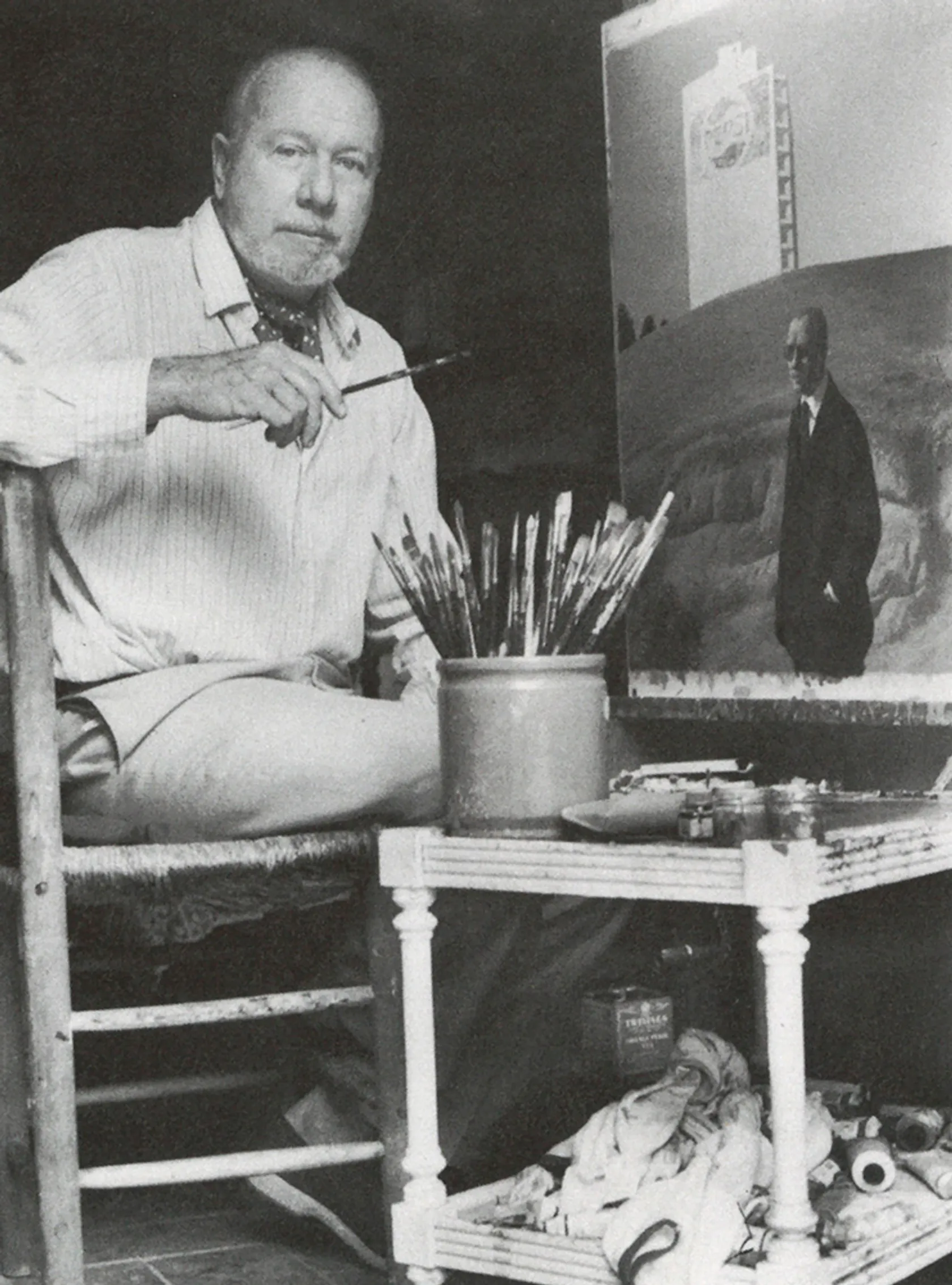
Jeffrey Smart painting ‘The Developer’, 1983
photographer unknown
Image courtesy Peter Quartermaine
The painting may be compared with other Smart pictures such as The Oil Drums, 1992, or The Cable Coils, 2000 – 01, in which industrial objects, heaped together, become quasi-monuments or works of public art. In the former a man with a trumpet blows a fanfare at a massive pile of coloured oil drums. In the latter, a small child sits perched on a gigantic coil of red wire. In both paintings the diminutive nature of the figure emphasises the enormous scale of the objects.
With Containers at Pisa airport, the coloured containers might pass for large-scale modular sculptures by a Minimalist such as Donald Judd. By now we should be accustomed to the idea that contemporary art can be anything at all, recognising that these containers are not devoid of aesthetic appeal, with their bold colours and sharply defined geometric relief patterns. The men might even be the artists, posing alongside their creation.
Smart was so pleased with this image that he reworked it as a coloured etching in which the detail was greatly reduced, making the containers into coloured squares, opaque as a Rubik’s Cube. He also removed the red and white pole, and transformed the figures into thin, shadowy forms. It’s a relaxed revision of the painting in which sky and foreground have been painted in an unusually free manner, allowing the containers to stand out even more vividly as flat impositions on an expressive landscape. It’s one of the few moments when this most fastidious of artists loosened his tight control over the composition and indulged in a brief flirtation with spontaneity.
JOHN McDONALD
John McDonald writes art, film & politics for his site, ‘Everything the artworld doesn’t want you to know’, Everythingthe.com