
Rupert Bunny
(1864 - 1947)
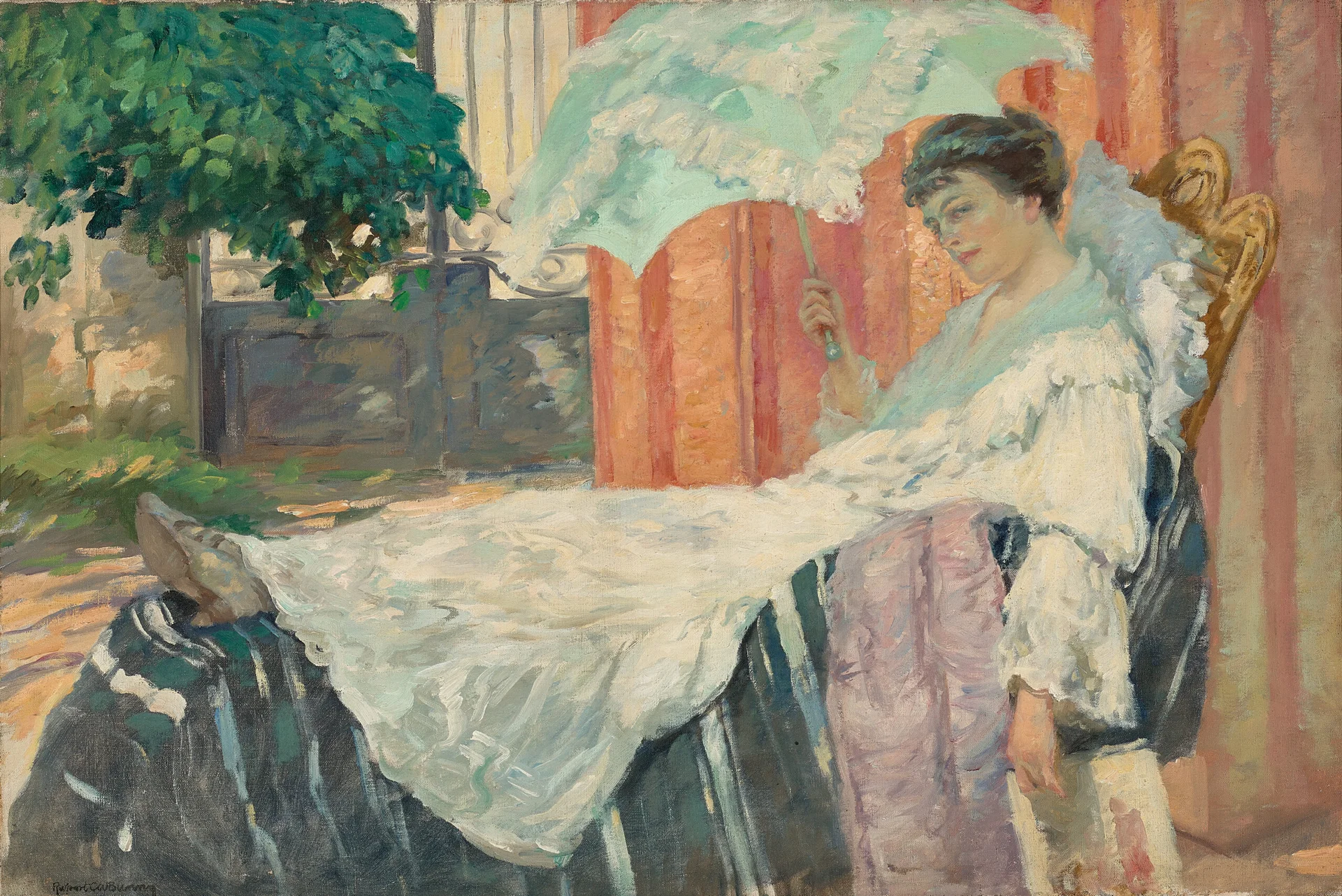
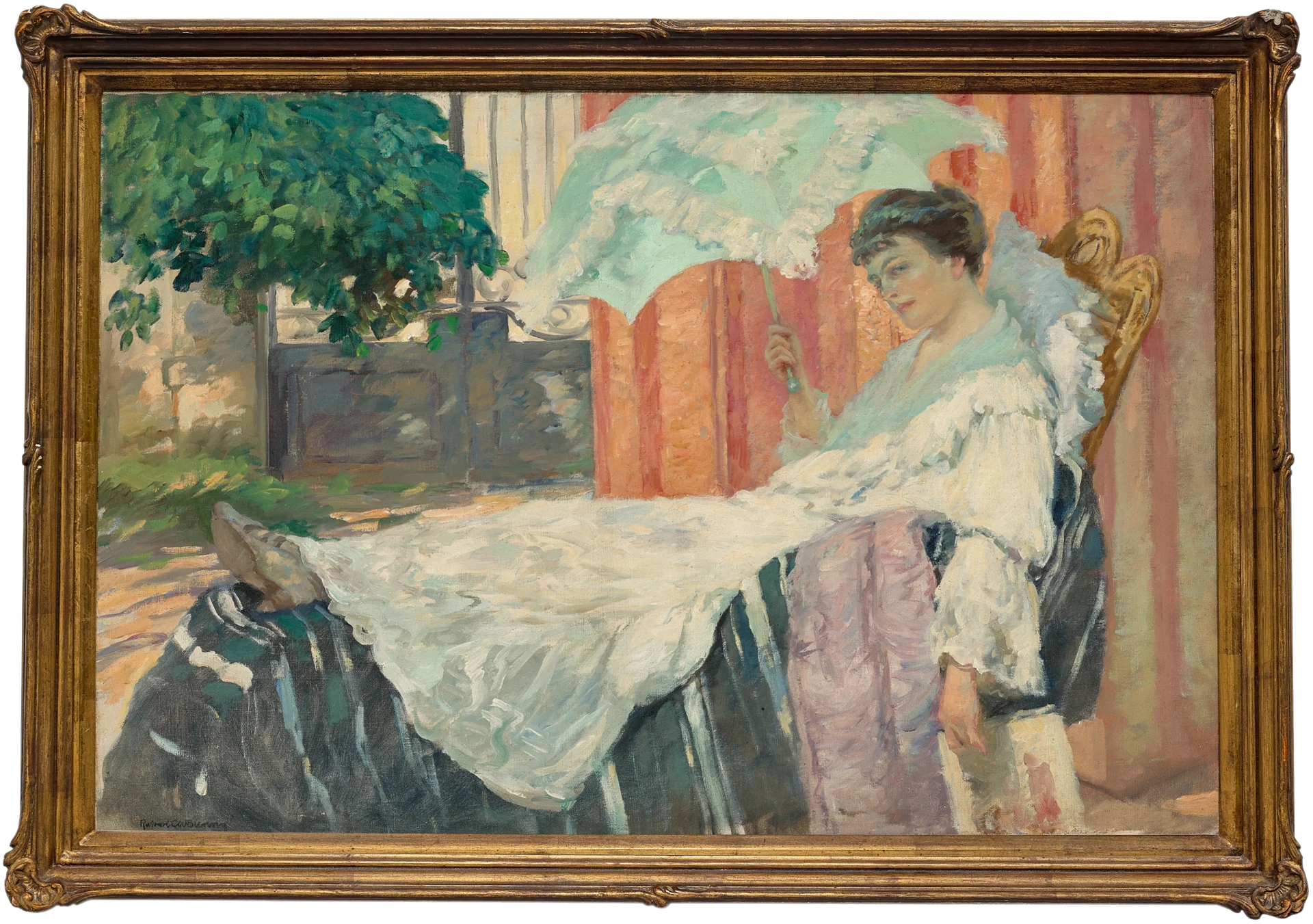
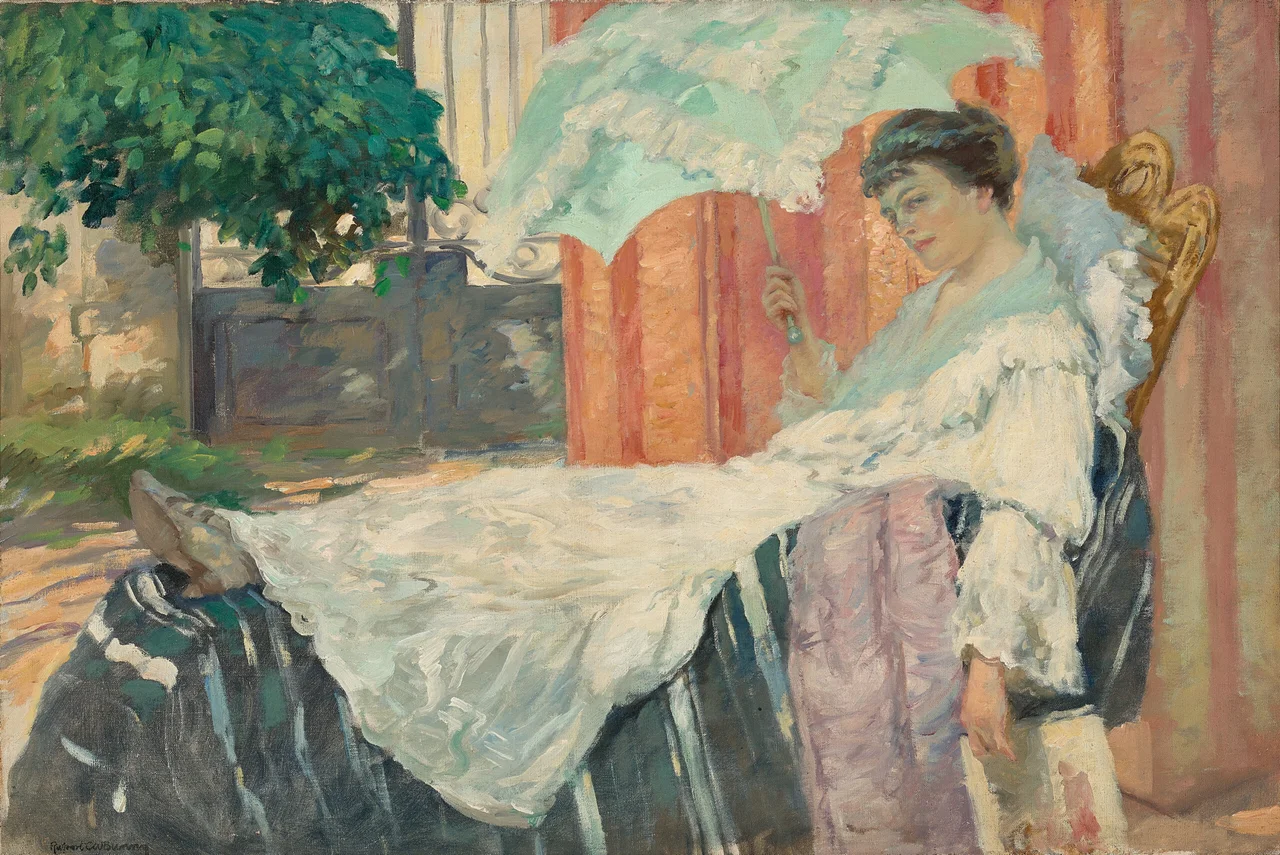
La chaise longue, c.1914
oil on canvas
54.0 x 81.0 cm
signed lower left: Rupert C W Bunny
Estimate:
$180,000 - $250,000
lot details
Anthony Hordern and Sons, Sydney (partial label attached verso)
Frank Whiddon, Sydney, acquired from the above in 1923
Thence by descent
Helen Row, Brisbane, 1970
Thence by descent
Mrs R. Row, Brisbane
Christie’s, Melbourne, 2 May 2002, lot 75
Private collection, Canberra
Exhibited
Rupert Bunny, Galerie Georges Petit, Paris, 16 – 31 March 1917, cat. 31
An Exhibition of Oil Paintings & Drawings by Rupert C. W. Bunny, Fine Arts Society’s Gallery, Melbourne, 15 – 27 November 1922, cat. 26
Exhibition of Oil Paintings & Drawings by Rupert C. W. Bunny, Anthony Hodern and Sons, Sydney, 2 – 31 May 1923, cat. 26
Literature
‘Sundry Shows’, The Bulletin, Sydney, vol. 43, no. 2232, 23 November 1922, p. 34
Thomas, D., Rupert Bunny, Melbourne, Lansdowne Press, 1970, cat. 0171, p. 117
Gérard–Austin, A., The Greatest Voyage: Australian Painters in the Paris Salons, 1885 – 1939, doctoral thesis, Universite Paris 1 – Pantheon–Sorbonne, March 2014, vol. 2, pp. 19, 84, 131 (illus.)
Thomas, D., The Life and Art of Rupert Bunny, A Catalogue Raisonné in Two Volumes, Thames & Hudson, Melbourne, 2017, cat. O366, vol. II, p. 50
Related Works
A sunny nook, morning, c.1913, oil on canvas, 65.3 x 40.4 cm, National Gallery of Victoria, Melbourne
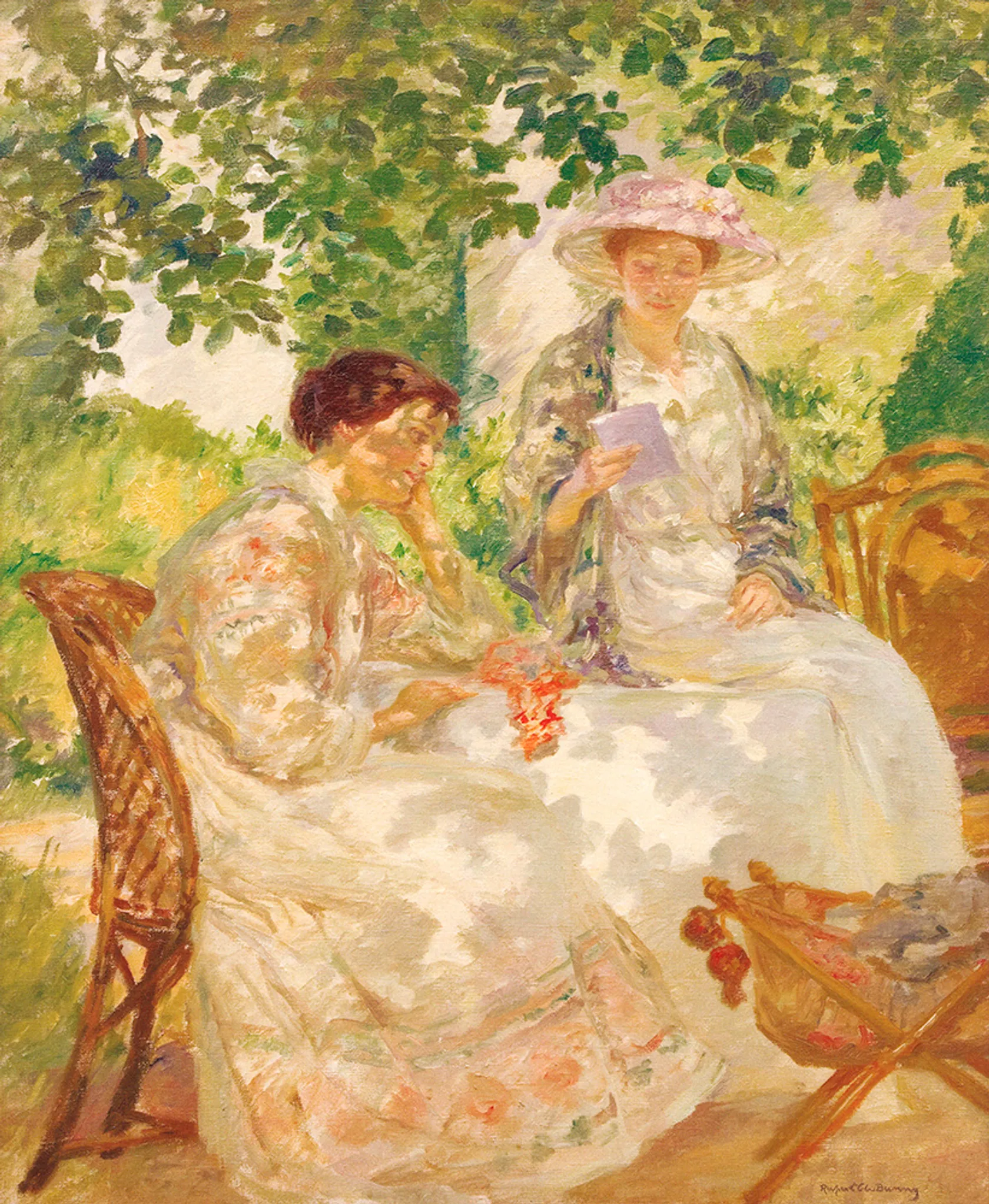
The Letter, c.1914 – 16, oil on canvas, 73.3 x 60.2 cm, The Kerry Stokes Collection, Perth
The garden bench, c.1915, oil on canvas, 73.0 x 60.4 cm, Art Gallery of New South Wales, Sydney
One of the most internationally successful Australian artists of his generation, Rupert Bunny was born in Melbourne and first trained at the National Gallery School, before settling permanently in Paris during the late 1880s where la belle époque was at its height. By the early years of the twentieth century, he had become the first Australian artist to receive an honourable mention at the Société des Artistes Français; was elected a sociétaire of various French exhibiting institutions; and enjoyed the prestige of being the only Antipodean artist until then to have his work acquired by the French State, with Après le bain, c.1904 bought from the New Salon for the Musée de Luxembourg (now the Musée d’Orsay).
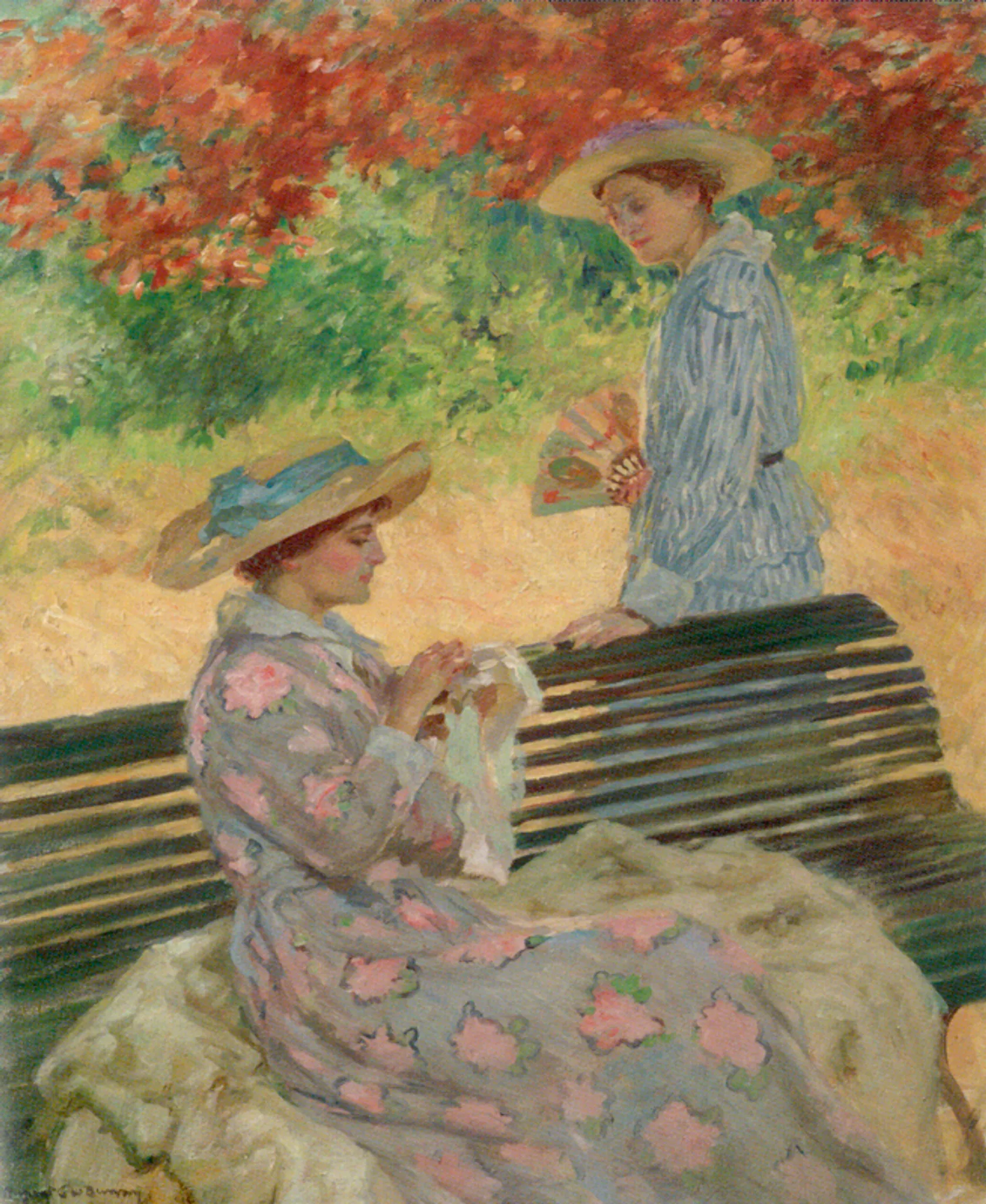
While Bunny continued to evoke an opulent, often indolent elegance in his works produced around the fin-de-siècle and early twentieth century, by the years immediately preceding World War I his paintings were ‘…evolving slowly towards a modern notion of a busy woman’s life, as she sewed, worked in the garden or chatted to a friend.’1 As Mary Eagle elucidates, ‘Bunny modified his imagery just sufficiently to hint at the change. His women were still softly pretty… but their clothes were less hampering and their expressions slightly more alert.’2 Painted circa 1914 and featuring the artist’s beautiful wife and favourite model, Jeanne-Héloise Morel, La chaise longue encapsulates brilliantly the ‘naturalness and sunny serenity’3 that embodied Bunny’s work at this time – a precious ‘golden age’ before the ravages of the Great War would forever alter the cultural, political and social landscape of his beloved France.
Rupert Bunny
The Letter, c.1914 – 16
oil on canvas
73.3 x 60.2 cm
The Kerry Stokes Collection, Perth
Rupert Bunny
The garden bench, c.1915
oil on canvas
73.0 x 60.4 cm
Art Gallery of New South Wales, Sydney
Having first met Jeanne in Paris in 1892, Bunny reportedly fell in love with her immediately, John Longstaff later recalling that ‘the very night they met… he fell in love with her at first sight. She was a regular Dresden china girl with a deliciously tip-tilted nose.’4 An artist herself, Jeanne subsequently became Bunny’s wife, muse and most enduring subject, appearing throughout his oeuvre in works ranging from elegant portraits to the dreamlike Symbolist compositions of the turn of the century. Here, reclining languorously upon a striped chaise longue, a book held loosely in one hand and a pale parasol aloft in the other, she is depicted enjoying an intimate moment of dolce far niente in the gentle sunlight. Her voluminous white dress cascades across the composition in loose, feathery strokes, while the warm pinks and mauves of the chaise and enclosing screen are offset by the verdant foliage beyond. Like the closely related The letter, c.1914–16 (The Kerry Stokes Collection, Perth), and A sunny nook, morning, c.1913 (National Gallery of Victoria), La chaise longue betrays a noticeable absence of artifice, imbued rather with the artist’s genuine love of his subject – and indeed, of the art of making pictures itself. Although frequently celebrated as a ‘painter of beautiful women’, Bunny’s interest here lies equally in capturing the fleeting effects of light as it plays across figure, fabric and foliage – dissolving forms and contours within a harmonious arrangement of soft whites, blues, greens and pinks. With its emphasis upon quiet domestic leisure and seemingly effortless synthesis of naturalism and Impressionist technique, La chaise longue attests, moreover, to the way in which Bunny created an art appropriate to his time and the conditions of modernity – assimilating avant-garde modes into establishment practice.
Transforming the prosaic into the poetic through his mastery of figure composition and feminine charm, and his exquisitely light and airy palette, thus Bunny offered contemporary audiences a vision of the everyday exuding joie de vivre and ‘…a peaceful remoteness from the ‘sturm and drang’ of modern life.’5 Significantly, La chaise longue was included in the artist’s celebrated solo exhibition at Galerie Georges Petit, Paris in March 1917, where leading French art critic Gustave Geffroy observed that Bunny’s paintings expressed ‘the luminous joy of daylight… and the pleasure of living in the shadow of trees looking out on a festival of sunshine…’6 With its charm, sensuous beauty and quiet intimacy, La chaise longue offers a quintessential example of Bunny’s lyrical explorations of the everyday – eloquently affirming Geffroy’s perceptive characterisation of the artist as at once ‘a realist and a visionary, an observer of truth and a poet of the world of dreams.’7
1. Eagle, M. and Jones, J., A Story of Australian Painting, Macmillan Australia, Sydney, 1994, p. 132
2. ibid.
3. Eagle, M., The Art of Rupert Bunny in the Australian National Gallery, Australian National Gallery, Canberra, 1991, p. 101
4. John Longstaff, cited in Thomas, D., The Life and Art of Rupert Bunny: A Catalogue Raisonné, vol. I, Thames & Hudson, Port Melbourne, 2017, p. 79
5. Sydney Morning Herald, Sydney, 22 September 1911, p. 7
6. Geffroy, G., ‘Rupert Bunny: Introduction’, Exposition Rupert C.W. Bunny, Galerie Georges Petit, Paris, 1917, n. p.
7. ibid.
VERONICA ANGELATOS