
Nora Heysen
(1911 - 2003)
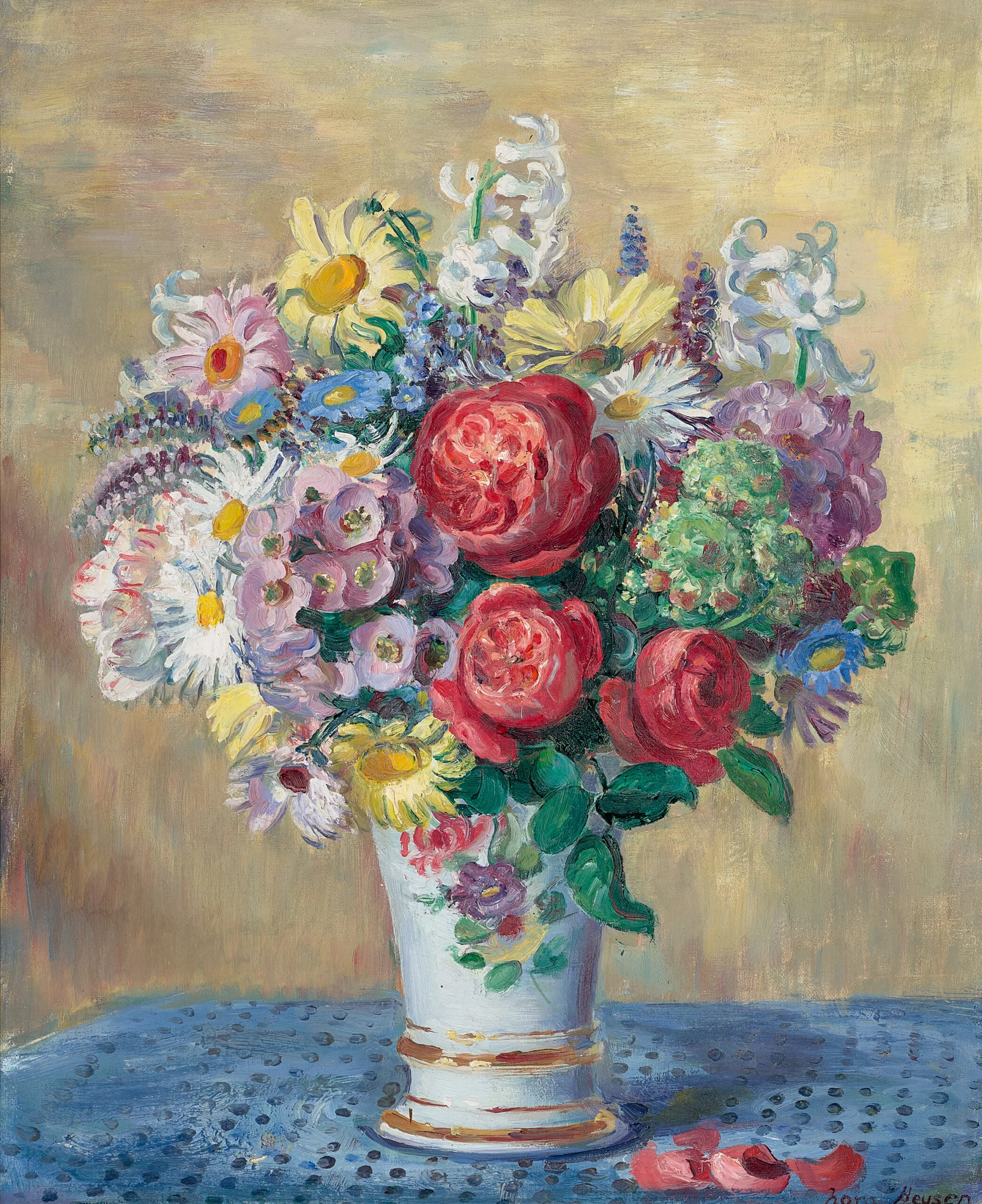
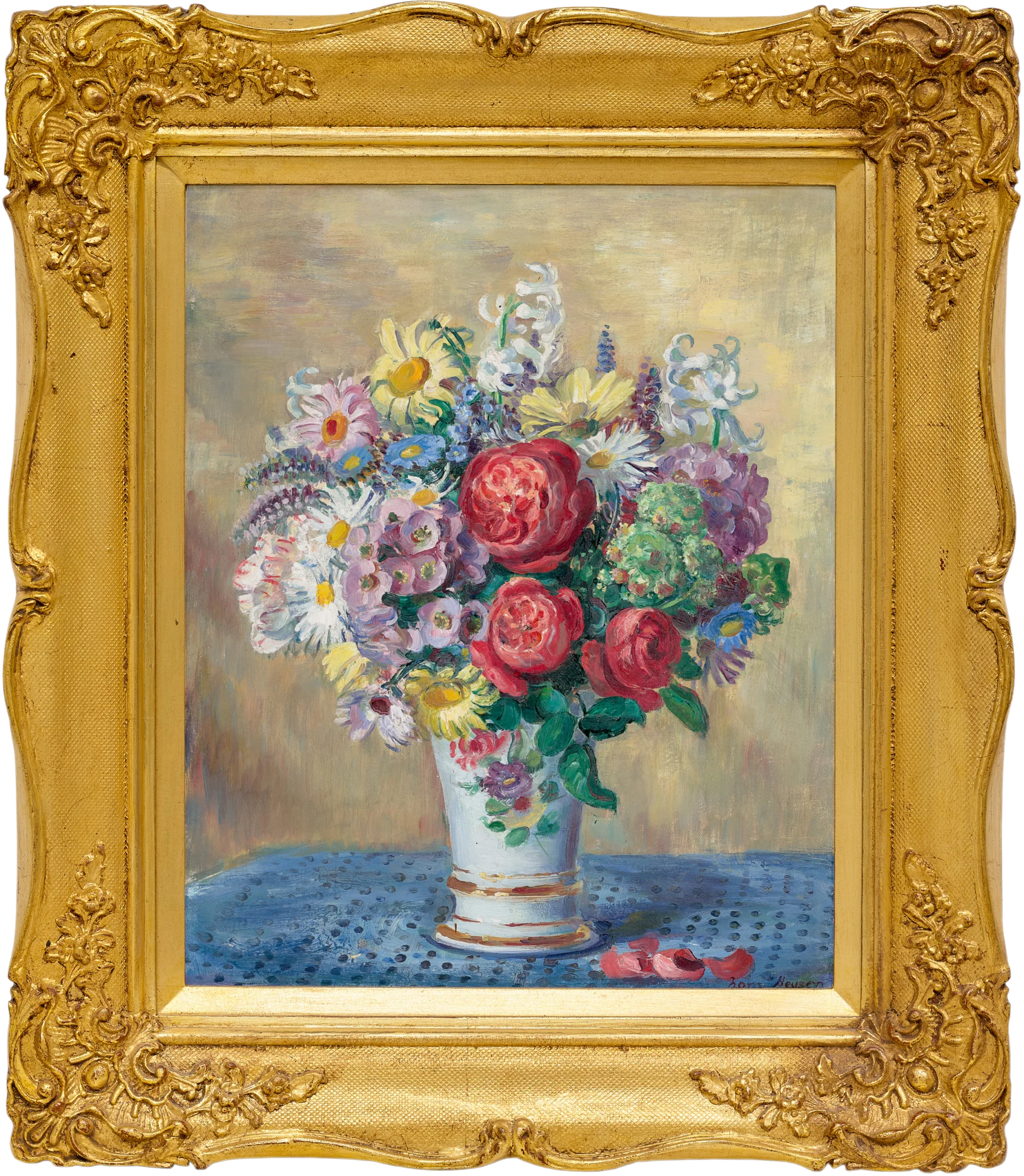
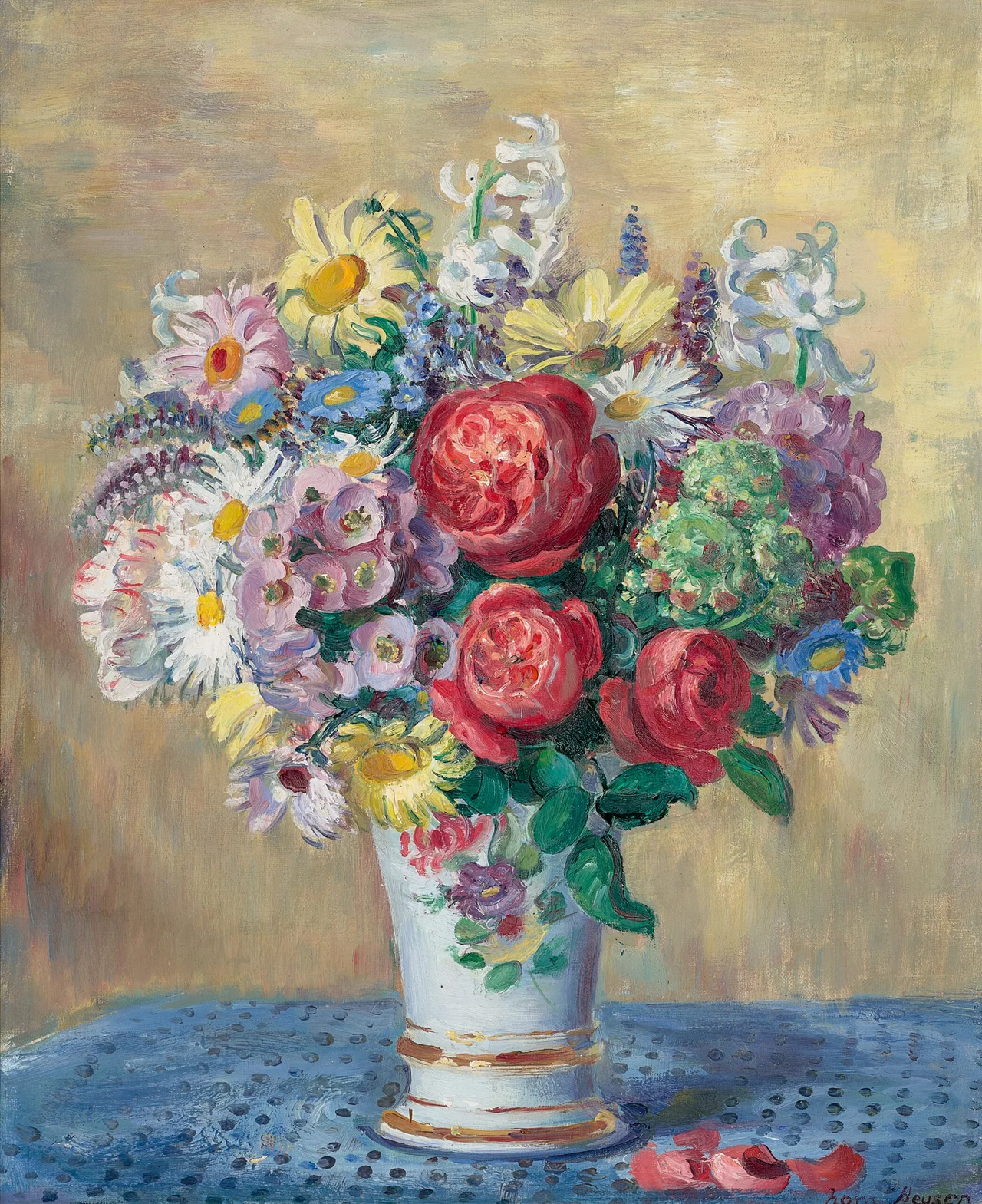
The blue tablecloth
oil on canvas on board
42.0 x 34.0 cm
signed lower right: Nora Heysen
Estimate:
$30,000 - $40,000
lot details
Private collection, Mount Gambier, South Australia
Principal Antique Auctions, Mount Gambier, July 2000, lot 2
Private collection, Victoria
Deutscher~Menzies, Melbourne, 21 August 2000, lot 67 (as ‘Still Life, Flowers in a Vase’)
Private collection, Hobart
Solander Gallery, Canberra
Private collection, Canberra, acquired from the above in April 2002
Exhibited
Lauraine Diggins Fine Art, Melbourne (label attached verso)
Australian Masters Old and New, Solander Gallery, Canberra, 8 March – 14 April 2002
Related Works
Poppies, 1938, oil on canvas, 54.0 x 44.0 cm, private collection, illus. in Speck, C. (ed.), Heysen to Heysen: selected letters of Nora Heysen and Hans Heysen, National Library of Australia, Canberra, 2011, p. 104
We are grateful to Fiona Mapp-Moroni for her assistance with this catalogue entry
Flower painting for Nora Heysen was not just an idle fancy; it was her chosen focus and research subject. Such was her commitment to floral still lifes that she sustained a long and financially successful career as a result, despite being derided by critics because of her gender or the long shadow cast by her father, the noted ‘master of the gum tree’ Hans Heysen. She always acknowledged his influence on her career, recalling later that ‘(w)e didn’t talk, except about painting. I learned more from him than from anyone… [all during] his precious working time. He was a remarkable teacher.’1 Whilst her father was indeed a great support and mentor to Heysen, she also undertook studies in Adelaide at the School of Fine Arts followed by two years from 1934 at London’s prestigious Central School of Art. On her return, she both challenged and enraged the local art world in 1939 by becoming the first woman to win the Archibald Prize and was subsequently the first woman appointed as an official war artist, based in Melbourne, New Guinea and Queensland from 1943. On her return, the Australian War Memorial acquired 152 of her paintings and drawings under the Official War Art Scheme.
Heysen never pretended to be a modernist and was scathing in her opinion of contemporary 1930s British flower painters such as Vanessa Bell, Augustus John and others, claiming their attempts ‘made me feel sick, they were so crude and badly arranged, badly painted and messy in all ways. I have come to the conclusion that no one can paint flowers here.’2 She was more interested in the earlier Dutch masters as well as the French artist Henri Fantin-Latour whose work she sought out repeatedly at the National Gallery in London. Her father also admired Fantin-Latour, urging his daughter to look particularly at how well he considered ‘the relative size of his flowers to his grey spaces and size of canvas. Fantin creates his atmosphere – both by relative tonal values and undefined edges (giving) more the impression of the flower without the definition of his early period.’3 Beyond the galleries, Heysen also had the fortune to meet the painter Orovida Pissarro, daughter of Lucien Pissarro, who advised her to lighten her palette, suggesting she utilise cadmiums, but no brown, ochre or black. Heysen followed this advice, writing to her parents afterwards that ‘(y)ou can certainly see the difference… more vibratio… more brilliant.’4 The blue tablecloth, is a clear summation of these inspirations and experiments, a bustle of blooms contained in a ceramic vase with a sense that the flowers are still living and attuned to the elements.
Roses were Nora Heysen’s great love and references to the flowers and her paintings of them pepper her long correspondence to friends and family. It is therefore not surprising that they take their place again within this painting, accompanied by hydrangeas, delphiniums and daisies. The blue tablecloth (which also appears in Poppies, 1938) provides a solid band of colour for the base whilst the subtle tones of the textured wall recall her comments relating to a self-portrait painted soon after seeing examples of Lucien Pissarro’s work, that she had ‘repainted the wall behind the head in broken colour – gave it much more vibration and light.’5
1. Nora Heysen, cited in Mattingley, C., ‘Nora Heysen: stands tall as artist and benefactor’, National Library of Australia News, Canberra, January 2007, p. 3
2. Nora Heysen, Letter to her parents, 30 April 1935, cited in Speck, C. (ed.), Heysen to Heysen: selected letters of Nora Heysen and Hans Heysen, National Library of Australia, Canberra, 2011, p. 36
3. Hans Heysen, Letter to Nora Heysen, 6 October 1936, cited in Speck, ibid., p. 47
4. Nora Heysen, Letter to her parents, 30 Oct 1935, cited in Speck, ibid., p. 48
5. Nora Heysen, cited in Lou Klepac, Nora Heysen, The Beagle Press, Sydney, 1989, p. 34
ANDREW GAYNOR