
William Delafield Cook
(1936 - 2015)
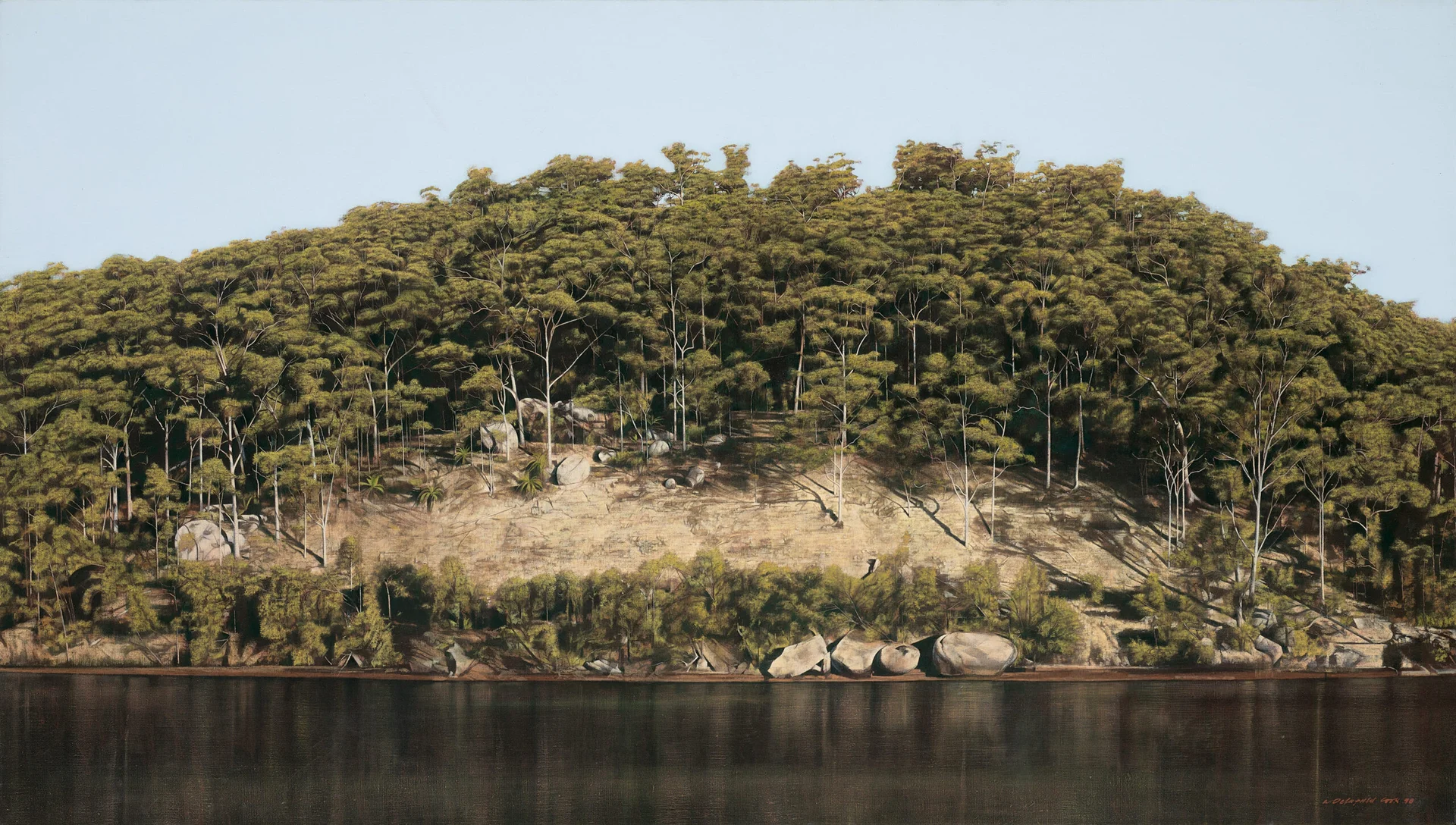
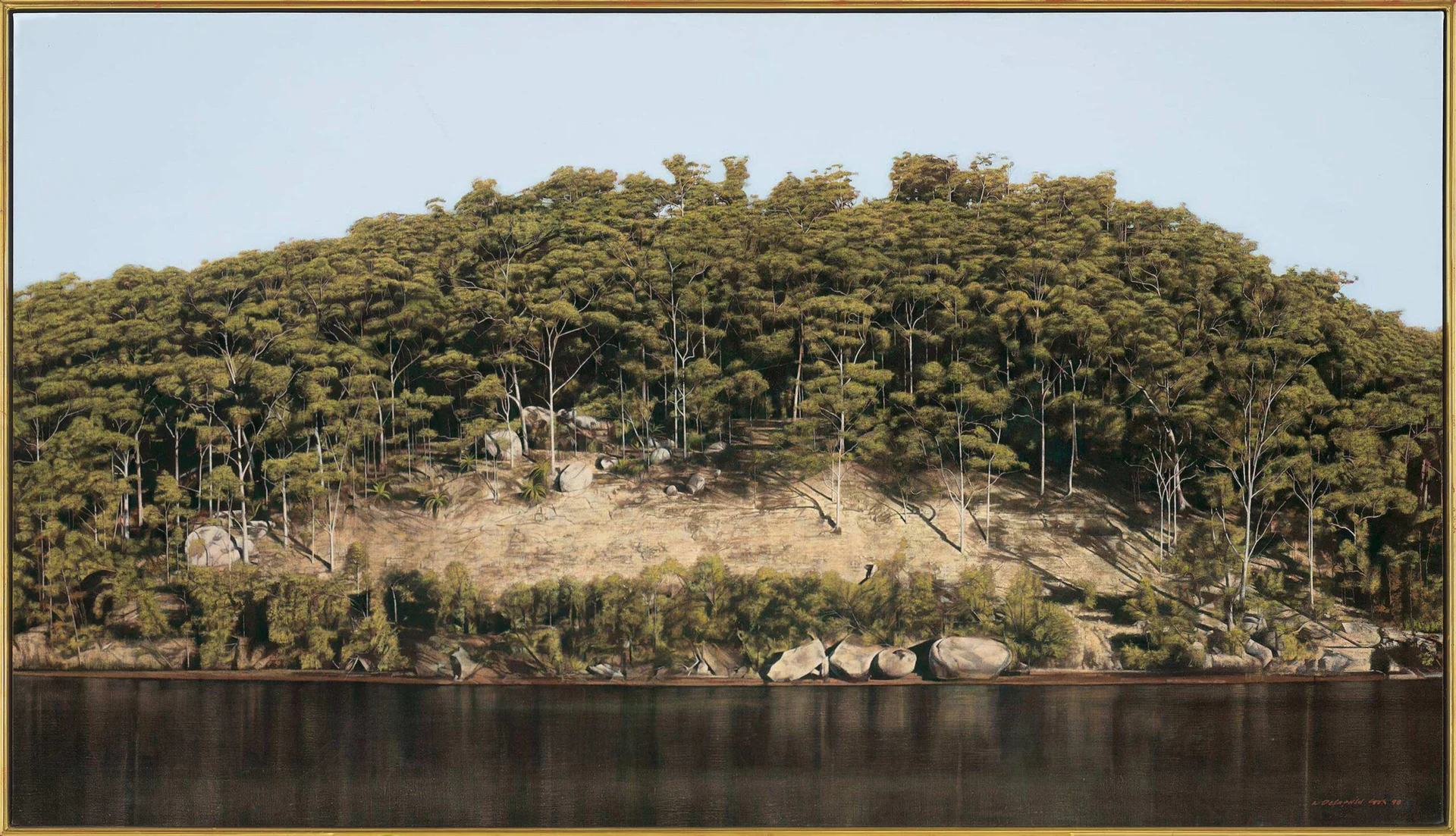
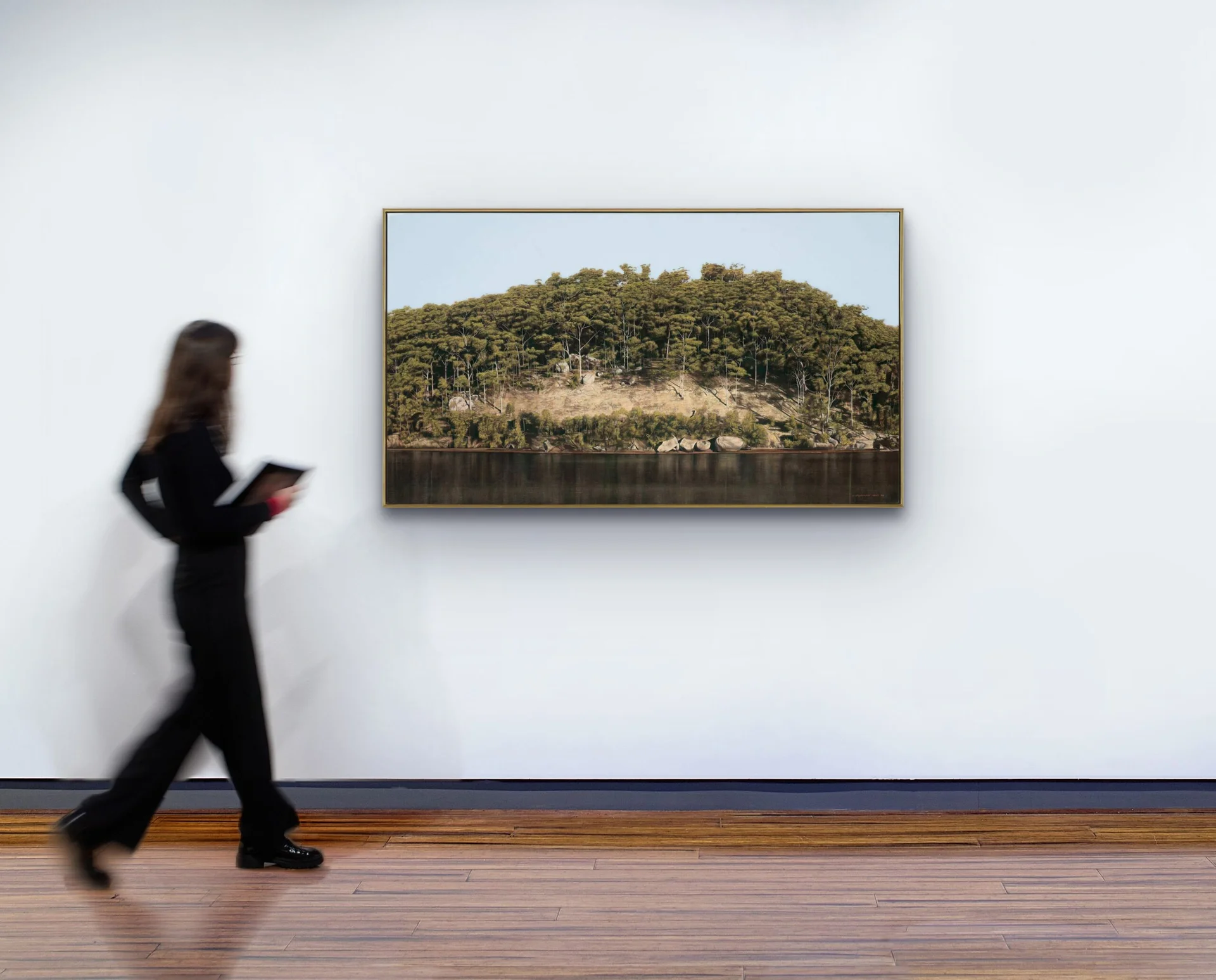
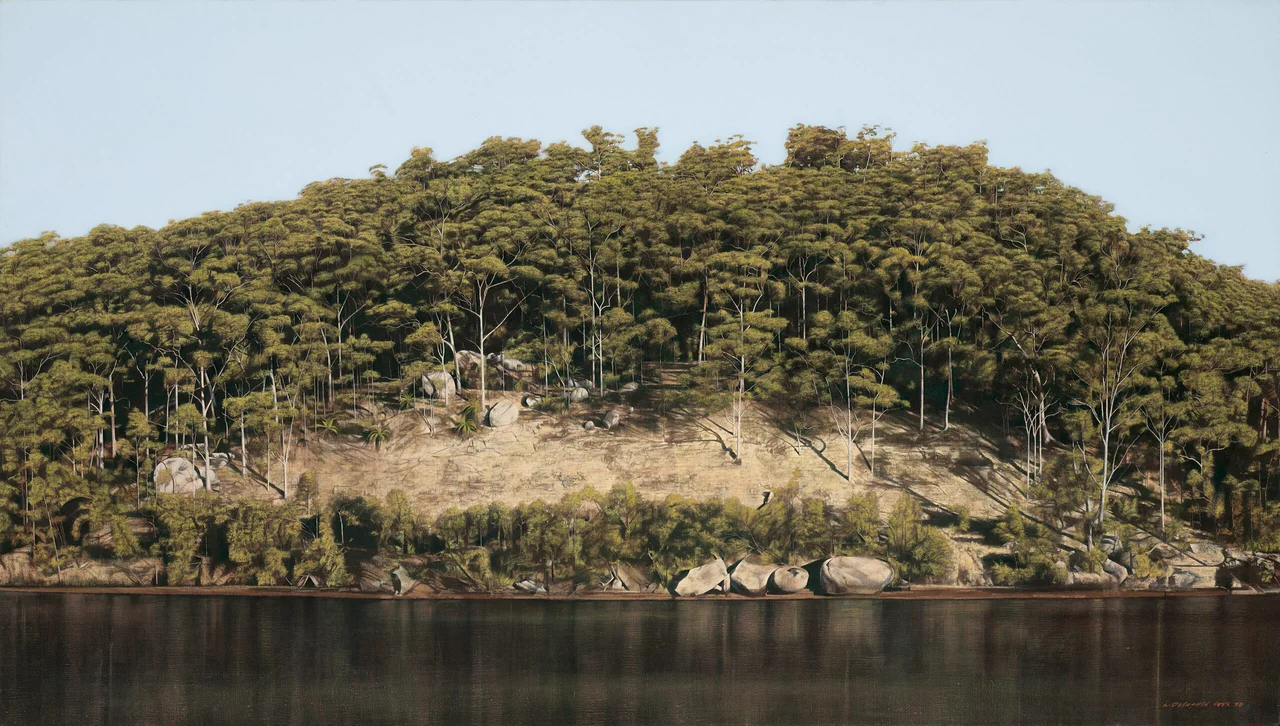
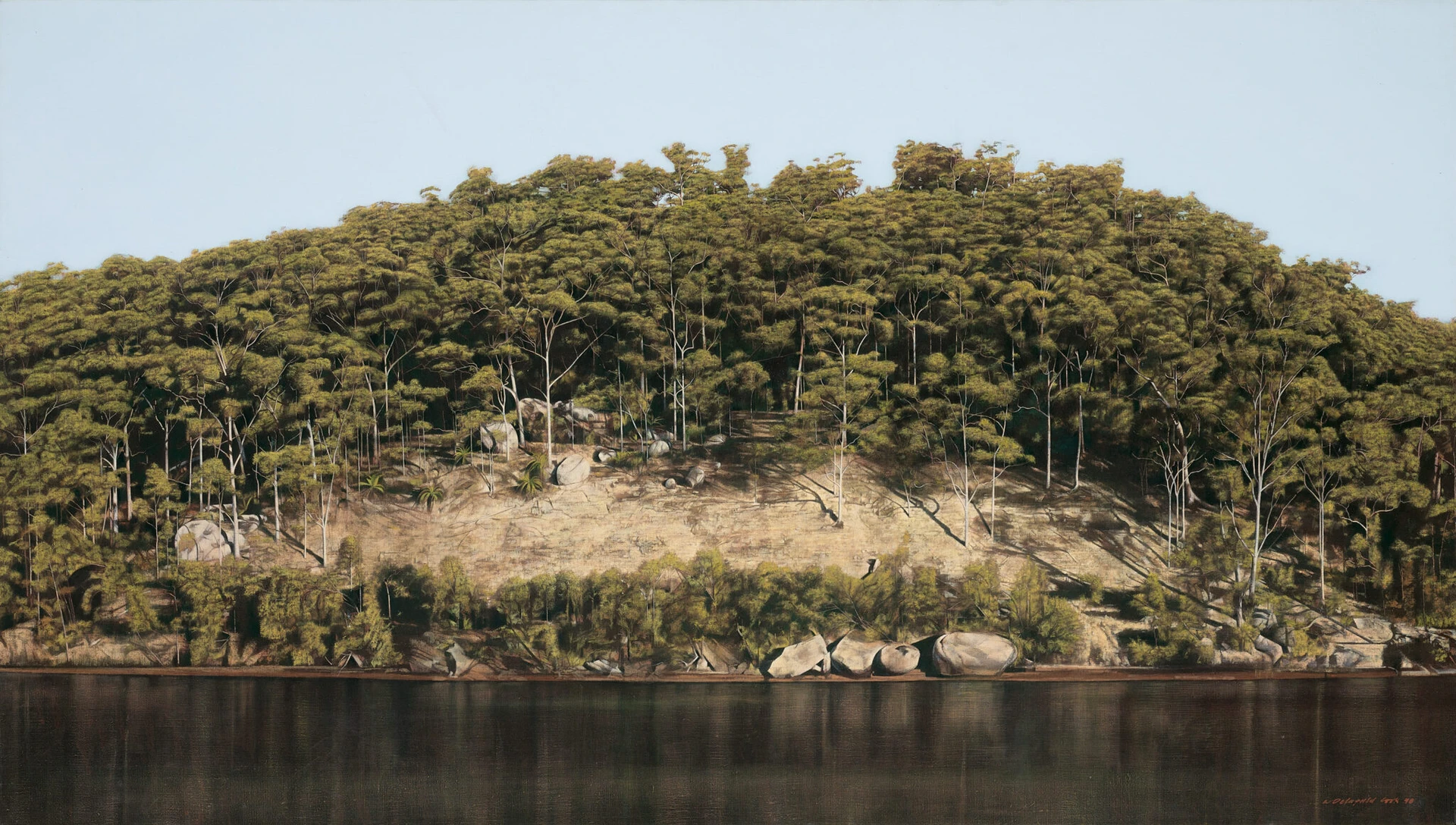
Bundanon – midday, 1998
oil on canvas
94.0 x 166.0 cm
signed and dated lower right: W Delafield Cook 98
Estimate:
$250,000 - $350,000
lot details
Rex Irwin Art Dealer, Sydney (label attached verso)
Feneley Fine Art Consultants, Sydney
Private collection, Canberra, acquired from the above in June 2003
‘By giving what is commonplace an exalted meaning, what is ordinary a mysterious aspect, what is familiar the impressiveness of the unfamiliar, to the finite the appearance of infinity…’1
With their glacial proportions and immutable subject, Delafield Cook’s Australian landscapes such as the magnificent Bundanon – midday, 1998 eloquently encapsulate the concept of time immemorial. For despite their visual immediacy and apparent fidelity, such landscapes nevertheless appear suspended in time – suffused with a sense of calm and tranquillity that evokes a disquieting anxiety through the landscape’s ability to expose our limits and the finitude of our existence.2 The span of a human life pales into insignificance in the face of such an ancient, monumental landscape; and indeed, as the artist admits, part of his motivation for fastidiously recording a place springs from ‘acknowledging your mortality’ and ‘attempting to leave something behind after you are gone.’3 Heightening the depiction of reality to such unimaginable degree to reveal the ‘essence’ of his subjects, thus Delafield Cook highlights the surreal within the real, inviting us to contemplate that which lies beyond our perception – the basic human quest for an underlying universal truth that transcends time or locality.
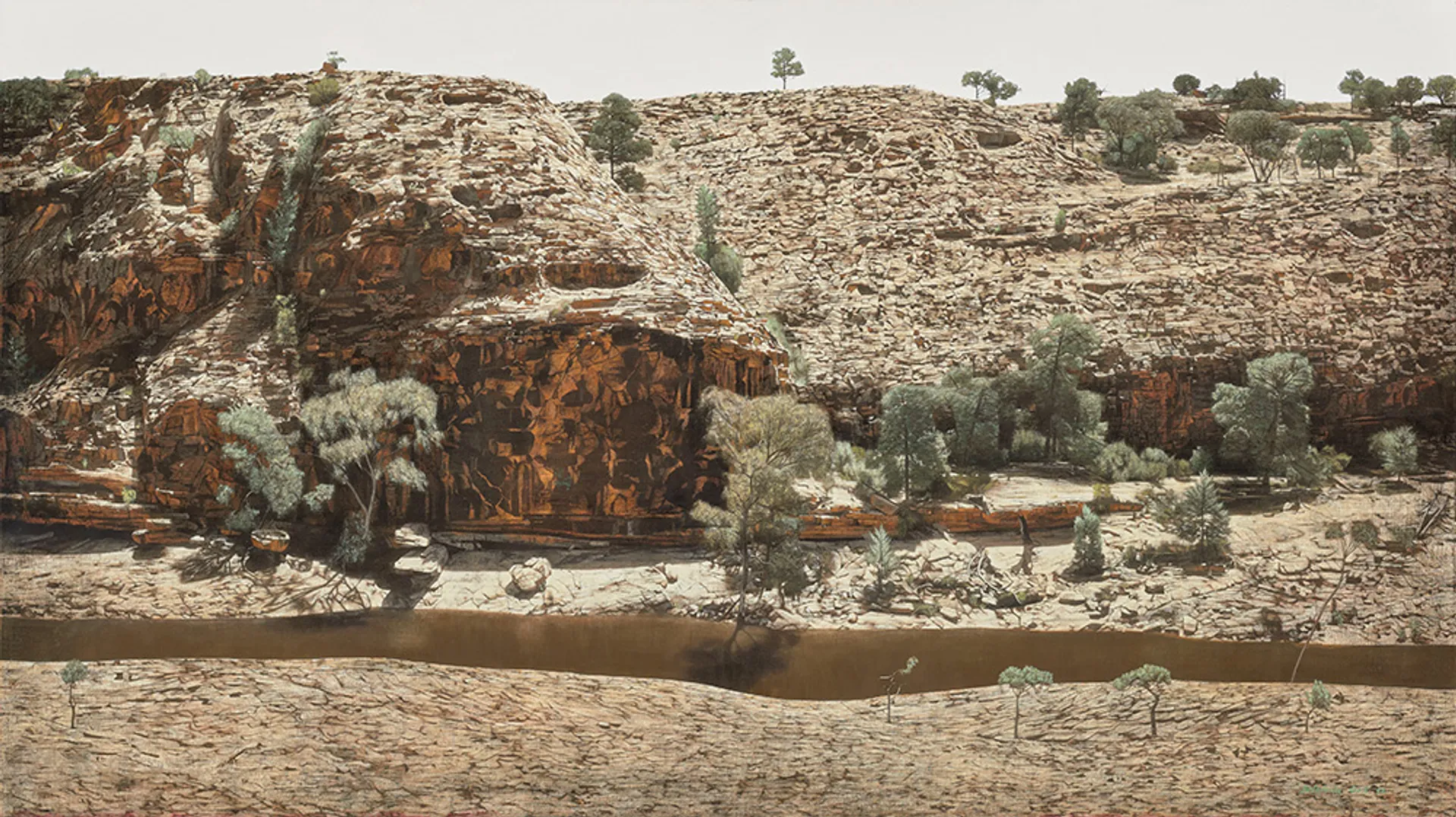
William Delafield Cook
Mootwingee, 1990
synthetic polymer paint on linen
110.0 x 197.0 cm
formerly in the National Australia Bank collection
Private collection, Sydney
Sold Deutscher and Hackett, 22 February 2022, lot 14, for $400,000 (inc. BP + GST)
Delafield Cook’s affinity for the Australian landscape and his consummate skill in capturing its essential character with an intensity unparalleled in Australian art are all the more remarkable when one considers that such paintings – which he created almost exclusively from the late 1970s onwards – were produced entirely from his studio in London. Having relocated to London in 1958 after what had been intended as a short trip became a second home, Delafield Cook would nevertheless spend part of every year for the last three decades of his life travelling back to Australia to undertake long journeys into the landscape ‘…where his ancestors had settled, where his grandfather had painted, where he had grown up…’4, before then returning to his studio abroad to recreate his vision. Paradoxically perhaps, such distance only enhanced the power of his iconic landscapes, allowing the artist to pursue ‘…the pure idea of land filtered through memory, in which all voices and activities are silenced, and the spirit of the earth can peacefully emerge.’5
In February 1998, Delafield Cook and his family visited ‘Bundanon’, the celebrated property on the Shoalhaven River in New South Wales where Arthur Boyd then lived and worked with his wife, Yvonne. Like Delafield Cook, Boyd divided his life between Australia and England, and was endlessly captivated by the beauty of the Australian terrain at Bundanon in particular – the brilliance of its light, the depth of its midday shadows, the winding Shoalhaven River and the magnificent Pulpit Rock, Boyd’s own ‘Mont Sainte-Victoire’. Such was Boyd’s attachment to this landscape and his desire to preserve it as a source of inspiration for future generations that he ultimately gifted Bundanon and its adjoining properties to the Australian people. During the Cooks’ visit, which coincided with a period of intense summer heat, the family swam in the river and explored the surrounding landscape, while Bill photographed both its minutiae and more dramatic manifestations, compiling an extensive visual archive from which the present painting would emerge.
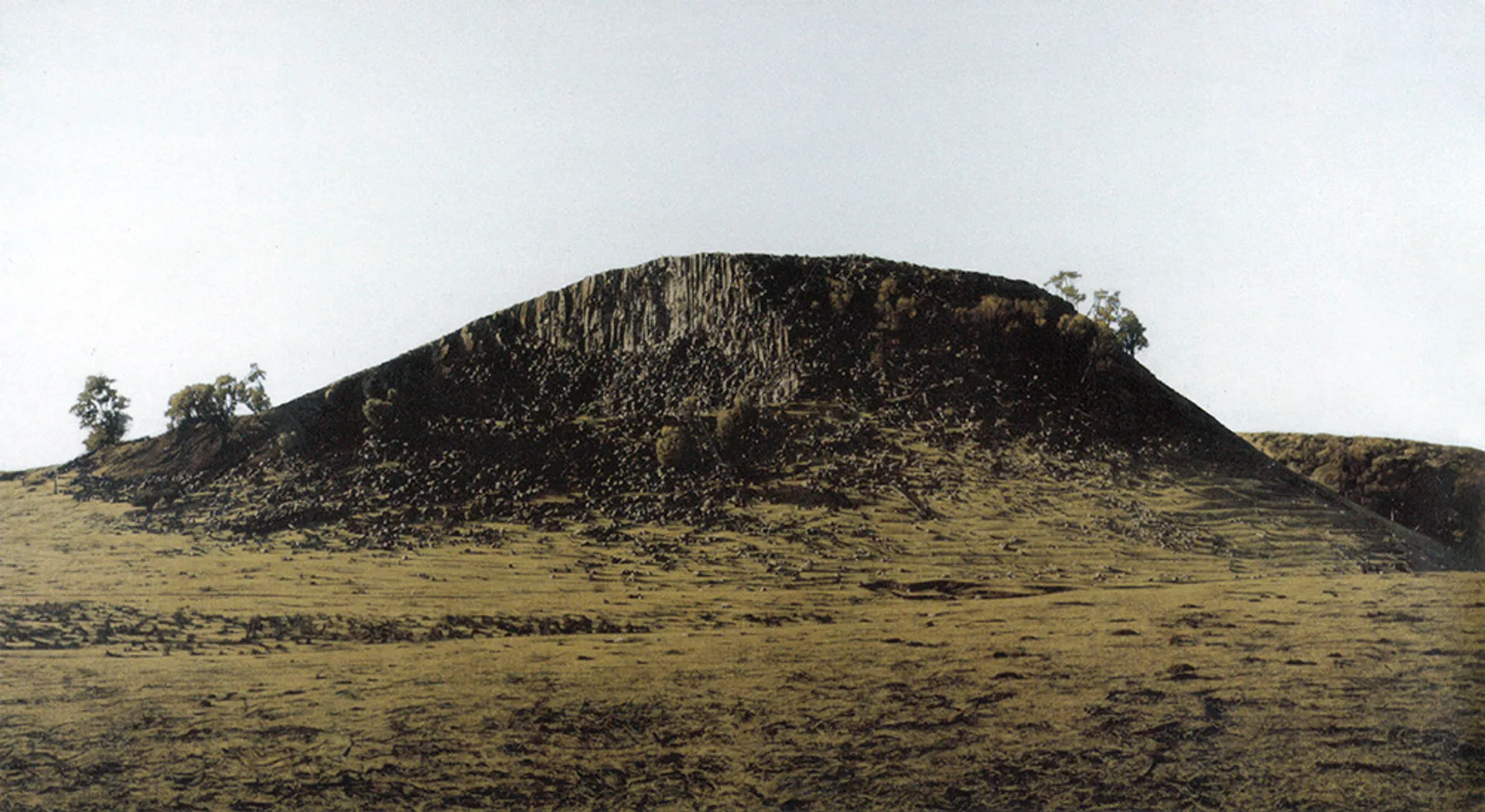
William Delafield Cook
The Quarry, Euroa, 1989 – 90
synthetic polymer paint on canvas
162.0 x 294.5 cm
Art Gallery of New South Wales, Sydney
Bundanon – midday offers a striking distillation of this experience. Stretching across the painting’s panoramic format, a densely wooded hillside rises monumentally beyond the dark, glassy expanse of the Shoalhaven River, its impenetrable vegetation interrupted by a broad clearing illuminated by the searing midday sun. Characteristically devoid of human presence, the landscape appears at once minutely observed and strangely otherworldly, the brilliant Australian light bleaching the exposed clearing while throwing the meticulously rendered surrounding forest into profound shadow. The high horizon line and elevated viewpoint compress the landscape within the picture plane, while the horizontal band of water across the foreground anchors the composition and intensifies the imposing scale of the hillside beyond. The familiar Australian bush is thus transformed into something monumental and mysterious, heightening the depiction of reality to reveal something of the landscape’s deeper, unknowable ‘essence’.
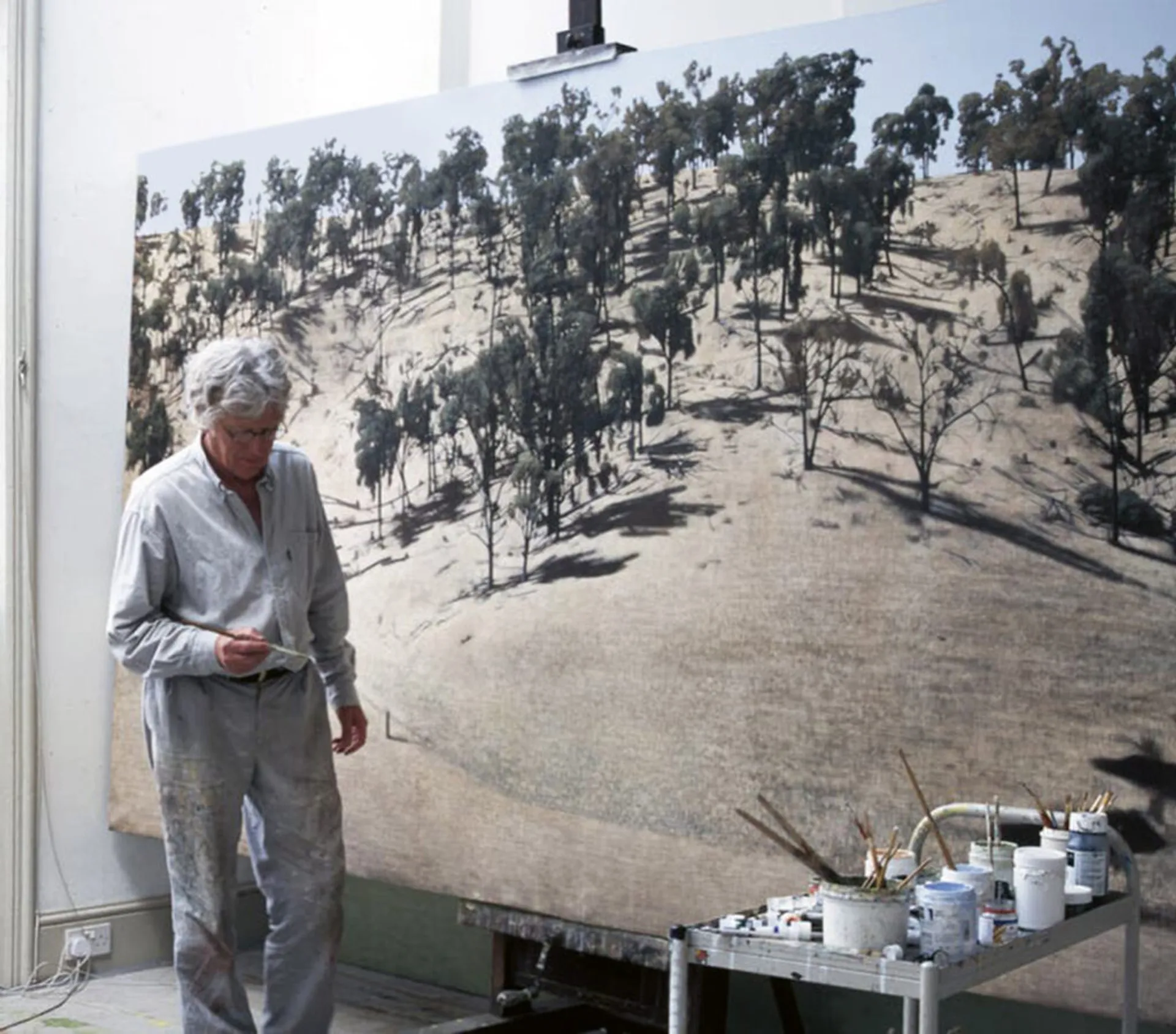
William Delafield Cook in his studio with Hillside I, 2004 – 11
photographer unknown
Notwithstanding its profound stillness, the landscape is informed by exquisitely rendered incidents, while the vast amplitude of the hillside is conveyed through the painting’s panoramic scale: ‘…it brings in this element of having to turn your head to take in the picture which fills the field of vision, like being there.’6 Infinite both in its detail and expanse, Bundanon – midday thus fathoms an Australian ‘sublime’, majestic in the manner of Caspar David Friedrich and the Romantics Delafield Cook so admired. Inspiring awe and reverence, the classical harmony and stillness imply that the forces of the cosmos have here aligned – that there is a divine order amidst the chaos of nature.7 Bereft of any apparent narrative, it is the landscape itself, distilled in its unknowable ‘essence’, that occupies the focus, imbued with a sense of drama that leaves the viewer poised indefinitely in a moment of suspense. As Delafield Cook observes of this quality in his art, ‘It’s the stage that we’re living out our lives in… The picture is the set, pregnant with possibilities.’8
1. Quote from Novalis, Poeticism (1798) inscribed in one of Cook’s notebooks; see Hart, D., William Delafield Cook, Craftsman House, Sydney, 1998, p. 220
2. Fitzpatrick, A., ‘Intimations of Mortality in the Work of William Delafield Cook’ in William Delafield Cook. A Survey, Gippsland Art Gallery, Sale, 2011, pp. 32 – 44
3. Delafield Cook, cited in Hart, op. cit., p. 184
4. ibid., p. 168
5. Gregg, S., ‘William Delafield Cook: A Survey’, in William Delafield Cook. A Survey, op. cit., pp. 2 – 23
6. Delafield Cook, cited in Hart, op. cit., p. 199
7. Gregg, op. cit., p. 9
8. Delafield Cook, cited ibid., p. 16
VERONICA ANGELATOS