1 October 2026
Auction, Media, News and Stories
A good romantic landscape by the late William Delafield Cook jnr hasn’t come to auction in Australia since 2024, when $687,500 was paid for Hillside 1. That painting set a record for the artist whose work is catnip to collectors of the bold and sweeping statement piece.
Hillside 1 was painted between 2004 and 2011, demonstrating the painstakingly slow pace at which major works emerged from the artist’s studio.
William Delafield Cook worked on Hillside 1 for close to a decade.
The night after Hillside 1 made such a hit, Smith and Singer auctioneers offered another astonishing Delafield Cook jnr, titled Haystack, which went for $500,000. (All prices include buyer’s premium.)
A much smaller painting than Hillside 1, which measured almost four metres long, Haystack at 82.5cm x 127cm probably performed better on a square centimetre basis – but that’s really no way to discuss a work of art.
Fast forward, and collectors of the rarefied art of Delafield Cook jnr must now be gleeful at the sight of lot eight in Leonard Joel’s Fine Art auction, taking place in Melbourne on October 6.
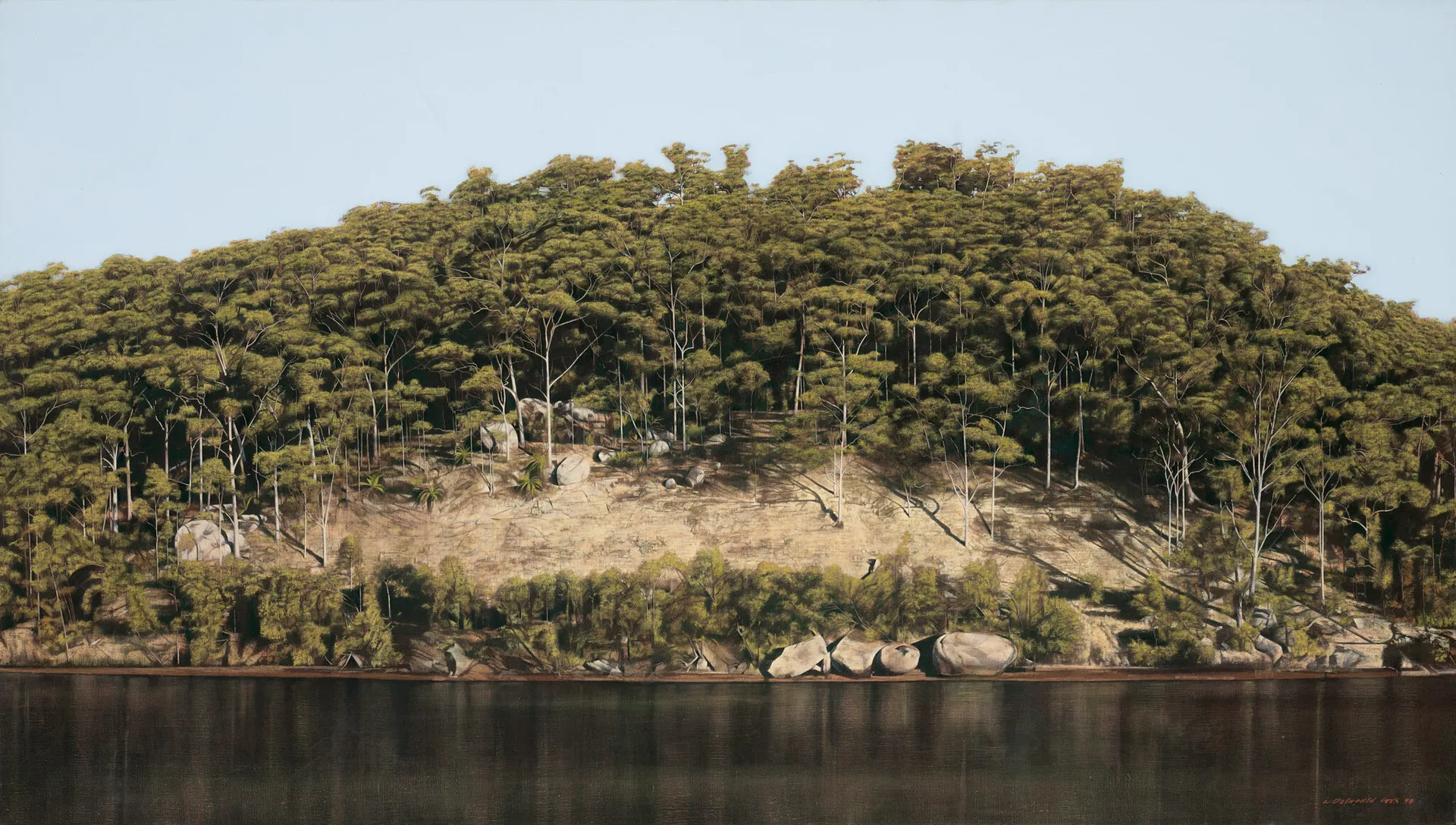
Hillside, Euroa, 1987, measures 111cm x 281.5cm – enough canvas for a sailing dinghy.
Leonard Joel’s estimate on the painting is $200,000 to $300,000.
The work depicts an Australian hill at sunset or sunrise, fringed with scrubby gum trees and ancient boulders. A wisp of campfire smoke at the base of the hill is barely visible – the only hint of human habitation in an otherwise still and silent landscape.
Saleroom notes that, unusually, another canvas by Delafield Cook jnr is on the market. Bundanon – midday, 1998, at 94cm x 166cm, has an estimate of $250,000 to $350,000 and is in Deutscher and Hackett’s blockbuster October 14 sale of An Important Private Collection, Canberra – more on that next week.
Bundanon – midday, by William Delafield Cook jnr carries an estimate of $250,000 to $350,000 in Deutscher and Hackett’s October 14 sale of An Important Private Collection, Canberra.
Hillside, Euroa and Bundanon – midday are beautiful works, to be sure. But when you speak the name of Delafield Cook in terms of Australian art, you need to be sure who you mean.
The Delafield Cooks are quite the dynasty.
William Delafield Cook jnr (1936-2015) was grandson to William Delafield Cook (1861-1931). The latter was a member of the Heidelberg School whose key artists included Tom Roberts, Arthur Streeton, Frederick McCubbin and Charles Conder.
Delafield Cook jnr was born in Melbourne, but lived and worked in the UK. His frequent study trips back to Australia enabled him to reinforce the sights, sounds and scents of his homeland.
Although he transcribed these sensations in a photorealist style, Delafield Cook jnr’s work was never dead. On the contrary, his paintings have a powerful poetry and presence.
In 2013, Delafield Cook jnr was appointed a Member of the Order of Australia for “significant service to the visual arts as a realist painter of Australian landscapes”.
Developer Lendlease certainly knew a good painting when it saw one. Hillside 1, which set the auction record in 2024, had hung for years in a display apartment at bayside Barangaroo in Sydney.
When all the apartments sold, Lendlease decided to move the picture on. With no more paintings to come out of the artist’s studio, could it be that Hillside, Euroa will also entice some big spenders? Does its size make it suitable only for a boardroom?
Leonard Joel head of art Wiebke Brix told Saleroom the scale of the work was “very much part of its appeal”, and she has already had interest from private collectors.
“Works by this artist do not come to market frequently – particularly important examples as this, with comparable works in major public collections,” Brix said.
The third Delafield Cook in the clan is Jonathan Delafield Cook, born in 1965 in the UK. This family member puts his inherited talents to use in charcoal drawings of the natural world, including wonderful, life-size portraits of bulls.
The antecedents of these pictures can be found in artists such as William Henry Davis (British, c.1783–1865) who painted the prize sheep and cattle of the landed gentry.
Jonathan Delafield Cook trained as an architectural draughtsman in Japan, and received the Darwin Scholarship at the Royal College of Art, London.
Another artist with prodigious drawing skills is the late Lloyd Rees, whose drawing titled Balls Head, 1931, is estimated at $8000 to $12,000 in the Leonard Joel sale. The artist lived on Sydney’s lower north shore, and often drew the rocky harbour foreshore near his home.
Lot 17 in the sale is Arthur Streeton’s 1921 oil on canvas, Lorne and the Bay, estimated at $200,000 to $300,000.
As art historian Dr Julie Cotter writes in the catalogue, Streeton returned to Australia in 1920 after serving as an official Australian war artist overseas.
In 1918 the Great Ocean Road construction project had been announced, and would employ many ex-service personnel.
So it was entirely within the spectrum of Streeton’s recent interests that he would make the then-difficult trip to Lorne to paint the region where the Great Ocean Road would soon open up easier access. The Great Ocean Road reached Lorne in 1922.
Lot 22 is John Olsen’s Bird at the Window, 1953-54, dating to just before the artist’s first exhibition in 1955. Its estimate is $20,000 to $30,000.
No sale is complete without a Grace Cossington Smith painting. The one in the Leonard Joel sale is lot two, Still Life with Lilies, estimated at $40,000 to $60,000.
Lot 1 is a gem of a painting by Elioth Gruner titled She-oaks in France, 1924, estimated at $30,000 to $50,000.
Gruner painted Spring frost, 1919, often voted by the public as their favourite artwork at the Art Gallery of New South Wales.
She-oaks in France also hung at the AGNSW in the Elioth Gruner Memorial Loan Exhibition, 1940. Born in 1882, Gruner died in 1939.
American artist Ida Kohlmeyer (1912-1997) makes her Australian auction debut with Synthesis #B, 1982, in oil and mixed media on canvas, consigned by a private collector in Sydney. Its estimate is $30,000 to $50,000.
Brix writes in the catalogue that Kohlmeyer studied with Mark Rothko in the late 1950s but moved away from “Rothko’s expansive rectangles, introducing circles, hard edges and linear elements”.
The work’s title reflects Kohlmeyer’s “ability to unite the seemingly opposing qualities that shaped her practice: structure and spontaneity, discipline and play, abstraction and the suggestion of language”, Brix writes.
In Hong Kong on Tuesday night Christie’s 20th Century Evening Sale hammered $US92.6 million worth or art – every lot sold – led by Jean-Michel Basquiat’s Ancient Scientist at $US9.8 million.
Christie’s reported that the sale set Asian auction records for Western artists Cézanne, Matisse, Dalí and Peter Paul Rubens.